Skip to content
Dabour HubLEARN · PRACTICE · EXPLORESign inStudent

2.1Representing Motion

Picturing Motion and Coordinate Systems — American System Physics Revision Notes & Topical Questions
10 min read 7 parts Lesson 3 of 5 1 quiz

🩺
100% Curriculum Specification Match Lesson Doctor Verified
The only platform with 100% curriculum specification match and verified interactive question banks.
0%read
Lesson summary

Draw motion diagrams and particle models for moving objects.Displacement = final position − initial positionΔx = xf − xi (m).Time interval = final time − initial timeΔt = tf − ti (s).Collinear vectors in the same direction add3 m east + 4 m east = 7 m east.Collinear vectors in op…

  • Collinear vectors in opposite directions subtract
  • Perpendicular displacements
  • A vector subtraction A − B equals A + (−B)
  • A car is at x = −4.0 m at t = 2.0 s and x = +11.0 m at t = 5.0 s. Find Δx and Δt
  • Coordinate system
  • Frame of reference

Section 1 of 7Picturing Motion and Coordinate Systems

1
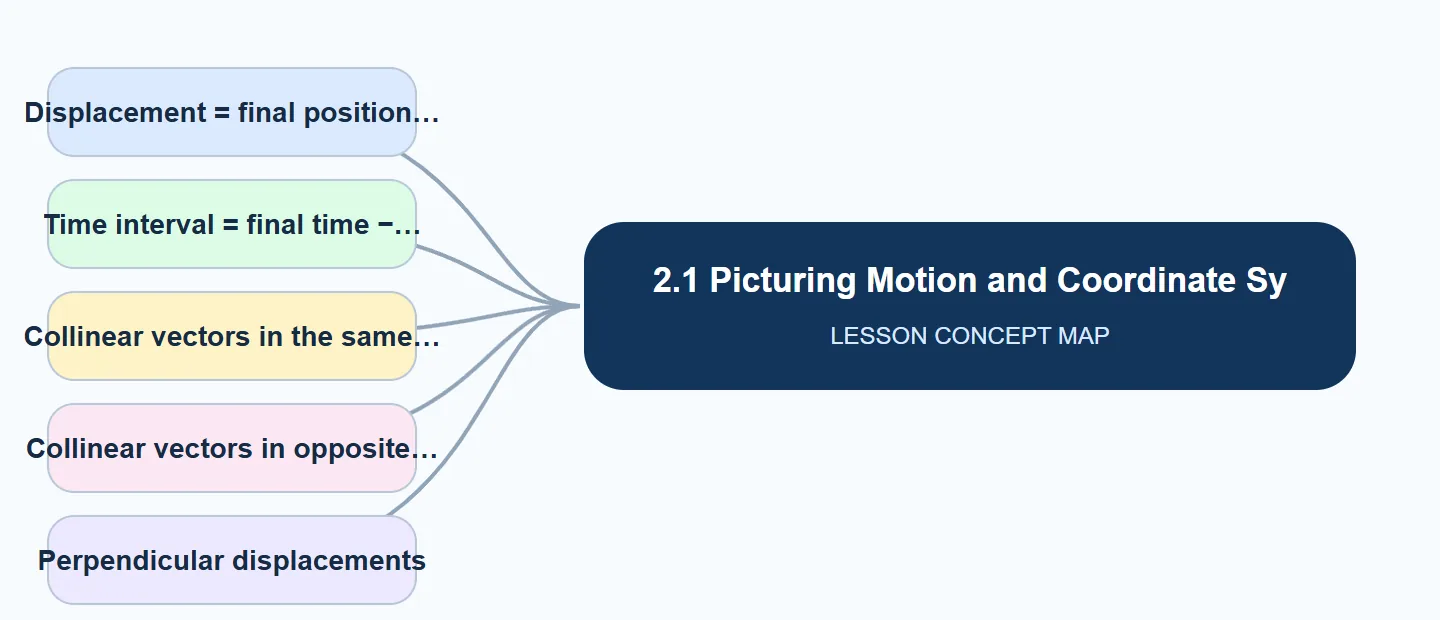
2.1 Picturing Motion and Coordinate Syste… concept map: Displacement = final position, Time interval = final time −, Collinear vectors in the same, Collinear vectors in opposite, Perpendicular displacements
Visual guide to the key ideas explained in this lesson.
2
Describing motion needs a reference point; a passenger sitting in a moving train is at rest relative to the train but moving relative to the ground.
3
A motion diagram records positions at equal time intervals. Dots close together mean the object moves slowly; dots far apart mean it moves fast.
4
The particle model reduces an object to a point, ignoring size, shape and rotation. It works when the object is small compared with the distances involved.
5
A coordinate system needs an origin and a positive direction. Positions on the other side of the origin are negative. The choice is yours, but you must use it consistently.
6
Scalars have only magnitude (e.g. 20 m, 5 s). Vectors have magnitude and direction (e.g. 20 m north). Vectors are drawn as arrows whose length represents magnitude.
7
Distance is the total path length; displacement is the straight-line change in position. Running one full lap of a 400 m track: distance 400 m, displacement 0.
8
Displacement Δx = xf − xi. Its sign gives direction. Moving from x = +8 m to x = +2 m gives Δx = −6 m (6 m in the negative direction).
9
Time interval Δt = tf − ti; time is a scalar.
10
Vectors add tip-to-tail. For vectors along one line, add magnitudes if same direction, subtract if opposite; the direction is that of the larger.
11
For two perpendicular vectors, the resultant magnitude is found by Pythagoras and the direction by tan θ = opposite/adjacent.
12A vector subtraction A − B equals A + (−B)
A vector subtraction A − B equals A + (−B) reverse B and add it tip-to-tail.

Section 2 of 7Process & sequence

1
Choose an origin (e.g. the starting point) and mark it zero.
2
Choose which direction is positive (e.g. right or east) and draw an axis arrow.
3
Draw a motion diagram: dots at equal time intervals, numbered in order.
4
Measure the position x of the object at each time from the origin, with sign.
5
Find the displacement for an interval: Δx = xf − xi, giving magnitude and direction.
6
Add up path lengths to obtain distance travelled if the object changes direction.

Drawing a motion diagram and particle modelwrite these steps in this order; each step is a marking point.

1
Imagine photographs of the object taken at equal time intervals.
2
Replace each image with a single dot at the object's centre (particle model).
3
Number the dots 0, 1, 2 ... in time order.
4
Add an origin and positive-direction arrow along the path.
5
Compare spacing: equal = constant speed; growing = speeding up; shrinking = slowing down.

Section 3 of 7Compare

Distance vs displacement
FeatureDistanceDisplacement
TypeScalarVector
Depends onActual path takenOnly start and end positions
Can be negative?NoYes (sign shows direction)
Round trip back to startTotal path lengthZero
Symbol / unitd, mΔx, m
Scalars and vectors
ScalarMatching vector
DistanceDisplacement
SpeedVelocity
MassWeight (force)
Time—

Section 4 of 7Worked examples

420 m
A runner goes 300 m east then 120 m west. Find the distance travelled and the displacement.
  • Distance = 300 + 120 = 420 m.
    • Taking east as positive, displacement = +300 + (−120) = +180 m, i.e. 180 m east.
50 m
A student walks 30 m north then 40 m east. Find the magnitude and direction of the displacement.
  • Magnitude = √(302 + 402) = √(900 + 1600) = √2500 = 50 m.
    • Direction: tan θ = 40/30, θ = 53° east of north (N53°E).
+15.0 m

A car is at x = −4.0 m at t = 2.0 s and x = +11.0 m at t = 5.0 s. Find Δx and Δt.

  • Δx = 11.0 − (−4.0) = +15.0 m (15.0 m in positive direction). Δt = 5.0 − 2.0 = 3.0 s.

Section 5 of 7Key terms

Section 6 of 7Command terms

Command terms
Identify / Describe (FRQ)
A short, specific statement; describing requires relevant characteristics, not a single word.
Explain / Justify (FRQ)
Give the cause-and-effect reasoning or evidence; a restated fact does not score.
Calculate
Show setup, substitution and the answer with units.
Predict
State the expected outcome; add a reason only if asked to justify.
MCQ technique
Read every option; eliminate distractors that are true statements but do not answer the question; watch for NOT/EXCEPT.

Section 7 of 7Exam technique

Keywords the mark scheme looks for in this lesson

Keywords the mark scheme looks for in this lesson
Motion · Motion diagram · Particle model · Coordinate system · Origin · Position · Distance · Scalar · Vector · Displacement · Time interval · Resultant · Frame of reference
Learn each definition in the Key words tab exactly; a missing keyword in a definition usually loses the mark.

How to get full marks (examiner guidance)

1
Answer exactly what is asked; extra correct material does not earn credit, and contradictory statements can cancel credit (AP FRQ).
2
Use precise vocabulary, never “it/stuff/things”.
3
Show units and working in calculations.
4
In MCQs, predict the answer before reading the options, then eliminate.

Words to avoid

1
displacement is the distance travelleddisplacement is the change in position in a stated direction.
2
displacement = 50 mdisplacement = 50 m north (vectors need direction).
3
a vector is a big quantitya vector has both magnitude and direction.
4
negative displacement means it went backwards in timenegative displacement means it moved in the negative direction.

Last updated: