Skip to content
Dabour HubLEARN · PRACTICE · EXPLORESign inStudent

2.3Representing Motion

How Fast? Speed and Velocity — American System Physics Revision Notes & Topical Questions

10 min read 7 parts Lesson 5 of 5 1 quiz

🩺
100% Curriculum Specification Match Lesson Doctor Verified
The only platform with 100% curriculum specification match and verified interactive question banks.
0%read
Lesson summary

Define and distinguish speed and velocity, average and instantaneous values.Average speed = total distance ÷ total time; v = d/t (m/s).Average velocity = displacement ÷ time interval; v̄ = Δx/Δt = (xf − xi)/(tf − ti) (m/s).Rearrangeddistance = speed × time (d = vt); time = distan…

  • Relative velocity in one dimension
  • Light-gate speed
  • Measuring speed in the lab
  • Typical speeds
  • A bus travels 12 km in 15 min, then 18 km in 25 min. Calculate its average speed in m/s
  • A car drives 60 km at 60 km/h then 60 km at 30 km/h. Find its average speed

Section 1 of 7How Fast? Speed and Velocity
Essential knowledge
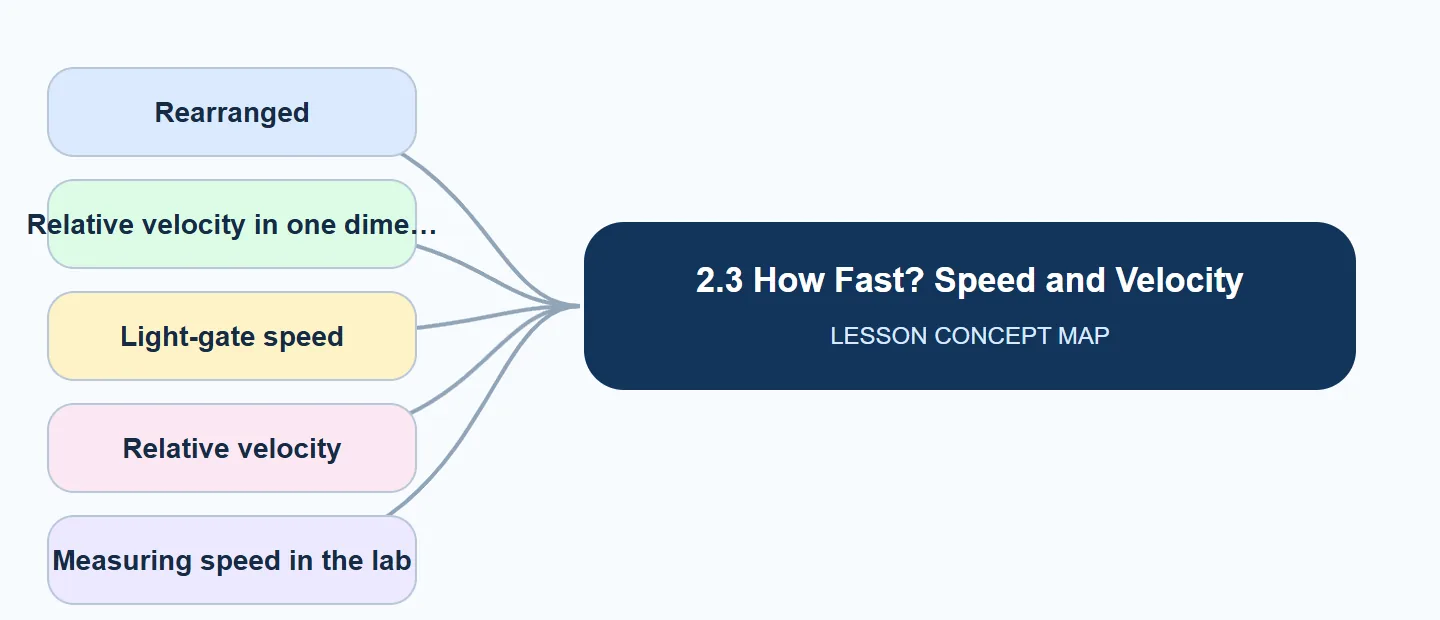
2.3 How Fast? Speed and Velocity concept map: Rearranged, Relative velocity in one dime, Light-gate speed, Relative velocity, Measuring speed in the lab
Visual guide to the key ideas explained in this lesson.
Speed tells how fast something moves; velocity tells how fast and in which direction. Two cars at 25 m/s travelling in opposite directions have the same speed but different velocities.
Average speed uses total distance, average velocity uses displacement. For a round trip, average velocity is zero even though average speed is not.
Not
Average speed is not the average of the speeds unless equal times are spent at each speed; always use total distance ÷ total time.
Instantaneous velocity is what the object is doing at one instant. On a curved position–time graph draw a tangent and find its gradient.
For constant velocity, average and instantaneous velocities are equal and the position–time graph is a straight line.
A velocity–time graph for constant velocity is a horizontal line. The area between the line and the time axis is the displacement (velocity × time).
Negative velocity means motion in the negative direction; on a v–t graph it lies below the time axis, and the area there counts as negative displacement.
Relative velocity
Relative velocity an observer on a train moving at 20 m/s sees a passenger walking forward at 1.5 m/s; someone on the ground sees the passenger at 21.5 m/s.
Measuring speed in the lab
Measuring speed in the lab time over a known distance with stopwatches (reaction time introduces error) or more accurately with light gates and data loggers.
Typical speeds
Typical speeds walking ~1.5 m/s, cycling ~6 m/s, car on highway ~30 m/s, sound in air ~340 m/s.

Section 2 of 7Process & sequence

1
Mark out a measured distance (e.g. 10.0 m) with a tape measure along a straight track.
2
Place a timer at the start and end (or use light gates connected to a data logger).
3
Start timing as the object crosses the start line and stop when it crosses the finish.
4
Repeat three times and calculate the mean time.
5
Calculate average speed = distance ÷ mean time.
6
For instantaneous speed, use a light gate with a card of known length: v = card length ÷ time the beam is blocked.

Measuring speed with a light gatewrite these steps in this order; each step is a marking point.

1
Fix a card of measured length (e.g. 5.0 cm) on top of the trolley.
2
Set the light gate so the card blocks the beam as the trolley passes.
3
The data logger records the time the beam is blocked.
4
Convert card length to metres.
5
Speed = card length ÷ blocked time, giving the instantaneous speed at the gate.

Section 3 of 7Compare

Speed vs velocity
FeatureSpeedVelocity
DefinitionDistance per unit timeDisplacement per unit time
TypeScalarVector
Can be negative?NoYes (sign shows direction)
Car driving a full circle at 20 m/sConstant (20 m/s)Changing (direction changes)
Average over a round tripTotal distance ÷ time (> 0)Zero (displacement 0)
Useful unit conversions
FromToOperation
km/hm/s÷ 3.6
m/skm/h× 3.6
cm/sm/s÷ 100
minutesseconds× 60

Section 4 of 7Worked examples

112.5 m/s

A bus travels 12 km in 15 min, then 18 km in 25 min. Calculate its average speed in m/s.

  • Total distance = 30 km = 30 000 m.
    • Total time = 40 min = 2400 s.
    • Average speed = 30 000/2400 = 12.5 m/s (≈ 13 m/s to 2 s.f.).
2A car drives 60 km at 60 km/h then 60 km at 30 km/h. Find its average speed.
  • Time 1 = 60/60 = 1.0 h;
    • time 2 = 60/30 = 2.0 h.
    • Total distance 120 km, total time 3.0 h.
    • Average speed = 120/3.0 = 40 km/h (not 45 km/h).
3A 5.0 cm card passes through a light gate in 0.020 s. Find the trolley's speed.
A 5.0 cm card passes through a light gate in 0.020 s. Find the trolley's speed.
  • v = 0.050 m / 0.020 s = 2.5 m/s.

Section 5 of 7Key terms

Section 6 of 7Command terms

Command terms
Identify / Describe (FRQ)
A short, specific statement; describing requires relevant characteristics, not a single word.
Explain / Justify (FRQ)
Give the cause-and-effect reasoning or evidence; a restated fact does not score.
Calculate
Show setup, substitution and the answer with units.
Predict
State the expected outcome; add a reason only if asked to justify.
MCQ technique
Read every option; eliminate distractors that are true statements but do not answer the question; watch for NOT/EXCEPT.

Section 7 of 7Exam technique

Keywords the mark scheme looks for in this lesson

Keywords the mark scheme looks for in this lesson
Speed · Average speed · Velocity · Average velocity · Instantaneous velocity · Instantaneous speed · Constant (uniform) velocity · Velocity–time graph · Relative velocity · Rate · Speedometer
Learn each definition in the Key words tab exactly; a missing keyword in a definition usually loses the mark.

How to get full marks (examiner guidance)

1
Answer exactly what is asked; extra correct material does not earn credit, and contradictory statements can cancel credit (AP FRQ).
2
Use precise vocabulary, never “it/stuff/things”.
3
Show units and working in calculations.
4
In MCQs, predict the answer before reading the options, then eliminate.

Words to avoid

1
speed and velocity are the samevelocity is speed in a given direction (a vector).
2
average speed = (v1 + v2)/2average speed = total distance ÷ total time.
3
velocity is distance over timevelocity is displacement over time (rate of change of position).
4
the car moving in a circle at 20 m/s has constant velocityits speed is constant but its velocity changes because its direction changes.
5
speed = 12speed = 12 m/s.

Last updated: