2.5Structure & Functions in Living Organisms
Nutrition — Edexcel International GCSE Biology 4BI1 Revision Notes & Topical Questions
15 min read 8 parts Lesson 5 of 21 1 quiz
Nutrition Edexcel IGCSE Biology 4BI1 notes: Describe photosynthesis with word and balanced symbol equations.Word equationcarbon dioxide + water → glucose + oxygen (light energy, chlorophyll).Balanced equation6CO2 + 6H2O → C6H12O6 + 6O2.Photosynthesis is an endothermic processligh…
- Three limiting factors
- Starch is tested with iodine
- Bile is not an enzyme
- Process of photosynthesis
- Factors affecting the rate
- Leaf structure and adaptations
Part 1 of 8Key ideas
Part 2 of 8Learning objectives
Part 3 of 8Essential knowledge
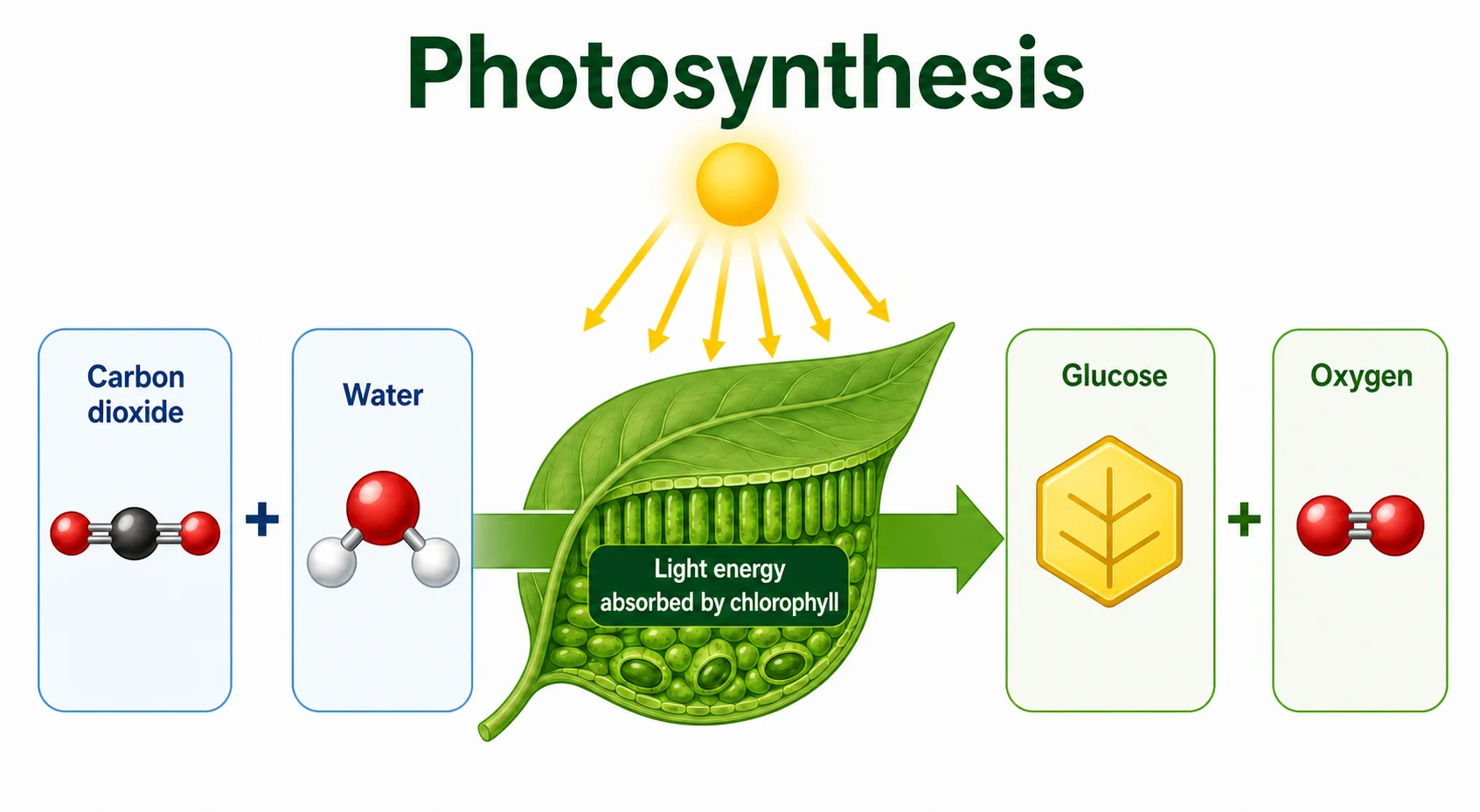
- Glucose may be respired, stored as insoluble starch, used to make cellulose for cell walls, converted to sucrose for transport in the phloem,
- or combined with nitrate ions to make amino acids.
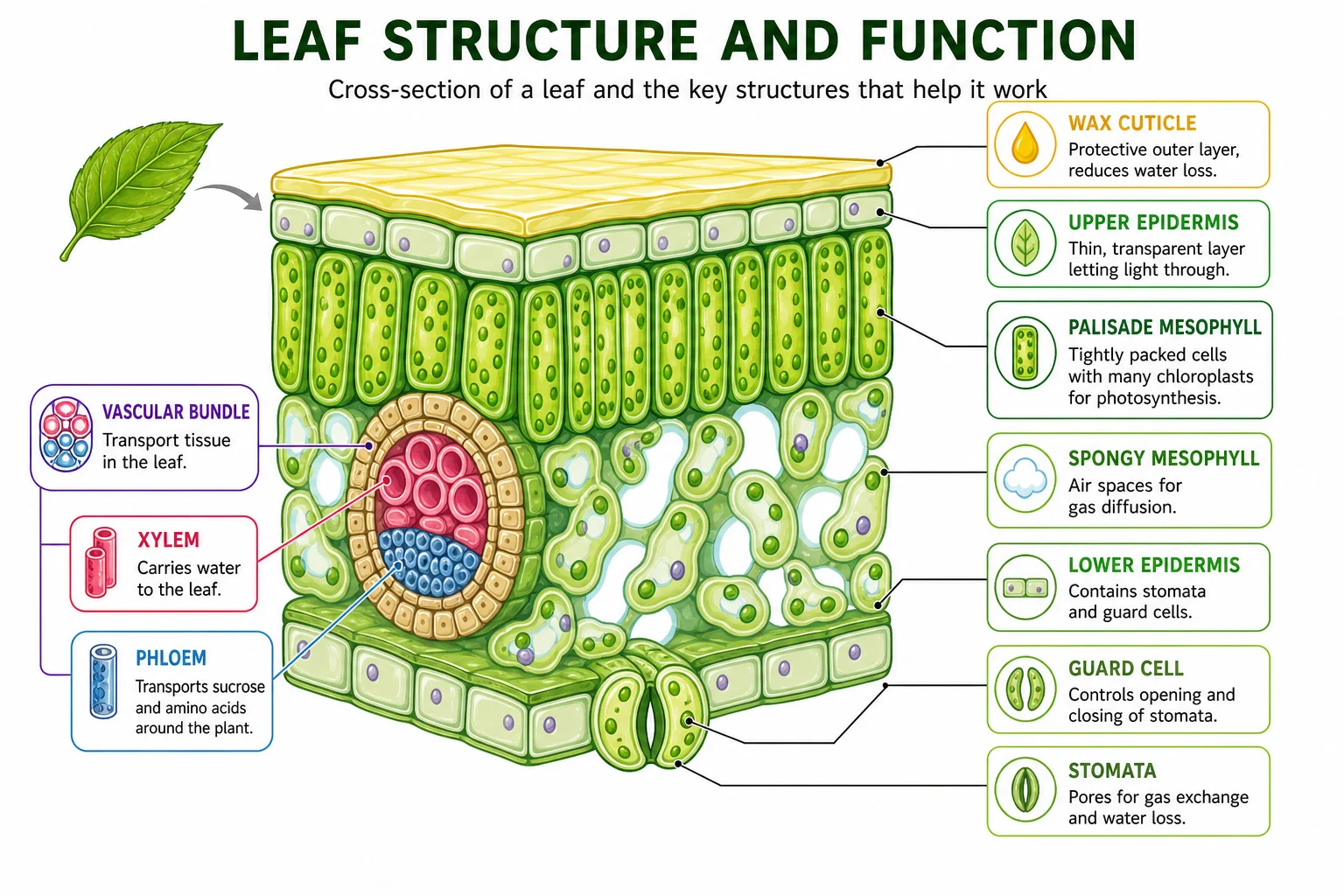
- leaves are broad and flat (large surface area for light) and thin (short diffusion distance for gases).
- A waxy cuticle reduces water loss
- the transparent upper epidermis lets light through
- the palisade mesophyll is packed with chloroplasts near the top surface
- the spongy mesophyll has air spaces for gas diffusion
- stomata controlled by guard cells allow gas exchange
- vascular bundles bring water (xylem) and remove sugars (phloem).
- destarch a plant by leaving it in the dark for 48 hours,
- then test leaves for starch after exposure to different conditions: cover part of a leaf with foil (light needed), use a variegated leaf,
- or enclose a leaf with sodium hydroxide / soda lime to absorb CO2 (CO2 needed).
- (chlorophyll needed)
- then test leaves for starch after exposure to different conditions: cover part of a leaf with foil (light needed), use a variegated leaf,
- The rate can be measured by counting oxygen bubbles from pondweed (e.g. Elodea) at different lamp distances, keeping temperature constant with a water bath.
- Energy requirements depend on activity level, age and pregnancy.
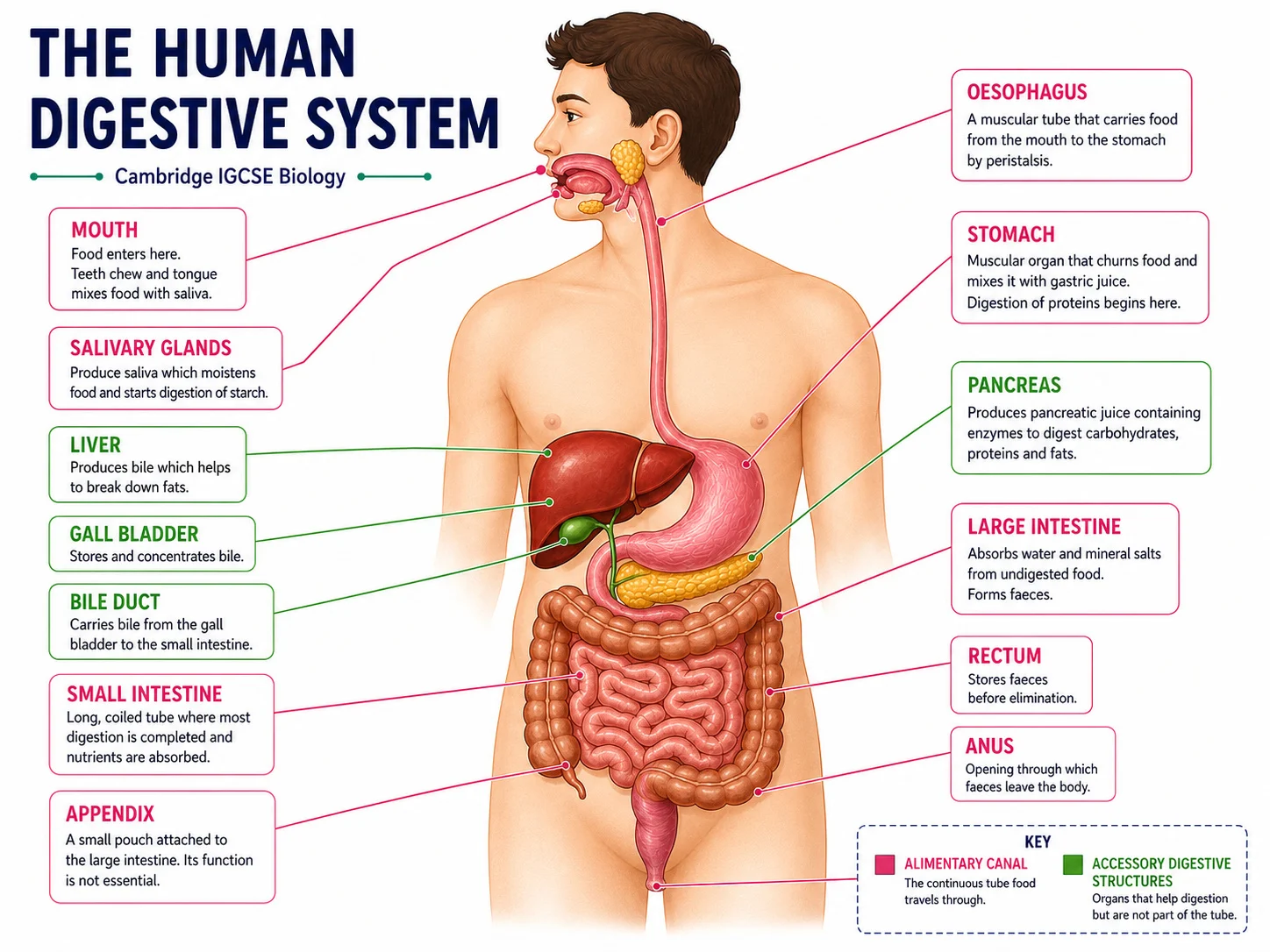
- Food passes mouth → oesophagus → stomach → small intestine → large intestine (colon) → rectum → anus.
- (duodenum and ileum)
- The salivary glands, pancreas and liver add secretions.
- Villi in the ileum have microvilli, thin walls one cell thick and a rich capillary network plus a lacteal, giving fast absorption.
- salivary glands and pancreas.
- Protease: stomach (pepsin), pancreas and small intestine.
- Lipase: pancreas.
- Maltase: small intestine lining.
- The pancreas releases its enzymes into the duodenum in an alkaline juice, so the small intestine works at about pH 8–9.
Part 4 of 8Process & sequence
- Light energy is absorbed by chlorophyll in chloroplasts of palisade cells.
- Carbon dioxide diffuses into the leaf through open stomata and air spaces.
- Water is absorbed by root hairs and carried up the xylem to the leaf.
- Light energy is converted to chemical energy, building glucose from CO2 and H2O.
- Oxygen is released as a by-product and diffuses out through stomata.
- Glucose is used for respiration or converted to starch, cellulose, sucrose, proteins and lipids.
From leaf to glucosewrite these steps in this order; each step is a marking point.
- Light absorbed by chlorophyll
- CO2 enters through stomata
- Water arrives through xylem
- Glucose made in chloroplast
- Oxygen released
- Glucose stored as starch
Part 5 of 8Worked examples
- Light intensity is proportional to 1/d2.
- Doubling the distance gives (1/2)2 = 1/4 of the original intensity.
- If light is the limiting factor, fewer oxygen bubbles are produced per minute because the rate of photosynthesis falls.
- At high light intensity light is no longer limiting.
- Another factor, such as carbon dioxide concentration or temperature, is now in short supply and limits the rate,
- so increasing light further has no effect.
Part 6 of 8Summary
- Photosynthesis turns light energy into chemical energy stored in glucose.
- Rate is controlled by the limiting factor: light, CO2 or temperature.
- Leaves are adapted for gas exchange and light absorption.
- A balanced diet supplies all nutrients in the right amounts.
- Enzymes digest food; villi absorb the products in the small intestine.
Part 7 of 8Keep going
Nutrition Edexcel IGCSE Biology 4BI1: what to do next
These Nutrition Edexcel IGCSE Biology 4BI1 notes covered the key ideas, worked examples and exam technique for this topic. Check your Nutrition Edexcel IGCSE Biology 4BI1 understanding with the practice questions below, then reread any Nutrition Edexcel IGCSE Biology 4BI1 point you were unsure about before moving on.
Nutrition Edexcel IGCSE Biology 4BI1: revision checklist
- Revise the main Nutrition Edexcel IGCSE Biology 4BI1 definitions until you can write them from memory.
- Practise Nutrition Edexcel IGCSE Biology 4BI1 exam questions under timed conditions.
- Link each Nutrition Edexcel IGCSE Biology 4BI1 idea to a diagram or a worked example.
- List the common Nutrition Edexcel IGCSE Biology 4BI1 mistakes and how to avoid them.
- Explain one Nutrition Edexcel IGCSE Biology 4BI1 idea out loud as if teaching a friend.
- Summarise Nutrition Edexcel IGCSE Biology 4BI1 in five key points on a revision card.
- Practice: Nutrition Edexcel IGCSE Biology 4BI1 practice questions
- Previous lesson: 2.4 Movement of Substances Into & Out of Cells — Notes
- Next lesson: 2.6 Respiration — Notes
- Course: Edexcel International Gcse Biology 4BI1 — all units
- Official syllabus: Pearson Edexcel International GCSEs
Part 8 of 8Compare: Compare
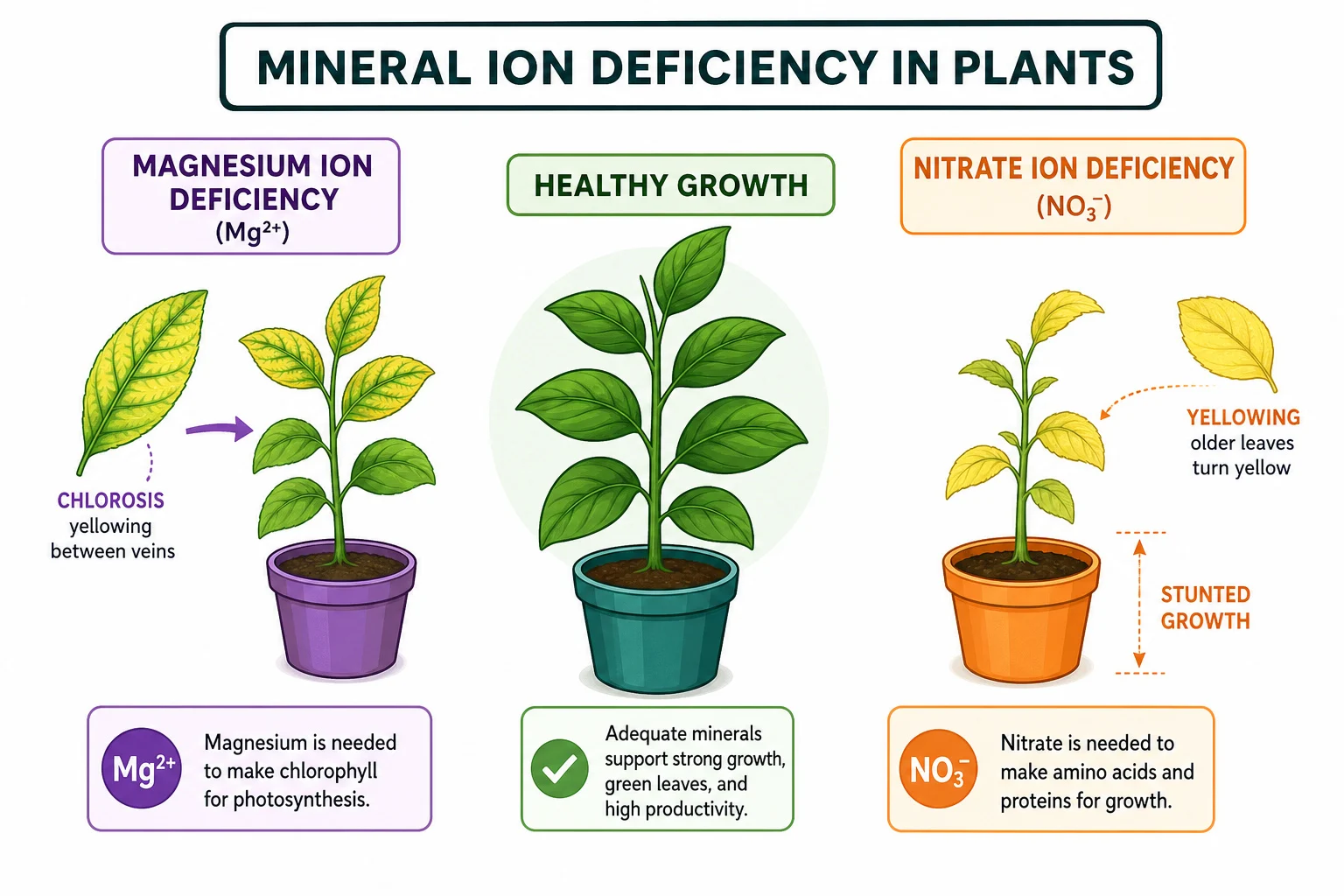
| Ion | Used for | Deficiency symptom |
|---|---|---|
| Nitrate (NO3-) | Making amino acids and therefore proteins | Stunted growth, yellow older leaves |
| Magnesium (Mg2+) | Making chlorophyll | Yellowing between the veins of leaves (chlorosis) |
| Phosphate | Making DNA and cell membranes; respiration | Poor root growth, purple older leaves |
| Potassium (K+) | Helping enzymes for photosynthesis and respiration | Yellow leaves with dead edges |
Ions are absorbed from soil water by root hair cells by active transport.
| Region | Main function |
|---|---|
| Mouth | Chewing (mechanical digestion); salivary amylase starts starch digestion |
| Stomach | Churning; pepsin (protease) digests protein; HCl kills bacteria (pH about 2) |
| Small intestine: duodenum | Receives pancreatic juice and bile; digestion continues |
| Small intestine: ileum | Final digestion and absorption through villi |
| Large intestine: colon | Absorbs water from undigested food |
| Rectum and anus | Stores faeces; egestion |
Key terms
Command terms
Exam technique
Keywords the mark scheme looks for in this lesson
How to get full marks (examiner guidance)
Marked practiceQuizzes for this lesson
Last updated:
\n