2.10Structure & Functions in Living Organisms
Co-ordination & Response — Edexcel International GCSE Biology 4BI1 Revision Notes & Topical Questions
10 min read 8 parts Lesson 10 of 21 1 quiz
Co-ordination & Response Edexcel IGCSE Biology 4BI1 notes: Explain why organisms must respond to changes and maintain homeostasis.The central nervous system (CNS) = brain + spinal cord.Reflex arcreceptor → sensory neurone → relay neurone → motor neurone → effector.Normal core bod…
- Response to changes in the environment
- Co-ordinating a response
- Response to stimuli in plants
- Nervous and hormonal control
- Human nervous system
- Role of neurotransmitters at synapses
Part 1 of 8Key ideas
Part 2 of 8Learning objectives
Part 3 of 8Essential knowledge
- ciliary muscles contract, suspensory ligaments slacken, the lens becomes fatter and refracts light more.
- Distant object: ciliary muscles relax, suspensory ligaments tighten, the lens is pulled thinner and refracts light less.
- Ligaments tighten or slacken;
- they never contract.
Part 4 of 8Process & sequence
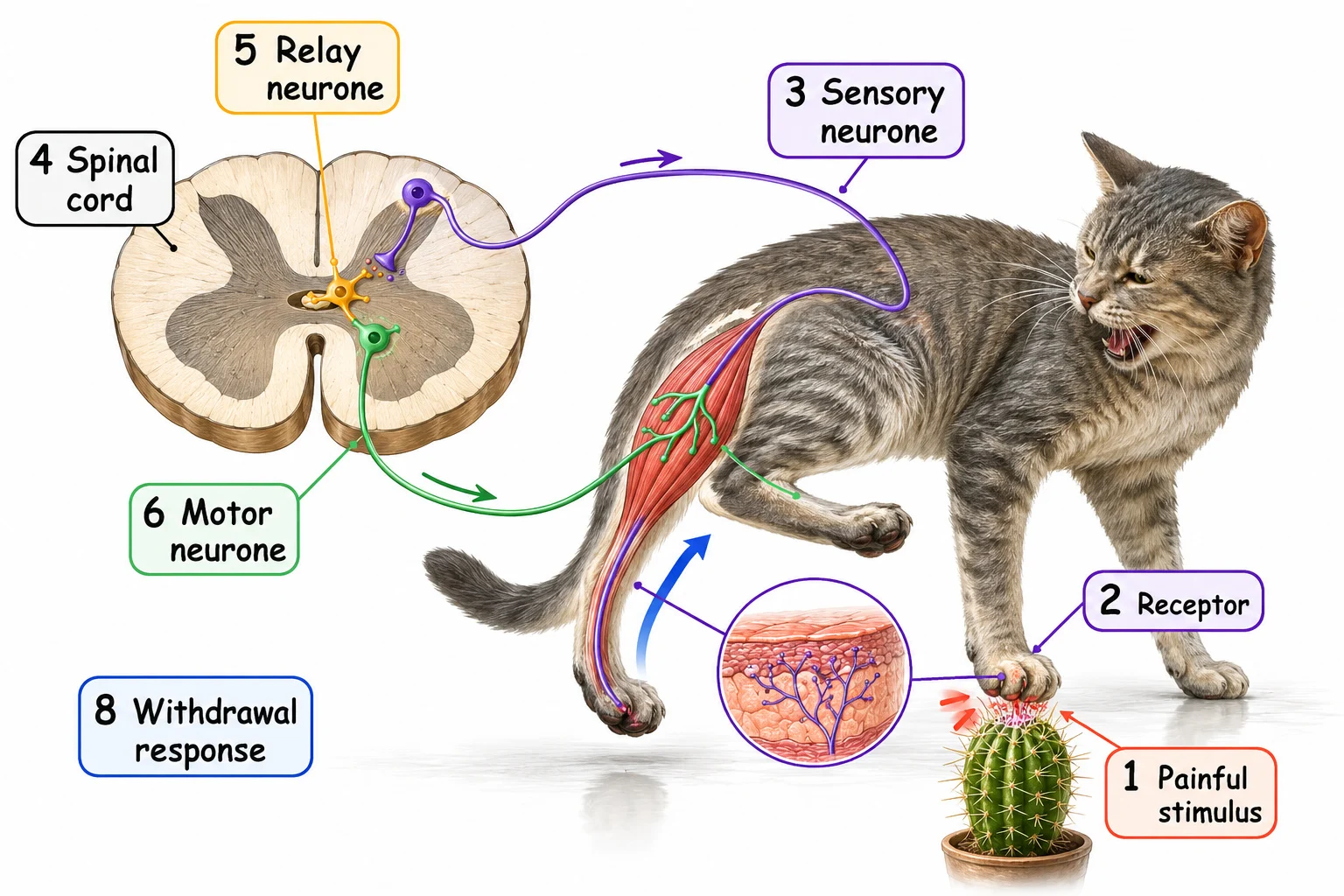
- Stimulus (e.g. heat from a hot object) is detected.
- Receptor in the skin generates an impulse.
- Sensory neurone carries the impulse to the spinal cord.
- Relay neurone in the spinal cord passes the impulse on via synapses.
- Motor neurone carries the impulse to the effector.
- Effector (muscle) contracts, pulling the hand away.
The reflex arcwrite these steps in this order; each step is a marking point.
- Stimulus detected by receptor
- Sensory neurone to spinal cord
- Relay neurone across synapses
- Motor neurone to effector
- Muscle contracts to respond
Part 5 of 8Worked examples
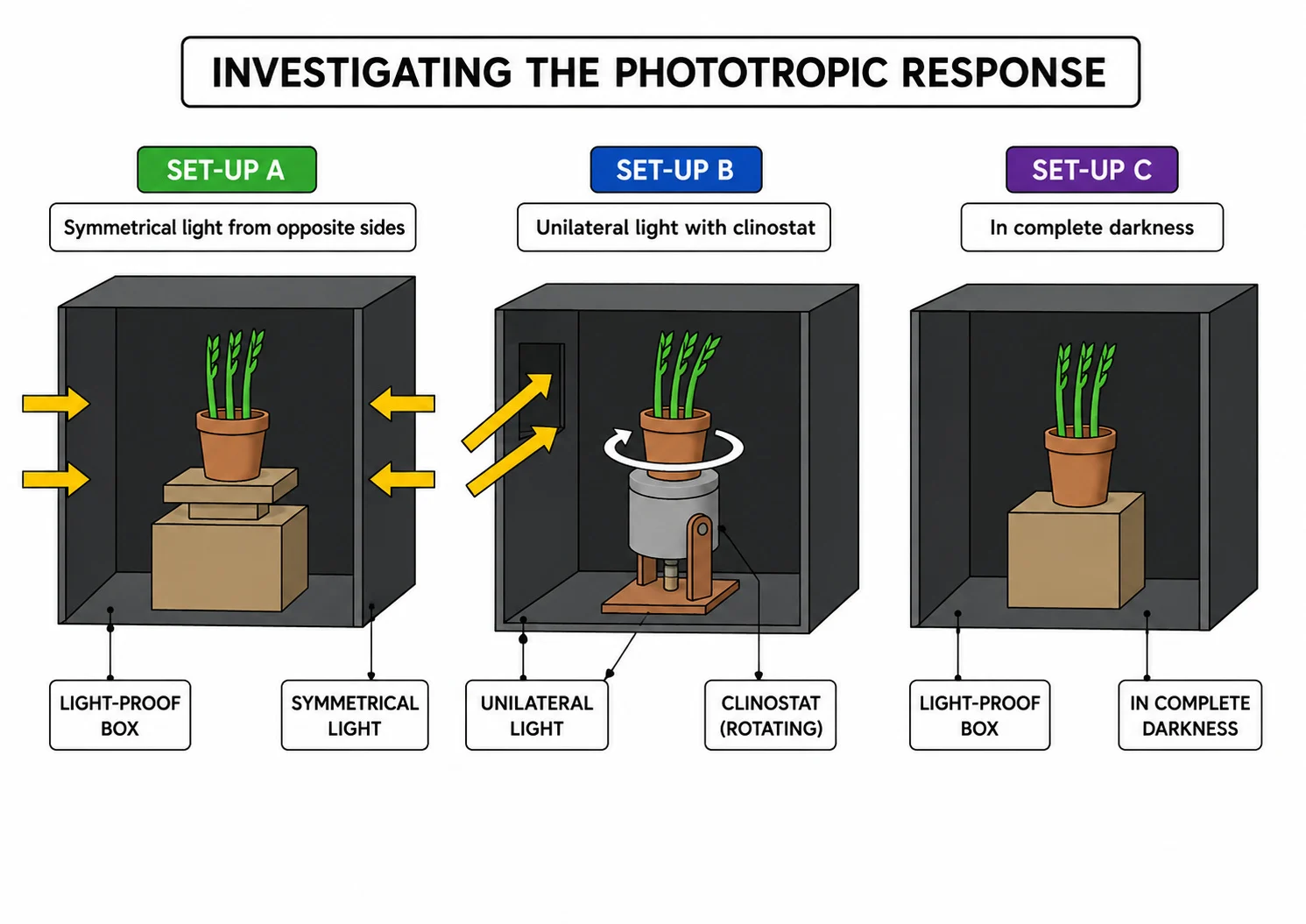
- Auxin is produced in the shoot tip.
- Light from one side causes auxin to accumulate on the shaded side.
- Auxin stimulates cell elongation in shoots,
- so cells on the shaded side elongate more than those on the lit side, and the shoot bends towards the light.
- This positive phototropism increases light absorbed for photosynthesis.
- A reflex arc involves few neurones and few synapses and passes through the spinal cord (or lower brain) without conscious decision-making,
- so the impulse reaches the effector in a shorter time.
Part 6 of 8Summary
- Organisms detect stimuli with receptors and respond with effectors.
- Homeostasis keeps internal conditions constant.
- Plants respond by tropisms controlled by auxin.
- Nerves are fast and short-lived; hormones are slower and longer-lasting.
- A reflex arc gives a rapid protective response.
Part 7 of 8Keep going
Co-ordination & Response Edexcel IGCSE Biology 4BI1: what to do next
These Co-ordination & Response Edexcel IGCSE Biology 4BI1 notes covered the key ideas, worked examples and exam technique for this topic. Check your Co-ordination & Response Edexcel IGCSE Biology 4BI1 understanding with the practice questions below, then reread any Co-ordination & Response Edexcel IGCSE Biology 4BI1 point you were unsure about before moving on.
Co-ordination & Response Edexcel IGCSE Biology 4BI1: revision checklist
- Revise the main Co-ordination & Response Edexcel IGCSE Biology 4BI1 definitions until you can write them from memory.
- Practise Co-ordination & Response Edexcel IGCSE Biology 4BI1 exam questions under timed conditions.
- Link each Co-ordination & Response Edexcel IGCSE Biology 4BI1 idea to a diagram or a worked example.
- List the common Co-ordination & Response Edexcel IGCSE Biology 4BI1 mistakes and how to avoid them.
- Practice: Co-ordination & Response Edexcel IGCSE Biology 4BI1 practice questions
- Previous lesson: 2.9 Excretion — Notes
- Next lesson: 3.1 Reproduction — Notes
- Course: Edexcel International Gcse Biology 4BI1 — all units
- Official syllabus: Pearson Edexcel International GCSEs
Part 8 of 8Compare: Compare
| Feature | Nervous | Hormonal |
|---|---|---|
| Signal | Electrical impulses (and chemical at synapses) | Chemical hormones |
| Transmission | Along neurones | In blood plasma |
| Speed | Very fast | Slower |
| Duration | Short-lived | Longer-lasting |
| Target | Very precise area | Widespread target organs |
| Tropism | Stimulus | Shoot response | Root response |
|---|---|---|---|
| Phototropism | Light | Positive (grows towards) | Negative (grows away) |
| Geotropism (gravitropism) | Gravity | Negative (grows up) | Positive (grows down) |
Auxin causes cell elongation in shoots but inhibits it in roots.
Key terms
Command terms
Exam technique
Keywords the mark scheme looks for in this lesson
How to get full marks (examiner guidance)
Marked practiceQuizzes for this lesson
Last updated:
\n