Skip to content
Dabour HubLEARN · PRACTICE · EXPLORESign inStudent

2.8Structure & Functions in Living Organisms

Transport Systems — Edexcel International GCSE Biology 4BI1 Revision Notes & Topical Questions

10 min read 8 parts Lesson 8 of 21 1 quiz

🩺
100% Curriculum Specification Match Lesson Doctor Verified
The only platform with 100% curriculum specification match and verified interactive question banks.
0%read
Lesson summary

Transport Systems Edexcel IGCSE Biology 4BI1 notes: Explain why multicellular organisms need transport systems.Single-celled organisms rely on diffusion because their surface area to volume ratio is large.Mineral ions are absorbed into root hairs by active transport, using energy…

  • Antibodies are specific
  • The need for a transport system
  • Role of xylem and phloem
  • Absorption of water by root hair cells
  • Transpiration
  • White blood cells and immunity

Part 1 of 8Key ideas

Single-celled organisms rely on diffusion because their surface area to volume ratio is large.
Mineral ions are absorbed into root hairs by active transport, using energy from respiration.
A potometer measures water uptake, which approximates the transpiration rate.
Rate = distance moved by bubble ÷ time (or volume ÷ time).
Haemoglobin + oxygen → oxyhaemoglobin (in the lungs).
Antibodies are specific
Antibodies are specific each fits only one antigen shape.
Memory cells give a faster, larger secondary response.

Part 2 of 8Learning objectives

1
Explain why multicellular organisms need transport systems.
2
Describe the roles of xylem and phloem and water uptake by root hairs.
3
Describe transpiration and investigate the factors affecting it using a potometer.
4
Describe the components of blood and the roles of white blood cells and vaccination.

Part 3 of 8Essential knowledge

Essential knowledge
The need for a transport system
The need for a transport system small organisms have a large surface area to volume ratio and short diffusion distances, so diffusion alone is enough. Large organisms have a small SA:V ratio and long distances, so they need mass transport systems (the circulatory system in animals, xylem and phloem in plants).
Role of xylem and phloem
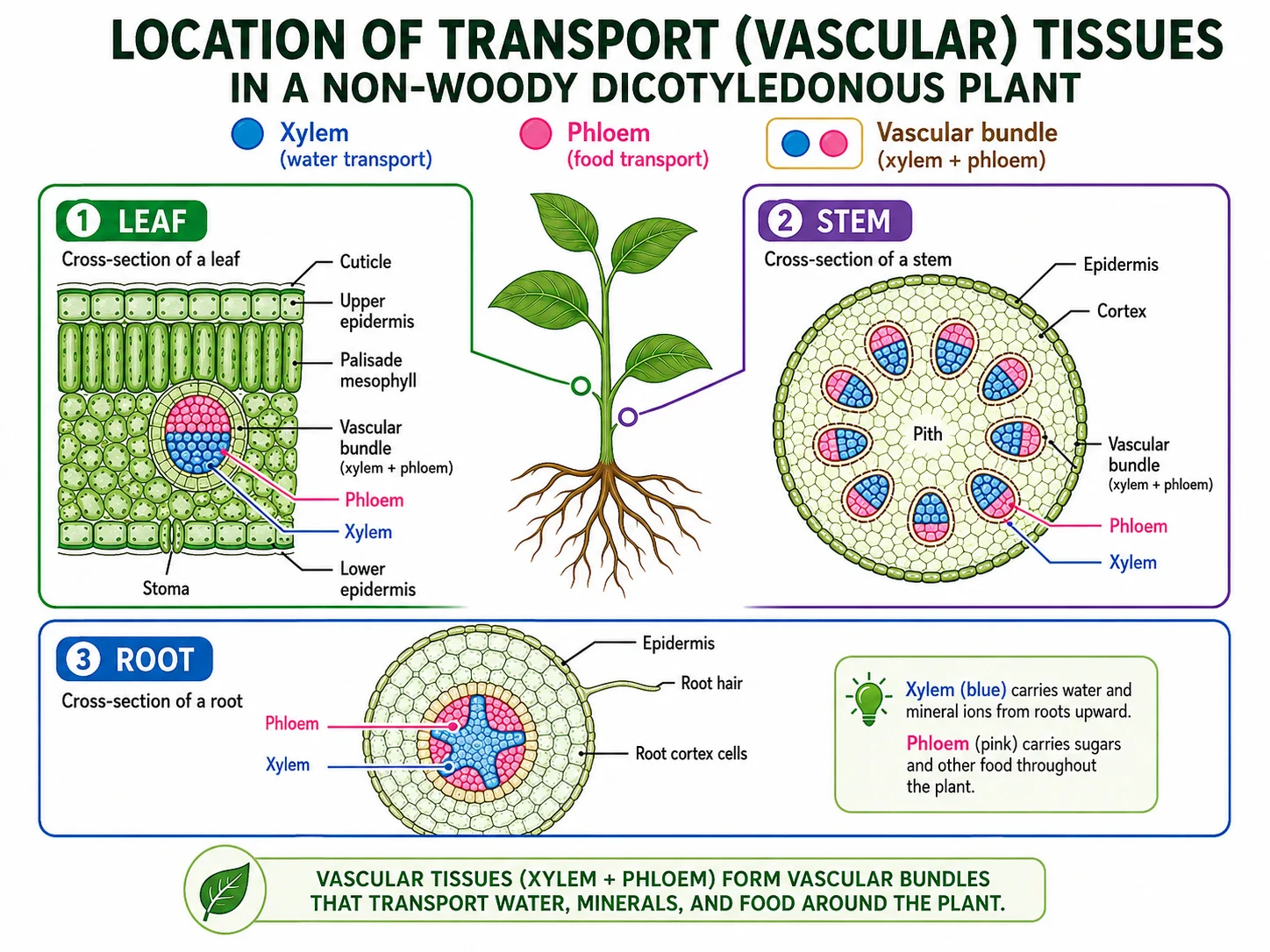
Role of xylem and phloem xylem vessels are dead, hollow and strengthened with lignin; they carry water and mineral ions upwards. Phloem is living tissue that transports sucrose and amino acids from leaves to where they are used or stored, both up and down.
Position of vascular tissues in roots, stems and leaves
Absorption of water by root hair cells
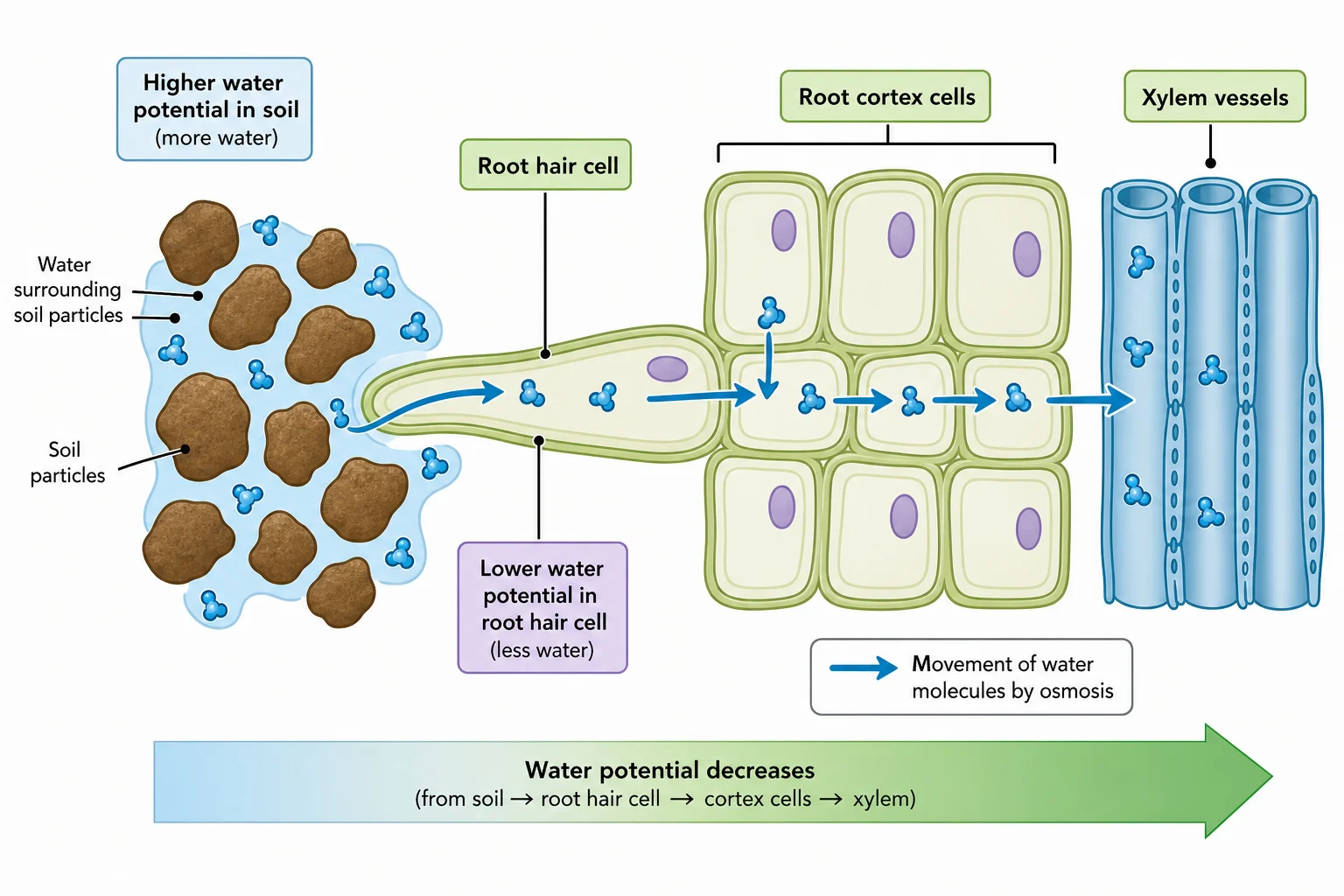
Absorption of water by root hair cells the long extension gives a large surface area. Soil water is more dilute than the cell sap, so water enters by osmosis; mineral ions are taken up by active transport against their concentration gradient.
Water uptake by root hair cells through osmosis
Transpiration
Transpiration water evaporates from mesophyll cells and diffuses out of stomata. This pulls water up the xylem in a continuous column. It supplies water for photosynthesis, carries minerals, cools the leaf and keeps cells turgid.
Practical — factors affecting transpiration
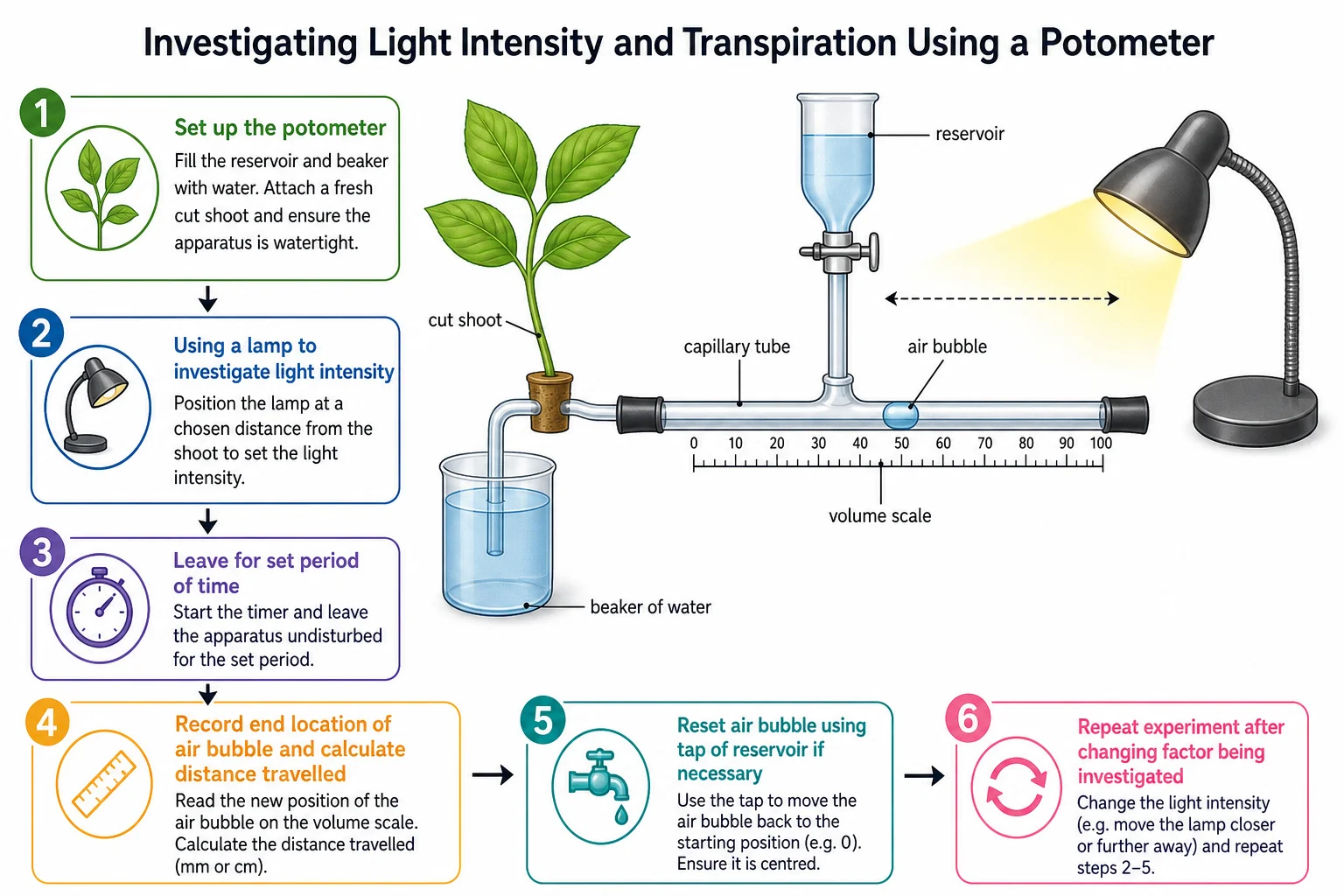
Practical — factors affecting transpiration cut a shoot underwater, fit it into a potometer with airtight seals, introduce an air bubble and measure how far it moves in a set time. Change one factor (e.g. use a fan for wind, a lamp for light, a plastic bag for humidity) and keep others constant; repeat and calculate mean rates.
Potometer apparatus for measuring water uptake
The blood
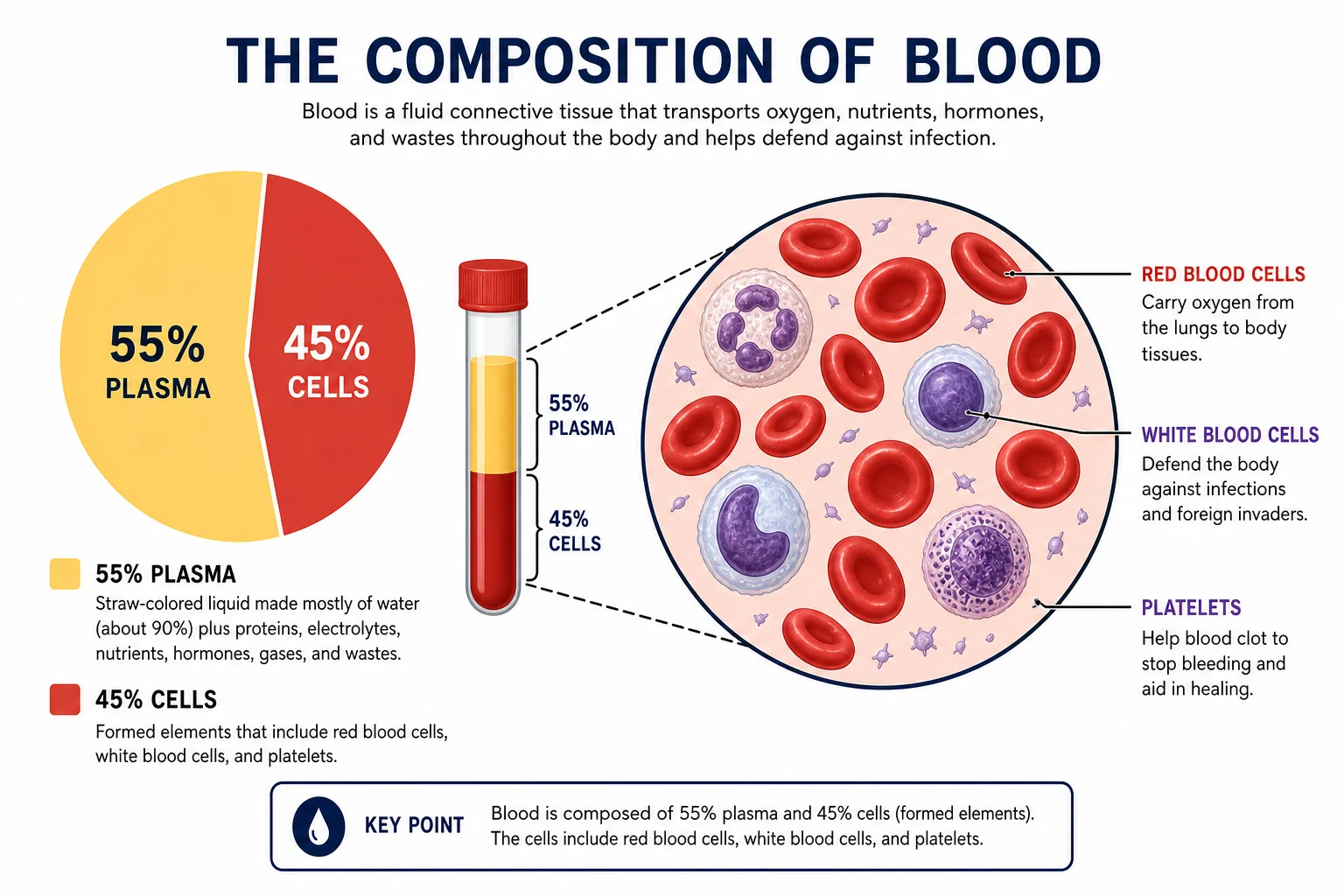
The blood blood consists of plasma, red blood cells, white blood cells and platelets. Red cells are adapted with a biconcave shape (large surface area), no nucleus (more room for haemoglobin) and flexibility.
Components of blood and their proportions
White blood cells and immunity
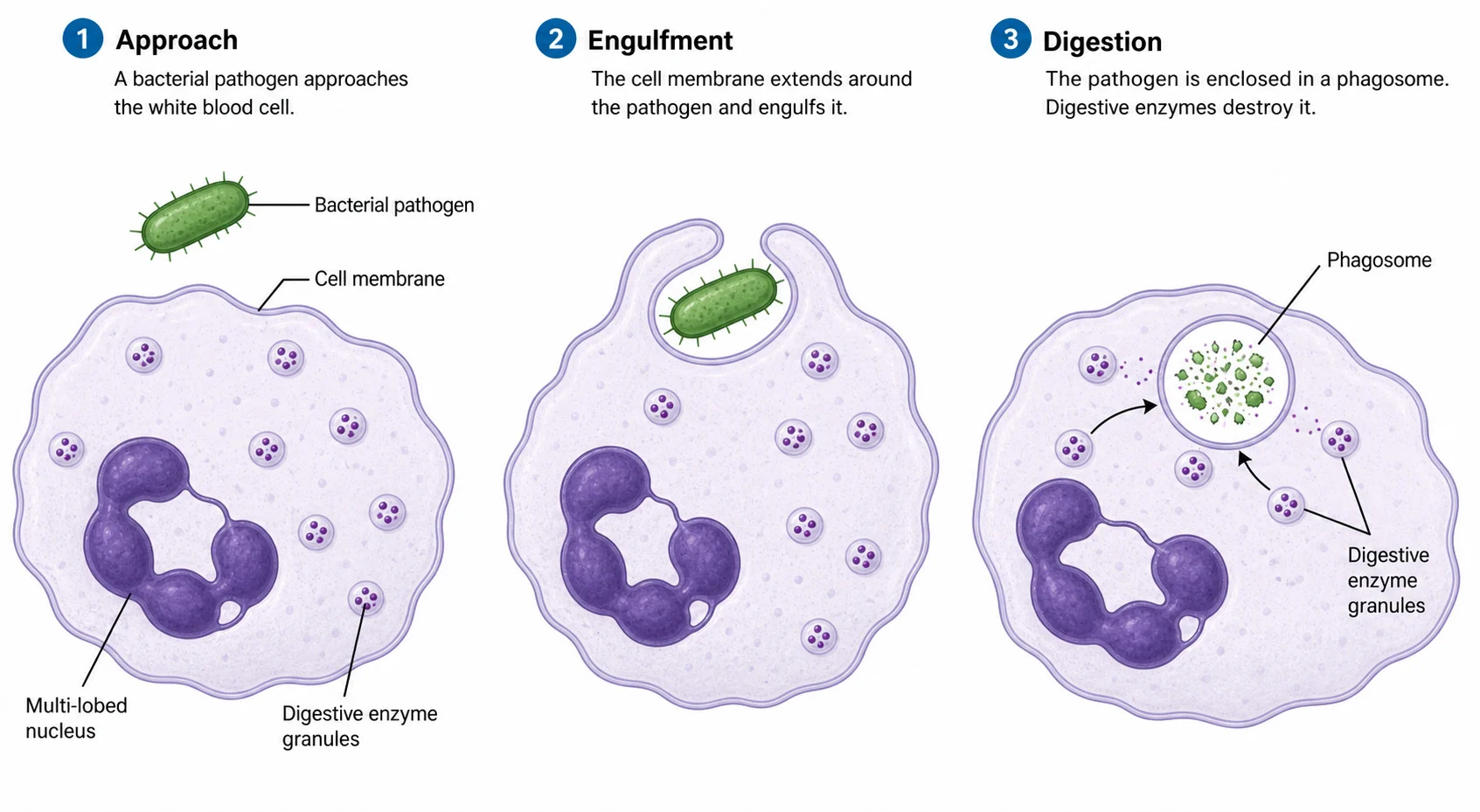
White blood cells and immunity phagocytes engulf and digest pathogens. Lymphocytes recognise antigens and produce specific antibodies, which cause pathogens to clump or mark them for destruction. Some lymphocytes become memory cells.
A phagocyte engulfing and digesting a pathogen
Vaccinations
Vaccinations a vaccine contains dead, weakened or inactivated pathogens or their antigens.
  • Lymphocytes produce antibodies and memory cells.
  • On later infection, memory cells cause a rapid, large production of antibodies,
    • (secondary response)
  • so the pathogen is destroyed before symptoms develop.
  • High vaccination rates give herd immunity.
Blood clotting
At a wound, platelets release chemicals that convert soluble fibrinogen into insoluble fibrin. The fibrin threads form a mesh that traps red blood cells, making a clot that dries to a scab. This stops blood loss and keeps pathogens out.
The heart as a double pump
The right side pumps deoxygenated blood to the lungs; the left side pumps oxygenated blood to the rest of the body. The septum keeps the two sides apart. The left ventricle wall is thicker because it pumps blood at higher pressure all round the body.
Route through the heart
Vena cava → right atrium → tricuspid valve → right ventricle → semilunar valve → pulmonary artery → lungs → pulmonary vein → left atrium → bicuspid valve → left ventricle → semilunar valve → aorta. Valves stop blood flowing backwards; coronary arteries supply the heart muscle itself.
Heart rate and exercise
The pacemaker in the right atrium sets the resting heart rate. During exercise heart rate and the volume pumped per beat both rise, delivering oxygen and glucose to muscles faster and removing CO2 faster. Adrenaline also raises heart rate.
Coronary heart disease
Fatty deposits (mainly cholesterol) build up in the coronary arteries, narrowing the lumen.
  • Less oxygen reaches the heart muscle, causing chest pain (angina); a complete blockage causes a heart attack.
  • Risk factors include a diet high in saturated fat, smoking, high blood pressure, obesity and lack of exercise.
Arteries and veins
Arteries carry blood away from the heart at high pressure; they have thick muscular, elastic walls and a narrow lumen. Veins carry blood to the heart at low pressure; they have thin walls, a wide lumen and valves to prevent backflow.
Capillaries
Capillaries have walls only one cell thick, giving a short diffusion distance for exchange with tissues. Blood flows slowly at low pressure, and some plasma leaks out to form tissue fluid around cells.
Main blood vessels
Heart
  • vena cava and pulmonary vein bring blood in;
    • aorta and pulmonary artery take it out.
  • Lungs: pulmonary artery in, pulmonary vein out.
  • Liver: hepatic artery and hepatic portal vein in, hepatic vein out.
  • Kidneys: renal artery in, renal vein out.
Potometer limitations
A potometer measures water uptake, not water loss, because a little water is used in photosynthesis. A lamp placed close also warms the shoot, so light and temperature change together. Leaky seals or air in the xylem give false readings.

Part 4 of 8Process & sequence

    • Water enters root hair cells from soil by osmosis.
    • Water moves across the root cortex cell to cell into the xylem.
    • Water rises up xylem vessels in a continuous column.
    • Water leaves xylem into leaf mesophyll cells.
    • Water evaporates from mesophyll cell surfaces into air spaces.
    • Water vapour diffuses out through stomata, pulling the column up (transpiration stream).

    Water through a plantwrite these steps in this order; each step is a marking point.

    1. Osmosis into root hair
    2. Across root to xylem
    3. Up xylem vessels
    4. Into leaf mesophyll
    5. Evaporation into air spaces
    6. Diffuses out of stomata

Part 5 of 8Worked examples

Worked examples
In a potometer, the bubble moves 45 mm in 5 minutes. The capillary tube has a cross-sectional area of 0.8 mm2. Calculate the rate of water uptake in mm3 per minute.
  • Volume = distance × area = 45 × 0.8 = 36 mm3. Rate = 36 ÷ 5 = 7.2 mm3 per minute.
Explain why a person who has been vaccinated does not become ill when infected with the pathogen.
  • The vaccine caused lymphocytes to produce memory cells specific to the antigen.
    • On infection, memory cells rapidly trigger production of large amounts of specific antibodies,
    • which destroy the pathogen before it can multiply enough to cause symptoms.

Part 6 of 8Summary

    • Large organisms need transport systems because of a small SA:V ratio.
    • Xylem carries water; phloem carries sugars.
    • Transpiration is increased by heat, wind and light, reduced by humidity.
    • White blood cells defend by phagocytosis and antibodies.
    • Vaccines produce memory cells for long-term immunity.

Part 7 of 8Keep going

  1. Transport Systems Edexcel IGCSE Biology 4BI1: what to do next

    These Transport Systems Edexcel IGCSE Biology 4BI1 notes covered the key ideas, worked examples and exam technique for this topic. Check your Transport Systems Edexcel IGCSE Biology 4BI1 understanding with the practice questions below, then reread any Transport Systems Edexcel IGCSE Biology 4BI1 point you were unsure about before moving on.

    Transport Systems Edexcel IGCSE Biology 4BI1: revision checklist

    • Revise the main Transport Systems Edexcel IGCSE Biology 4BI1 definitions until you can write them from memory.
    • Practise Transport Systems Edexcel IGCSE Biology 4BI1 exam questions under timed conditions.
    • Link each Transport Systems Edexcel IGCSE Biology 4BI1 idea to a diagram or a worked example.
    • List the common Transport Systems Edexcel IGCSE Biology 4BI1 mistakes and how to avoid them.

Part 8 of 8Compare: Compare

Components of blood
ComponentStructureFunction
Red blood cellsBiconcave, no nucleus, contain haemoglobinCarry oxygen as oxyhaemoglobin
PhagocytesLobed nucleus, can change shapeEngulf and digest pathogens
LymphocytesLarge round nucleusProduce antibodies; form memory cells
PlateletsCell fragmentsHelp blood clot, sealing wounds
PlasmaLiquid, mostly waterTransports CO2, glucose, urea, hormones, heat
Factors affecting transpiration rate
Factor increasedEffect on rateReason
TemperatureIncreasesWater molecules have more kinetic energy; faster evaporation and diffusion
HumidityDecreasesSmaller concentration gradient of water vapour
Wind speedIncreasesWater vapour blown away, keeping gradient steep
Light intensityIncreasesStomata open wider for photosynthesis

Key terms

Command terms

Command terms
Give / State / Name
Recall a fact; one idea per mark.
Define
Give the exact meaning using the specification keywords.
Describe
Give an account of what happens / the pattern in data, quoting values; no reasons needed.
Explain
Give reasons with linked statements (cause → effect). Each linked step is usually a separate marking point.
Suggest
Use knowledge in a new context; more than one answer may be accepted.
Compare
Similarities and differences; each point must refer to both items.
Calculate
Show working; include units; check significant figures. Method marks are given even if the final answer is wrong.
Discuss
Explore the issue from different angles and link the points.
Evaluate / Assess
Weigh strengths and weaknesses and reach a supported judgement.
Deduce
Draw a conclusion from the information given.
Justify
Support a statement/choice with evidence.

Exam technique

Keywords the mark scheme looks for in this lesson

Keywords the mark scheme looks for in this lesson
Xylem · Phloem · Transpiration · Osmosis · Root hair cell · Plasma · Phagocyte · Lymphocyte · Antigen · Vaccination
Learn each definition in the Key words tab exactly; a missing keyword in a definition usually loses the mark.

How to get full marks (examiner guidance)

How to get full marks (examiner guidance)
Use specification keywords exactly (e.g. eukaryotic/prokaryotic, enzyme–substrate complex, active site, complementary).
Link ideas
Link ideas for “explain” each marking point is usually a cause → consequence step; unlinked facts often score nothing.
Use the information in the question
“discuss/evaluate” answers must use the data provided and match the number of marks.
Convert units carefully (mg → g, cm3 → dm3) and show working for calculations.
Avoid vague words
“it”, “stuff”, “things”, “goes up”, “energy is made”. Name the substance and the process.
Do not extrapolate a graph line beyond the data or to zero unless asked.
Six-mark extended responses are marked on content AND a logical, linked line of reasoning.

Last updated:

\n