Skip to content
Dabour HubLEARN · PRACTICE · EXPLORESign inStudent

2.9Structure & Functions in Living Organisms

Excretion — Edexcel International GCSE Biology 4BI1 Revision Notes & Topical Questions

10 min read 8 parts Lesson 9 of 21 1 quiz

🩺
100% Curriculum Specification Match Lesson Doctor Verified
The only platform with 100% curriculum specification match and verified interactive question banks.
0%read
Lesson summary

Excretion Edexcel IGCSE Biology 4BI1 notes: Name the excretory products of plants and humans and the organs that remove them.Plants excrete O2 (by day) and CO2 (at night) through stomata by diffusion.Humans excrete CO2 via the lungs, urea via the kidneys and water/salts via the s…

  • Excretion in plants
  • Excretion in humans
  • Two roles of the kidney
  • Urinary system
  • Nephron structure
  • Ultrafiltration

Part 1 of 8Key ideas

1
Plants excrete O2 (by day) and CO2 (at night) through stomata by diffusion.
2
Humans excrete CO2 via the lungs, urea via the kidneys and water/salts via the skin.
3
Urea is made in the liver by deamination of excess amino acids.
4
Glucose and protein should be absent from healthy urine; glucose in urine can indicate diabetes.
5
Proteins and blood cells are too large to pass through the glomerulus into the filtrate.
6
ADH is released by the pituitary gland when blood water concentration is too low.
7
1More ADH2collecting duct more permeable3more water reabsorbed4small volume of concentrated urine
8
This is an example of negative feedback.

Part 2 of 8Learning objectives

1
Name the excretory products of plants and humans and the organs that remove them.
2
Label the urinary system and the structure of a nephron.
3
Describe ultrafiltration, selective reabsorption of glucose and water reabsorption.
4
Explain the role of ADH in controlling urine concentration.

Part 3 of 8Essential knowledge

Essential knowledge
Excretion in plants
Excretion in plants leaves excrete oxygen produced in photosynthesis and carbon dioxide produced in respiration. These gases diffuse out through the stomata. Which gas is excreted depends on the balance of photosynthesis and respiration.
Excretion in humans
Excretion in humans the lungs excrete carbon dioxide from respiration; the kidneys excrete urea, excess water and ions in urine; the skin loses water, salts and small amounts of urea in sweat.
Two roles of the kidney
Two roles of the kidney excretion (removing urea) and osmoregulation (keeping the water and ion content of blood constant so that cells are not damaged by osmosis).
Urinary system
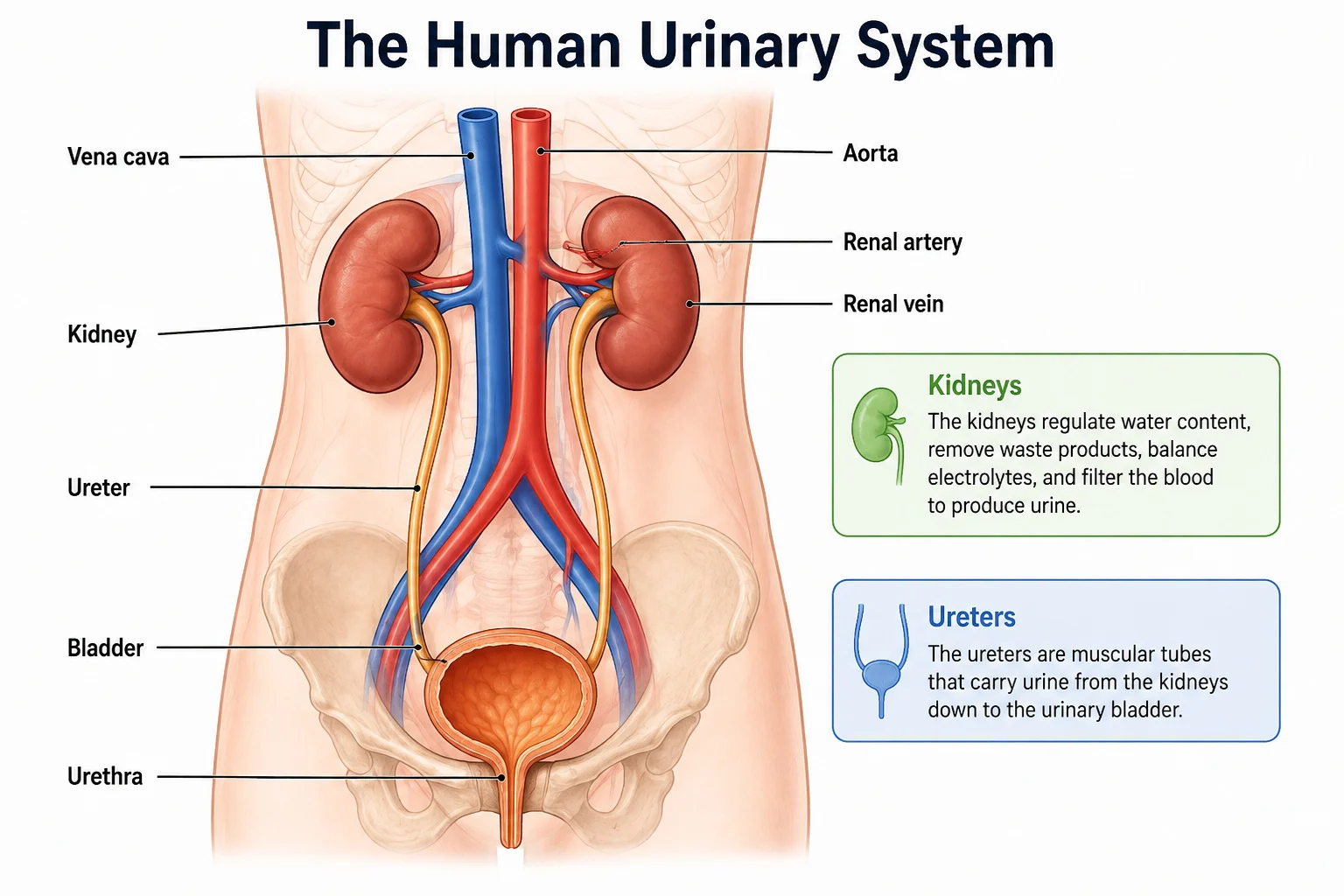
Urinary system the renal artery brings blood to each kidney and the renal vein takes filtered blood away. Each kidney has an outer cortex, an inner medulla and a pelvis. Urine passes down the ureters to the bladder, which stores it; a sphincter muscle controls release through the urethra.
Human urinary system: kidneys, ureters, bladder and urethra
Nephron structure
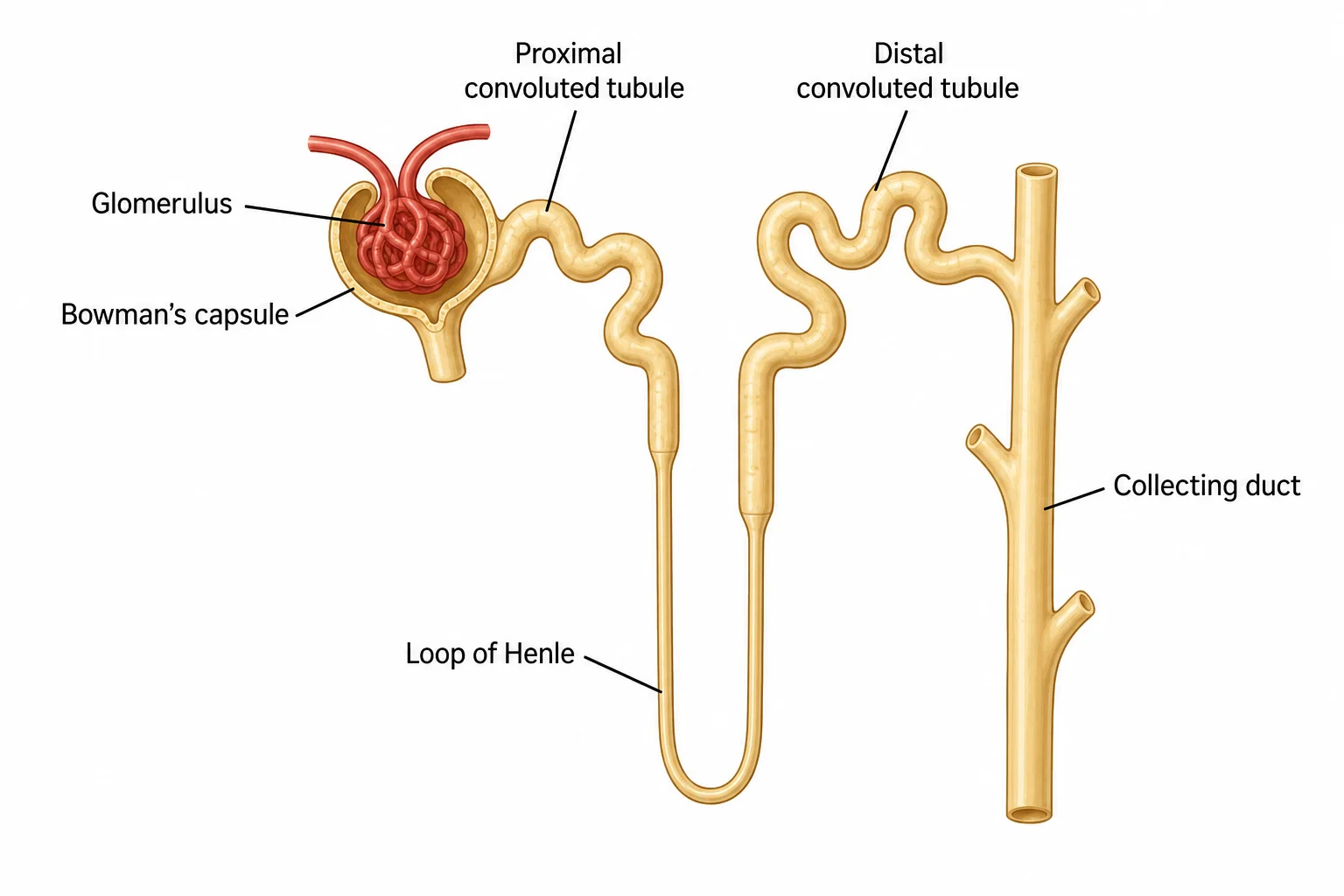
Nephron structure each kidney contains about a million nephrons. A nephron starts with the Bowman's capsule around the glomerulus, then the proximal convoluted tubule, loop of Henle, distal convoluted tubule and finally the collecting duct, which drains into the pelvis.
Structure and main regions of a nephron
Ultrafiltration
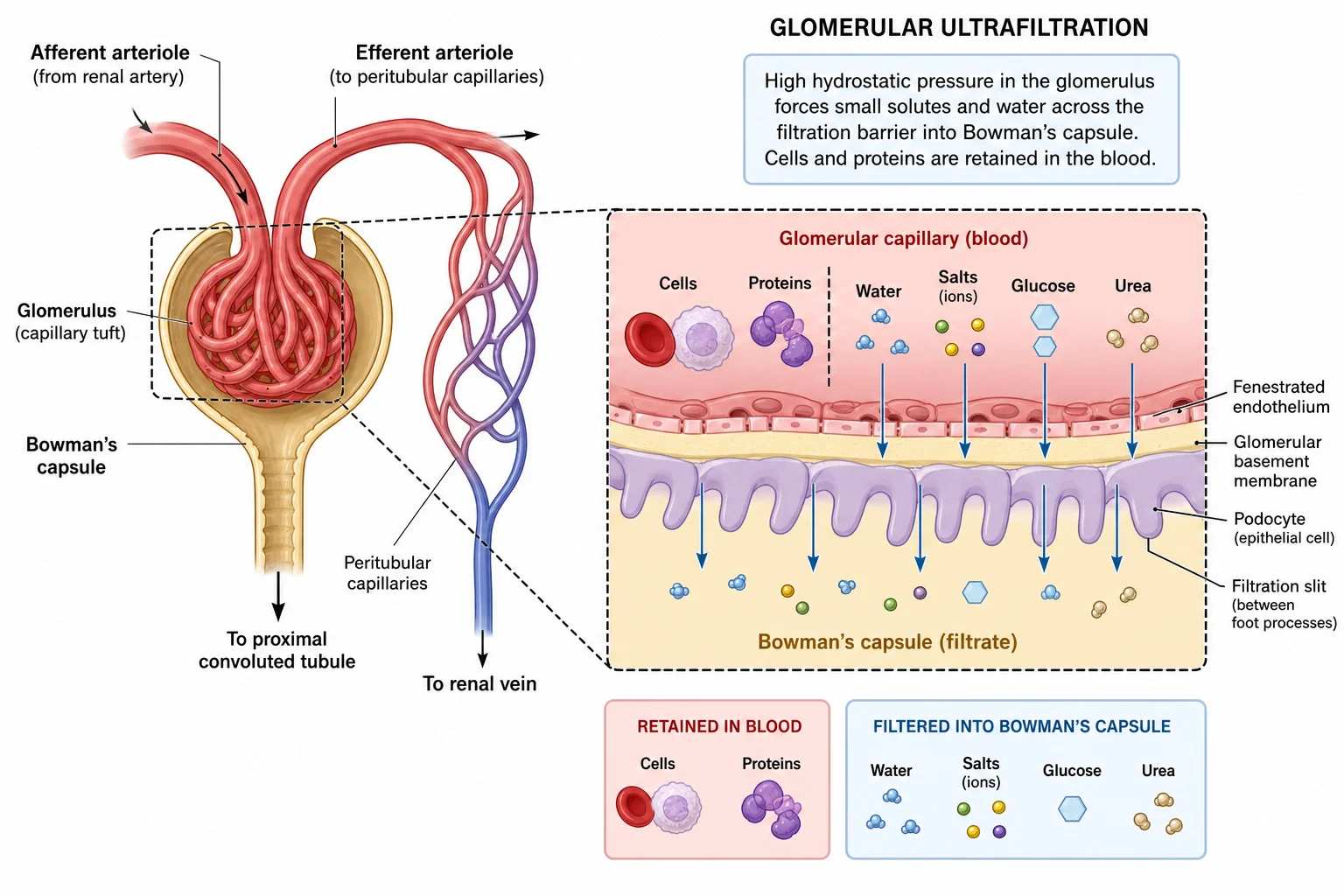
Ultrafiltration the afferent arteriole entering the glomerulus is wider than the efferent arteriole leaving, which creates high pressure. Water, glucose, urea, amino acids and ions are forced into the capsule to form the glomerular filtrate. Red blood cells and large proteins remain in the blood.
Glomerulus and filtration into Bowman’s capsule
Selective reabsorption
Selective reabsorption in the proximal tubule all the glucose is reabsorbed by active transport, using energy from the many mitochondria in the tubule cells,
  • which also have microvilli to increase surface area.
  • Some water and ions are also reabsorbed.
  • The loop of Henle sets up a salty medulla so water can later leave the collecting duct by osmosis.
ADH and water balance
ADH and water balance if the blood is too concentrated (e.g. after sweating), the hypothalamus detects this and the pituitary releases more ADH.
  • ADH makes the collecting duct walls more permeable, so more water is reabsorbed and a small volume of concentrated urine is produced.
  • If blood is too dilute, less ADH is released and a large volume of dilute urine results.
Composition of urine
Composition of urine water, urea and mineral ions. The volume and concentration vary with water intake, temperature and exercise; glucose and protein are normally absent.
Why waste must be removed
If carbon dioxide builds up it forms an acidic solution, lowering pH and reducing enzyme activity. A build-up of waste also concentrates body fluids, so water leaves cells by osmosis and they cannot function properly.
Where nephron parts lie
The Bowman's capsule, glomerulus and both convoluted tubules are in the outer cortex; the loop of Henle and collecting duct run into the inner medulla. Collecting ducts empty into the renal pelvis, which leads to the ureter.
Protein in urine
High blood pressure can damage the glomerulus so that protein molecules are forced into the filtrate. Protein cannot be reabsorbed, so it appears in the urine. In a healthy person protein stays in the blood.
Urea along the nephron
As water is reabsorbed along the nephron, the urea left in the filtrate becomes more concentrated, so urea concentration is highest in the collecting duct and urine.
Urine colour
A large volume of urine is pale because the urea is diluted by lots of water. A small volume is dark yellow because the urea is concentrated, e.g. after heavy sweating on a hot day or during exercise.

Part 4 of 8Process & sequence

    • Blood enters the kidney in the renal artery and passes into the glomerulus.
    • High pressure forces water, glucose, urea, salts into the Bowman's capsule (ultrafiltration);
      • cells and proteins stay in blood.
    • In the proximal tubule all glucose is reabsorbed into the blood by active transport.
    • The loop of Henle concentrates salts in the medulla.
    • Water is reabsorbed from the collecting duct, the amount controlled by ADH.
    • The remaining fluid (urine) drains through the ureter to the bladder.
    • Filtered blood leaves the kidney in the renal vein.

    Urine formation in a nephronwrite these steps in this order; each step is a marking point.

    1. Blood enters glomerulus
    2. Ultrafiltration into Bowman's capsule
    3. Glucose reabsorbed in proximal tubule
    4. Loop of Henle concentrates medulla
    5. Water reabsorbed (ADH) in collecting duct
    6. Urine to ureter and bladder

Part 5 of 8Worked examples

1Smaller in volume and more concentrated
A student runs on a hot day and drinks little. Explain how the volume and concentration of urine change.
  • Water is lost in sweat, so the blood becomes more concentrated.
    • This is detected by the hypothalamus and the pituitary gland releases more ADH into the blood.
    • ADH makes the collecting ducts more permeable to water, so more water is reabsorbed into the blood by osmosis.
    • The urine produced is smaller in volume and more concentrated.
2Selectively reabsorbed
Explain why glucose is present in the glomerular filtrate but not in urine of a healthy person.
  • Glucose molecules are small enough to be forced out of the glomerulus during ultrafiltration.
    • However, in the proximal convoluted tubule all glucose is selectively reabsorbed into the blood by active transport, so none reaches the urine.

Part 6 of 8Summary

    • Excretion removes metabolic waste: CO2, urea, excess water.
    • Kidneys do excretion and osmoregulation.
    • The nephron works by ultrafiltration then selective reabsorption.
    • ADH makes the collecting duct more permeable to water.
    • Urine contains urea, water and salts but no glucose or protein.

Part 7 of 8Keep going

  1. Excretion Edexcel IGCSE Biology 4BI1: what to do next

    These Excretion Edexcel IGCSE Biology 4BI1 notes covered the key ideas, worked examples and exam technique for this topic. Check your Excretion Edexcel IGCSE Biology 4BI1 understanding with the practice questions below, then reread any Excretion Edexcel IGCSE Biology 4BI1 point you were unsure about before moving on.

    Excretion Edexcel IGCSE Biology 4BI1: revision checklist

    • Revise the main Excretion Edexcel IGCSE Biology 4BI1 definitions until you can write them from memory.
    • Practise Excretion Edexcel IGCSE Biology 4BI1 exam questions under timed conditions.
    • Link each Excretion Edexcel IGCSE Biology 4BI1 idea to a diagram or a worked example.
    • List the common Excretion Edexcel IGCSE Biology 4BI1 mistakes and how to avoid them.

Part 8 of 8Compare: Compare

Excretory organs and products
Organism / organWaste productHow removed
Plant leavesOxygen (from photosynthesis)Diffuses out through stomata
Plant leavesCarbon dioxide (from respiration, at night)Diffuses out through stomata
Human lungsCarbon dioxide (and some water)Exhaled
Human kidneysUrea, excess water and ionsUrine
Human skinWater, salts, a little ureaSweat
Parts of the nephron and their jobs
RegionFunction
Glomerulus and Bowman's capsuleUltrafiltration of small molecules from blood
Proximal convoluted tubuleSelective reabsorption of all glucose (active transport), some water and ions
Loop of HenleCreates high salt concentration in the medulla so water can be reabsorbed
Distal convoluted tubuleAdjusts ion balance
Collecting ductReabsorbs water under control of ADH

Key terms

Command terms

Command terms
Give / State / Name
Recall a fact; one idea per mark.
Define
Give the exact meaning using the specification keywords.
Describe
Give an account of what happens / the pattern in data, quoting values; no reasons needed.
Explain
Give reasons with linked statements (cause → effect). Each linked step is usually a separate marking point.
Suggest
Use knowledge in a new context; more than one answer may be accepted.
Compare
Similarities and differences; each point must refer to both items.
Calculate
Show working; include units; check significant figures. Method marks are given even if the final answer is wrong.
Discuss
Explore the issue from different angles and link the points.
Evaluate / Assess
Weigh strengths and weaknesses and reach a supported judgement.
Deduce
Draw a conclusion from the information given.
Justify
Support a statement/choice with evidence.

Exam technique

Keywords the mark scheme looks for in this lesson

Keywords the mark scheme looks for in this lesson
Excretion · Urea · Osmoregulation · Nephron · Ultrafiltration · Selective reabsorption · Glomerulus · ADH · Ureter · Urethra
Learn each definition in the Key words tab exactly; a missing keyword in a definition usually loses the mark.

How to get full marks (examiner guidance)

How to get full marks (examiner guidance)
Use specification keywords exactly (e.g. eukaryotic/prokaryotic, enzyme–substrate complex, active site, complementary).
Link ideas
Link ideas for “explain” each marking point is usually a cause → consequence step; unlinked facts often score nothing.
Use the information in the question
“discuss/evaluate” answers must use the data provided and match the number of marks.
Convert units carefully (mg → g, cm3 → dm3) and show working for calculations.
Avoid vague words
“it”, “stuff”, “things”, “goes up”, “energy is made”. Name the substance and the process.
Do not extrapolate a graph line beyond the data or to zero unless asked.
Six-mark extended responses are marked on content AND a logical, linked line of reasoning.

Last updated:

\n