Skip to content
Dabour HubLEARN · PRACTICE · EXPLORESign inStudent

2.10Structure & Functions in Living Organisms

Co-ordination & Response — Edexcel International GCSE Biology 4BI1 Revision Notes & Topical Questions

10 min read 8 parts Lesson 10 of 21 1 quiz

🩺
100% Curriculum Specification Match Lesson Doctor Verified
The only platform with 100% curriculum specification match and verified interactive question banks.
0%read
Lesson summary

Co-ordination & Response Edexcel IGCSE Biology 4BI1 notes: Explain why organisms must respond to changes and maintain homeostasis.The central nervous system (CNS) = brain + spinal cord.Reflex arcreceptor → sensory neurone → relay neurone → motor neurone → effector.Normal core bod…

  • Response to changes in the environment
  • Co-ordinating a response
  • Response to stimuli in plants
  • Nervous and hormonal control
  • Human nervous system
  • Role of neurotransmitters at synapses

Part 1 of 8Key ideas

The central nervous system (CNS) = brain + spinal cord.
Reflex arc
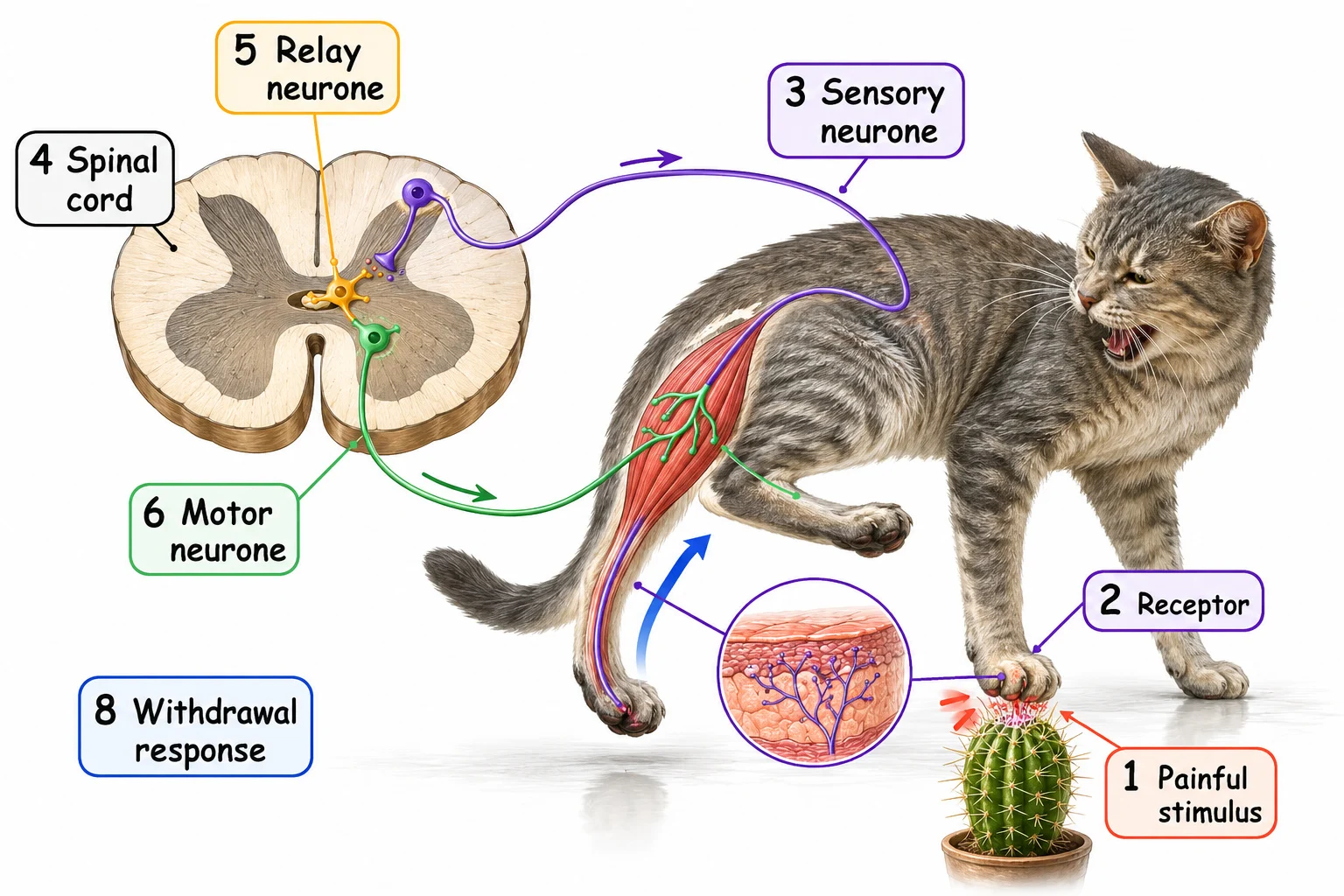
Reflex arc receptor → sensory neurone → relay neurone → motor neurone → effector.
Normal core body temperature is about 37 °C.
Homeostasis controls body temperature, blood water content and blood glucose.
Neurotransmitter diffuses across the synaptic gap and binds to receptors on the next neurone.
Synapses make sure impulses travel in one direction only.
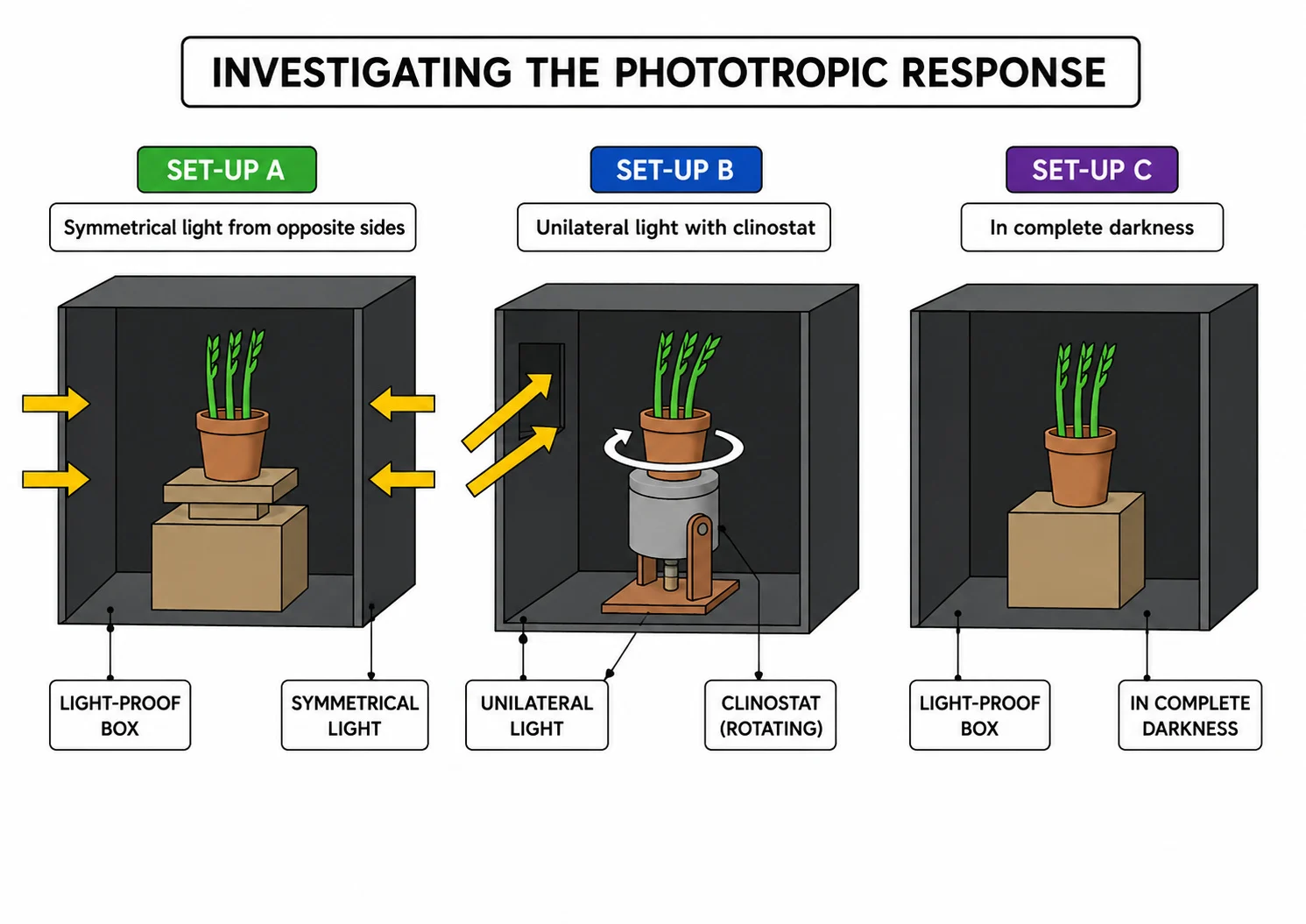
In a shoot lit from one side, auxin moves to the shaded side, cells there elongate more and the shoot bends towards light.

Part 2 of 8Learning objectives

1
Explain why organisms must respond to changes and maintain homeostasis.
2
Describe phototropism and geotropism and the role of auxin.
3
Compare nervous and hormonal control.
4
Describe the structure of the human nervous system, synapses and the reflex arc.

Part 3 of 8Essential knowledge

Essential knowledge
Response to changes in the environment
Response to changes in the environment organisms must detect and respond to changes (stimuli) to survive, e.g. finding food, avoiding predators and keeping conditions suitable for enzymes.
Homeostasis
Homeostasis the internal environment, including body temperature, water content and blood glucose concentration, is kept within narrow limits. This is usually by negative feedback: a change from the set point triggers responses that reverse it.
Co-ordinating a response
Co-ordinating a response stimulus → receptor → co-ordinator (CNS or endocrine gland) → effector → response. Effectors are muscles (contract) or glands (secrete).
Response to stimuli in plants
Response to stimuli in plants shoots show positive phototropism and negative geotropism; roots show positive geotropism. Auxin is made at the tip and diffuses back; unequal distribution of auxin causes unequal cell elongation and bending.
Unilateral light, rotating clinostat and dark controls in a phototropism investigation
Nervous and hormonal control
Nervous and hormonal control the nervous system uses electrical impulses along neurones: fast, short-lived and precise. The endocrine system uses hormones carried in the blood: slower, longer-lasting and often affecting several organs (e.g. adrenaline, insulin).
Human nervous system
Human nervous system the CNS (brain and spinal cord) is linked to receptors and effectors by nerves of the peripheral nervous system. Sense organs contain receptors, e.g. the eye has light receptors (rods and cones) in the retina.
Role of neurotransmitters at synapses
Role of neurotransmitters at synapses when an impulse reaches the end of a neurone, neurotransmitter is released into the synaptic gap, diffuses across and binds to receptor molecules on the next neurone, triggering a new impulse. Only the first neurone releases transmitter, so impulses pass one way.
Simple reflex arc
Simple reflex arc reflexes are fast, automatic and protective (e.g. withdrawing a hand from a hot object, blinking). The pathway bypasses conscious parts of the brain, passing through a relay neurone in the spinal cord.
Reflex arc linking receptor, sensory neurone, spinal cord, motor neurone and muscle
Structure of the eye
The cornea refracts light entering the eye; the iris controls pupil size; the lens focuses light onto the retina, which contains rods and cones. The fovea has many cones for detailed colour vision. The optic nerve carries impulses to the brain; the blind spot has no receptors.
Focusing (accommodation)
Near object
  • ciliary muscles contract, suspensory ligaments slacken, the lens becomes fatter and refracts light more.
  • Distant object: ciliary muscles relax, suspensory ligaments tighten, the lens is pulled thinner and refracts light less.
  • Ligaments tighten or slacken;
    • they never contract.
Pupil reflex
In bright light the circular muscles of the iris contract and the radial muscles relax, so the pupil narrows and protects the retina. In dim light the radial muscles contract and the circular muscles relax, so the pupil widens to let in more light.
Thermoregulatory centre
The hypothalamus in the brain contains receptors that monitor blood temperature and also receives impulses from temperature receptors in the skin. It co-ordinates responses that keep core temperature near 37 °C.
Skin when the body is too hot
Arterioles supplying skin capillaries dilate (vasodilation), so more blood flows near the surface and more heat is lost by radiation. Sweat glands secrete more sweat; its evaporation transfers heat away from the skin.
Skin when the body is too cold
Arterioles supplying skin capillaries constrict (vasoconstriction), so less blood flows near the surface and less heat is lost. Sweating decreases. Shivering, rapid muscle contractions, releases heat from respiration, and hair erector muscles raise hairs to trap insulating air.
Adrenaline
Released by the adrenal glands in danger (fight or flight). It raises heart rate and breathing rate, diverts blood to the muscles and away from the gut, and causes the liver to convert glycogen to glucose, so muscles receive more glucose and oxygen for respiration.
Insulin and blood glucose
When blood glucose rises, the pancreas detects it and secretes insulin into the blood. Insulin makes liver and muscle cells take up glucose and store it as glycogen, so blood glucose falls back to normal. Very high or very low blood glucose can damage cells or starve the brain.
Sex hormones
Testosterone (testes) triggers male secondary sexual characteristics such as facial hair, a deeper voice and more muscle. Oestrogen (ovaries) triggers female secondary sexual characteristics and repairs the uterus lining. Progesterone (ovaries) maintains the uterus lining.

Part 4 of 8Process & sequence

    • Stimulus (e.g. heat from a hot object) is detected.
    • Receptor in the skin generates an impulse.
    • Sensory neurone carries the impulse to the spinal cord.
    • Relay neurone in the spinal cord passes the impulse on via synapses.
    • Motor neurone carries the impulse to the effector.
    • Effector (muscle) contracts, pulling the hand away.

    The reflex arcwrite these steps in this order; each step is a marking point.

    1. Stimulus detected by receptor
    2. Sensory neurone to spinal cord
    3. Relay neurone across synapses
    4. Motor neurone to effector
    5. Muscle contracts to respond

Part 5 of 8Worked examples

1Explain how a plant shoot bends towards light coming from one side.
  • Auxin is produced in the shoot tip.
    • Light from one side causes auxin to accumulate on the shaded side.
    • Auxin stimulates cell elongation in shoots,
      • so cells on the shaded side elongate more than those on the lit side, and the shoot bends towards the light.
    • This positive phototropism increases light absorbed for photosynthesis.
2Explain why a reflex action is faster than a voluntary response.
  • A reflex arc involves few neurones and few synapses and passes through the spinal cord (or lower brain) without conscious decision-making,
    • so the impulse reaches the effector in a shorter time.

Part 6 of 8Summary

    • Organisms detect stimuli with receptors and respond with effectors.
    • Homeostasis keeps internal conditions constant.
    • Plants respond by tropisms controlled by auxin.
    • Nerves are fast and short-lived; hormones are slower and longer-lasting.
    • A reflex arc gives a rapid protective response.

Part 7 of 8Keep going

  1. Co-ordination & Response Edexcel IGCSE Biology 4BI1: what to do next

    These Co-ordination & Response Edexcel IGCSE Biology 4BI1 notes covered the key ideas, worked examples and exam technique for this topic. Check your Co-ordination & Response Edexcel IGCSE Biology 4BI1 understanding with the practice questions below, then reread any Co-ordination & Response Edexcel IGCSE Biology 4BI1 point you were unsure about before moving on.

    Co-ordination & Response Edexcel IGCSE Biology 4BI1: revision checklist

    • Revise the main Co-ordination & Response Edexcel IGCSE Biology 4BI1 definitions until you can write them from memory.
    • Practise Co-ordination & Response Edexcel IGCSE Biology 4BI1 exam questions under timed conditions.
    • Link each Co-ordination & Response Edexcel IGCSE Biology 4BI1 idea to a diagram or a worked example.
    • List the common Co-ordination & Response Edexcel IGCSE Biology 4BI1 mistakes and how to avoid them.

Part 8 of 8Compare: Compare

Nervous vs hormonal control
FeatureNervousHormonal
SignalElectrical impulses (and chemical at synapses)Chemical hormones
TransmissionAlong neuronesIn blood plasma
SpeedVery fastSlower
DurationShort-livedLonger-lasting
TargetVery precise areaWidespread target organs
Plant tropisms
TropismStimulusShoot responseRoot response
PhototropismLightPositive (grows towards)Negative (grows away)
Geotropism (gravitropism)GravityNegative (grows up)Positive (grows down)

Auxin causes cell elongation in shoots but inhibits it in roots.

Key terms

Command terms

Command terms
Give / State / Name
Recall a fact; one idea per mark.
Define
Give the exact meaning using the specification keywords.
Describe
Give an account of what happens / the pattern in data, quoting values; no reasons needed.
Explain
Give reasons with linked statements (cause → effect). Each linked step is usually a separate marking point.
Suggest
Use knowledge in a new context; more than one answer may be accepted.
Compare
Similarities and differences; each point must refer to both items.
Calculate
Show working; include units; check significant figures. Method marks are given even if the final answer is wrong.
Discuss
Explore the issue from different angles and link the points.
Evaluate / Assess
Weigh strengths and weaknesses and reach a supported judgement.
Deduce
Draw a conclusion from the information given.
Justify
Support a statement/choice with evidence.

Exam technique

Keywords the mark scheme looks for in this lesson

Keywords the mark scheme looks for in this lesson
Stimulus · Receptor · Effector · Homeostasis · Neurone · Synapse · Reflex action · Hormone · Tropism · Auxin
Learn each definition in the Key words tab exactly; a missing keyword in a definition usually loses the mark.

How to get full marks (examiner guidance)

How to get full marks (examiner guidance)
Use specification keywords exactly (e.g. eukaryotic/prokaryotic, enzyme–substrate complex, active site, complementary).
Link ideas
Link ideas for “explain” each marking point is usually a cause → consequence step; unlinked facts often score nothing.
Use the information in the question
“discuss/evaluate” answers must use the data provided and match the number of marks.
Convert units carefully (mg → g, cm3 → dm3) and show working for calculations.
Avoid vague words
“it”, “stuff”, “things”, “goes up”, “energy is made”. Name the substance and the process.
Do not extrapolate a graph line beyond the data or to zero unless asked.
Six-mark extended responses are marked on content AND a logical, linked line of reasoning.

Last updated:

\n