100% Curriculum Specification Match Lesson Doctor Verified
The only platform with 100% curriculum specification match and verified interactive question banks.
0%read
Lesson summary
Cell Structure Edexcel IGCSE Biology 4BI1 notes: Describe the functions of the main cell structures.All cells with a nucleus contain the same genes; differentiation depends on which genes are switched on.Plant cells store starch; animal cells store glycogen.Examples of specialise…
Examples of specialised animal cells
Examples of specialised plant cells
Similarities and differences
Importance of cell differentiation
Stem cells in medicine — advantages
Stem cells — disadvantages
Part 1 of 8Key ideas
1
All cells with a nucleus contain the same genes; differentiation depends on which genes are switched on.
2
Plant cells store starch; animal cells store glycogen.
3Examples of specialised animal cells
Examples of specialised animal cells red blood cells, sperm, nerve cells, ciliated cells.
Stem cells could treat conditions such as diabetes, paralysis and some blood disorders.
6
Bone marrow transplants use adult stem cells to treat leukaemia.
Part 2 of 8Learning objectives
1
Describe the functions of the main cell structures.
2
Compare animal and plant cells.
3
Explain the importance of cell differentiation.
4
Evaluate the use of stem cells in medicine.
Part 3 of 8Essential knowledge
Essential knowledge
Cell structures
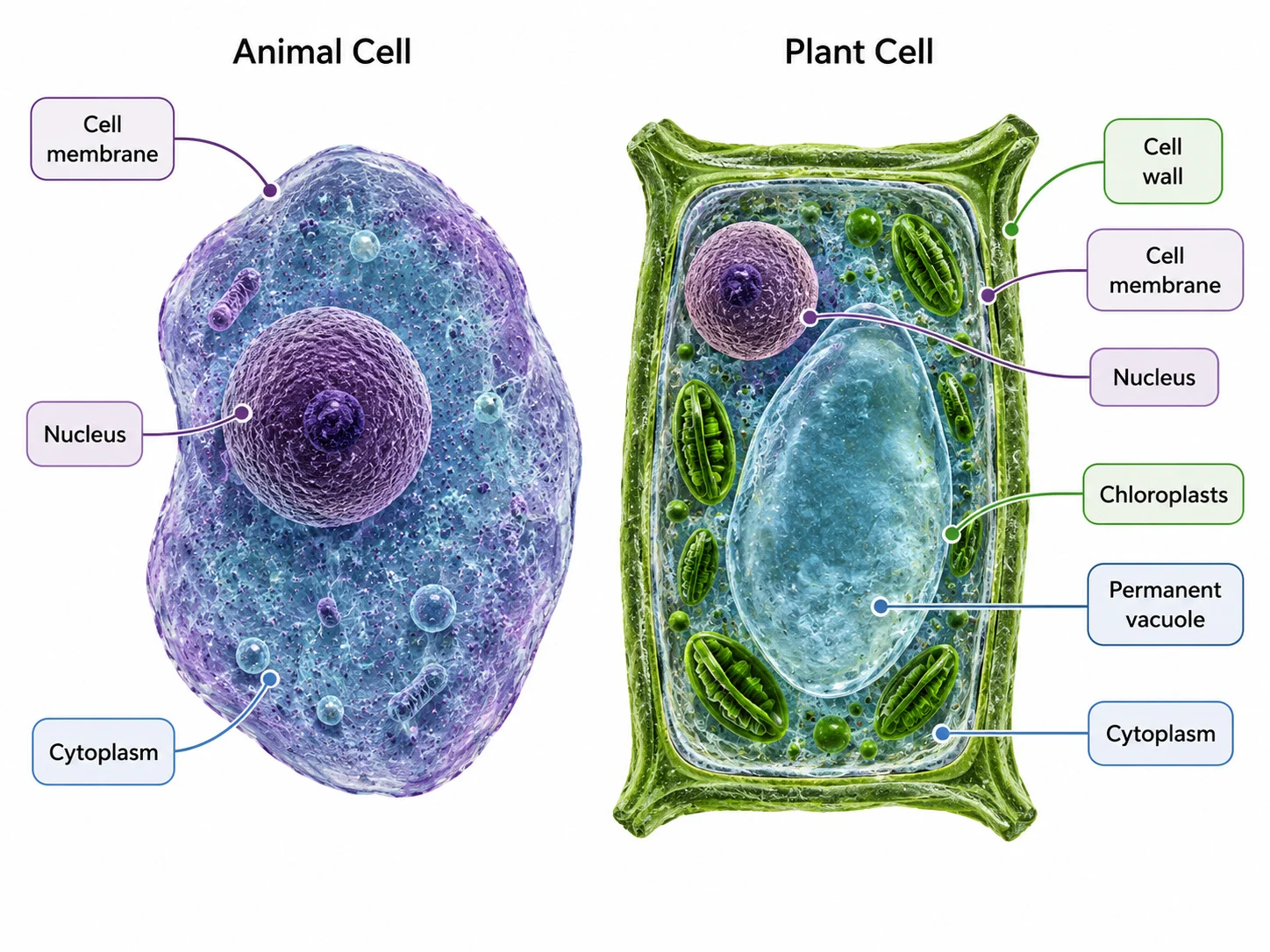
Cell structures the nucleus holds DNA and controls the cell; cytoplasm is the site of most reactions; the cell membrane controls entry and exit; mitochondria release energy by aerobic respiration; ribosomes make proteins.
Plant cells also have a cellulose cell wall for support, chloroplasts for photosynthesis and a vacuole containing cell sap.
Similarities and differences
Similarities and differences animal and plant cells share nucleus, cytoplasm, membrane, mitochondria and ribosomes. Only plant cells have a cell wall, chloroplasts and a large permanent vacuole. Animal cells usually have irregular shapes; plant cells are more regular due to the wall.
Structures of animal and plant cells compared
Importance of cell differentiation
Importance of cell differentiation multicellular organisms need different cells for different jobs. During development, cells differentiate by expressing only certain genes, producing specialised cells such as nerve cells (long axons) or palisade cells (many chloroplasts). This division of labour makes the organism more efficient.
Most animal cells lose the ability to differentiate early, while many plant cells keep this ability throughout life in meristems at shoot and root tips.
Stem cells in medicine — advantages
Stem cells in medicine — advantages embryonic stem cells can form almost any cell type and could replace damaged cells, e.g. insulin-producing cells for diabetes or nerve cells after spinal injury. Adult stem cells from bone marrow are already used to treat leukaemia.
Stem cells — disadvantages
Stem cells — disadvantages using embryos raises ethical concerns because the embryo is destroyed; stem cells may divide uncontrollably and form tumours; transplanted cells may be rejected by the immune system; cultures could transfer viral infections; adult stem cells can make only a limited range of cells.
Light vs electron microscope
The nucleus, cell wall, chloroplasts and vacuole can be seen with a light microscope, but ribosomes and the detail of mitochondria are too small and need an electron microscope.
Adaptations of specialised animal cells
Ciliated cells in the airways have cilia that beat to sweep mucus and trapped particles towards the throat. Nerve cells are very long to carry impulses over large distances. Red blood cells are biconcave with no nucleus, giving more room for haemoglobin.
Adult stem cells in bone marrow
These can divide to form only blood cells: red cells, white cells and the cells that make platelets. Transplants can treat leukaemia, anaemia, clotting disorders or a weakened immune system.
Donor vs patient's own stem cells
Donor cells carry different antigens, so the patient must take immunosuppressant drugs to stop rejection. Cells grown from the patient's own stem cells have the same genes and antigens, so they are not rejected.
Part 4 of 8Process & sequence
A zygote divides by mitosis to form a ball of identical unspecialised cells.
Cells receive signals that switch particular genes on or off.
Only certain genes are expressed, so specific proteins are made.
The cell changes shape and gains structures suited to its function.
Specialised cells group into tissues, then organs.
From stem cell to organwrite these steps in this order; each step is a marking point.
Unspecialised stem cell
Genes switched on or off
Specialised cell forms
Cells form tissue
Tissues form organ
Part 5 of 8Worked examples
1Explain why a root hair cell does not contain chloroplasts.
Root hair cells are underground and receive no light, so they cannot photosynthesise.
The genes for chloroplast development are not expressed, as the cell has differentiated to absorb water and minerals instead.
2
Give one argument for and one against using embryonic stem cells to treat paralysis.
For: embryonic stem cells can differentiate into nerve cells, which could replace damaged cells and restore movement.
Againstthe embryo is destroyed, which many people think is unethical, and there is a risk of tumour formation or rejection.
Part 6 of 8Summary
Both animal and plant cells have a nucleus, cytoplasm, membrane, mitochondria and ribosomes.
Only plant cells have a cell wall, chloroplasts and a permanent vacuole.
Differentiation produces specialised cells.
Stem cells offer treatments but raise ethical and safety issues.
Part 7 of 8Keep going
Cell Structure Edexcel IGCSE Biology 4BI1: what to do next
These Cell Structure Edexcel IGCSE Biology 4BI1 notes covered the key ideas, worked examples and exam technique for this topic. Check your Cell Structure Edexcel IGCSE Biology 4BI1 understanding with the practice questions below, then reread any Cell Structure Edexcel IGCSE Biology 4BI1 point you were unsure about before moving on.