Skip to content
Dabour HubLEARN · PRACTICE · EXPLORESign inStudent

2.4Structure & Functions in Living Organisms

Movement of Substances Into & Out of Cells — Edexcel International GCSE Biology 4BI1 Revision Notes & Topical Questions

10 min read 8 parts Lesson 4 of 21 1 quiz

🩺
100% Curriculum Specification Match Lesson Doctor Verified
The only platform with 100% curriculum specification match and verified interactive question banks.
0%read
Lesson summary

Movement of Substances Into & Out of Cells Edexcel IGCSE Biology 4BI1 notes: Define diffusion, osmosis and active transport.Diffusion and osmosis are passivethey need no energy from respiration.Active transport needs energy (ATP) from respiration, so it stops if respiration is in…

  • Factors affecting rate
  • SA:V ratio
  • Practical – diffusion
  • Practical – osmosis
  • Why use percentage change in mass
  • Water potential

Part 1 of 8Key ideas

1Diffusion and osmosis are passive
Diffusion and osmosis are passive they need no energy from respiration.
2
Active transport needs energy (ATP) from respiration, so it stops if respiration is inhibited.
3
% change in mass = (final mass − initial mass) ÷ initial mass × 100.
4
Animal cells placed in pure water can swell and burst (lyse); plant cells do not burst because of the cell wall.
5
A 1 cm cube has SA:V of 6:1; a 2 cm cube has 24:8 = 3:1.
6
Agar cubes with phenolphthalein and alkali lose their pink colour faster when smaller, showing larger SA:V increases diffusion rate.
7
Visking tubing acts as a model partially permeable membrane.
8
Root hair cells take in mineral ions by active transport because the ion concentration is higher inside the cell than in the soil.

Part 2 of 8Learning objectives

1
Define diffusion, osmosis and active transport.
2
Explain how SA:V, distance, temperature and concentration gradient affect rate of movement.
3
Describe experiments to investigate diffusion and osmosis using living and non-living systems.
4
Calculate percentage change in mass and SA:V ratios.

Part 3 of 8Essential knowledge

Essential knowledge
Diffusion
Diffusion is the net movement of particles from a region of higher concentration to a region of lower concentration.
  • It happens because particles in liquids and gases move randomly;
    • more particles move from the crowded area than back into it.
  • Examplesoxygen and carbon dioxide at the alveoli and in leaves, and digested food molecules into villi.
Osmosis
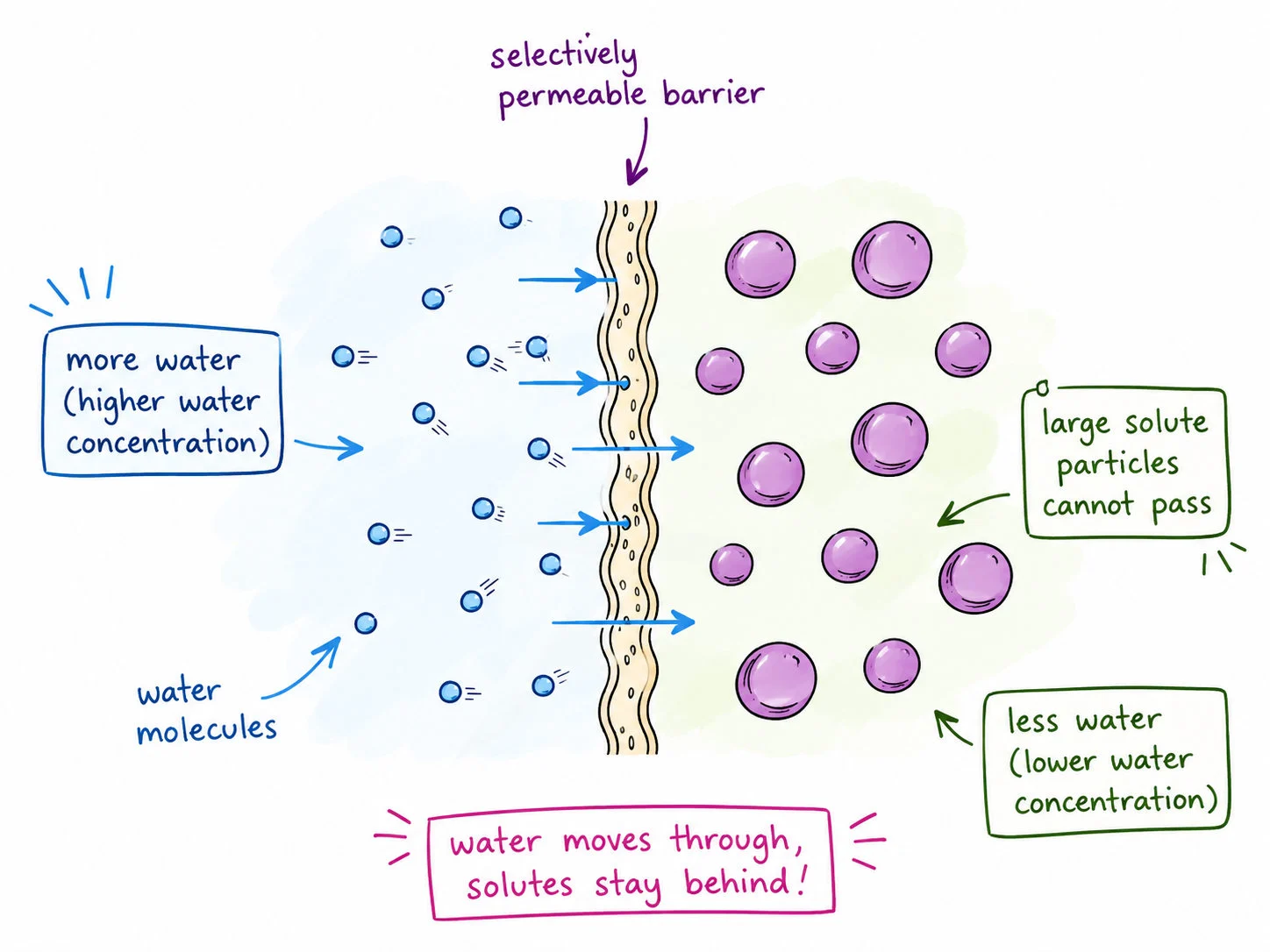
Osmosis is a special case of diffusion involving water only. Water moves from a dilute solution (lots of free water molecules) to a concentrated solution, across a partially permeable membrane. Solute molecules that are too big cannot cross.
Osmosis across a partially permeable membrane
Plant cells
In plant cells, water entering by osmosis makes the cell turgid, which supports non-woody plants.
  • If water leaves, the cell becomes flaccid and, in strong solutions, plasmolysed.
  • In animal cells there is no wall, so cells can burst in water or shrink and crenate in concentrated solutions.
Active transport
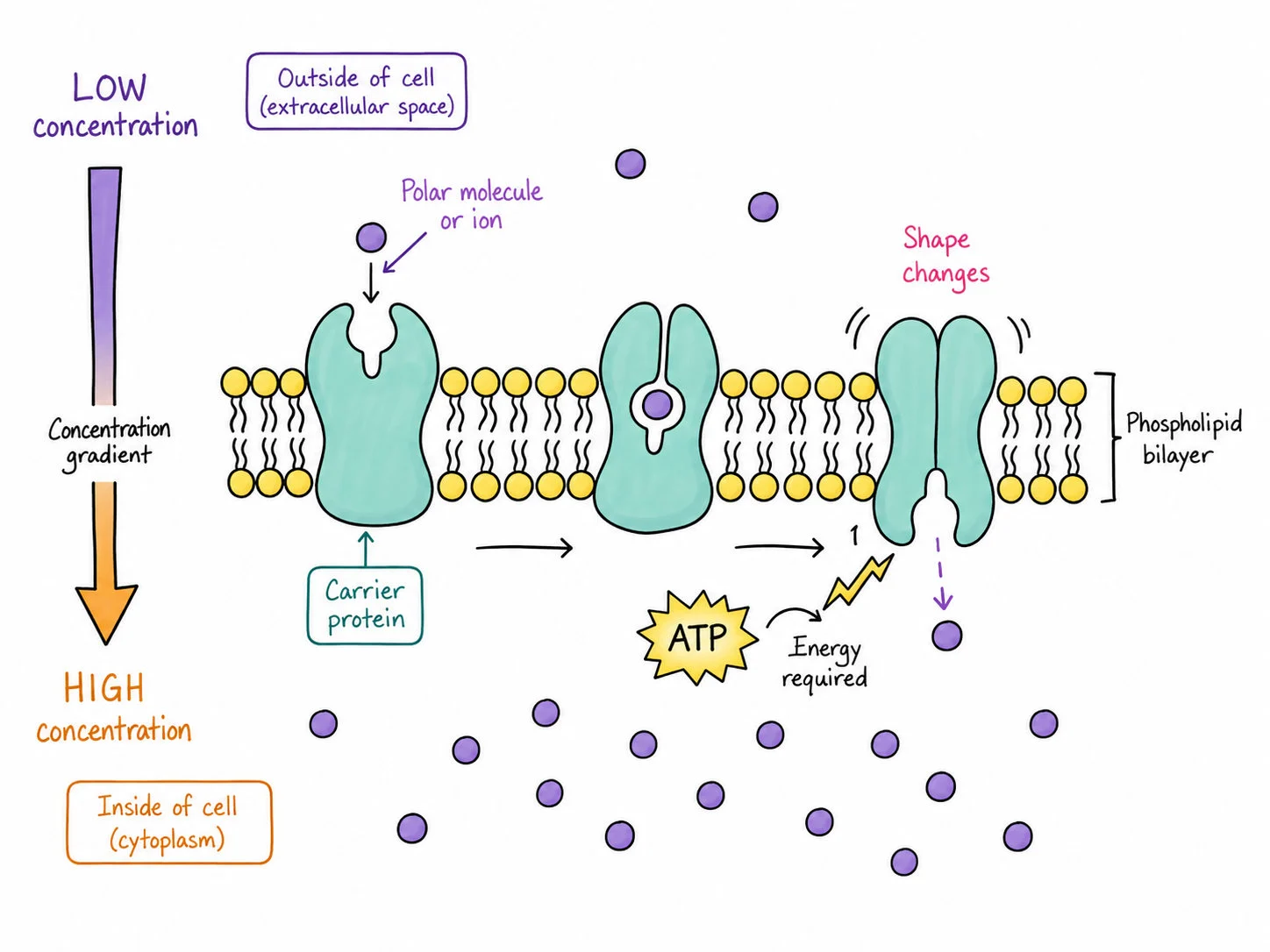
Active transport moves substances from low to high concentration. Carrier proteins in the membrane use energy released by respiration. Examples: uptake of mineral ions by root hair cells, and absorption of glucose from the gut when its concentration in the gut is low.
Active transport using ATP
Factors affecting rate
Factors affecting rate a steeper concentration gradient, higher temperature, larger surface area to volume ratio and shorter diffusion distance all increase the rate of diffusion and osmosis. Organisms maximise exchange with thin, folded surfaces and good blood supply to keep gradients steep.
SA:V ratio
SA:V ratio falls as an organism gets bigger. Small organisms can rely on diffusion across their surface, but large ones need specialised exchange surfaces (lungs, gills, villi) and transport systems.
Practical – diffusion
Practical – diffusion cubes of agar containing an indicator (e.g. phenolphthalein made pink with alkali) are placed in acid; time how long each size takes to go colourless. Smaller cubes decolourise faster. Alternatively, dye spreading in water at different temperatures can be timed.
Practical – osmosis
Practical – osmosis potato cylinders in a range of sucrose concentrations gain mass in dilute solutions and lose mass in concentrated ones. Visking tubing filled with sucrose solution in water shows liquid rising in a capillary tube. Control variables: size of potato pieces, time, temperature, volume of solution.
Why use percentage change in mass
Potato cylinders never start at exactly the same mass, so percentage change allows fair comparison. Each piece is blotted before weighing so surface solution does not add to the mass. Repeats at each concentration help identify anomalies.
Water potential
Water potential describes how freely water molecules can move. Pure water has the highest water potential; adding solute lowers it. In osmosis water moves from a higher to a lower water potential across a partially permeable membrane.
Improving the agar cube practical
Judging exactly when a cube turns colourless is subjective. A more quantitative method is to cut the cube after a fixed time and measure how far the colourless region has spread. Cut cubes carefully with a ruler and sharp scalpel so their sizes are accurate.

Part 4 of 8Process & sequence

    • Cut identical cylinders of potato with a cork borer and trim them to the same length.
    • Blot each cylinder dry and record its starting mass on a balance.
    • Place one cylinder in each of a range of sucrose solutions (e.g. 0.0 to 1.0 mol/dm3).
    • Leave for a set time (e.g. 30 minutes or overnight) at the same temperature.
    • Remove, blot dry gently and record the final mass.
    • Calculate percentage change in mass and plot it against sucrose concentration.
    • Read off where the line crosses zero: this estimates the concentration of the potato cells' contents.

    Osmosis in a potato cylinderwrite these steps in this order; each step is a marking point.

    1. Cut equal potato cylinders
    2. Weigh each cylinder
    3. Place in sucrose solutions
    4. Leave for fixed time
    5. Blot dry and reweigh
    6. Plot % change in mass

Part 5 of 8Worked examples

−12%
A potato cylinder had a mass of 2.50 g before and 2.20 g after 30 minutes in 0.8 mol/dm3 sucrose solution. Calculate the percentage change in mass and explain the result.
  • Change = 2.20 − 2.50 = −0.30 g.
    • Percentage change = −0.30 ÷ 2.50 × 100 = −12%.
    • The solution was more concentrated than the potato cell contents,
    • so water left the cells by osmosis through the partially permeable cell membranes, reducing the mass.
2:1

Calculate the surface area to volume ratio of a 3 cm cube and compare it with a 1 cm cube.

  • 3 cm cube: surface area = 6 × 3 × 3 = 54 cm2; volume = 27 cm3; ratio = 54:27 = 2:1.
    • 1 cm cube: 6:1.
    • The smaller cube has a larger SA:V, so substances diffuse into its centre faster.

Part 6 of 8Summary

    • Diffusion is passive net movement down a concentration gradient.
    • Osmosis is diffusion of water through a partially permeable membrane.
    • Active transport moves substances against a gradient and uses energy.
    • Rate increases with gradient, temperature and SA:V ratio, and decreases with distance.
    • Potato cylinders in sucrose solutions show osmosis by change in mass.

Part 7 of 8Keep going

  1. Movement of Substances Into & Out of Cells Edexcel IGCSE Biology 4BI1: what to do next

    These Movement of Substances Into & Out of Cells Edexcel IGCSE Biology 4BI1 notes covered the key ideas, worked examples and exam technique for this topic. Check your Movement of Substances Into & Out of Cells Edexcel IGCSE Biology 4BI1 understanding with the practice questions below, then reread any Movement of Substances Into & Out of Cells Edexcel IGCSE Biology 4BI1 point you were unsure about before moving on.

    Movement of Substances Into & Out of Cells Edexcel IGCSE Biology 4BI1: revision checklist

    • Revise the main Movement of Substances Into & Out of Cells Edexcel IGCSE Biology 4BI1 definitions until you can write them from memory.
    • Practise Movement of Substances Into & Out of Cells Edexcel IGCSE Biology 4BI1 exam questions under timed conditions.
    • Link each Movement of Substances Into & Out of Cells Edexcel IGCSE Biology 4BI1 idea to a diagram or a worked example.
    • List the common Movement of Substances Into & Out of Cells Edexcel IGCSE Biology 4BI1 mistakes and how to avoid them.

Part 8 of 8Compare: Compare

Comparing the three transport processes
FeatureDiffusionOsmosisActive transport
DirectionHigh → low concentrationDilute → concentrated solution (water)Low → high concentration
Energy from respiration?No (passive)No (passive)Yes
Membrane needed?NoYes, partially permeableYes, with carrier proteins
Substances movedGases, small solutesWater onlyIons, glucose, amino acids
ExampleO2 into blood at alveoliWater into root hair cellsMineral ions into root hairs
Factors affecting the rate of diffusion
FactorChangeEffect on rate
Concentration gradientSteeperFaster
TemperatureHigherFaster (particles have more kinetic energy)
Surface area to volume ratioLargerFaster
Distance (thickness)ShorterFaster

The same factors affect osmosis.

Key terms

Command terms

Command terms
Give / State / Name
Recall a fact; one idea per mark.
Define
Give the exact meaning using the specification keywords.
Describe
Give an account of what happens / the pattern in data, quoting values; no reasons needed.
Explain
Give reasons with linked statements (cause → effect). Each linked step is usually a separate marking point.
Suggest
Use knowledge in a new context; more than one answer may be accepted.
Compare
Similarities and differences; each point must refer to both items.
Calculate
Show working; include units; check significant figures. Method marks are given even if the final answer is wrong.
Discuss
Explore the issue from different angles and link the points.
Evaluate / Assess
Weigh strengths and weaknesses and reach a supported judgement.
Deduce
Draw a conclusion from the information given.
Justify
Support a statement/choice with evidence.

Exam technique

Keywords the mark scheme looks for in this lesson

Keywords the mark scheme looks for in this lesson
Diffusion · Osmosis · Active transport · Concentration gradient · Partially permeable membrane · Turgid · Plasmolysis · Surface area to volume ratio · Carrier protein
Learn each definition in the Key words tab exactly; a missing keyword in a definition usually loses the mark.

How to get full marks (examiner guidance)

How to get full marks (examiner guidance)
Use specification keywords exactly (e.g. eukaryotic/prokaryotic, enzyme–substrate complex, active site, complementary).
Link ideas
Link ideas for “explain” each marking point is usually a cause → consequence step; unlinked facts often score nothing.
Use the information in the question
“discuss/evaluate” answers must use the data provided and match the number of marks.
Convert units carefully (mg → g, cm3 → dm3) and show working for calculations.
Avoid vague words
“it”, “stuff”, “things”, “goes up”, “energy is made”. Name the substance and the process.
Do not extrapolate a graph line beyond the data or to zero unless asked.
Six-mark extended responses are marked on content AND a logical, linked line of reasoning.

Last updated:

Cambridge 9700 AS Biology Core Formula

Magnification Triangle & Unit Conversion

Formula: M = I / A  ⇔  A = I / M  ⇔  I = M × A

Units: 1 mm = 1,000 μm = 1,000,000 nm.
Rule: Convert Image size (ruler mm) to μm by ×1,000 before dividing by Actual size.

\n