2.7Structure & Functions in Living Organisms
Gas Exchange — Edexcel International GCSE Biology 4BI1 Revision Notes & Topical Questions
10 min read 8 parts Lesson 7 of 21 1 quiz
Gas Exchange Edexcel IGCSE Biology 4BI1 notes: Describe gas exchange in leaves and how it changes between day and night.In daylight photosynthesis is faster than respiration: net O2 out, CO2 in.At night only respiration occursnet O2 in, CO2 out.Air pathwaynose/mouth → trachea → b…
- Gas exchange in plants
- Leaf adaptations
- Night vs day
- Respiratory system
- Ventilation
- Alveoli adaptations
Part 1 of 8Key ideas
Part 2 of 8Learning objectives
Part 3 of 8Essential knowledge
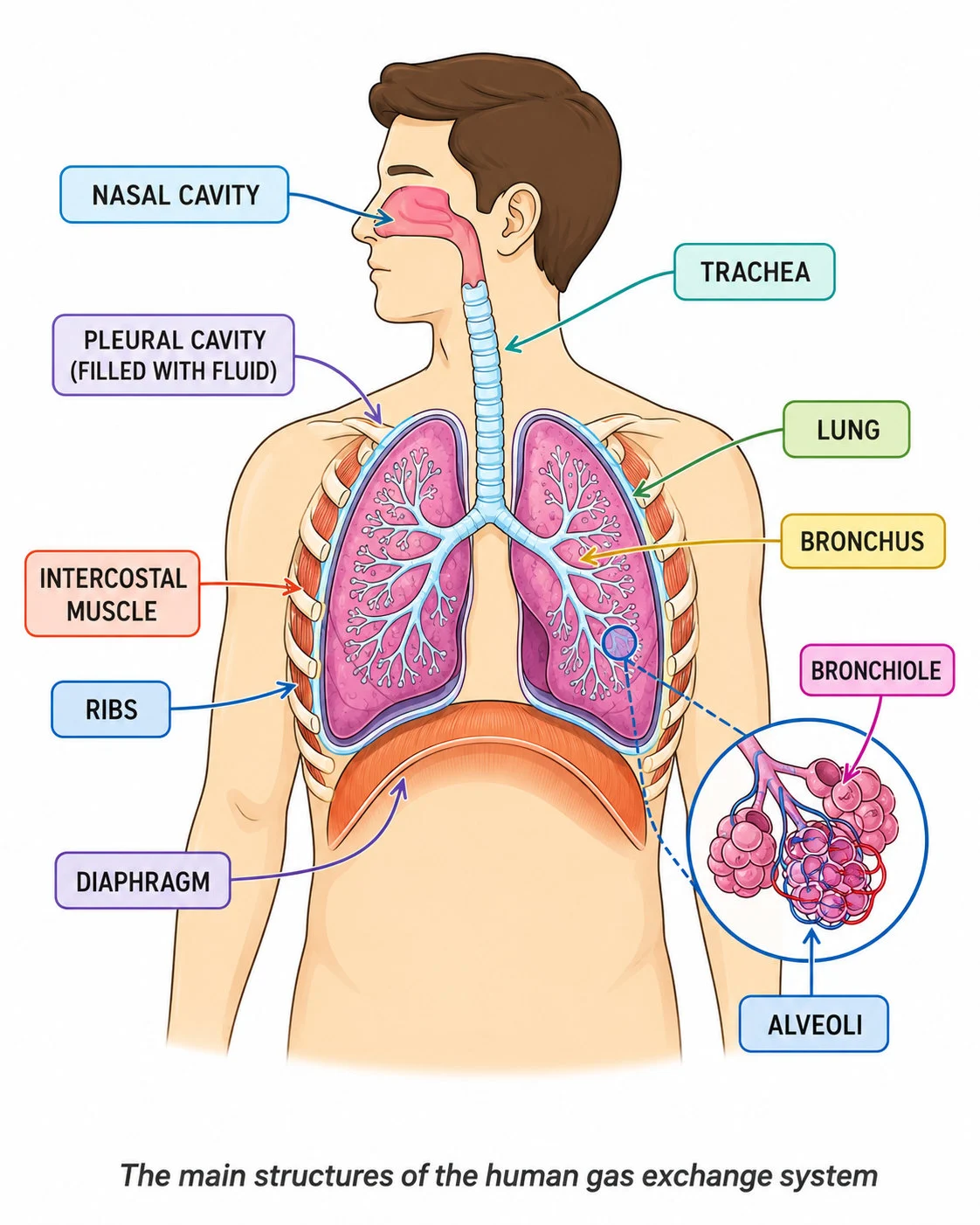
- and finally alveoli.
- The lungs lie in the thorax, protected by the ribs and surrounded by pleural membranes, with the diaphragm below.
- Emphysema destroys alveolar walls, reducing surface area so sufferers are breathless.
- Carbon monoxide reduces oxygen transport;
- nicotine is addictive and, with CO, increases the risk of coronary heart disease.
Part 4 of 8Process & sequence
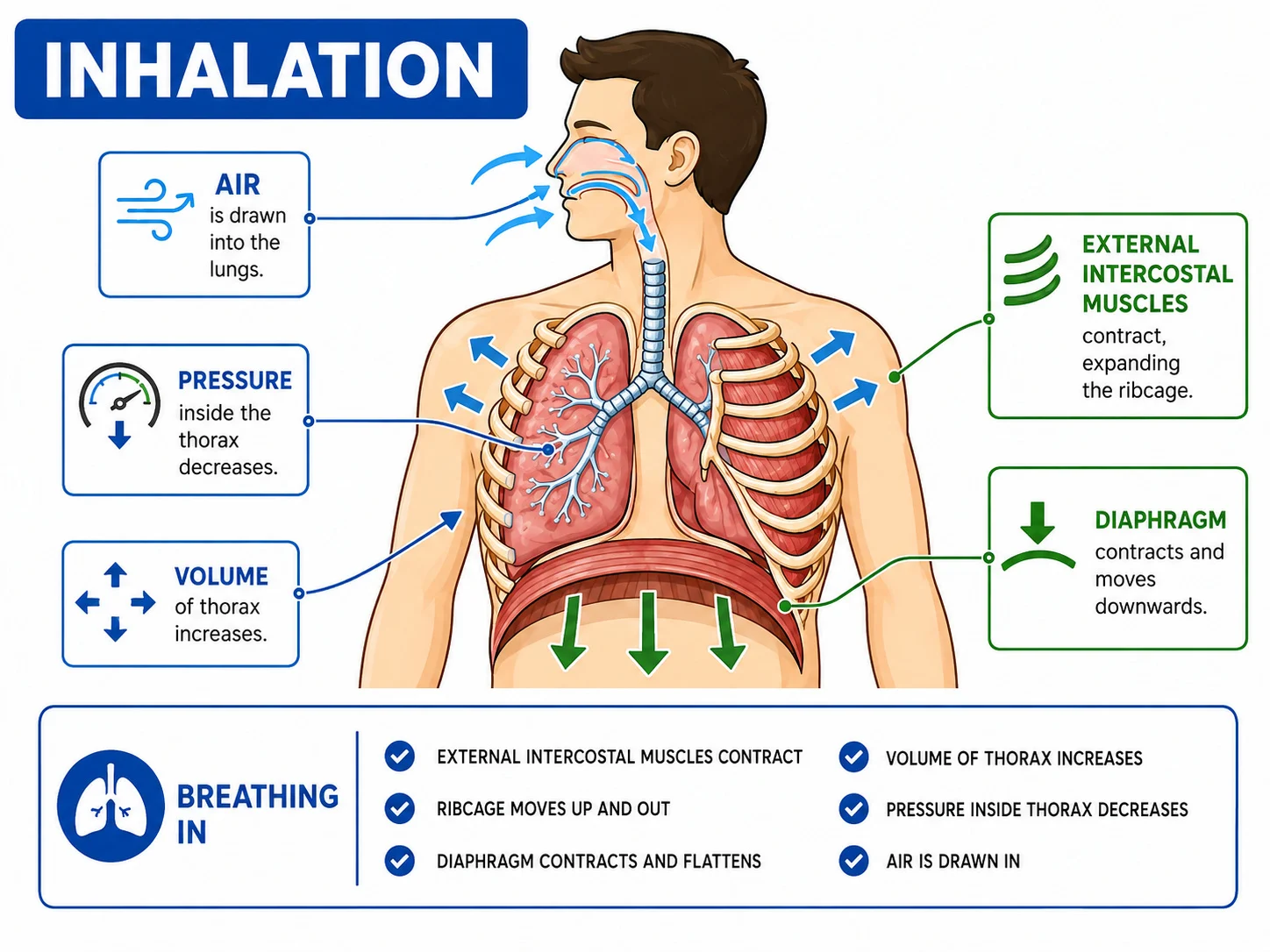
- Intercostal muscles contract, moving the ribs up and out.
- The diaphragm contracts and flattens.
- Volume of the thorax increases, so pressure inside falls below atmospheric pressure.
- Air is drawn in through trachea, bronchi and bronchioles to the alveoli.
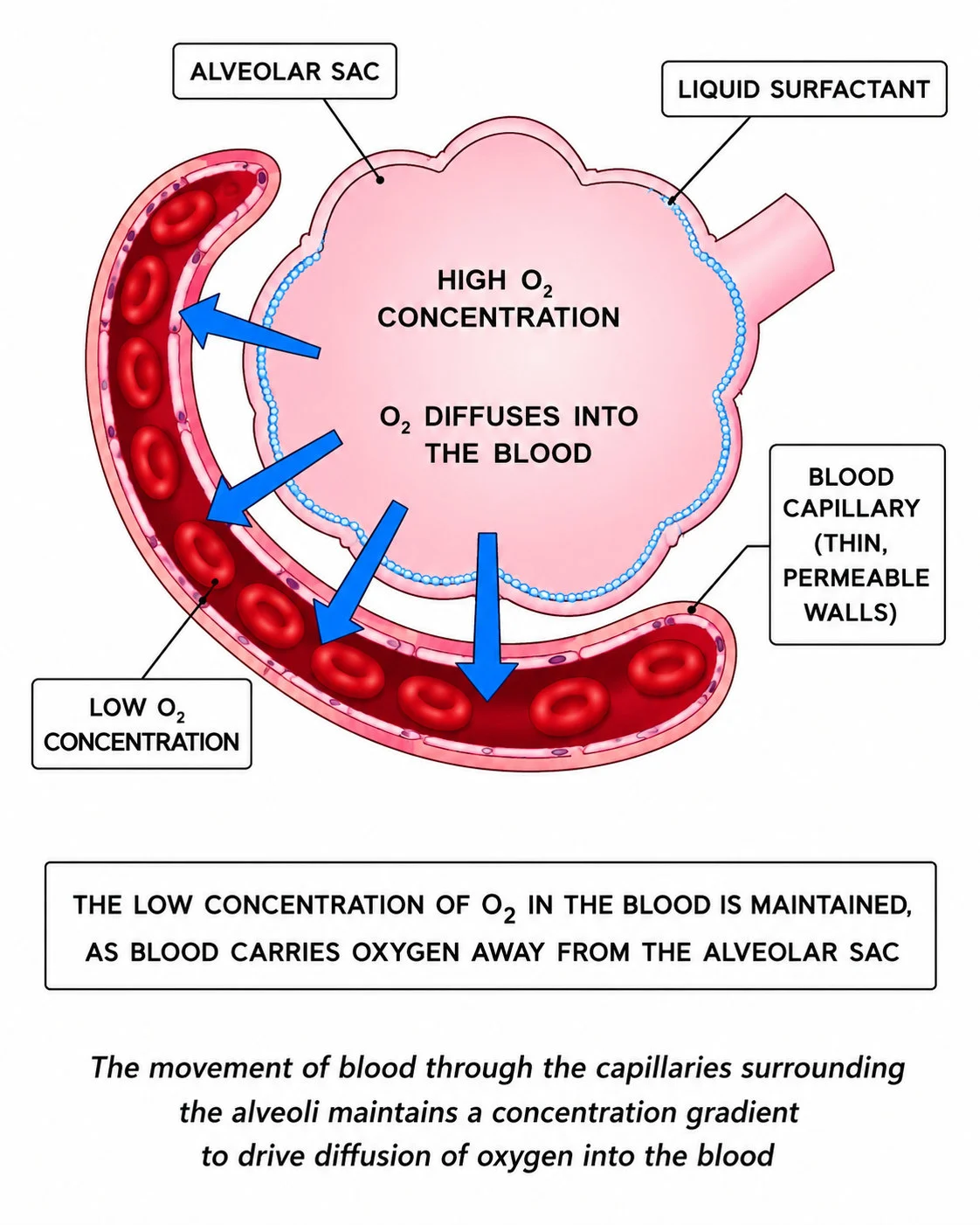
- Oxygen diffuses into blood; carbon dioxide diffuses into alveoli.
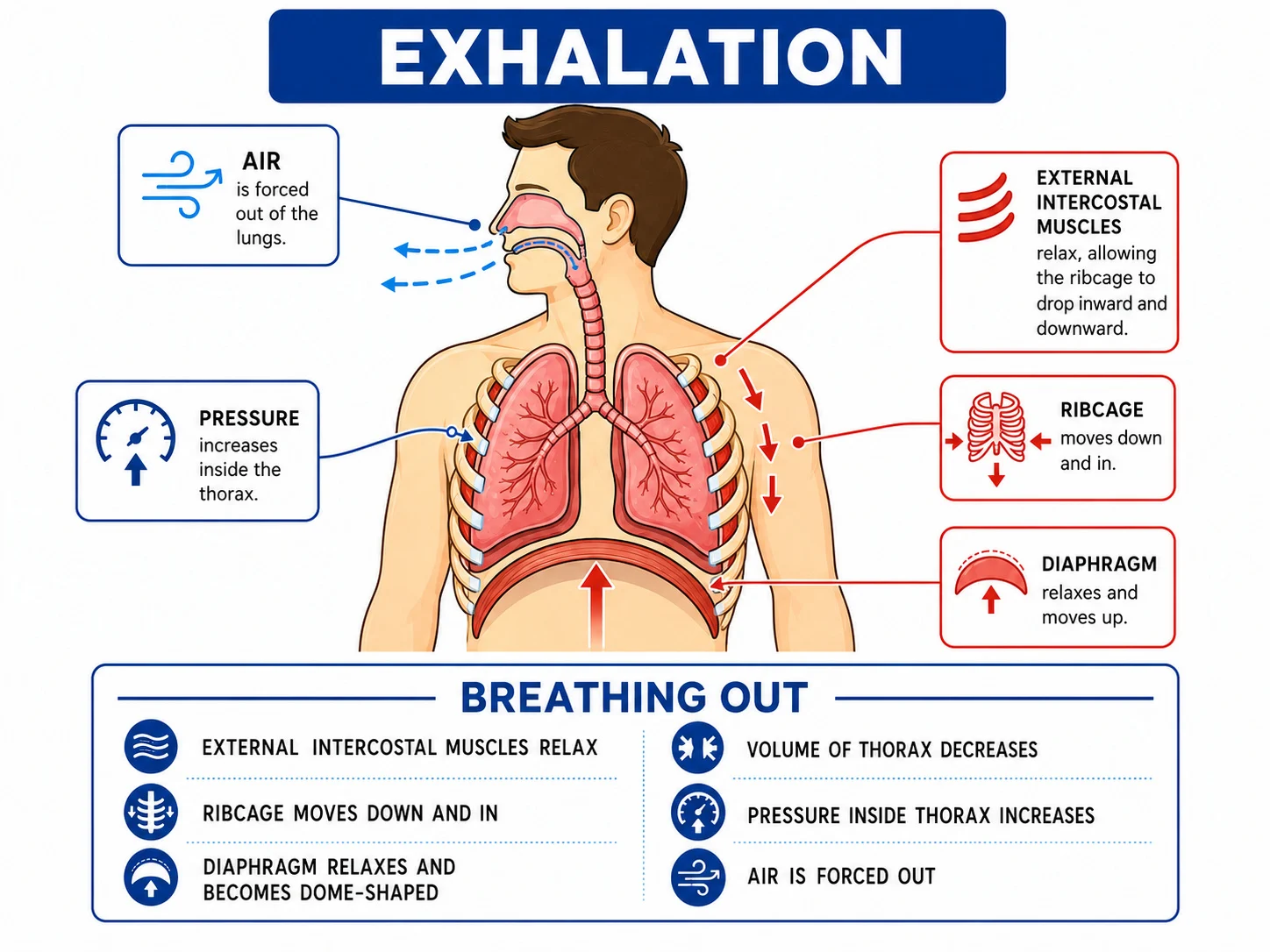
- To exhale, muscles relax, ribs move down and in, diaphragm domes up, volume falls and pressure rises, pushing air out.
Breathing inwrite these steps in this order; each step is a marking point.
- Intercostal muscles contract
- Ribs move up and out
- Diaphragm contracts and flattens
- Thorax volume increases
- Pressure falls below atmospheric
- Air flows into lungs
Part 5 of 8Worked examples
- In bright light the rate of photosynthesis was greater than the rate of respiration, so the leaf took in more CO2 than it released.
- The CO2 concentration in the tube fell, so the indicator changed from red to purple.
- The alveolar walls are broken down, forming fewer, larger air spaces, so the surface area for gas exchange is reduced.
- Less oxygen diffuses into the blood, so respiring muscles receive less oxygen and the person breathes faster to compensate.
Part 6 of 8Summary
- Leaves exchange gases by diffusion through stomata and air spaces.
- Net gas exchange in plants depends on light intensity.
- Breathing in: intercostals and diaphragm contract, volume up, pressure down.
- Alveoli have large surface area, thin walls and a rich blood supply.
- Smoking causes lung cancer, bronchitis, emphysema and heart disease.
Part 7 of 8Keep going
Gas Exchange Edexcel IGCSE Biology 4BI1: what to do next
These Gas Exchange Edexcel IGCSE Biology 4BI1 notes covered the key ideas, worked examples and exam technique for this topic. Check your Gas Exchange Edexcel IGCSE Biology 4BI1 understanding with the practice questions below, then reread any Gas Exchange Edexcel IGCSE Biology 4BI1 point you were unsure about before moving on.
Gas Exchange Edexcel IGCSE Biology 4BI1: revision checklist
- Revise the main Gas Exchange Edexcel IGCSE Biology 4BI1 definitions until you can write them from memory.
- Practise Gas Exchange Edexcel IGCSE Biology 4BI1 exam questions under timed conditions.
- Link each Gas Exchange Edexcel IGCSE Biology 4BI1 idea to a diagram or a worked example.
- Practice: Gas Exchange Edexcel IGCSE Biology 4BI1 practice questions
- Previous lesson: 2.6 Respiration — Notes
- Next lesson: 2.8 Transport Systems — Notes
- Course: Edexcel International Gcse Biology 4BI1 — all units
- Official syllabus: Pearson Edexcel International GCSEs
Part 8 of 8Compare: Compare
| Condition | Net gas exchange | Indicator colour |
|---|---|---|
| Bright light | Photosynthesis > respiration: CO2 taken in | Purple |
| Dim light | Photosynthesis = respiration | Red (no change) |
| Darkness (foil) | Respiration only: CO2 released | Yellow |
| No leaf (control) | None | Red |
| Component | Effect |
|---|---|
| Tar | Irritates airways, more mucus; contains carcinogens causing lung cancer |
| Nicotine | Addictive; raises heart rate and blood pressure |
| Carbon monoxide | Binds to haemoglobin, reducing oxygen carried by blood |
| Smoke particles/heat | Paralyse cilia; mucus builds up causing bronchitis and smoker's cough |
| Overall | Emphysema, COPD, coronary heart disease |
Key terms
Command terms
Exam technique
Keywords the mark scheme looks for in this lesson
How to get full marks (examiner guidance)
Marked practiceQuizzes for this lesson
Last updated:
\n