Curriculum
Course: General Biology
Login

Curriculum

General Biology

Text lesson

3.3 DNA, RNA & Protein Synthesis

Describe the structure of DNA and RNA and the rules of base pairing.

1Key ideas2Key ideas3Key ideas4Key ideas5Key ideas6Key ideas7Key ideas8Key ideas9Key ideas10Key ideas11Key ideas12Key ideas13Key ideas14Key ideas15Key ideas16Key ideas17Key ideas18Key ideas19Key ideas
Key ideas
1 / 19Next ▶
Key ideas
◀ Previous2 / 19Next ▶
Key ideas
◀ Previous3 / 19Next ▶
Key ideas
◀ Previous4 / 19Next ▶
Key ideas
◀ Previous5 / 19Next ▶
Key ideas
◀ Previous6 / 19Next ▶
Key ideas
◀ Previous7 / 19Next ▶
Key ideas
◀ Previous8 / 19Next ▶
Key ideas
◀ Previous9 / 19Next ▶
Key ideas
◀ Previous10 / 19Next ▶
Key ideas
◀ Previous11 / 19Next ▶
Key ideas
◀ Previous12 / 19Next ▶
Key ideas
◀ Previous13 / 19Next ▶
Key ideas
◀ Previous14 / 19Next ▶
Key ideas
◀ Previous15 / 19Next ▶
Key ideas
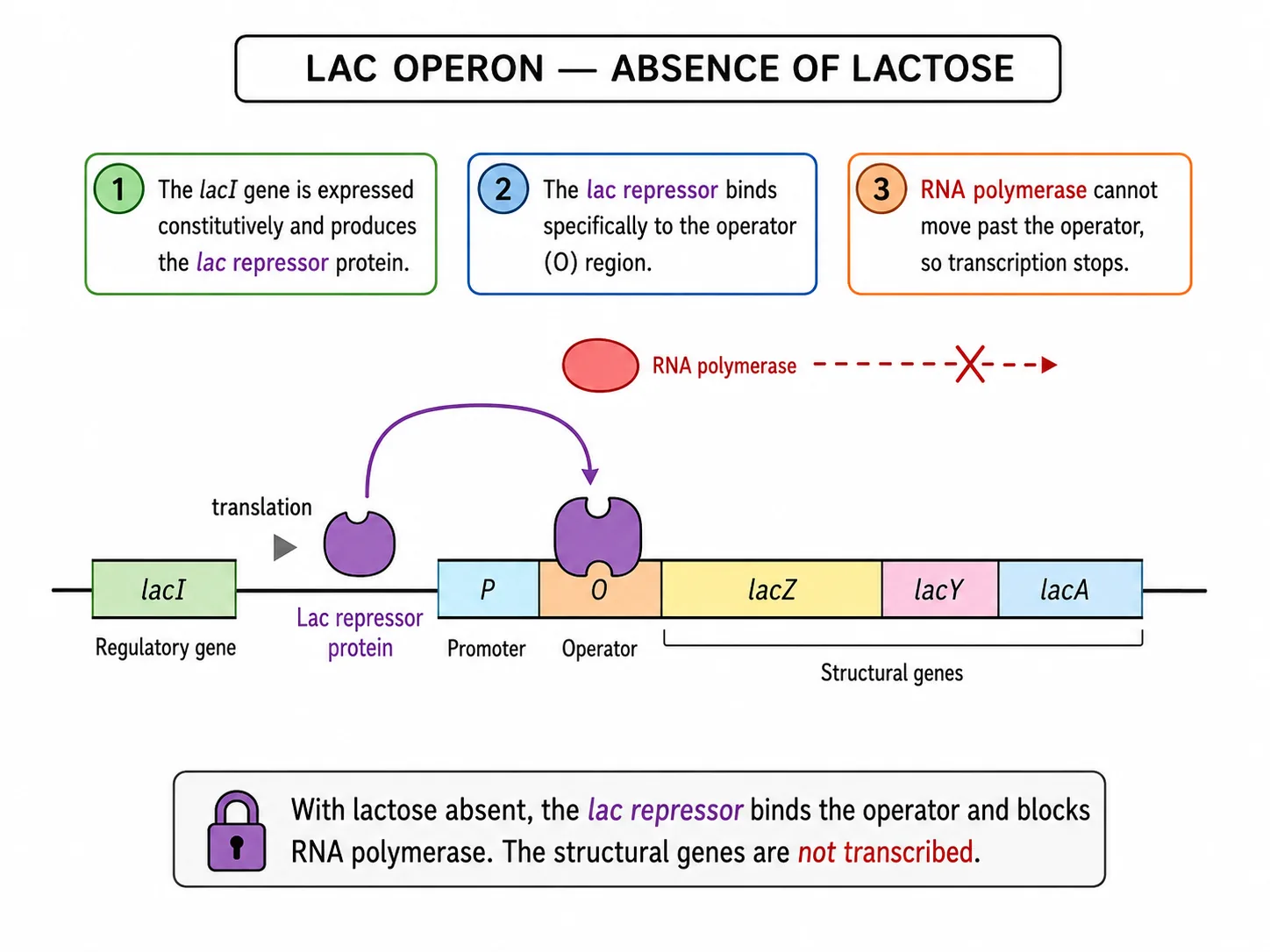
" loading= - Dr Khaled Dabour Academy⤢ Enlarge
Key ideas
Chargaff’s rule
in double-stranded DNA, %A = %T and %G = %C.
A pairs with T by 2 hydrogen bonds

G pairs with C by 3 hydrogen bondsso GC-rich DNA melts at higher temperature.
Meselson and Stahl (1958) used
15
N/
◀ Previous16 / 19Next ▶
Key ideas
1

14
2

N density labelling to show replication is semiconservative.
3

61 code for 20 amino acids and 3 are stop codons (UAA, UAG, UGA)

AUG is the start codon (Met).
4

The code is redundant (degenerate) but not ambiguous, and nearly universal among organisms.
5

Polymerases only add to a free 3′-OH

so all nucleic acid synthesis runs 5’→3′.
6

Each amino acid added costs energy
◀ Previous17 / 19Next ▶
Key ideas
1

aminoacyl-tRNA synthetases use ATP and elongation uses GTP.
2

Frameshift mutations (insertions/deletions not in multiples of 3) usually disrupt the protein far more than a single substitution.
3

RNA nucleotides contain ribose rather than deoxyribose, and RNA is usually single-stranded but can fold back to form double-stranded regions.
4

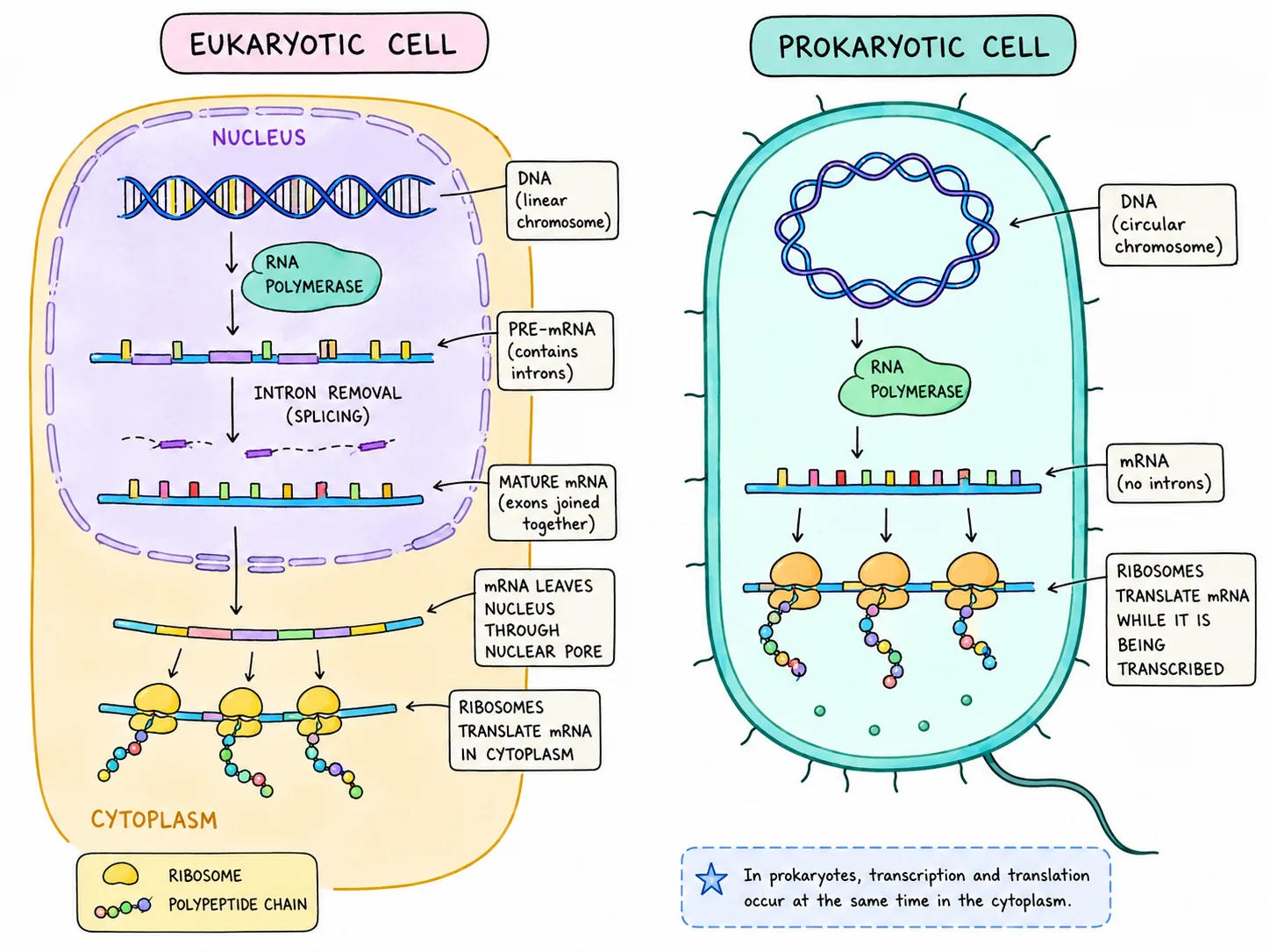
Eukaryotic cells keep their DNA as several linear chromosomes that are wound around histone proteins.
5

Prokaryotic cells usually hold their DNA in one circular chromosome and may also carry small circular plasmids.
6

The base-pairing rules are conserved through evolution

so they apply in the same way across different groups of organisms.
◀ Previous18 / 19Next ▶
Key ideas
Key ideas
Heritable information is stored in DNA

but some viruses use RNA as their genetic material instead.
◀ Previous19 / 19
1Essential knowledge2Essential knowledge3Essential knowledge4Essential knowledge5Essential knowledge6Essential knowledge7Essential knowledge8Essential knowledge
Essential knowledge
1 / 8Next ▶
Essential knowledge
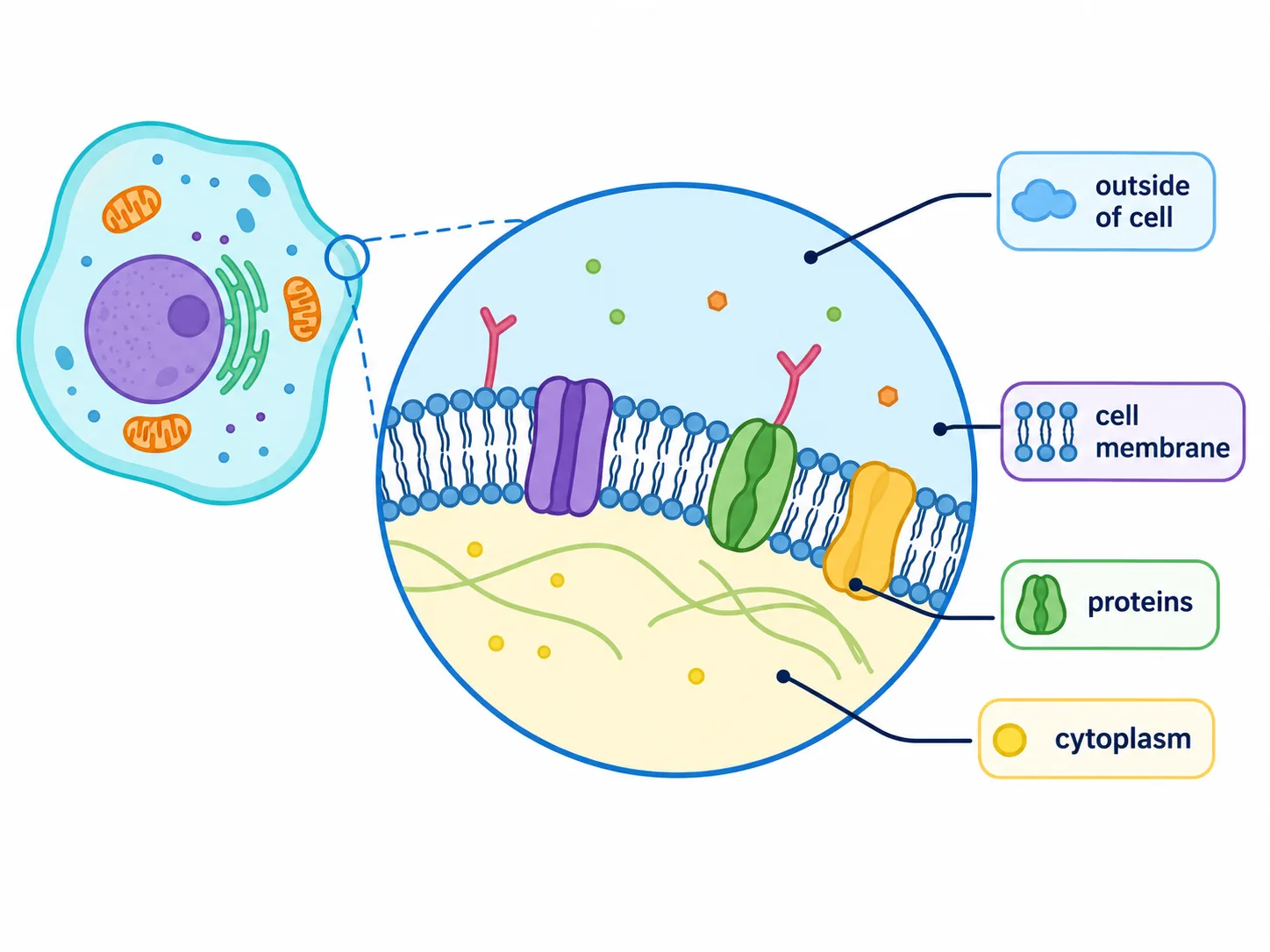
Cell Surface Membrane" loading= - Dr Khaled Dabour Academy⤢ Enlarge
Essential knowledge
1
Structure of DNA
each nucleotide has deoxyribose, phosphate and a base.
Purines (A, G) have two rings

pyrimidines (C, T, U) have one.
Sugar-phosphate backbones are joined by phosphodiester bonds and the bases pair inside the helix, a purine always opposite a pyrimidine,
so the helix width stays constant (about 2 nm).
◀ Previous2 / 8Next ▶
Essential knowledge
Essential knowledge
2
Griffith’s transforming principle, Avery-MacLeod-McCarty (DNA is the transforming agent), Hershey-Chase (phage DNA, not protein, enters bacteria), Franklin’s X-ray images and the Watson-Crick model (1953) together established DNA as the genetic material.
3
Replication
begins at origins (one in bacteria, many in eukaryotes).
Helicase unwinds, topoisomerase relieves supercoiling, primase makes RNA primers, DNA polymerase extends them.
◀ Previous3 / 8Next ▶
Essential knowledge
1

The leading strand is continuous

the lagging strand is made in Okazaki fragments joined by ligase.
2

Proofreading and mismatch repair keep the error rate at about 1 in 109-1010 bases.
3

4
4

Telomeres
5

linear chromosomes shorten at their ends each round because the last primer cannot be replaced

telomerase (active in germ cells, stem cells and many cancers) extends the repetitive telomere sequence.
6

5
◀ Previous4 / 8Next ▶
Essential knowledge
1

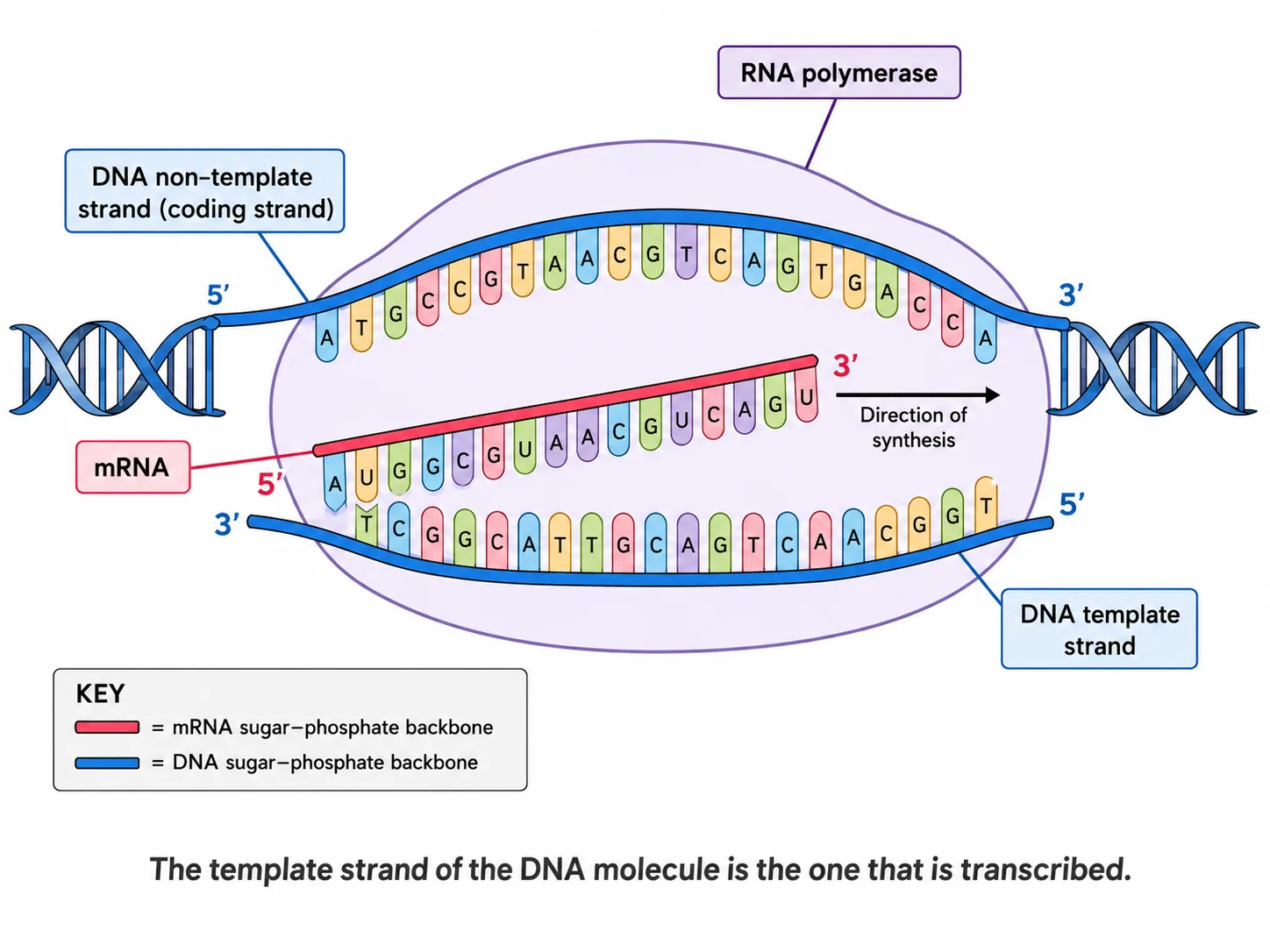
RNA polymerase reads the template (antisense) strand 3’→5′ and builds RNA 5’→3′

the RNA matches the coding strand except U replaces T. In eukaryotes transcription factors assemble at the TATA box of the promoter.
2

6
3

RNA processing
4

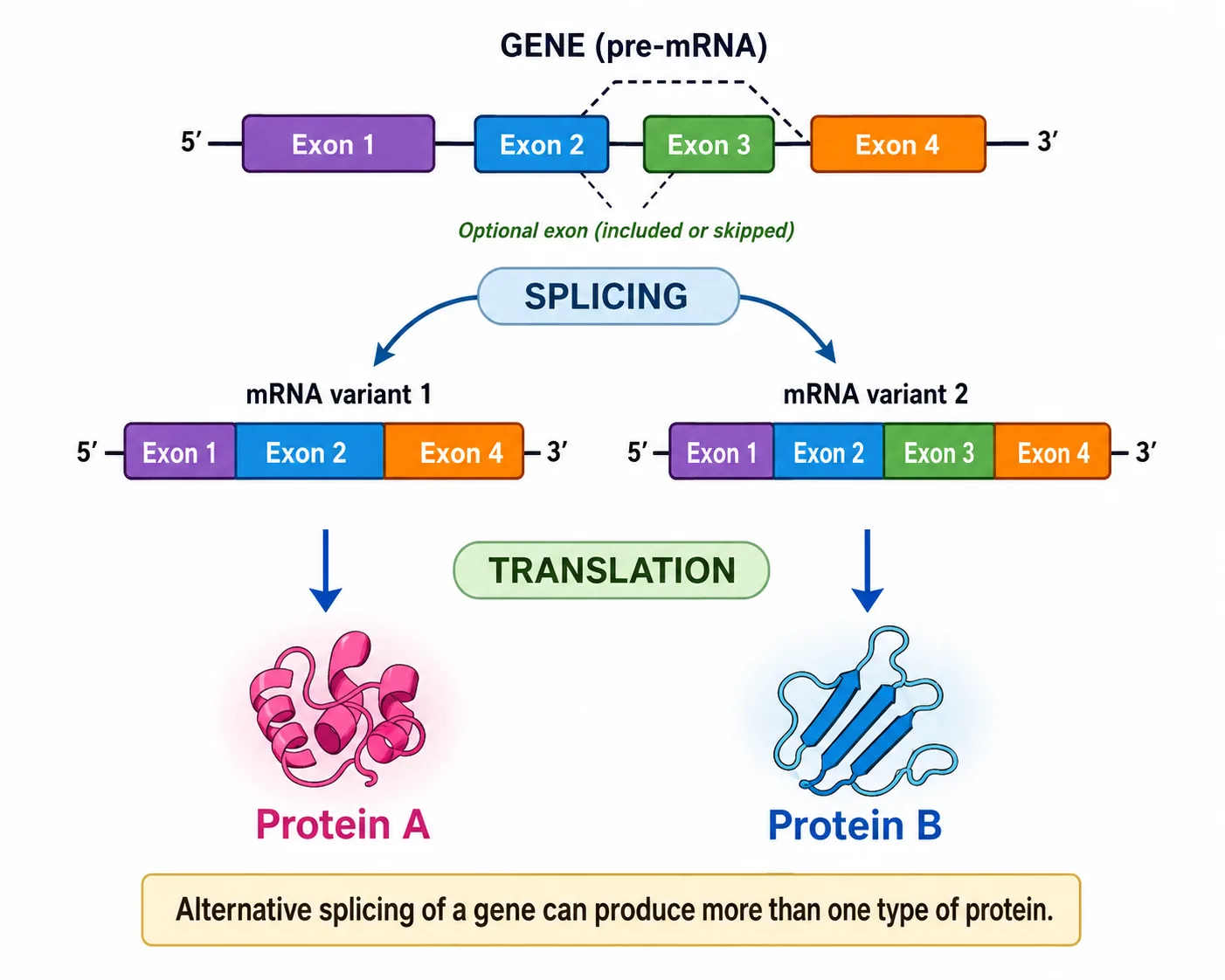
a 5′ modified guanine cap and a 3′ poly-A tail protect mRNA and aid export and ribosome binding. Spliceosomes remove introns and join exons

alternative splicing lets one gene produce several proteins.
5

7
6

Translation
◀ Previous5 / 8Next ▶
Essential knowledge
Essential knowledge
tRNAs are charged with the correct amino acid by aminoacyl-tRNA synthetases.
The ribosome has A (aminoacyl), P (peptidyl) and E (exit) sites

rRNA in the large subunit catalyses peptide bond formation (a ribozyme).
Polypeptides for secretion carry a signal peptide that directs the ribosome to the rough ER.
8
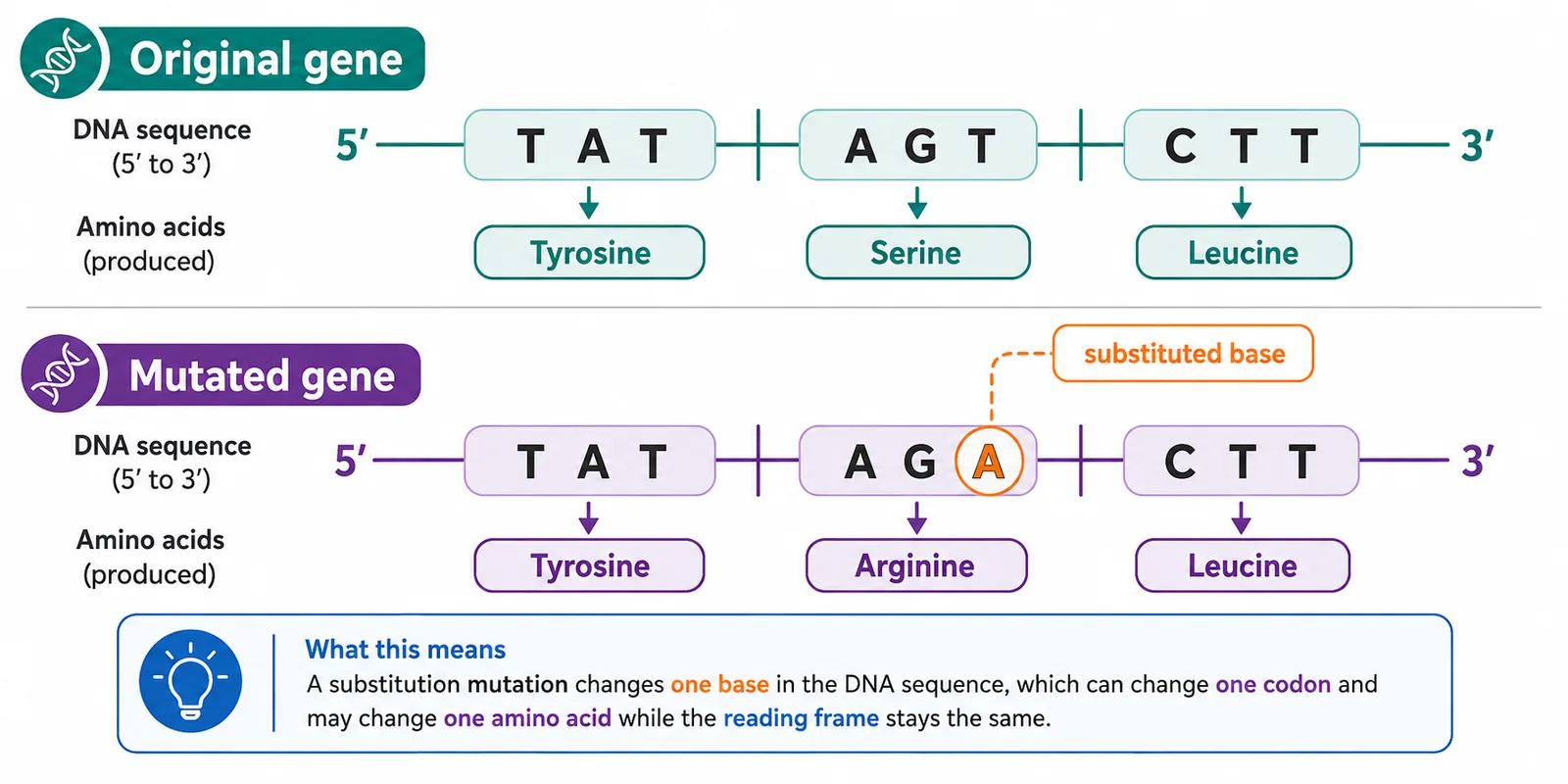
Mutations
silent (same amino acid), missense (different amino acid, e.g. sickle-cell Glu→Val), nonsense (premature stop), and frameshift (insertion/deletion). Mutagens include UV light (thymine dimers), X-rays and chemicals.
◀ Previous6 / 8Next ▶
Essential knowledge
1

9
2

Gene regulation
3

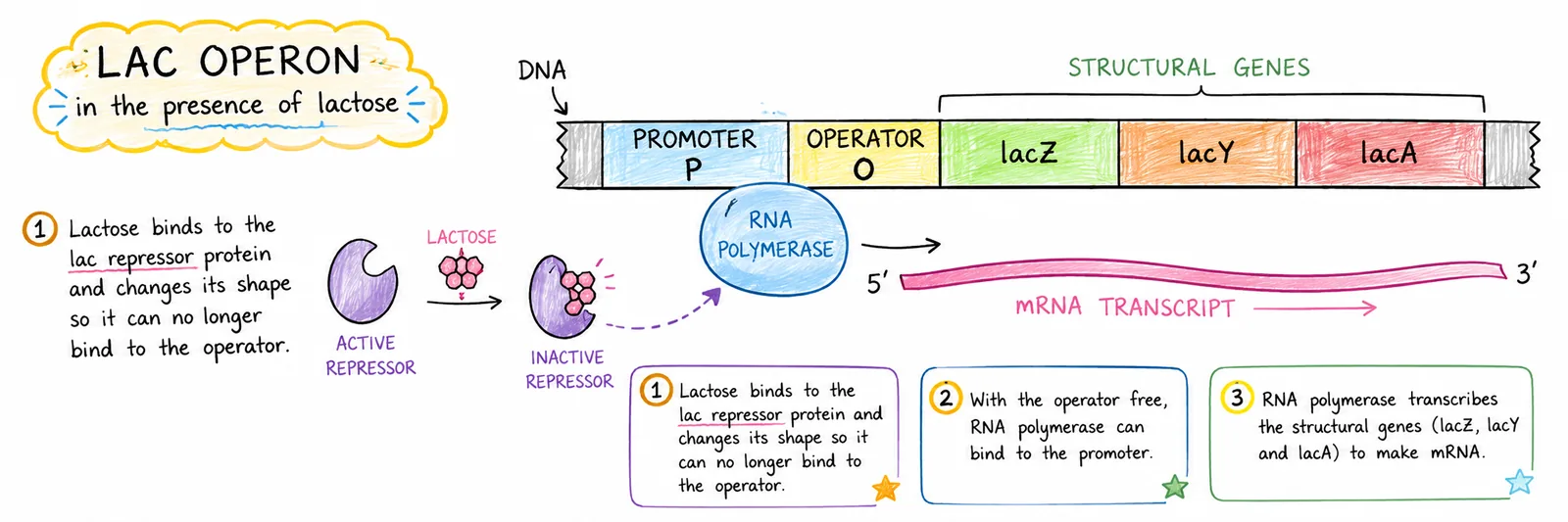
in bacteria operons such as
4

lac
5

(inducible) and
6

trp
◀ Previous7 / 8Next ▶
Essential knowledge
Essential knowledge
(repressible) are controlled by repressors binding the operator

eukaryotes regulate by chromatin packing, transcription factors, enhancers, RNA processing and microRNAs.
◀ Previous8 / 8
1Process & sequence2Process & sequence3Process & sequence4Process & sequence
Process & sequence
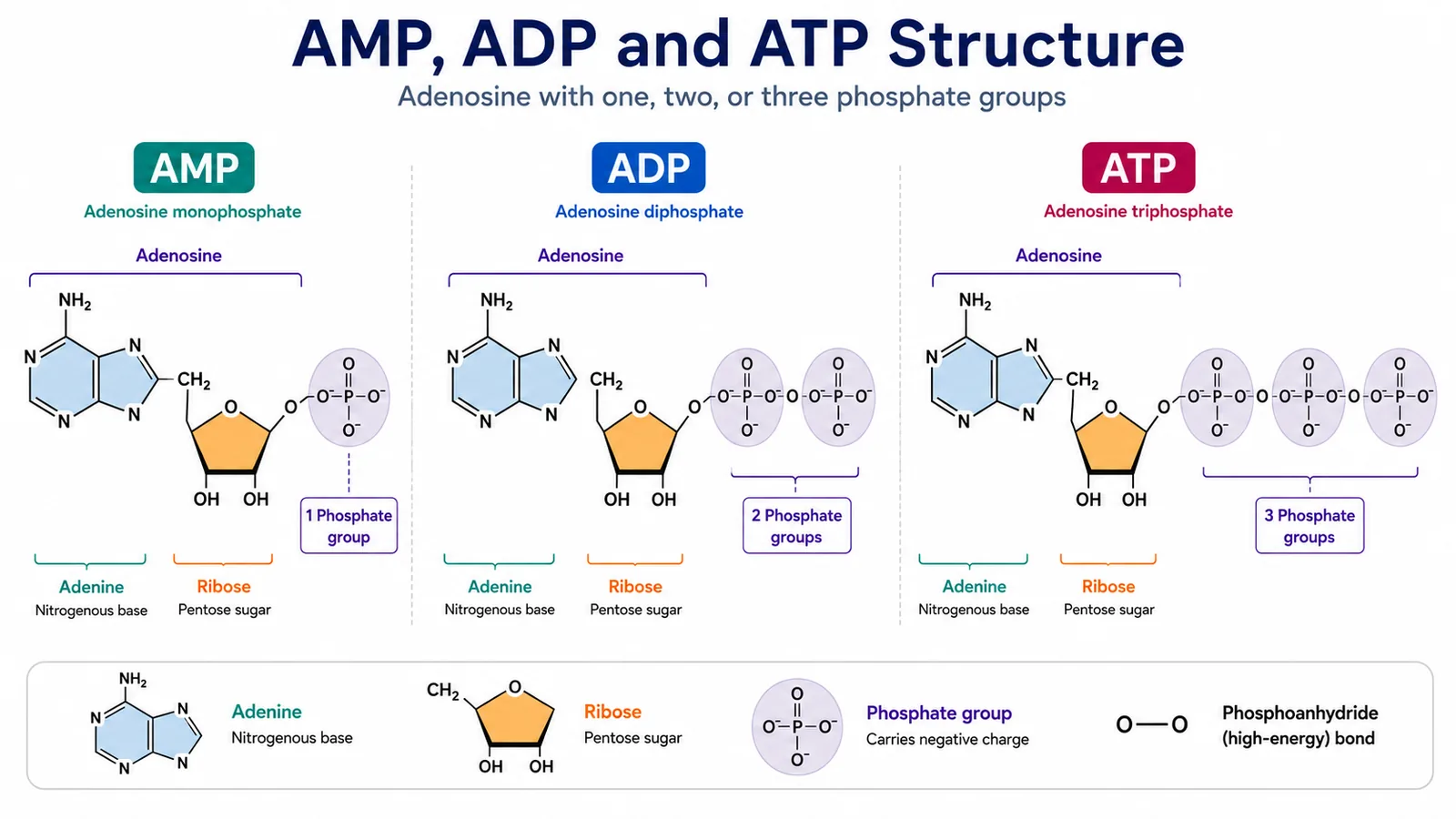
Ribosome Subunits and mRNA" loading= - Dr Khaled Dabour Academy⤢ Enlarge
Process & sequence
1
Helicase unwinds the DNA double helix at the origin, forming replication forks

single-strand binding proteins hold strands apart.
2
Primase lays down a short RNA primer

DNA polymerase III extends it 5’→3′ (leading strand continuous, lagging strand in Okazaki fragments).
3
DNA polymerase I replaces primers with DNA and ligase seals the gaps

proofreading corrects errors.
1 / 4Next ▶
Process & sequence
1

4
2

Transcription: RNA polymerase binds the promoter, unwinds DNA and builds mRNA 5’→3′ from the template strand until a terminator.
3

5
4

In eukaryotes pre-mRNA is capped, polyadenylated and spliced

then exported through nuclear pores.
5

6
6

Translation: the small ribosomal subunit binds mRNA, initiator tRNA (Met) pairs with AUG, and the large subunit joins.
◀ Previous2 / 4Next ▶
Process & sequence
1

7
2

Elongation through A, P and E sites adds amino acids via peptide bonds until a stop codon brings a release factor.
3

From gene to protein — write these steps in this order

each step is a marking point.
4

DNA unwinds at the promoter
5

RNA polymerase makes pre-mRNA
6

Cap, tail and splicing
◀ Previous3 / 4Next ▶
Process & sequence
Process & sequence
mRNA exported to cytoplasm
Ribosome reads codons
Polypeptide folds into protein
◀ Previous4 / 4
1Worked examples2Worked examples3Worked examples4Worked examples5Worked examples6Worked examples7Worked examples8Worked examples9Worked examples10Worked examples11Worked examples12Worked examples
Worked examples
1 / 12Next ▶
Worked examples
◀ Previous2 / 12Next ▶
Worked examples
◀ Previous3 / 12Next ▶
Worked examples
◀ Previous4 / 12Next ▶
Worked examples
◀ Previous5 / 12Next ▶
Worked examples
◀ Previous6 / 12Next ▶
Worked examples
◀ Previous7 / 12Next ▶
Worked examples
◀ Previous8 / 12Next ▶
Worked examples
◀ Previous9 / 12Next ▶
Worked examples
◀ Previous10 / 12Next ▶
Worked examples
◀ Previous11 / 12Next ▶
Worked examples
" loading= - Dr Khaled Dabour Academy⤢ Enlarge
Worked examples
A DNA template strand reads 3′-TAC GGA TTC ACT-5′. Give the mRNA and the amino acid sequence.
mRNA is complementary and antiparallel: 5′-AUG CCU AAG UGA-3′.

Using the code: AUG = Met (start), CCU = Pro, AAG = Lys, UGA = stop.Polypeptide: Met-Pro-Lys.
By Chargaff’s rule T = A = 22%. A + T = 44%

so G + C = 56%, and G = C = 28%.
◀ Previous12 / 12
1Summary2Summary3Summary4Summary
Summary
1

1
2

DNA is a
3

double helix of antiparallel strands
4

with complementary base pairing.
5

2
6

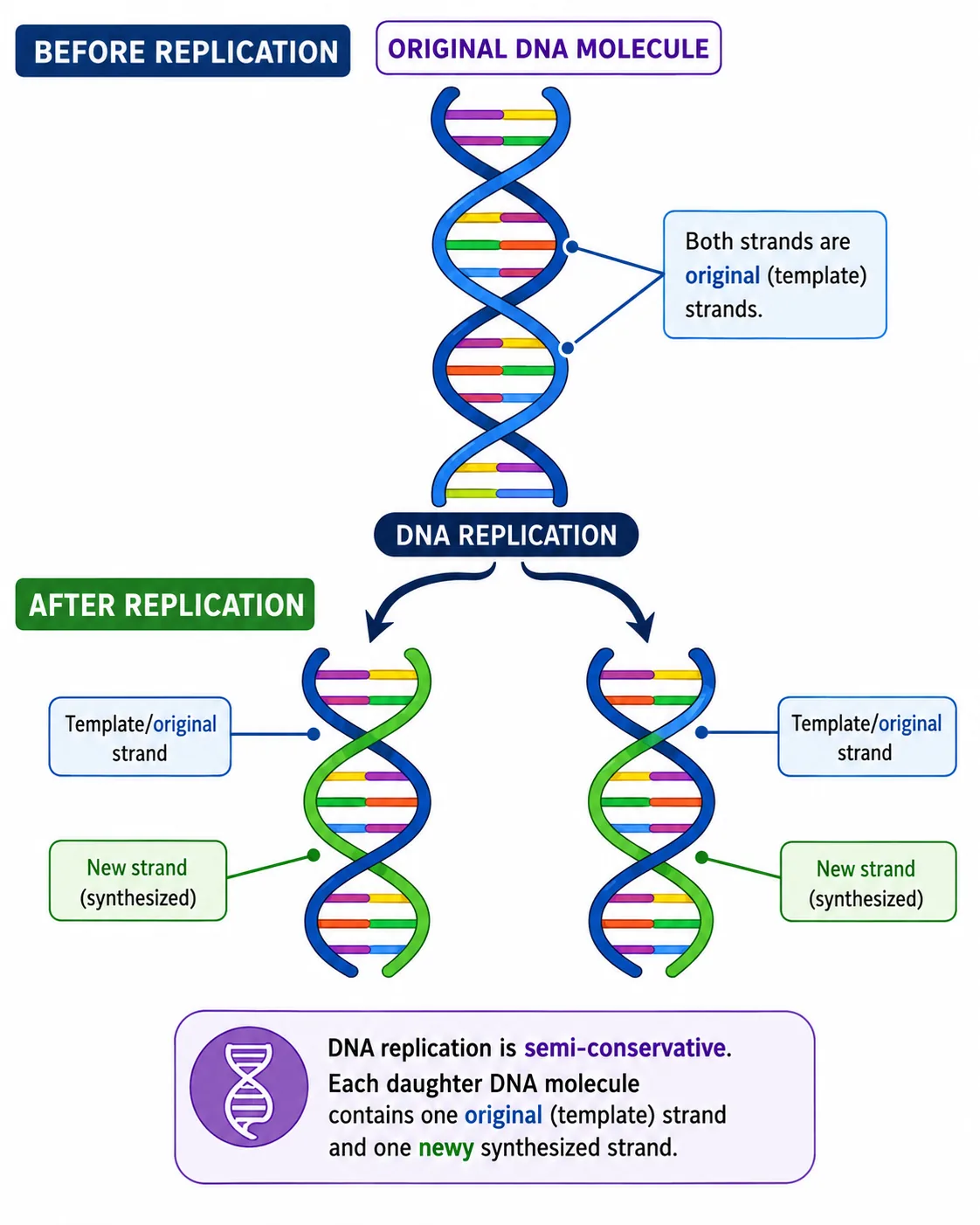
Replication is
1 / 4Next ▶
Summary
Summary
semiconservative
and always proceeds 5’→3′.
3
Central dogma:
DNA → RNA → protein
.
◀ Previous2 / 4Next ▶
Summary
Summary
4
Eukaryotic mRNA is
capped, tailed and spliced
before export.
5
Mutations change the base sequence and can be
◀ Previous3 / 4Next ▶
Summary
Summary
silent, missense, nonsense or frameshift
◀ Previous4 / 4
1Check yourself2Check yourself3Check yourself4Check yourself5Check yourself6Check yourself7Check yourself8Check yourself
Check yourself
1 / 8Next ▶
Check yourself
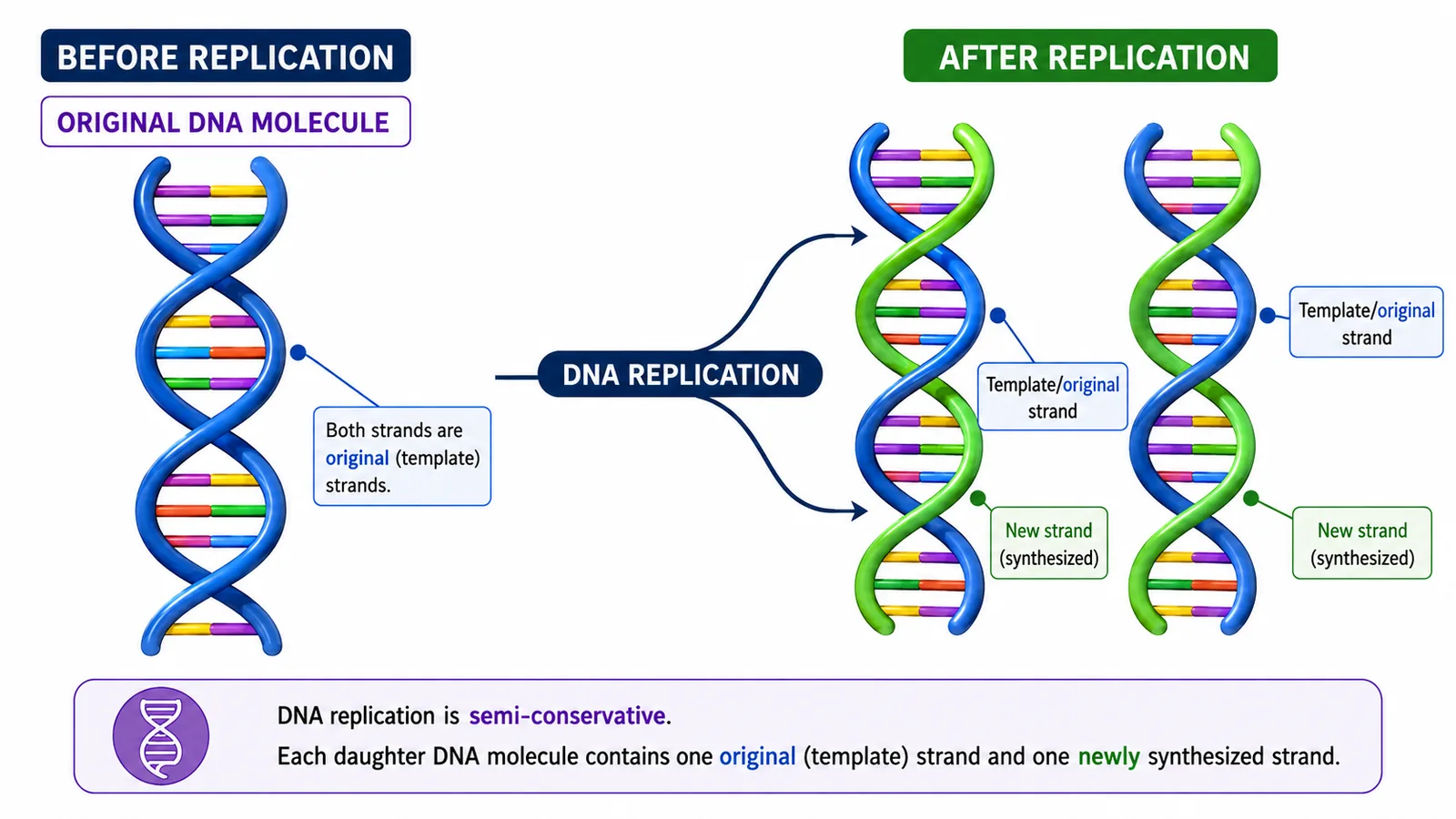
DNA replication: semi-conservative" loading= - Dr Khaled Dabour Academy⤢ Enlarge
Check yourself
Q1. Which enzyme joins Okazaki fragments on the lagging strand?
A. Primase
B. Helicase
C. DNA ligase
D. RNA polymerase
Show answer
◀ Previous2 / 8Next ▶
Check yourself
1

C. DNA ligase forms the phosphodiester bond that seals the gaps between fragments.
2

Q2. If an mRNA codon is 5′-GCA-3′, the tRNA anticodon is:
3

1
4

A. 3′-CGU-5′
5

2
6

B. 5′-CGT-3′
◀ Previous3 / 8Next ▶
Check yourself
Check yourself
3
C. 3′-GCA-5′
4
D. 5′-UGC-3′
A. Anticodons pair antiparallel and complementary: G-C, C-G, A-U

giving 3′-CGU-5′.
Q3. Meselson and Stahl found one band of intermediate density after one round of replication. This ruled out:
◀ Previous4 / 8Next ▶
Check yourself
Check yourself
A. Semiconservative replication
B. Conservative replication
C. Base pairing
D. Dispersive and semiconservative replication
B. Conservative replication would give one heavy and one light band, not a single hybrid band.
Q4. Which is removed from eukaryotic pre-mRNA before translation?
◀ Previous5 / 8Next ▶
Check yourself
1

A. Exons
2

B. The 5′ cap
3

C. The poly-A tail
4

D. Introns
5

D. Splicing removes introns and joins exons

the cap and tail are added, not removed.
6

Q5. A substitution changes a codon from UAC (Tyr) to UAA. This is a:
◀ Previous6 / 8Next ▶
Check yourself
1

A. Nonsense mutation
2

B. Silent mutation
3

C. Missense mutation
4

D. Frameshift mutation
5

A. UAA is a stop codon

so translation ends early: a nonsense mutation.
6

Q6. Which base is found in RNA but not in DNA?
◀ Previous7 / 8Next ▶
Check yourself
Check yourself
A. Thymine
B. Uracil
C. Adenine
D. Cytosine
B. RNA uses uracil in place of thymine.
◀ Previous8 / 8

Nucleotide

The monomer of nucleic acids, made of a pentose sugar, a phosphate group and a nitrogenous base.

Antiparallel

The arrangement of the two DNA strands running in opposite 5’→3′ directions.

Semiconservative replication

Replication in which each new DNA double helix keeps one parental strand and one newly made strand.

DNA polymerase

The enzyme that adds nucleotides to the 3′ end of a growing DNA strand using a template.

Okazaki fragment

A short DNA segment made discontinuously on the lagging strand and later joined by DNA ligase.

Transcription

Synthesis of an RNA molecule complementary to a DNA template strand by RNA polymerase.

Codon

A sequence of three mRNA nucleotides that specifies one amino acid or a stop signal.

Anticodon

The three-base sequence on a tRNA that pairs with a complementary mRNA codon.

Intron

A non-coding sequence in eukaryotic pre-mRNA that is removed by splicing.

Point mutation

A change in a single nucleotide pair of a gene, such as a substitution, insertion or deletion.

DNA versus RNA
Feature DNA RNA
Sugar Deoxyribose Ribose
Bases A, T, G, C A, U, G, C
Strands Usually double-stranded helix Usually single-stranded
Main role Long-term storage of genetic information mRNA, tRNA, rRNA roles in expressing genes
Stability Very stable Short-lived, easily degraded
Prokaryotic versus eukaryotic gene expression
Feature Prokaryotes Eukaryotes
Location Transcription and translation both in cytoplasm, coupled Transcription in nucleus, translation in cytoplasm
mRNA processing None 5′ cap, poly-A tail, splicing of introns
Genes per mRNA Often several (polycistronic, operons) Usually one
Ribosome size 70S 80S (cytosolic)

Mitochondria and chloroplasts have 70S ribosomes, supporting endosymbiosis.

Command terms
Identify / Describe (FRQ)
A short, specific statement; describing requires relevant characteristics, not a single word.
Explain / Justify (FRQ)
Give the cause-and-effect reasoning or evidence; a restated fact does not score.
Calculate
Show setup, substitution and the answer with units.
Predict
State the expected outcome; add a reason only if asked to justify.
MCQ technique
Read every option; eliminate distractors that are true statements but do not answer the question; watch for NOT/EXCEPT.

Keywords the mark scheme looks for in this lesson

Keywords the mark scheme looks for in this lesson
Nucleotide · Antiparallel · Semiconservative replication · DNA polymerase · Okazaki fragment · Transcription · Codon · Anticodon · Intron · Point mutation
Learn each definition in the Key words tab exactly; a missing keyword in a definition usually loses the mark.

How to get full marks (examiner guidance)

1

Answer exactly what is asked; extra correct material does not earn credit, and contradictory statements can cancel credit (AP FRQ).
2

Use precise vocabulary (e.g. “active site”, “concentration gradient”, “allele”), never “it/stuff/things”.
3

Show units and working in calculations.
4

In MCQs, predict the answer before reading the options, then eliminate.
Accepted payment methods