Curriculum
Course: General Biology
Login

Curriculum

General Biology

Text lesson

3.4 Evolution

Summarise Darwin’s theory of natural selection and the evidence for evolution.
1Key ideas2Key ideas3Key ideas4Key ideas
Key ideas
1 / 4Next ▶
Key ideas
pasted 1782554692328 0" loading= - Dr Khaled Dabour Academy⤢ Enlarge
1

Hardy-Weinberg
2

p + q = 1 and p
3

2
4

+ 2pq + q
5

= 1.
6

Hardy-Weinberg equilibrium requires no mutation, random mating, no selection, a very large population and no gene flow.
◀ Previous2 / 4Next ▶
Key ideas
Key ideas
Darwin (On the Origin of Species, 1859) and Wallace independently proposed natural selection.
Individuals do not evolve

populations evolve.
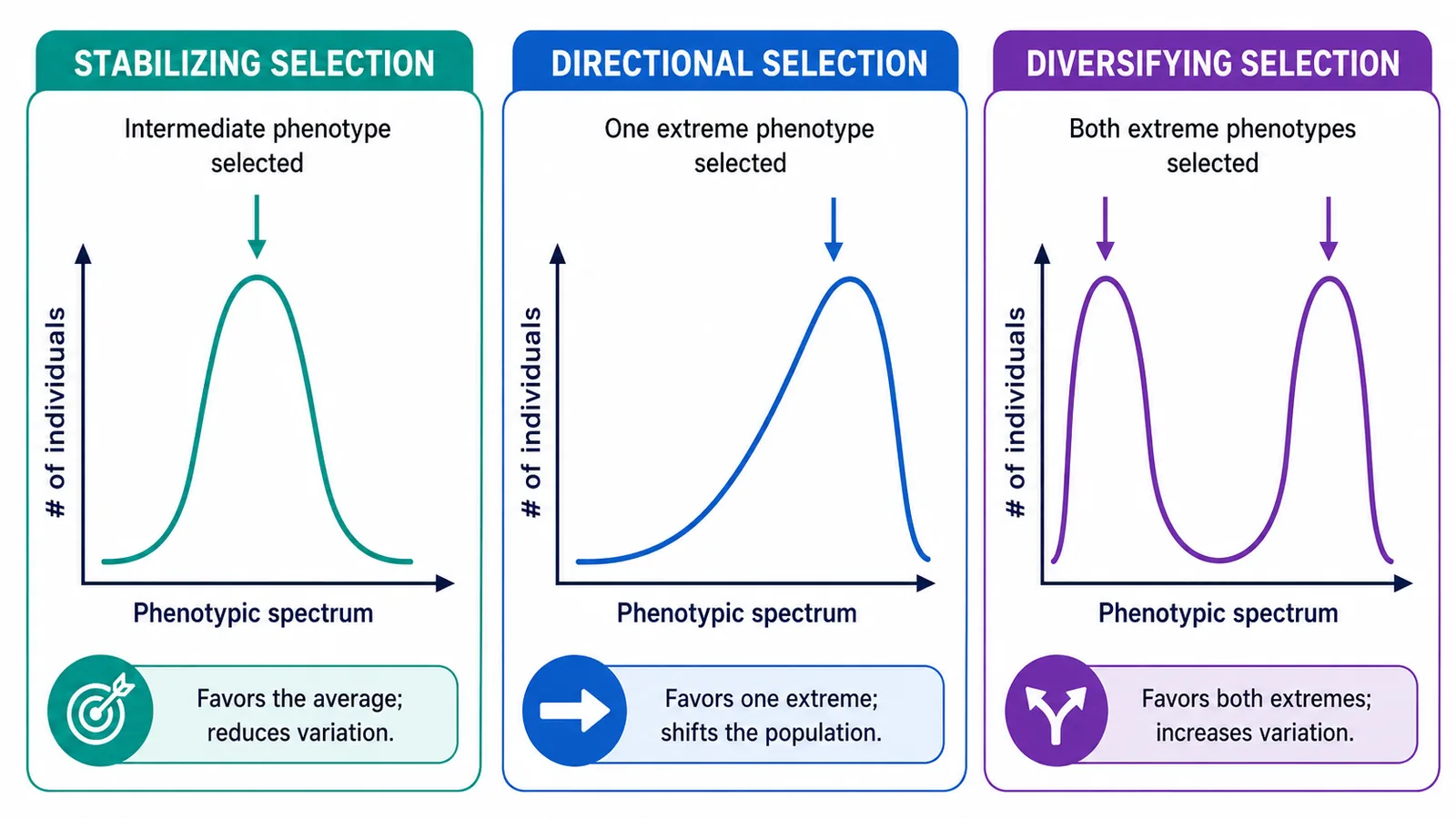
Three modes of selection
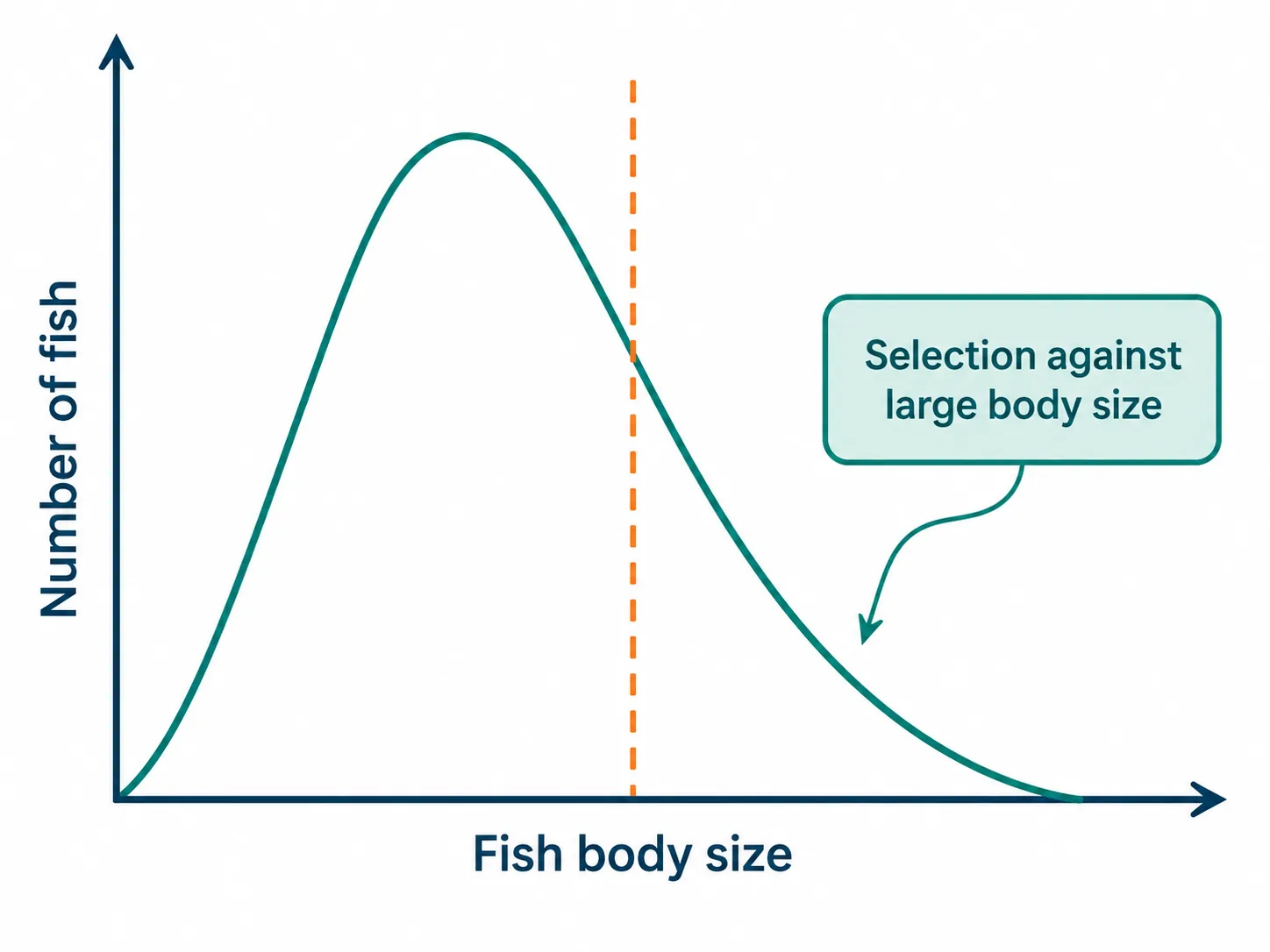
directional, stabilising (e.g. human birth weight) and disruptive.
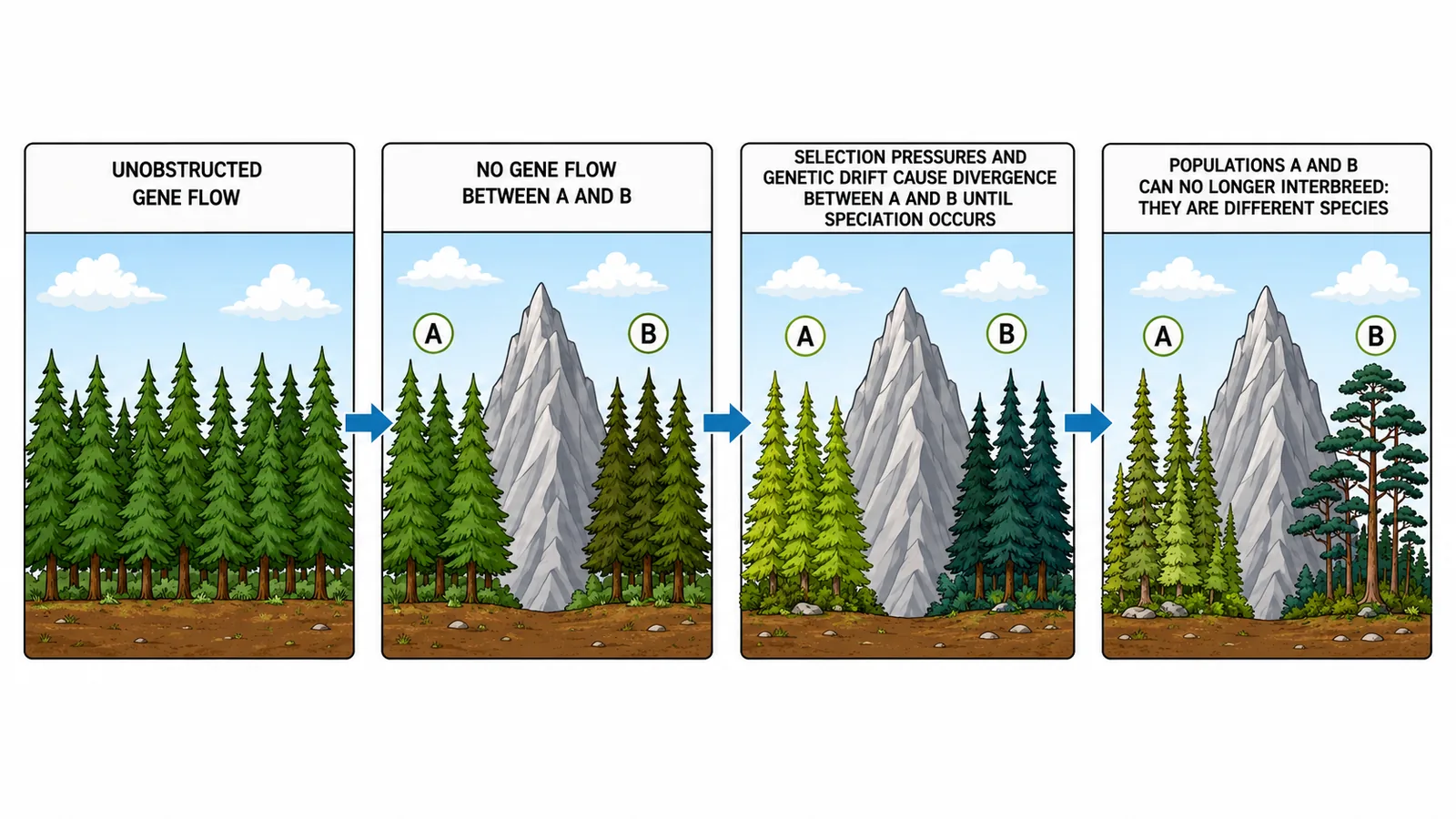
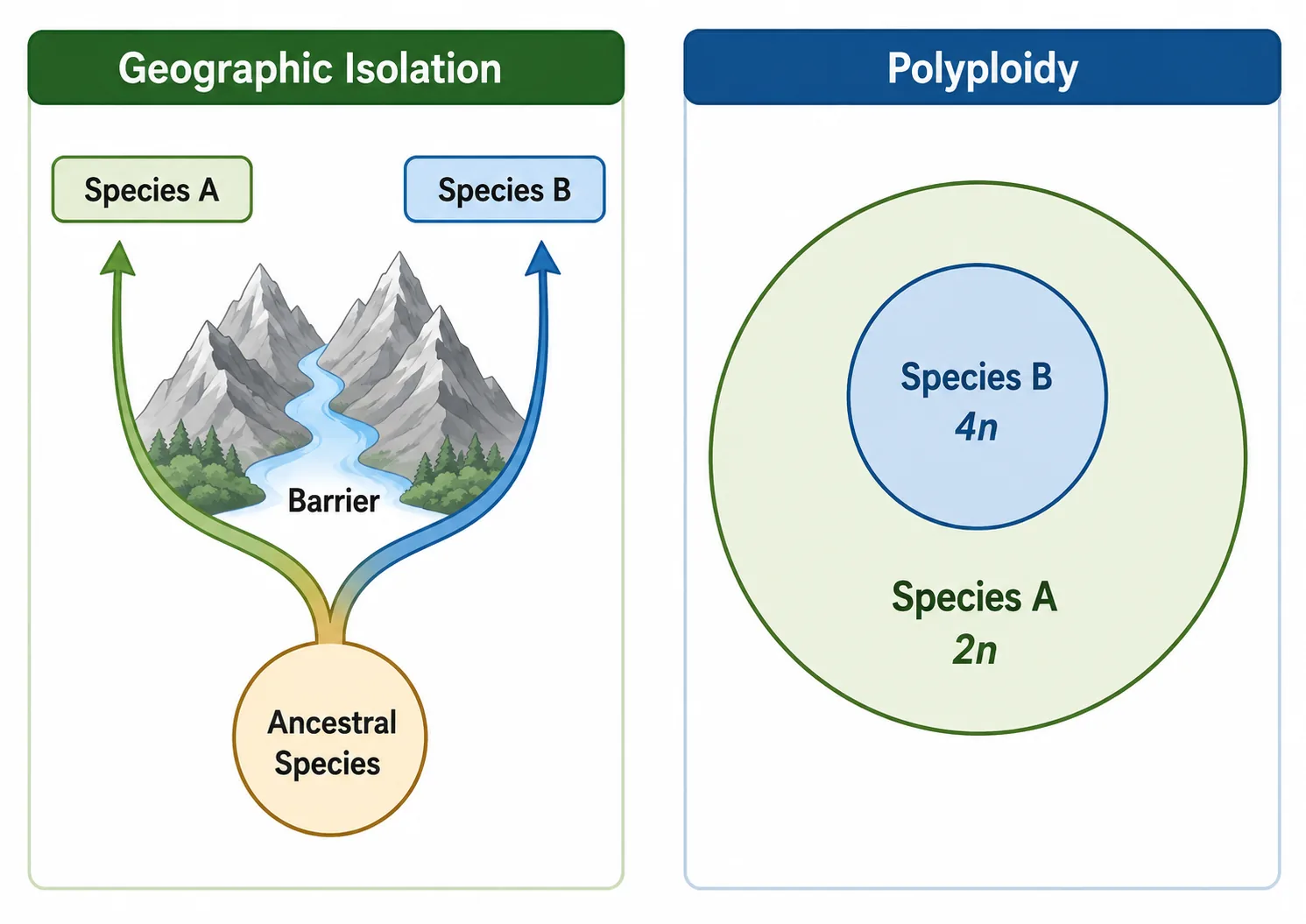
Allopatric speciation involves geographic separation

sympatric speciation (e.g. polyploidy in plants) does not.
Earth is about 4.6 billion years old

the earliest fossil prokaryotes are about 3.5 billion years old.
◀ Previous3 / 4Next ▶
Key ideas
Key ideas
Radiometric dating uses half-lives, e.g.
14
C half-life about 5730 years.
◀ Previous4 / 4
1Essential knowledge2Essential knowledge3Essential knowledge4Essential knowledge5Essential knowledge6Essential knowledge7Essential knowledge8Essential knowledge
Essential knowledge
1 / 8Next ▶
Essential knowledge
◀ Previous2 / 8Next ▶
Essential knowledge
◀ Previous3 / 8Next ▶
Essential knowledge
◀ Previous4 / 8Next ▶
Essential knowledge
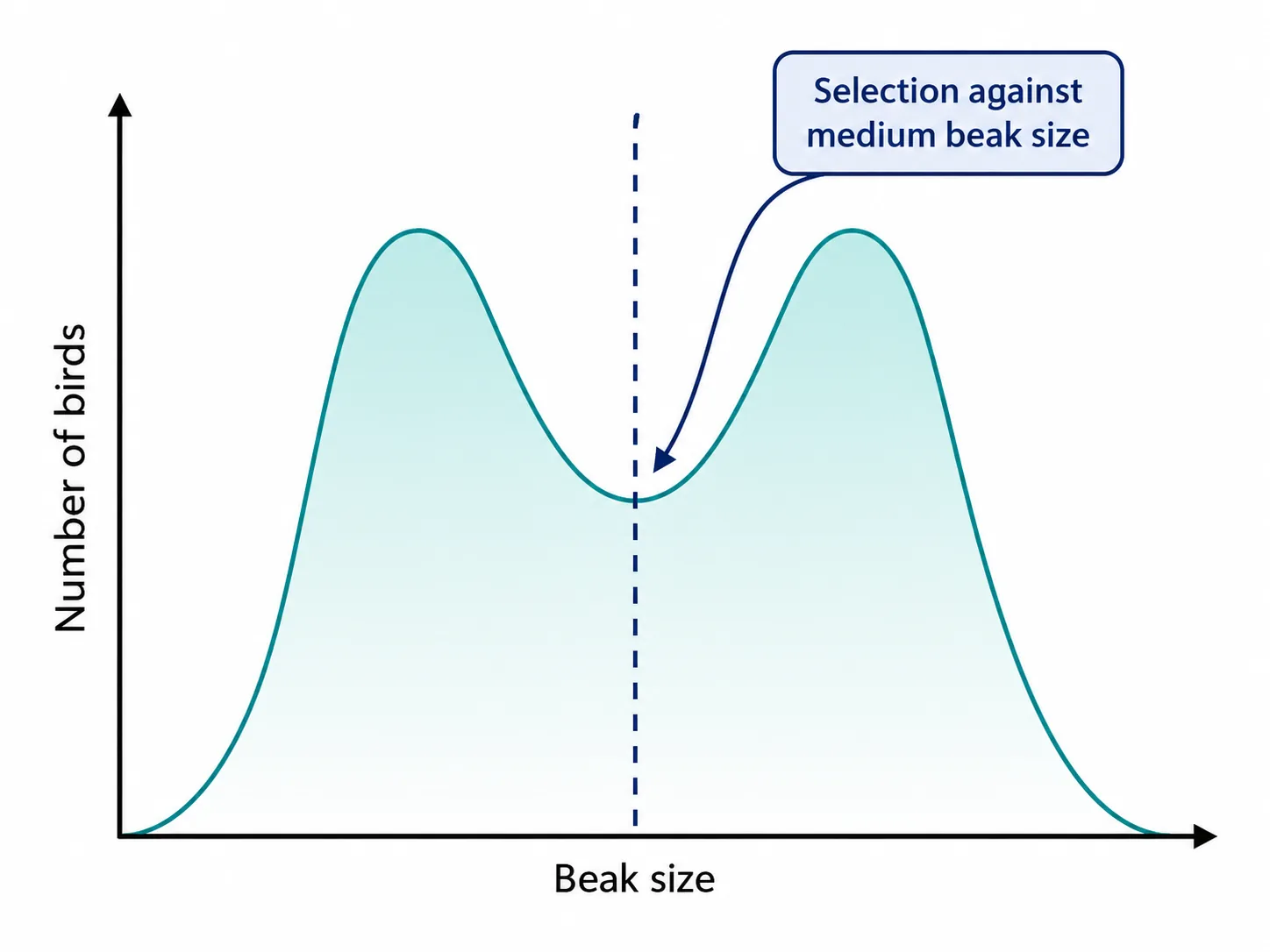
Disruptive selection on beak size in birds" loading= - Dr Khaled Dabour Academy⤢ Enlarge
Essential knowledge
Darwin’s observations
variation among individuals, heritability, overproduction of offspring and a struggle for existence. Inference: those best suited leave more offspring

so favourable traits accumulate. Artificial selection by breeders shows the same principle.
Evidence for evolution
the fossil record (transitional forms such as
Tiktaalik
and early whales), homologous structures, vestigial structures (human appendix, whale pelvis), embryology, biogeography (island species resemble nearby mainland species) and molecular homology (the universal genetic code, DNA and protein sequence similarities).
◀ Previous5 / 8Next ▶
Essential knowledge
Essential knowledge
Direct observation
antibiotic resistance in bacteria, pesticide resistance in insects and beak changes in Galapagos finches during droughts show evolution in real time.
Hardy-Weinberg
in an ideal non-evolving population allele and genotype frequencies stay constant. Deviations from predicted frequencies indicate that one of the conditions is violated and evolution is occurring.
Genetic drift
chance events change allele frequencies. A bottleneck (sudden population crash, e.g. northern elephant seals) or founder effect (small group colonising, e.g. high polydactyly in some isolated communities) reduces diversity.
◀ Previous6 / 8Next ▶
Essential knowledge
1

Selection types
2

directional shifts the mean

stabilising favours intermediates and reduces variancedisruptive favours both extremes.
3

Sexual selection results in dimorphism through mate choice or male-male competition.
4

Balancing selection, e.g. heterozygote advantage of the sickle-cell allele in malarial regions, maintains variation.
5

Speciation
6

allopatric (geographic barrier) and sympatric (polyploidy, habitat differentiation, sexual selection). Adaptive radiation produces many species from one ancestor

tempo may be gradual or punctuated equilibrium.
◀ Previous7 / 8Next ▶
Essential knowledge
1

Phylogeny
2

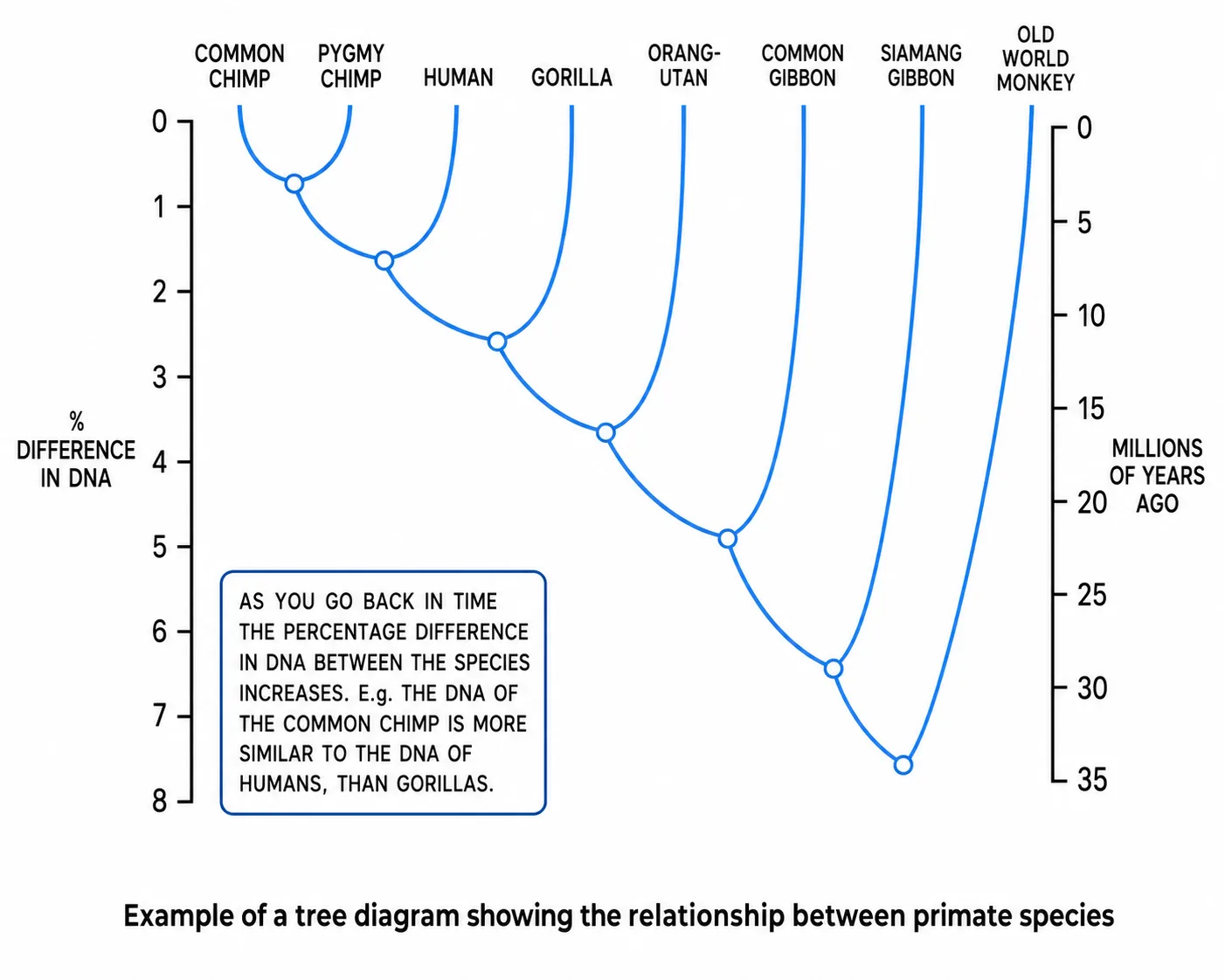
trees show hypothesised relationships

nodes are common ancestors and sister taxa share the most recent ancestor. Cladistics groups organisms by shared derived characters into monophyletic clades. The three domains are Bacteria, Archaea and Eukarya.
3

Miller-Urey experiments showed organic molecules can form from simple gases

an RNA world, protocells and later the endosymbiotic origin of mitochondria and chloroplasts are key steps.
◀ Previous8 / 8
1Process & sequence2Process & sequence3Process & sequence4Process & sequence
Process & sequence
Process & sequence
1
Individuals in a population show heritable variation, originating from mutation and recombination.
2
More offspring are produced than the environment can support, creating competition.
3
Individuals with favourable traits survive and reproduce more (higher fitness).
1 / 4Next ▶
Process & sequence
1

4
2

Their alleles become more frequent in the next generation.
3

5
4

Over many generations the population becomes adapted to its environment.
5

6
6

If populations are isolated and diverge enough, reproductive isolation leads to new species.
◀ Previous2 / 4Next ▶
Process & sequence
Process & sequence
Natural selection — write these steps in this order

each step is a marking point.
Heritable variation exists
Overproduction and competition
Favourable traits survive better
Survivors reproduce more
Allele frequencies change
◀ Previous3 / 4Next ▶
Process & sequence
Process & sequence
Population becomes adapted
◀ Previous4 / 4
1Worked examples2Worked examples
Worked examples
1

In a population of 1000, 90 individuals show the recessive phenotype (aa). Assuming Hardy-Weinberg, find q, p and the number of heterozygotes.
2

q2 = 90/1000 = 0.09

so q = 0.3. p = 1 – 0.3 = 0.7. 2pq = 2 x 0.7 x 0.3 = 0.42so 0.42 x 1000 = 420 heterozygotes. (AA: p2 = 0.49, i.e. 490.)
3

Explain why the frequency of antibiotic-resistant bacteria rises when an antibiotic is overused.
4

Resistance alleles arise by random mutation or are gained by horizontal gene transfer before exposure.

The antibiotic kills susceptible cells, so resistant cells survive and divide; the resistance allele frequency increases.(directional selection)The antibiotic does not cause the mutation.
5

Mutations are random changes that occur continuously, and only rarely produce a new phenotype.
6

A new trait that helps survival after an environmental change can spread quickly through a population.
1 / 2Next ▶
Worked examples
1

Phenotypic variation can come from genetic causes, environmental causes, or a combination of both.
2

Selective breeding must be repeated over many generations before a new breed reliably shows the chosen traits in every offspring.
◀ Previous2 / 2
1Summary2Summary3Summary4Summary
Summary
Summary
1
Evolution is
change in allele frequency
in a population.
2
Natural selection acts on
1 / 4Next ▶
Summary
1

heritable variation
2

and produces adaptation.
3

3
4

Drift, gene flow and mutation also change allele frequencies
5

without adaptation
6

.
◀ Previous2 / 4Next ▶
Summary
Summary
4
Hardy-Weinberg gives a
null model
with no evolution.
5
New species form when
◀ Previous3 / 4Next ▶
Summary
Summary
reproductive isolation
evolves.
◀ Previous4 / 4
1Check yourself2Check yourself3Check yourself4Check yourself5Check yourself6Check yourself7Check yourself8Check yourself9Check yourself10Check yourself11Check yourself
Check yourself
1 / 11Next ▶
Check yourself
◀ Previous2 / 11Next ▶
Check yourself
◀ Previous3 / 11Next ▶
Check yourself
◀ Previous4 / 11Next ▶
Check yourself
" loading= - Dr Khaled Dabour Academy⤢ Enlarge
Check yourself
Q1. If q = 0.4 in a population in Hardy-Weinberg equilibrium, the frequency of heterozygotes is:
A. 0.16
B. 0.24
C. 0.36
D. 0.48
Show answer
◀ Previous5 / 11Next ▶
Check yourself
Check yourself
D. p = 0.6

so 2pq = 2 x 0.6 x 0.4 = 0.48.
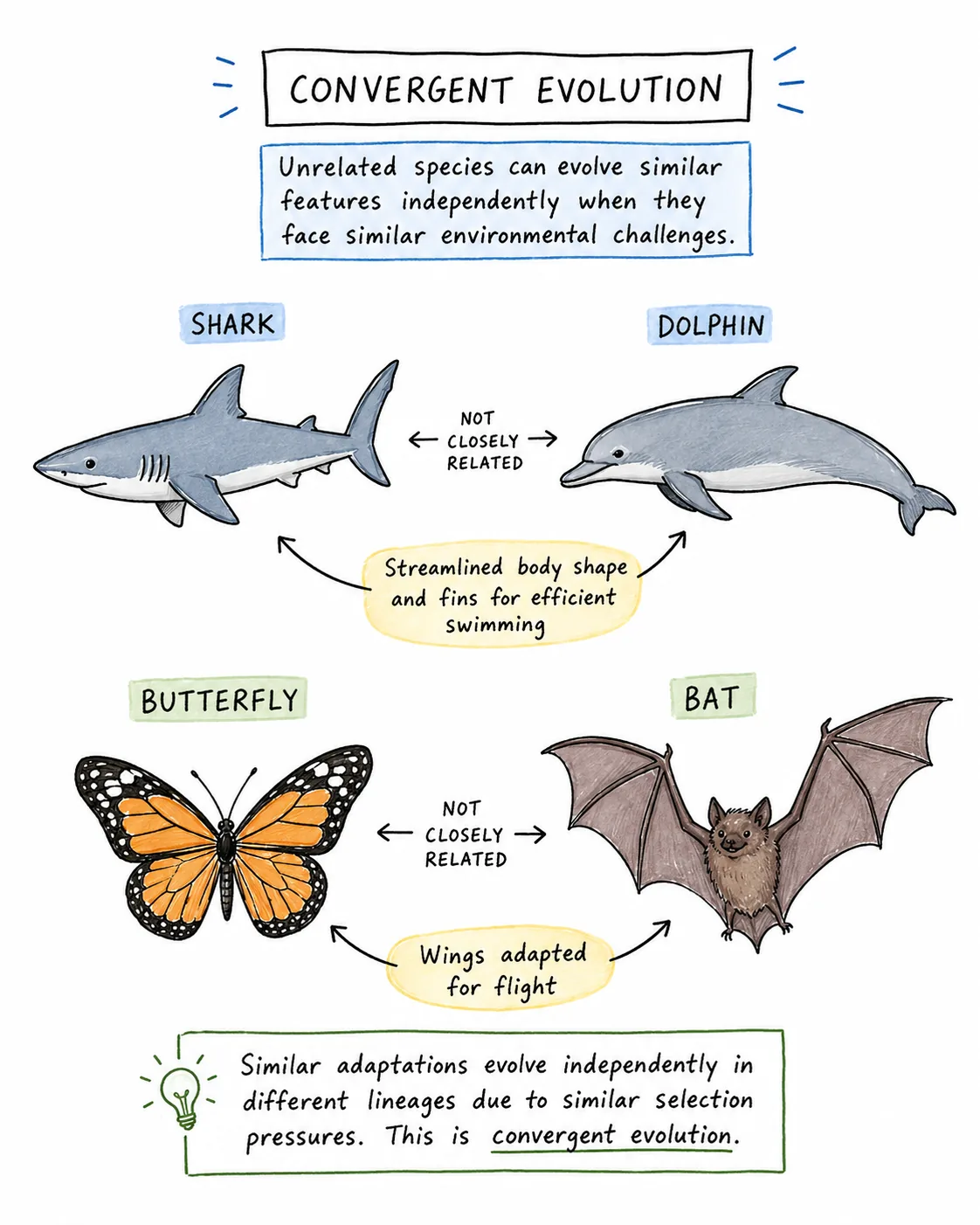
Q2. The wing of a bat and the wing of an insect are:
1
A. Analogous structures
2
B. Homologous structures
◀ Previous6 / 11Next ▶
Check yourself
1

3
2

C. Vestigial structures
3

4
4

D. Transitional forms
5

A. They share function but evolved independently: convergent, analogous structures.
6

Q3. A small group colonises an island and has different allele frequencies from the mainland. This is:
◀ Previous7 / 11Next ▶
Check yourself
1

A. Gene flow
2

B. Bottleneck effect
3

C. Founder effect
4

D. Sexual selection
5

C. A new population started by a few individuals shows the founder effect, a form of drift.
6

Q4. Which is a postzygotic barrier?
◀ Previous8 / 11Next ▶
Check yourself
Check yourself
A. Different mating seasons
B. Hybrid sterility
C. Different courtship displays
D. Incompatible gametes
B. Hybrid sterility acts after a zygote has formed.
Q5. Human birth weight

where very small and very large babies have lower survival, shows:
◀ Previous9 / 11Next ▶
Check yourself
1

A. Stabilising selection
2

B. Directional selection
3

C. Disruptive selection
4

D. Genetic drift
5

A. Intermediate values are favoured, reducing variation.
6

Q6. Which is the ultimate source of new alleles?
◀ Previous10 / 11Next ▶
Check yourself
Check yourself
A. Genetic drift
B. Natural selection
C. Gene flow
D. Mutation
D. Only mutation creates new alleles

the others shift existing frequencies.
◀ Previous11 / 11

Evolution

A change in the allele frequencies of a population over generations.

Natural selection

Differential survival and reproduction of individuals because of heritable traits that suit their environment.

Fitness

The relative contribution an individual makes to the gene pool of the next generation.

Gene pool

All the alleles of all genes present in a population.

Genetic drift

Random change in allele frequencies, strongest in small populations.

Gene flow

Transfer of alleles between populations by migration of individuals or gametes.

Homologous structures

Structures sharing ancestry but possibly differing in function, such as vertebrate forelimbs.

Analogous structures

Structures with similar function arising by convergent evolution, not shared ancestry.

Speciation

The formation of new species when populations become reproductively isolated.

Biological species concept

A species is a group of populations whose members can interbreed and produce fertile offspring.

Mechanisms of microevolution
Mechanism Effect on allele frequencies Adaptive?
Natural selection Increases alleles that raise fitness Yes, consistently
Genetic drift (bottleneck, founder effect) Random change; loss of variation No
Gene flow Makes populations more similar Not necessarily
Mutation Source of new alleles; slow direct effect No (random)
Non-random mating Changes genotype frequencies, not allele frequencies Sexual selection can be
Reproductive isolating barriers
Barrier Type Example
Habitat isolation Prezygotic Two snake species, one aquatic, one terrestrial
Temporal isolation Prezygotic Species breeding in different seasons
Behavioural isolation Prezygotic Different courtship songs in birds
Mechanical/gametic isolation Prezygotic Incompatible genitalia or sperm-egg proteins
Hybrid inviability/sterility Postzygotic Mule (horse x donkey) is sterile
Command terms
Identify / Describe (FRQ)
A short, specific statement; describing requires relevant characteristics, not a single word.
Explain / Justify (FRQ)
Give the cause-and-effect reasoning or evidence; a restated fact does not score.
Calculate
Show setup, substitution and the answer with units.
Predict
State the expected outcome; add a reason only if asked to justify.
MCQ technique
Read every option; eliminate distractors that are true statements but do not answer the question; watch for NOT/EXCEPT.

Keywords the mark scheme looks for in this lesson

Keywords the mark scheme looks for in this lesson
Evolution · Natural selection · Fitness · Gene pool · Genetic drift · Gene flow · Homologous structures · Analogous structures · Speciation · Biological species concept
Learn each definition in the Key words tab exactly; a missing keyword in a definition usually loses the mark.

How to get full marks (examiner guidance)

1

Answer exactly what is asked; extra correct material does not earn credit, and contradictory statements can cancel credit (AP FRQ).
2

Use precise vocabulary (e.g. “active site”, “concentration gradient”, “allele”), never “it/stuff/things”.
3

Show units and working in calculations.
4

In MCQs, predict the answer before reading the options, then eliminate.
Accepted payment methods