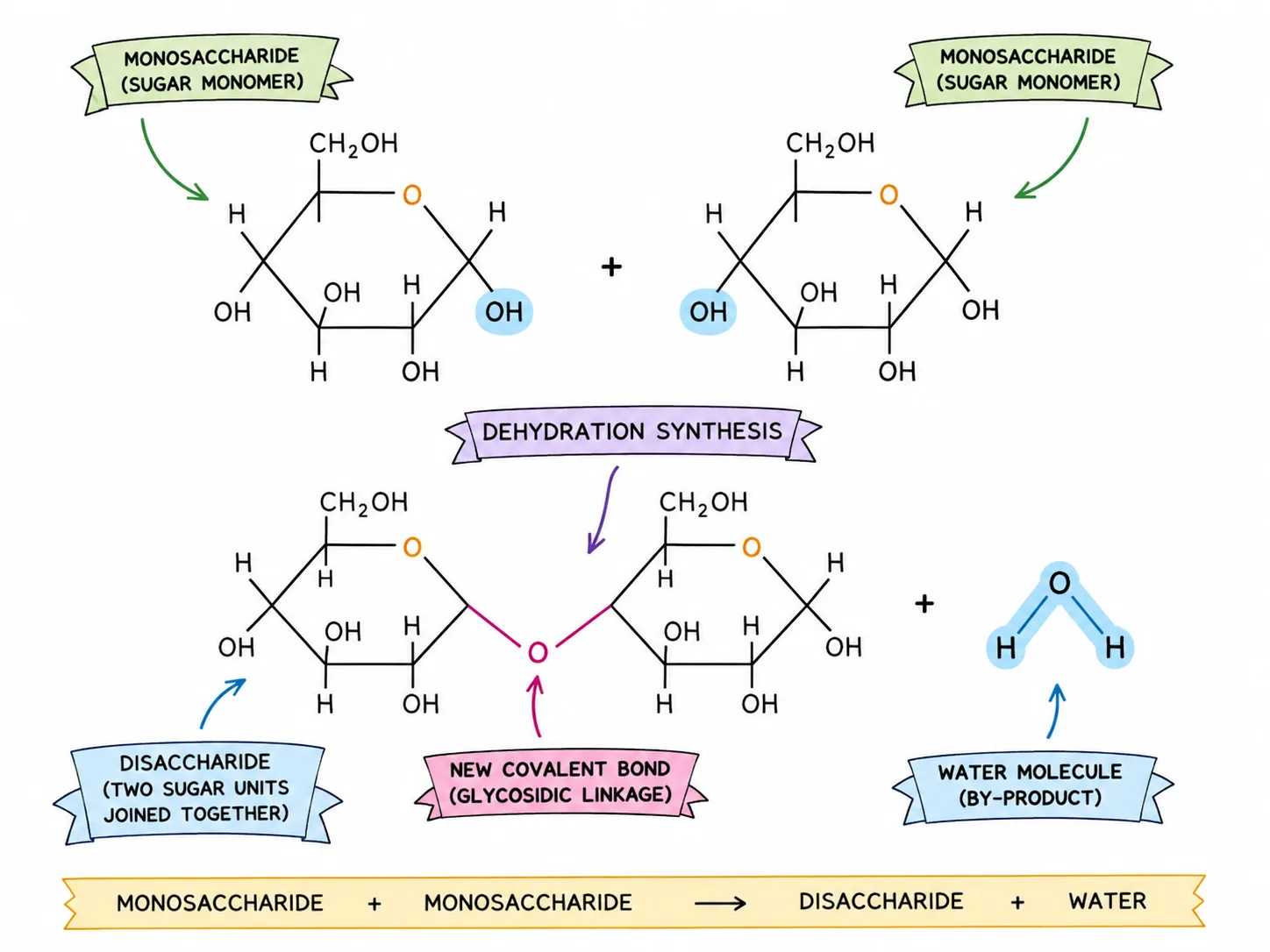
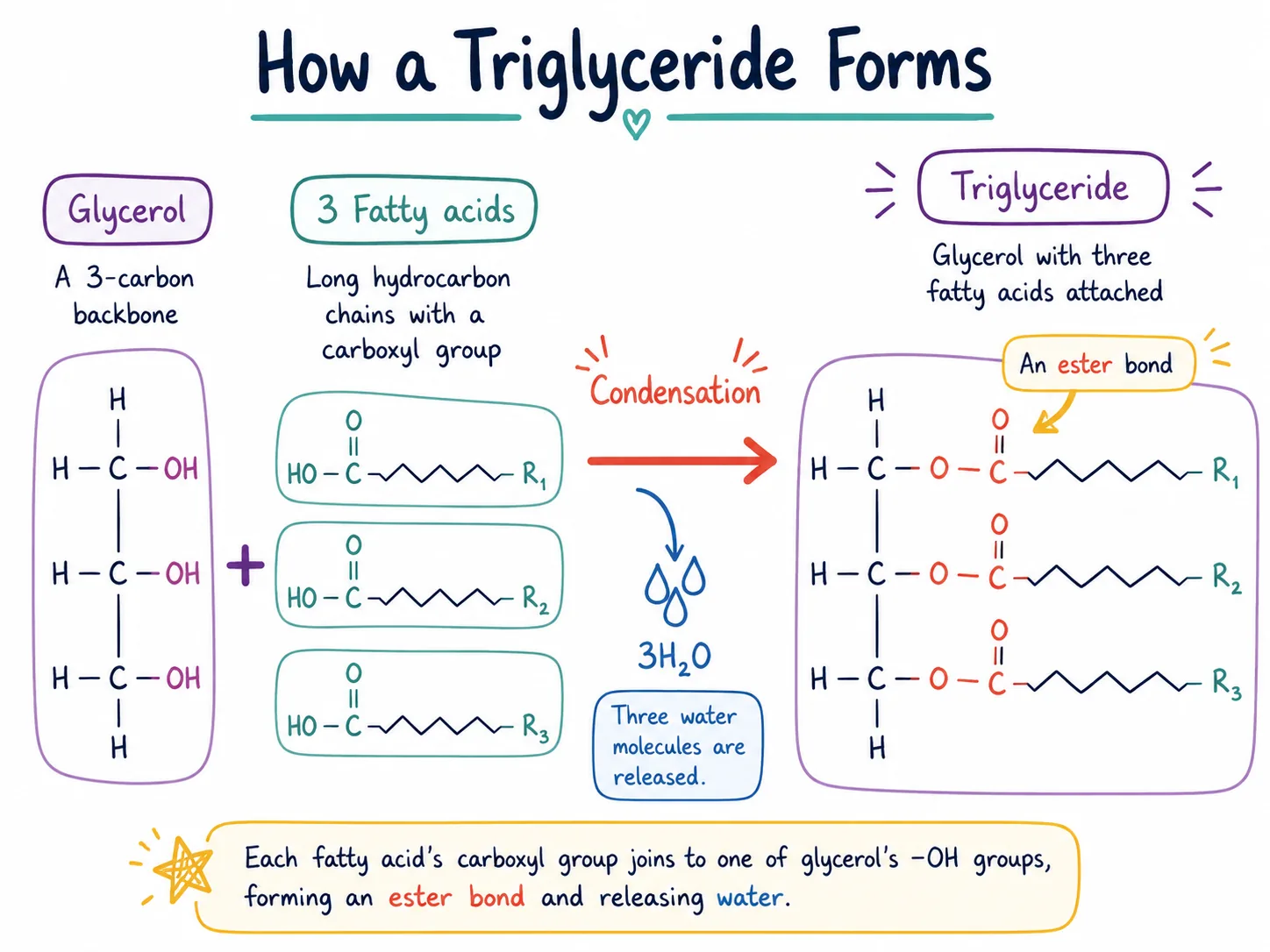
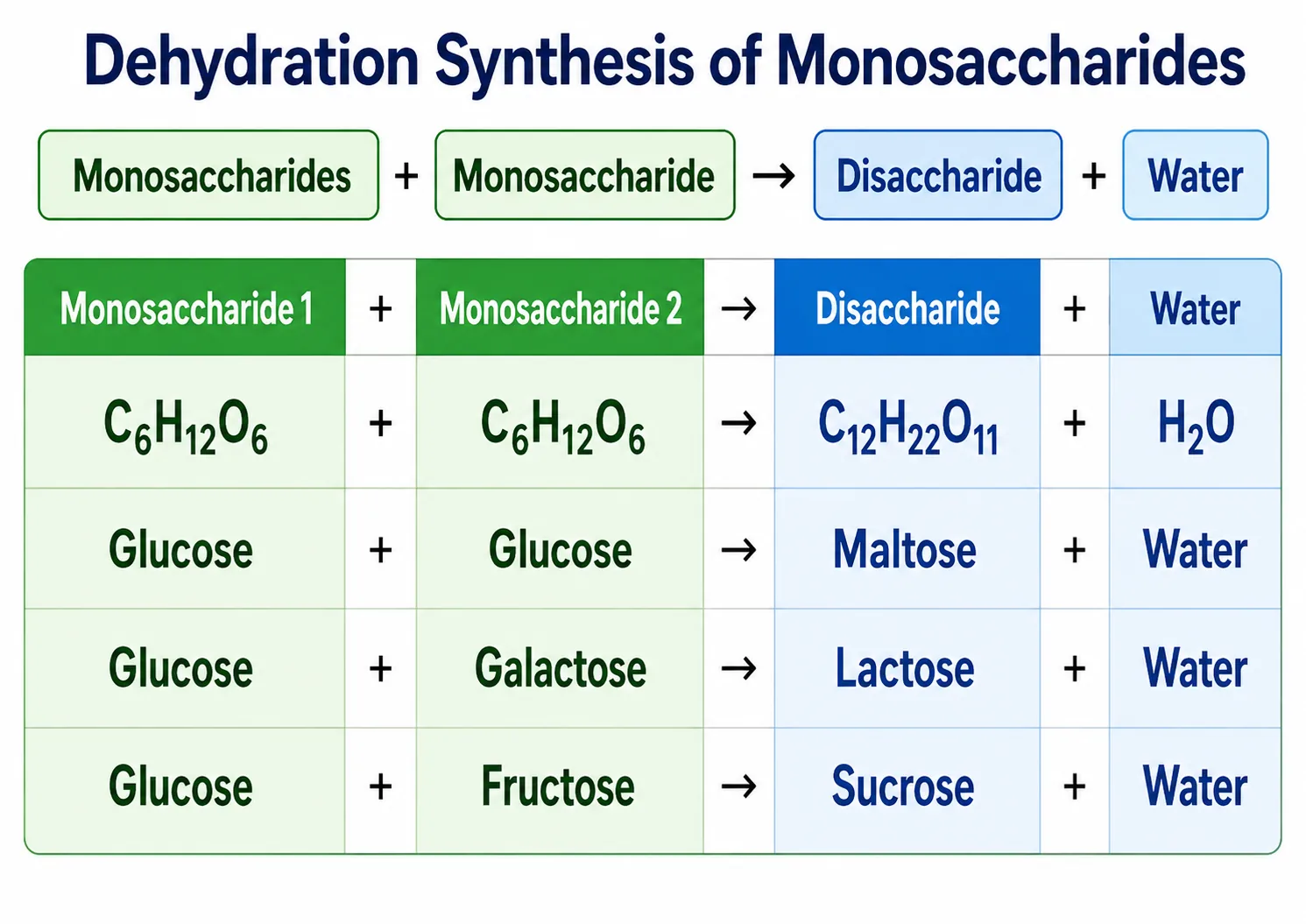
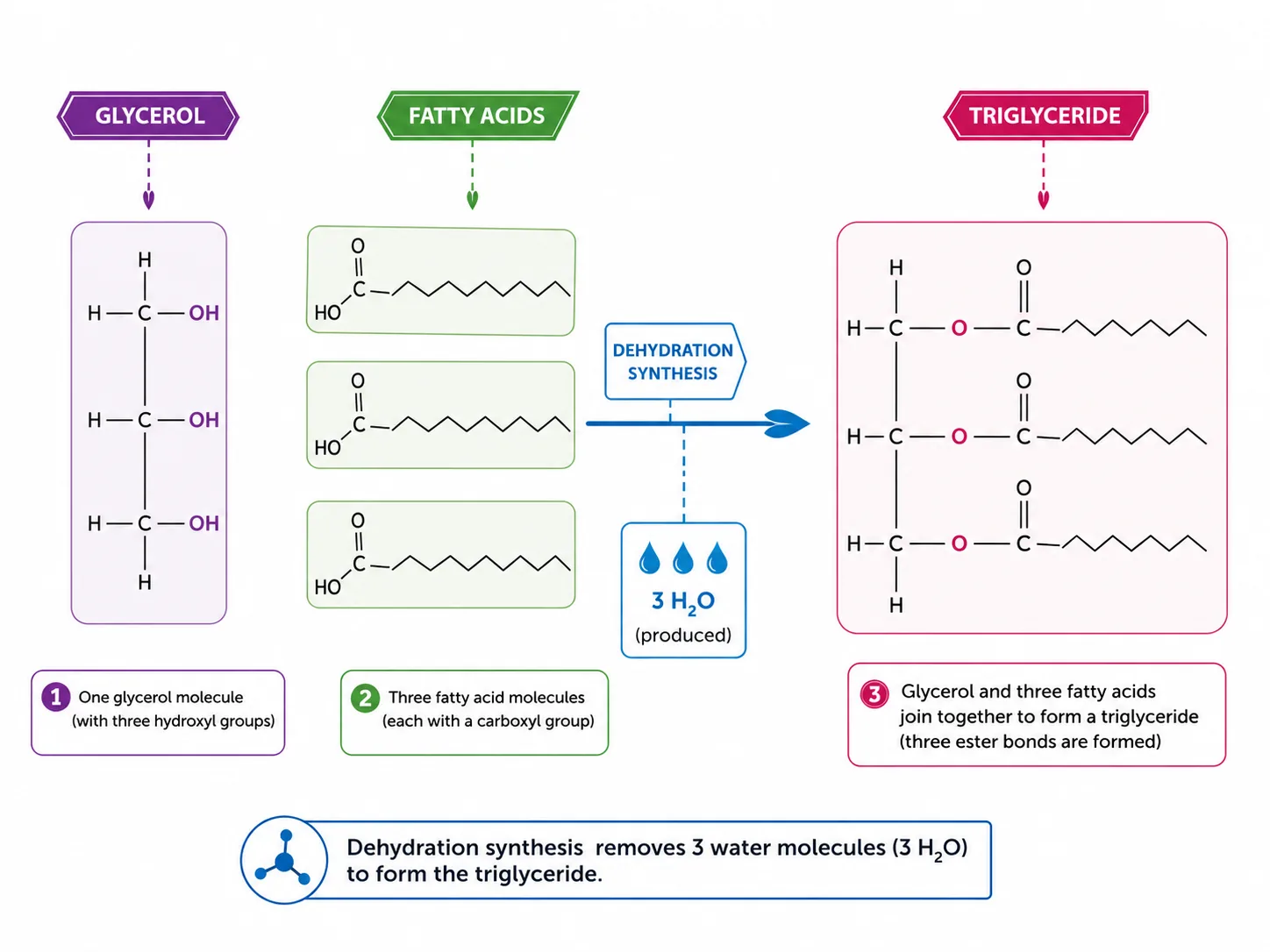
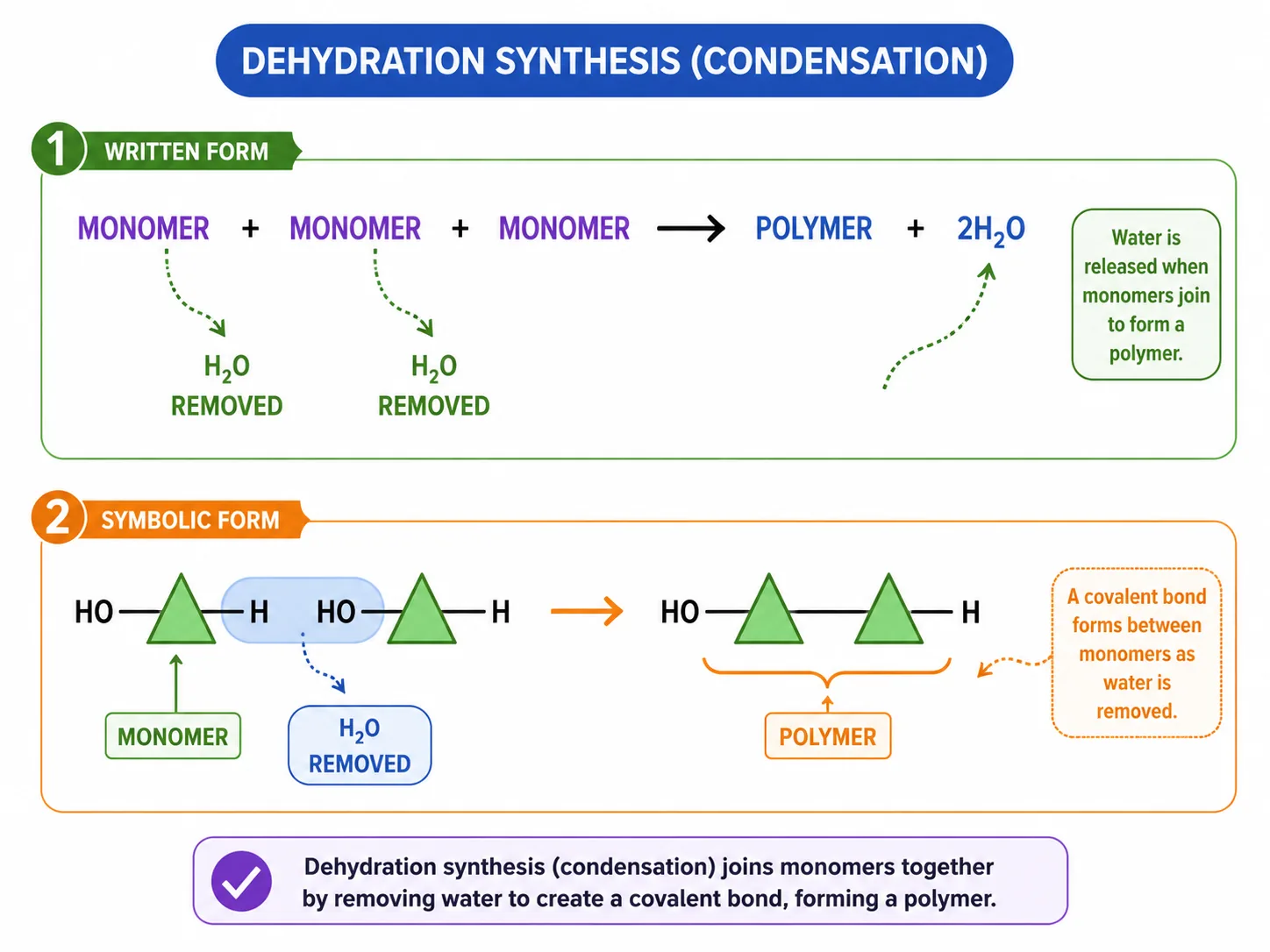
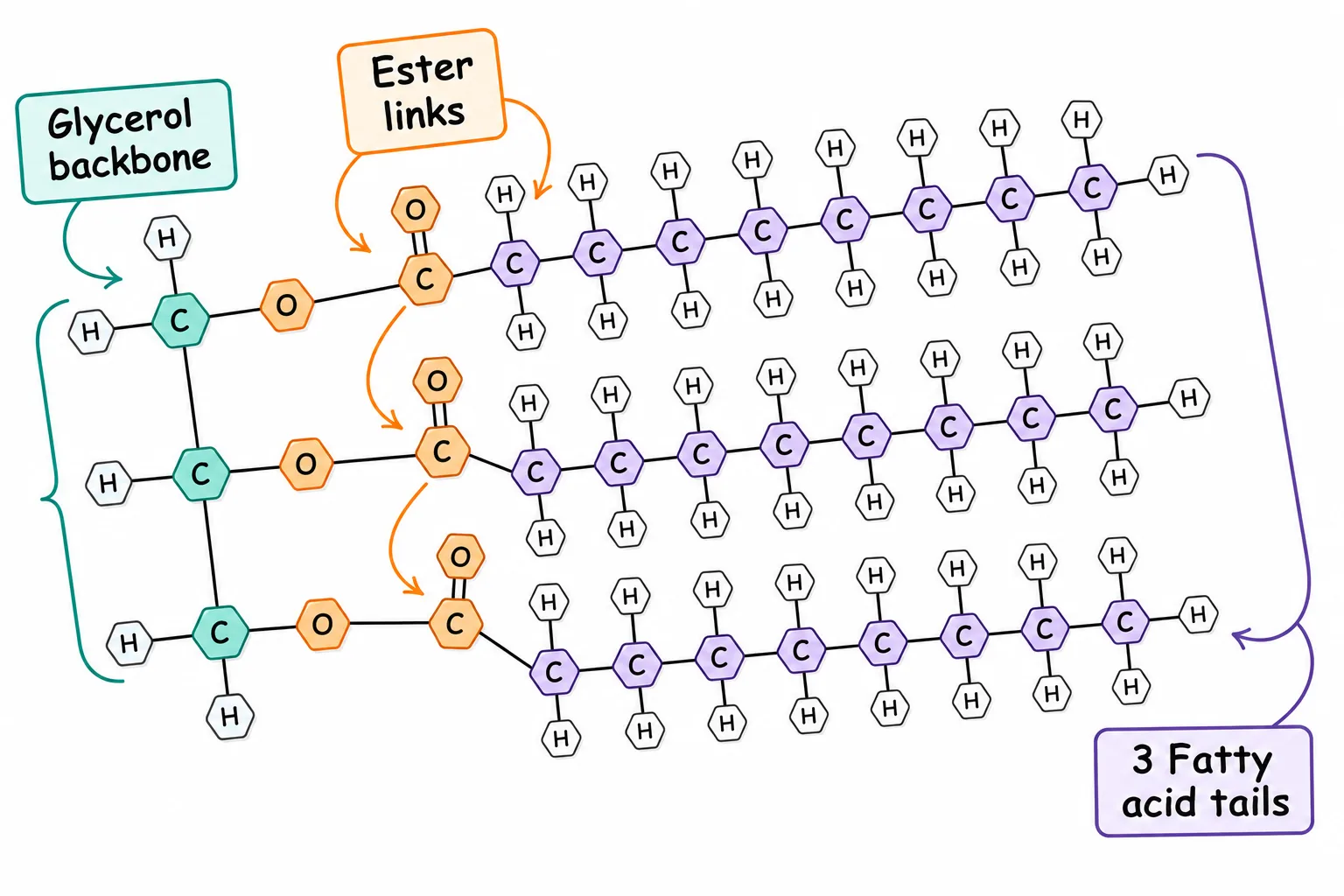
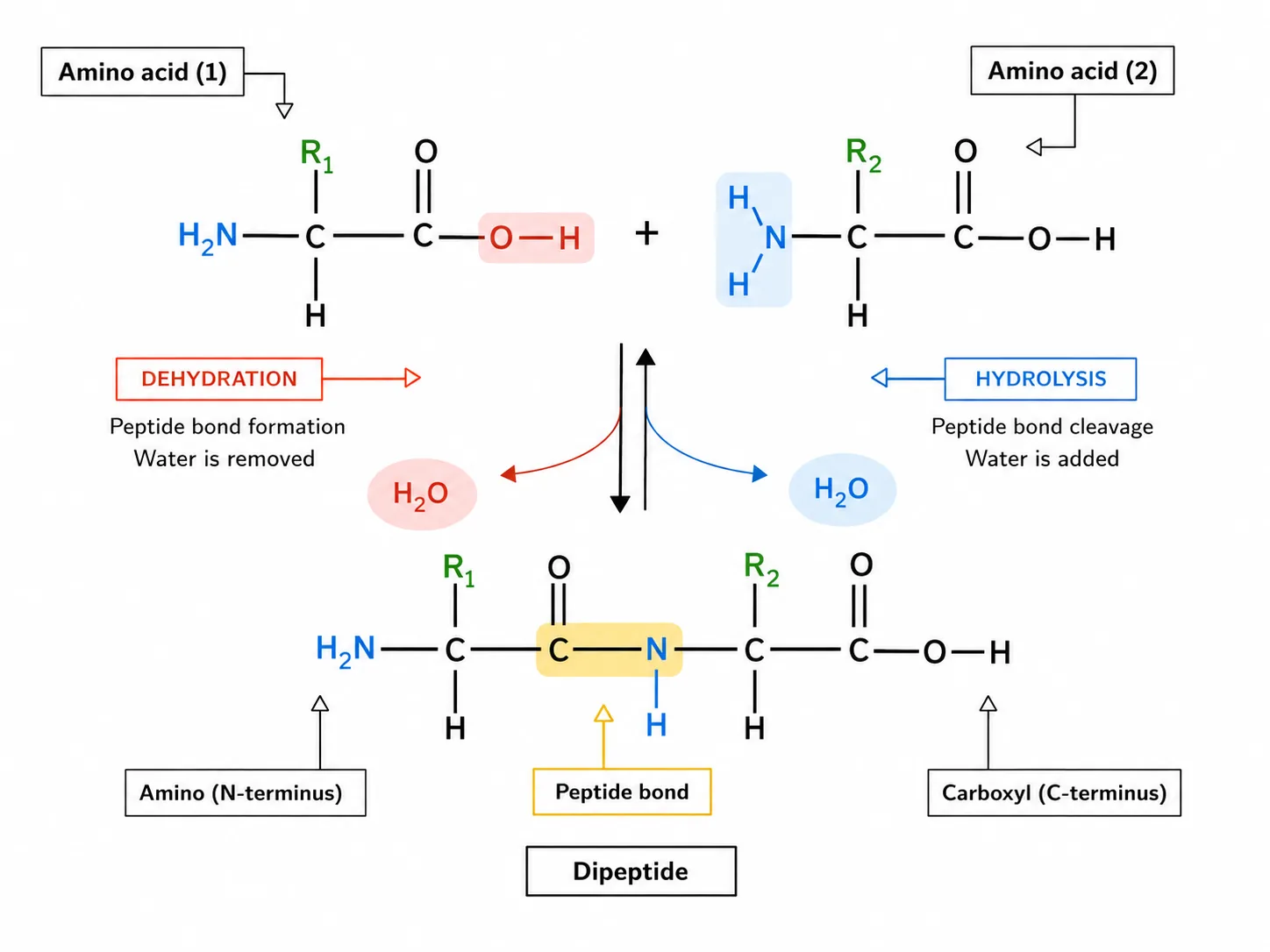
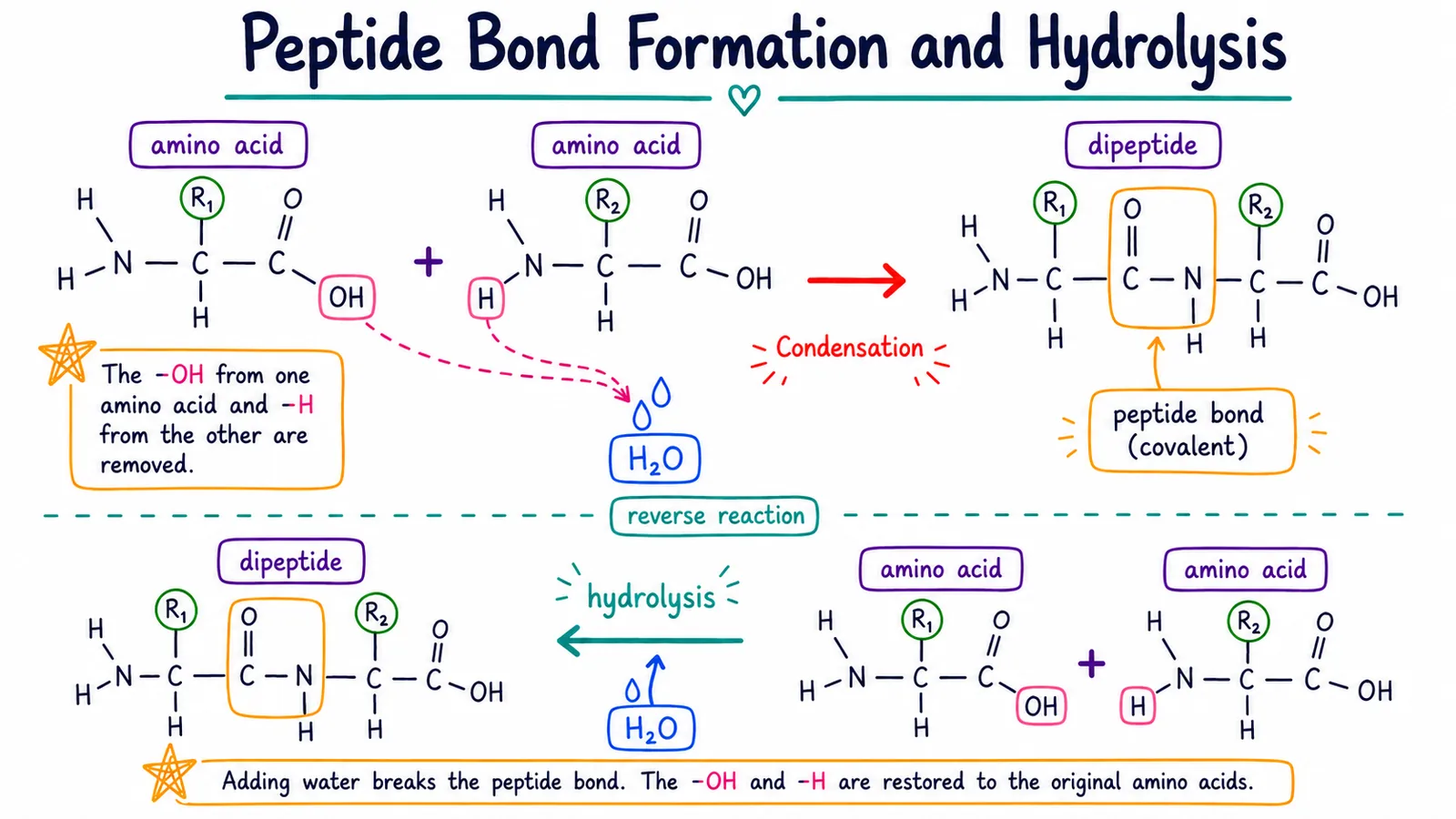
Essential knowledge→In dehydration synthesis, a hydrogen is removed from one monomer and a hydroxyl group from the other, and together they form water.
Process & sequence3Process & sequence4Process & sequence
Process & sequence
Process & sequence
Monomers are made or absorbed by the cell.
Enzymes join monomers by dehydration synthesis, releasing H
O.
1 / 4Next ▶
Process & sequence
Process & sequence
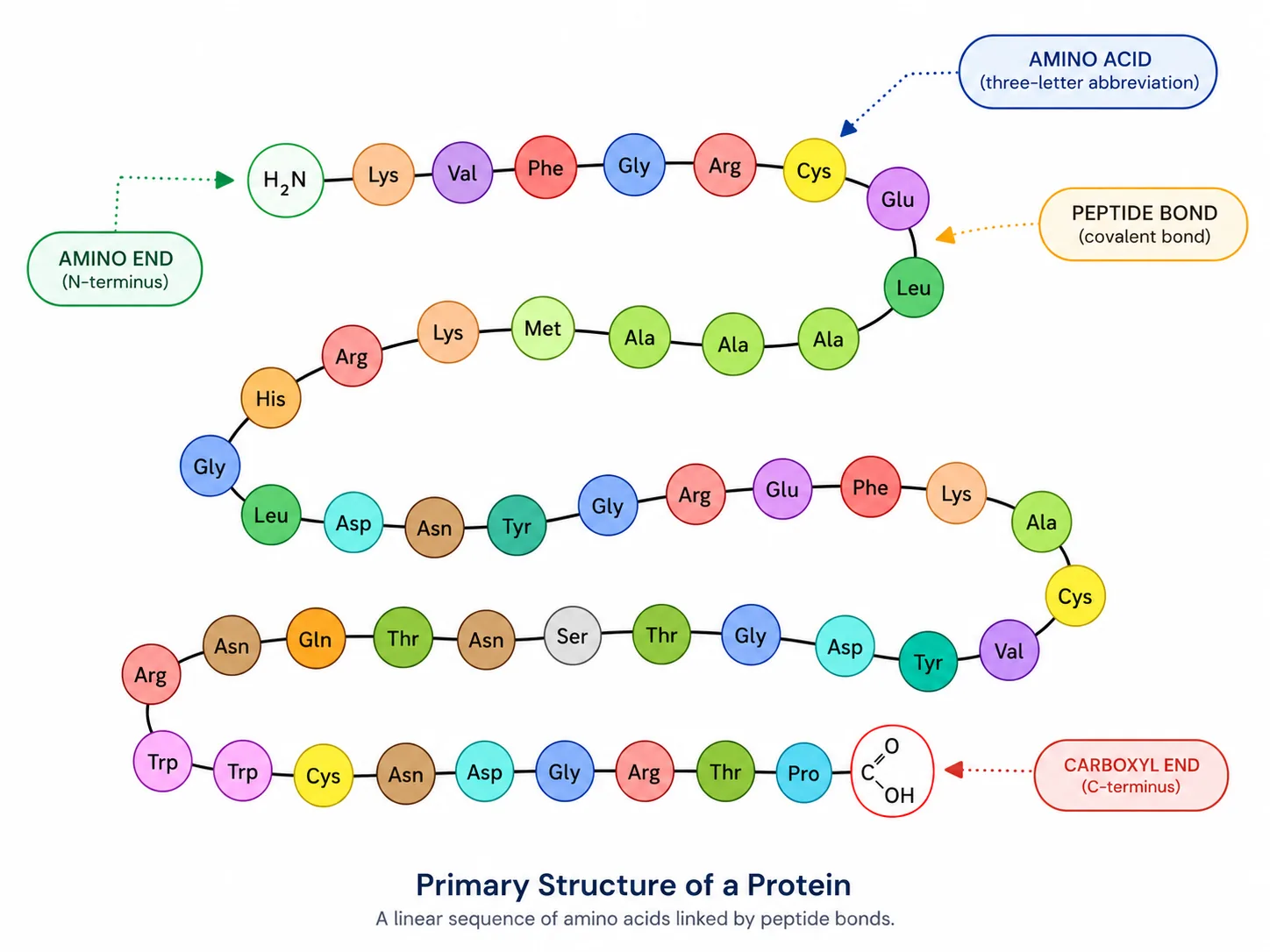
The polymer chain grows (e.g. amino acids in sequence on a ribosome).
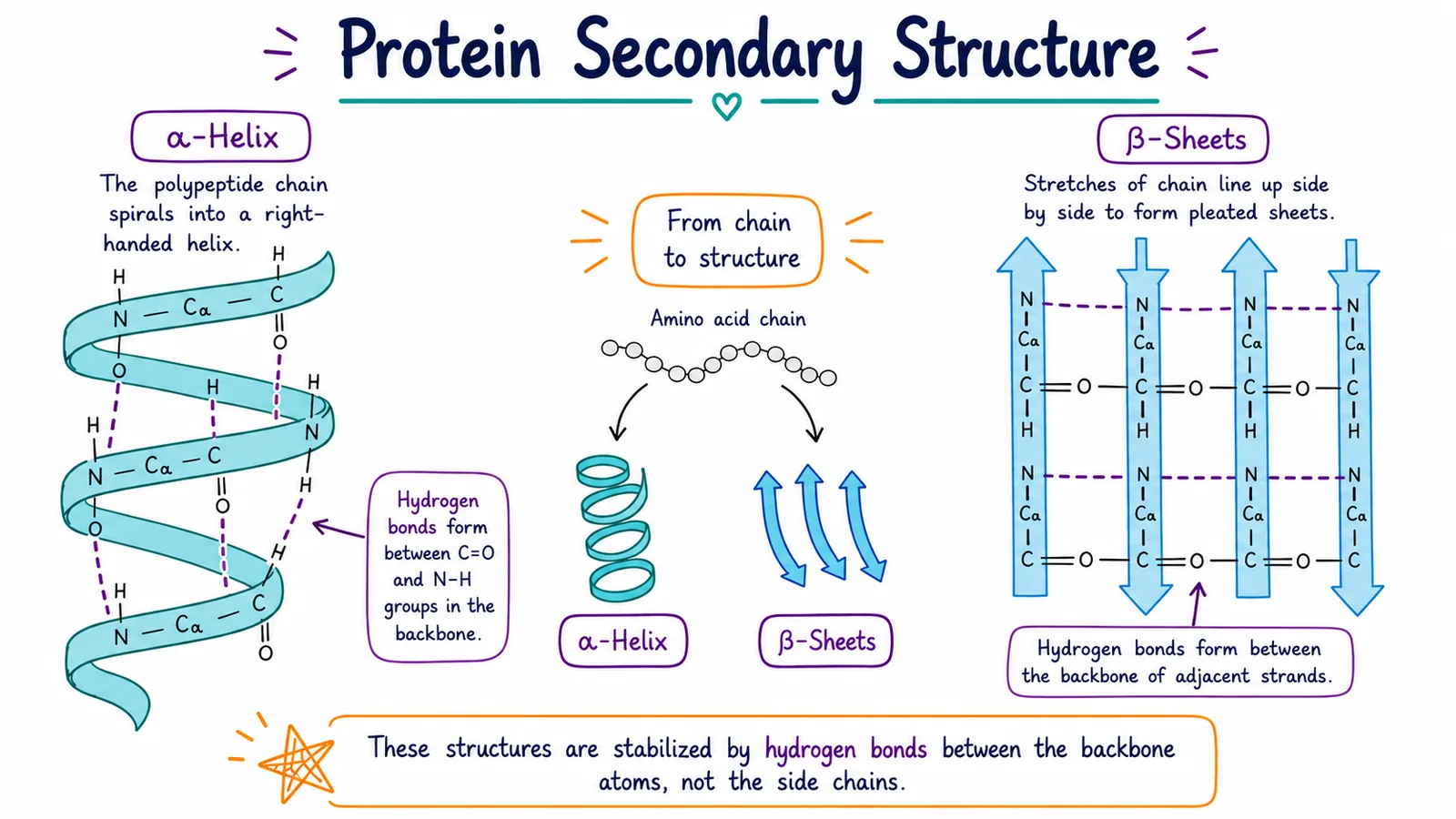
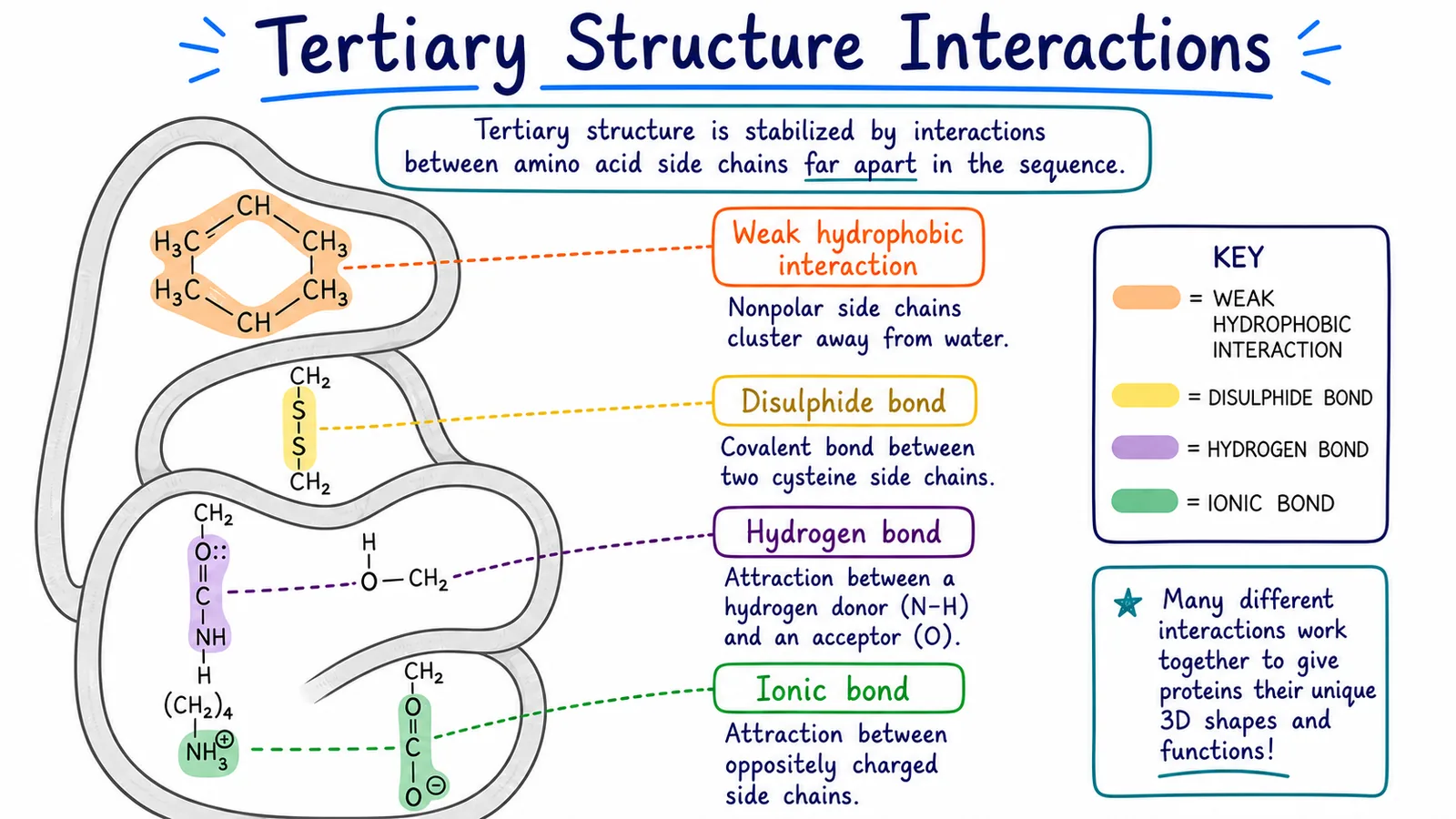
Chain folds into a functional shape (proteins) or branches/coils (polysaccharides).
Polymer performs its role (storage, structure, catalysis, information).
◀ Previous, 2 / 4Next ▶
Process & sequence
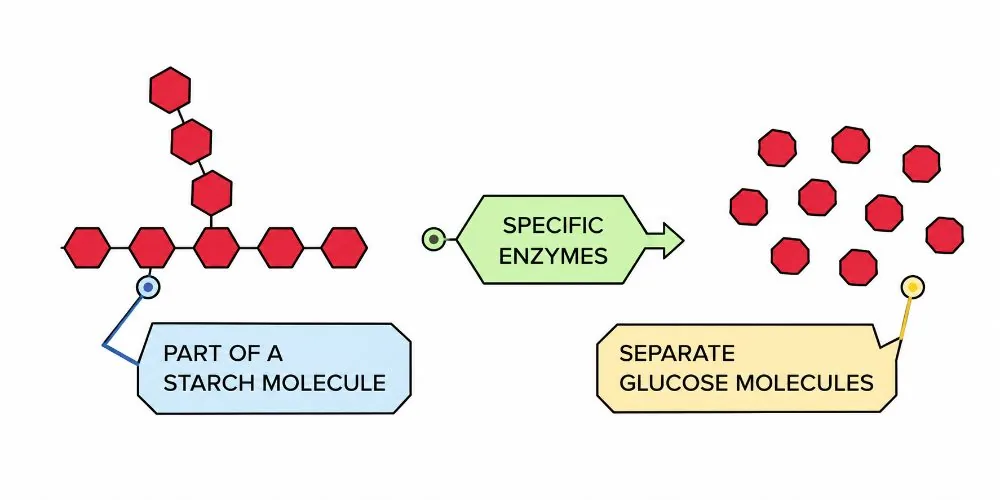
When needed, hydrolysis adds H
O to release monomers for reuse or energy.
3Building and breaking polymers — write these steps in this order
each step is a marking point.
Monomers available
Dehydration synthesis removes water
Polymer formed
◀ Previous, 3 / 4Next ▶
Process & sequence
Folding gives function
Hydrolysis adds water
Monomers released
◀ Previous, 4 / 4
1.3 Biological Macromolecules · 3 / 6
1.3 Worked examples
Worked examples
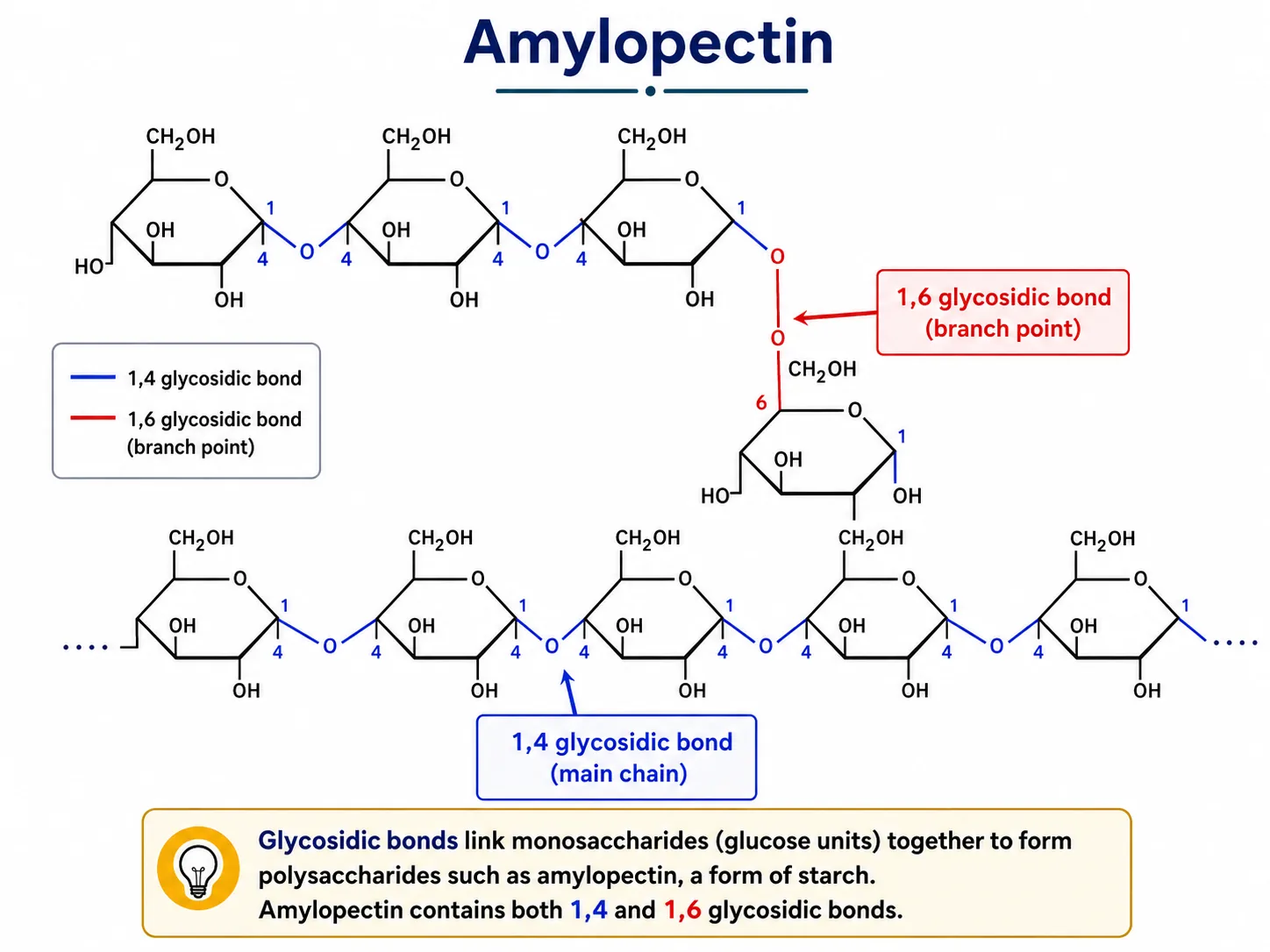
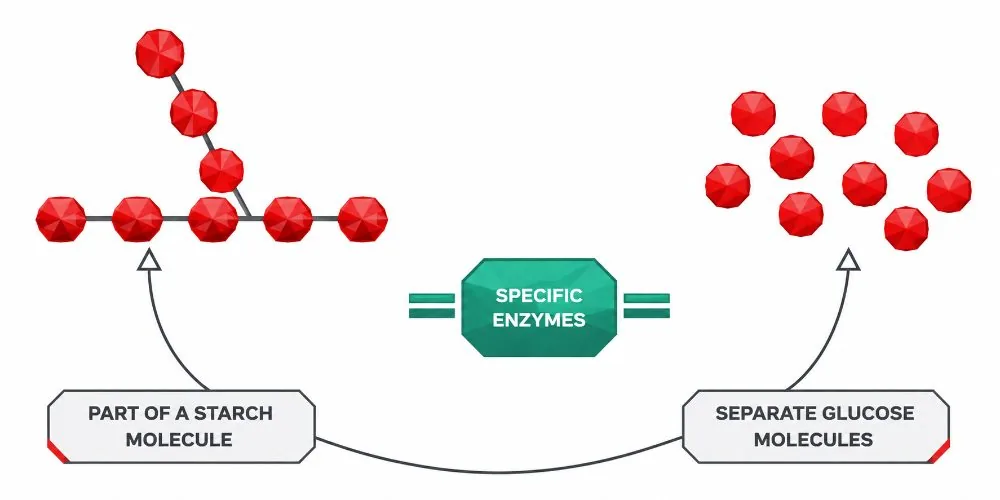
Amylopectin structure
Worked examples
⤢ Enlarge
Worked examples
How many water molecules are released when a polypeptide of 150 amino acids is synthesised?
How many are needed to fully hydrolyse it?
Each peptide bond releases one water 150 – 1 = 149 molecules released. Hydrolysis of all 149 peptide bonds needs 149 water molecules.
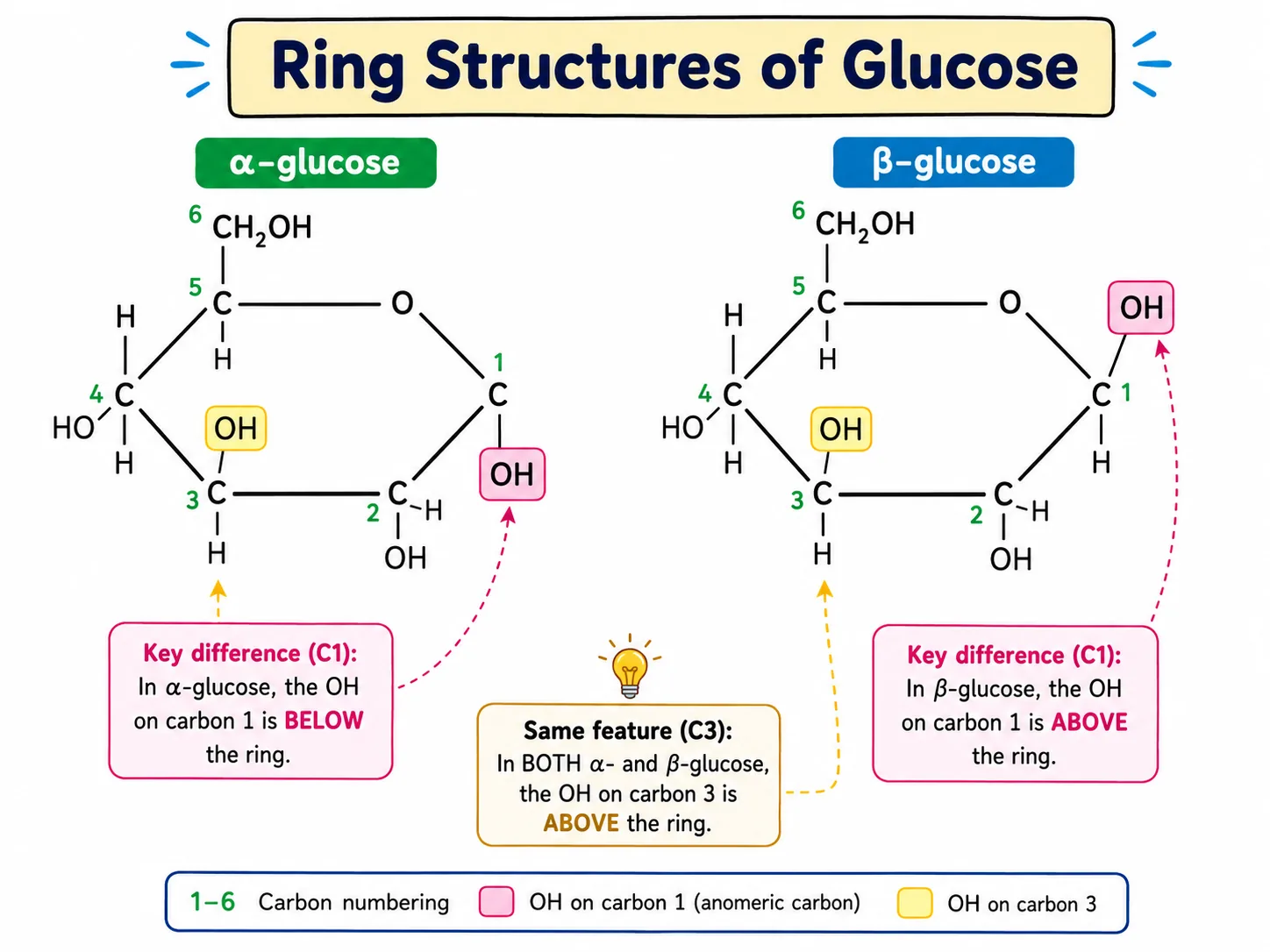
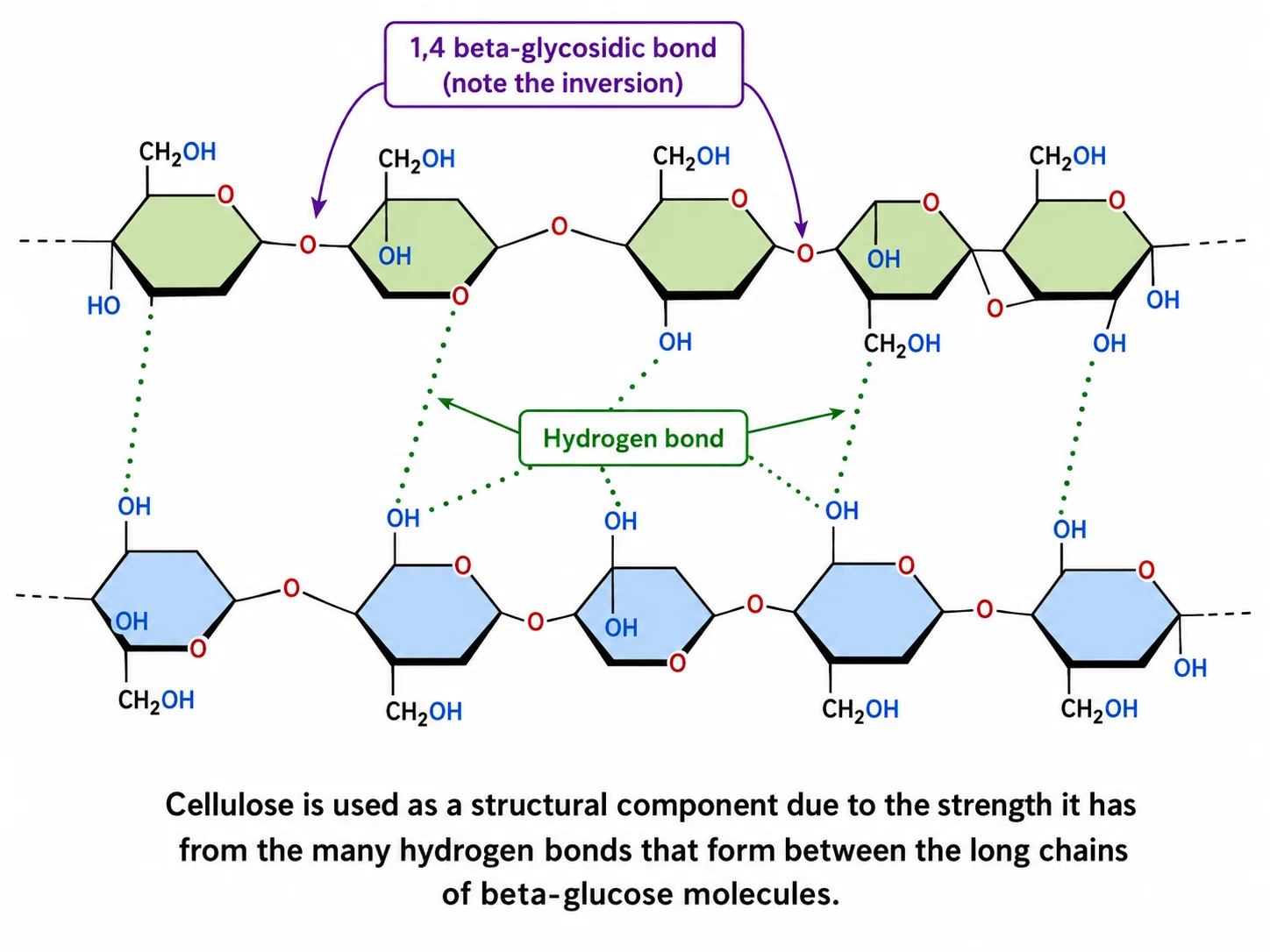
Explain why cellulose and starch have such different properties even though both are made of glucose.
Starch uses α-glucose
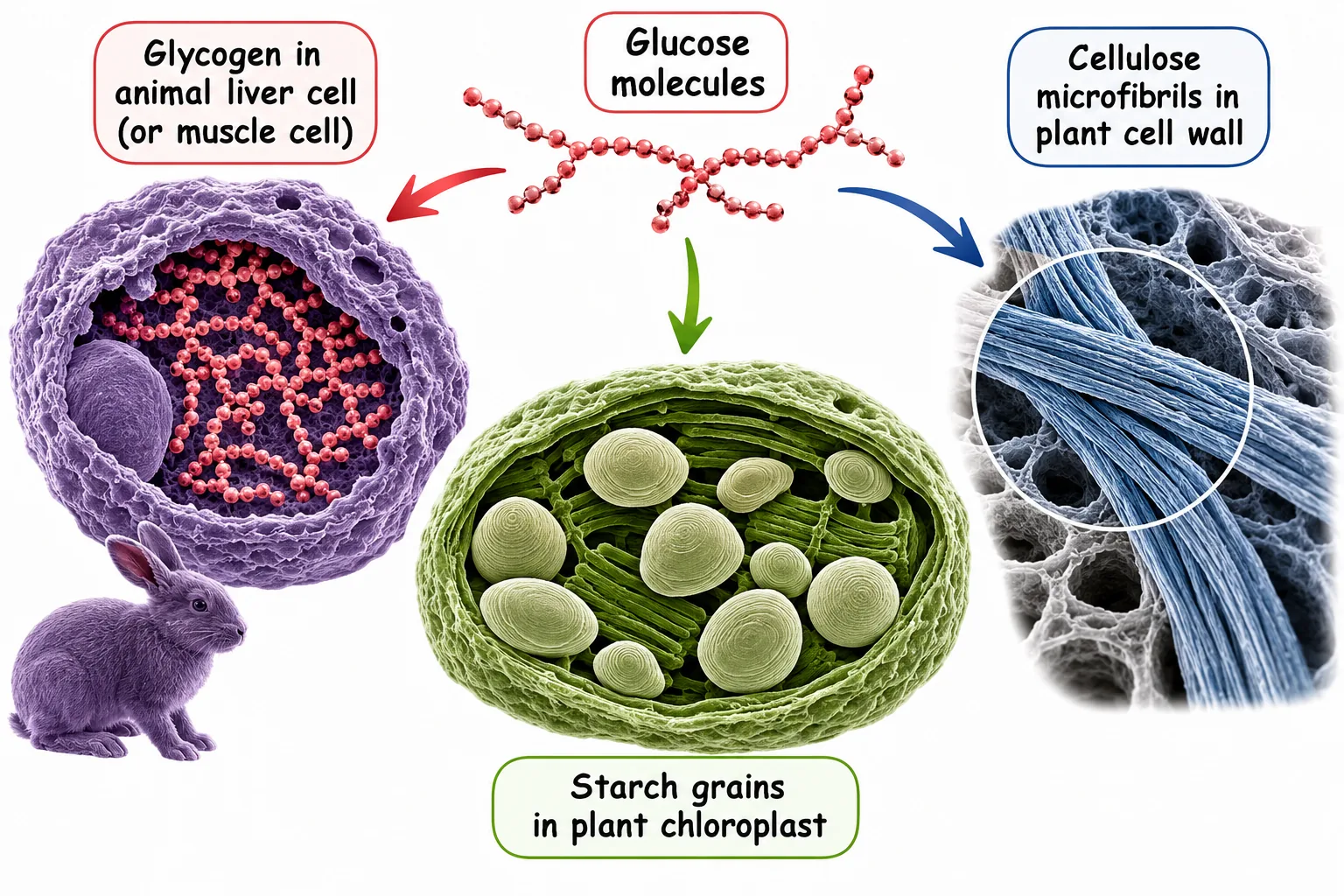
its α-1,4 linkages make a helical, compact molecule (with branches in amylopectin) that is easily hydrolysed for energy.Cellulose uses β-glucose; alternate monomers are flipped,forming straight chains that H-bond to neighbouring chains, making strong microfibrils for cell walls.Most animal enzymes cannot hydrolyse β-1,4 links.
1.3 Biological Macromolecules · 4 / 6
1.3 Summary
Summary
Summary3Summary
Summary
Polymers are built by
dehydration synthesis
and broken by
hydrolysis
.
1 / 3Next ▶
Summary
Summary
Carbohydrates
give quick energy and structure.
Lipids
are hydrophobic and store the most energy per gram.