Curriculum
General Biology
1. Foundations
0/6
2. Cells & Energy
0/10
3. Genetics & Evolution
0/8
-
3.1 Mitosis & Meiosis
 Preview
-
3.1 Mitosis & Meiosis - Check yourself
 Preview
-
3.2 Classical Genetics
Preview
-
3.2 Classical Genetics - Check yourself
Preview
-
3.3 DNA, RNA & Protein Synthesis
Preview
-
3.3 DNA, RNA & Protein Synthesis - Check yourself
Preview
-
3.4 Evolution
Preview
-
3.4 Evolution - Check yourself
Preview
4. Diversity of Life
0/4
5. Animal Systems
0/4
6. Ecology & Biotechnology
0/4
Text lesson
3.2 Classical Genetics
Use genetic vocabulary correctly and solve monohybrid and dihybrid crosses.
1Key ideas2Key ideas3Key ideas4Key ideas5Key ideas6Key ideas
Key ideas
 ⤢ Enlarge
Key ideas
P(A and B) = P(A) × P(B) for independent events.
P(A or B) = P(A) + P(B) for mutually exclusive events.
Number of gamete types = 2
n
where n = number of heterozygous gene pairs.
χ
◀ Previous4 / 6Next ▶
Key ideas
1
2
2
= Σ(O – E)
3
/E
degrees of freedom = number of categories – 1critical value at p = 0.05 with 1 df is 3.84.
4
Recombination frequency (%) = recombinants / total offspring × 100
1% = 1 map unit (centimorgan).
5
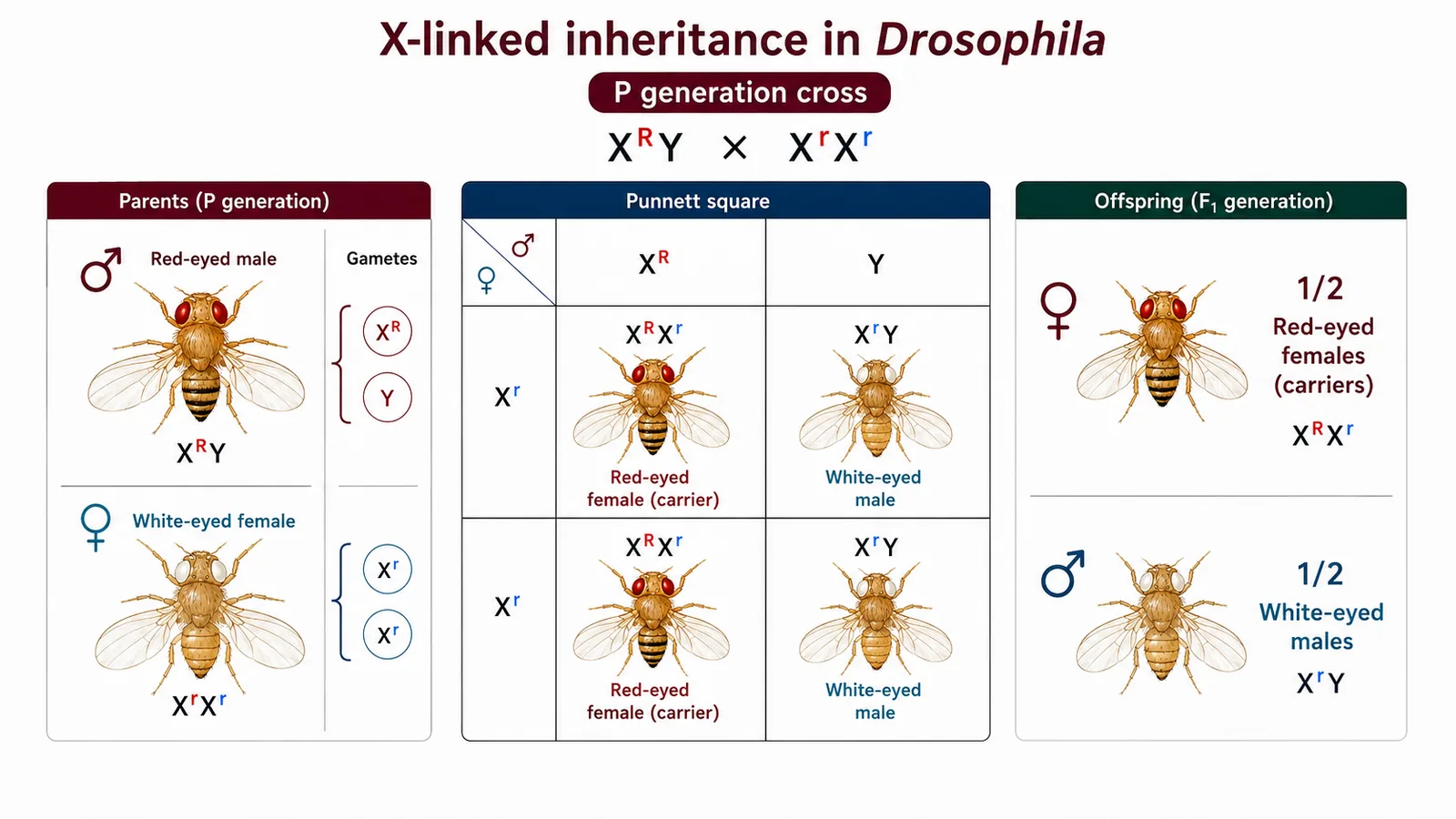
X-linked recessive traits (haemophilia, red-green colour blindness) are more common in males, who are hemizygous (X
6
a
◀ Previous5 / 6Next ▶
Key ideas
1
Y).
2
Linked genes lie close together on the same chromosome and do not assort independently.
3
Pedigrees
4
autosomal recessive can skip generations
autosomal dominant appears in every generation with affected parent.
◀ Previous6 / 6
1Essential knowledge2Essential knowledge3Essential knowledge4Essential knowledge5Essential knowledge6Essential knowledge7Essential knowledge8Essential knowledge9Essential knowledge10Essential knowledge11Essential knowledge12Essential knowledge13Essential knowledge


Essential knowledge
 ⤢ Enlarge
1
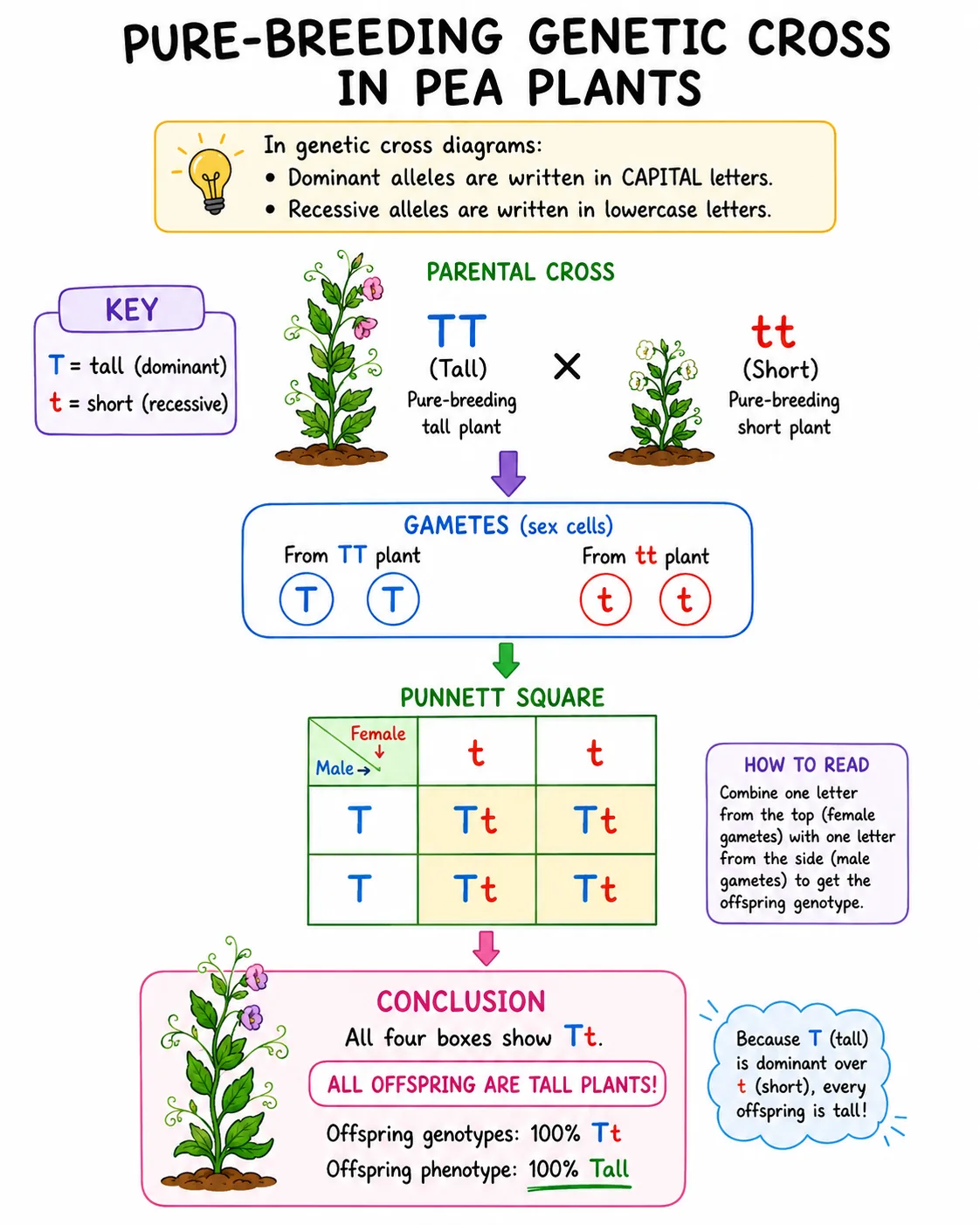
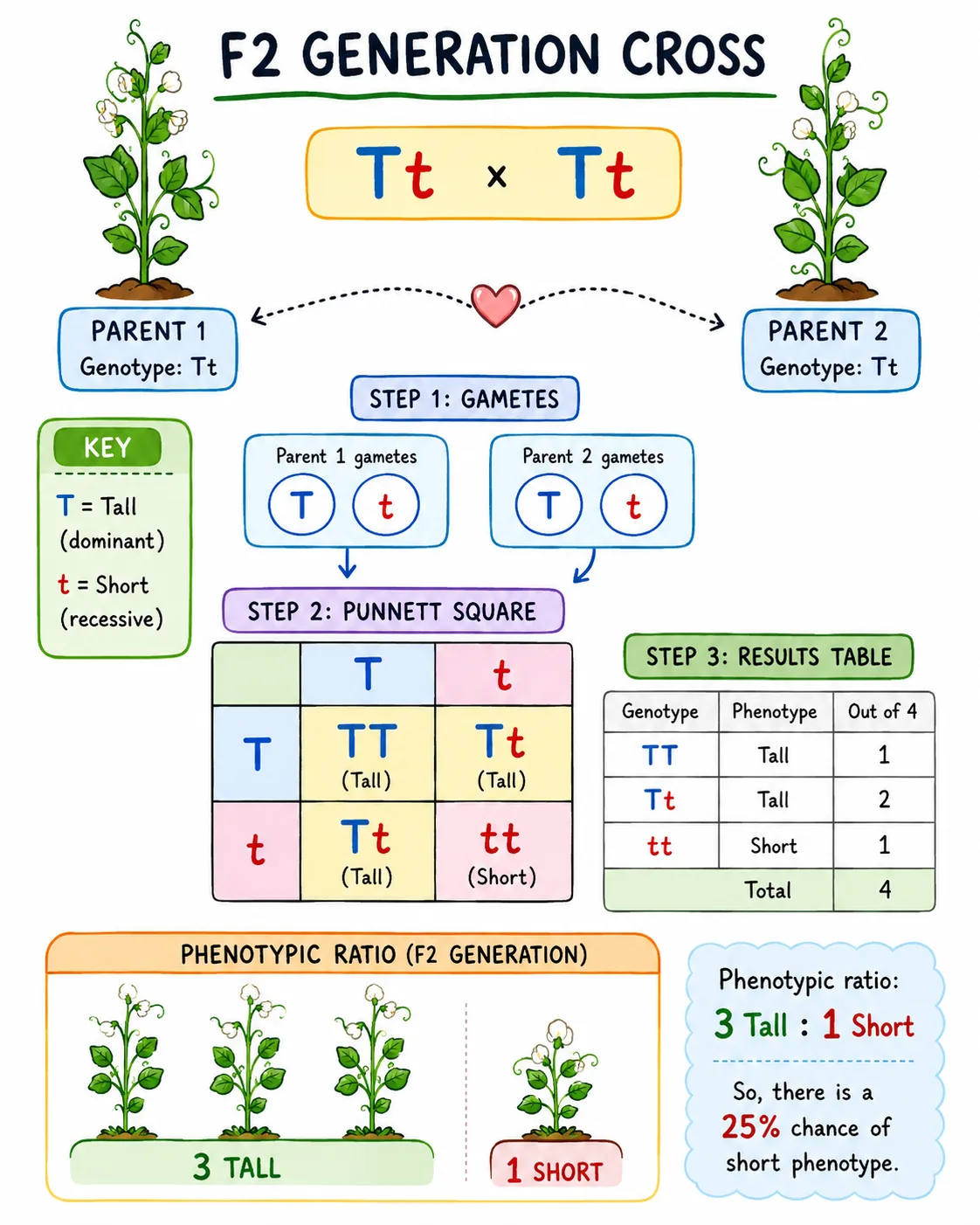
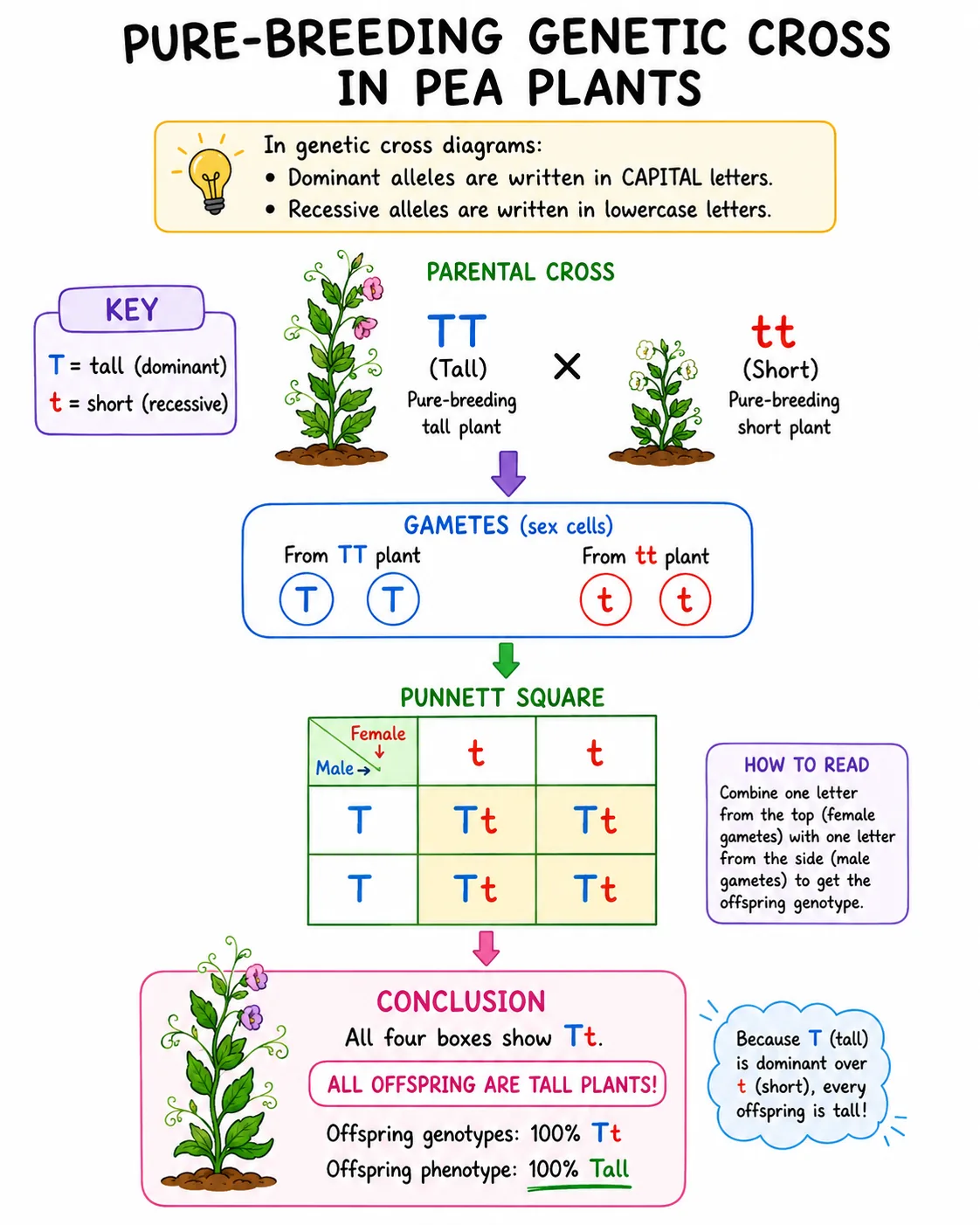
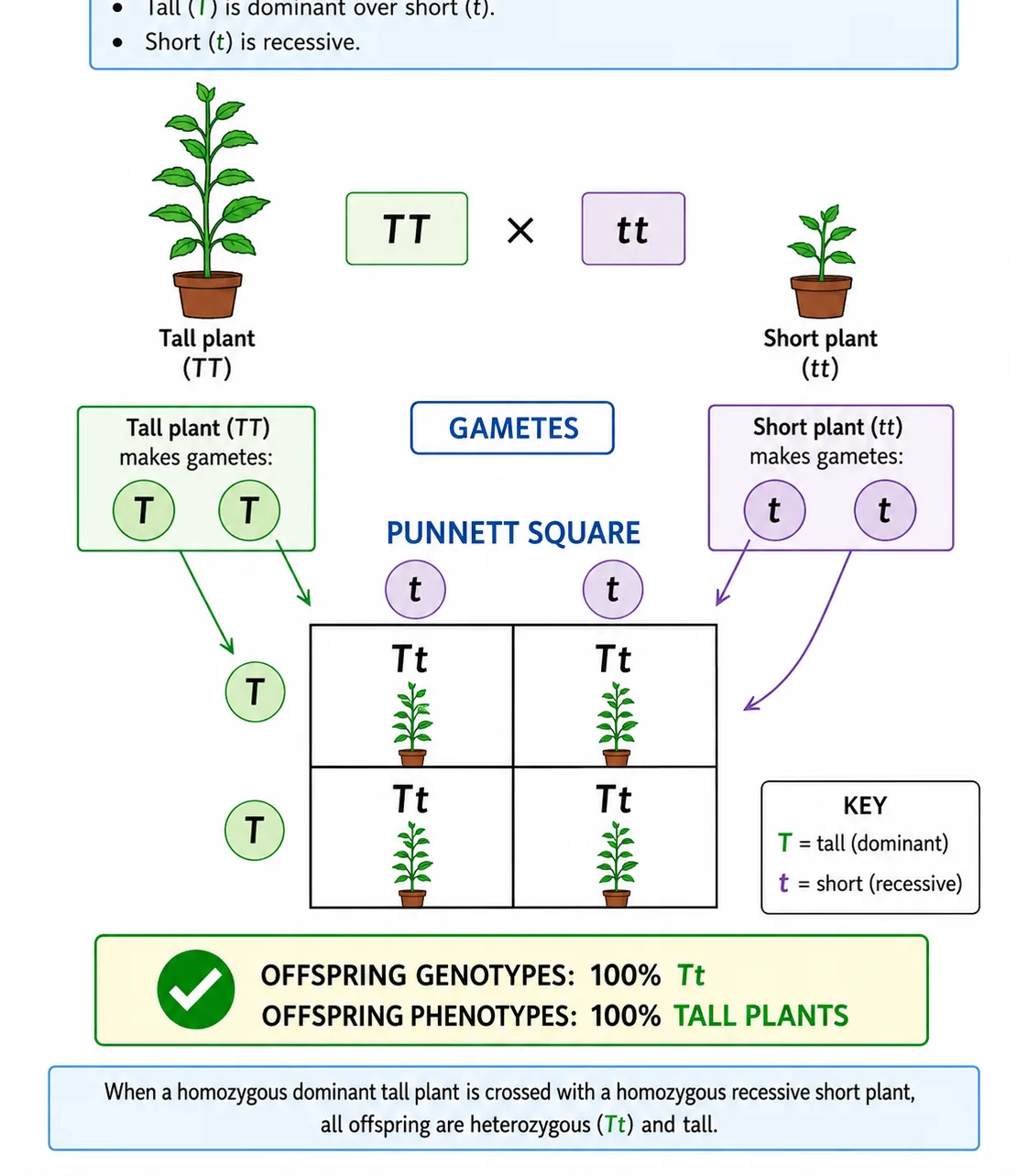
Mendel used true-breeding pea plants, controlled pollination and counted large numbers of offspring. The P generation gives an F
2
1
3
(all showing the dominant trait) and self-crossing gives an F
4
2
5
with a 3:1 ratio.
6
Law of segregation
◀ Previous8 / 13Next ▶
Essential knowledge
Essential knowledge
each organism has two alleles for each gene
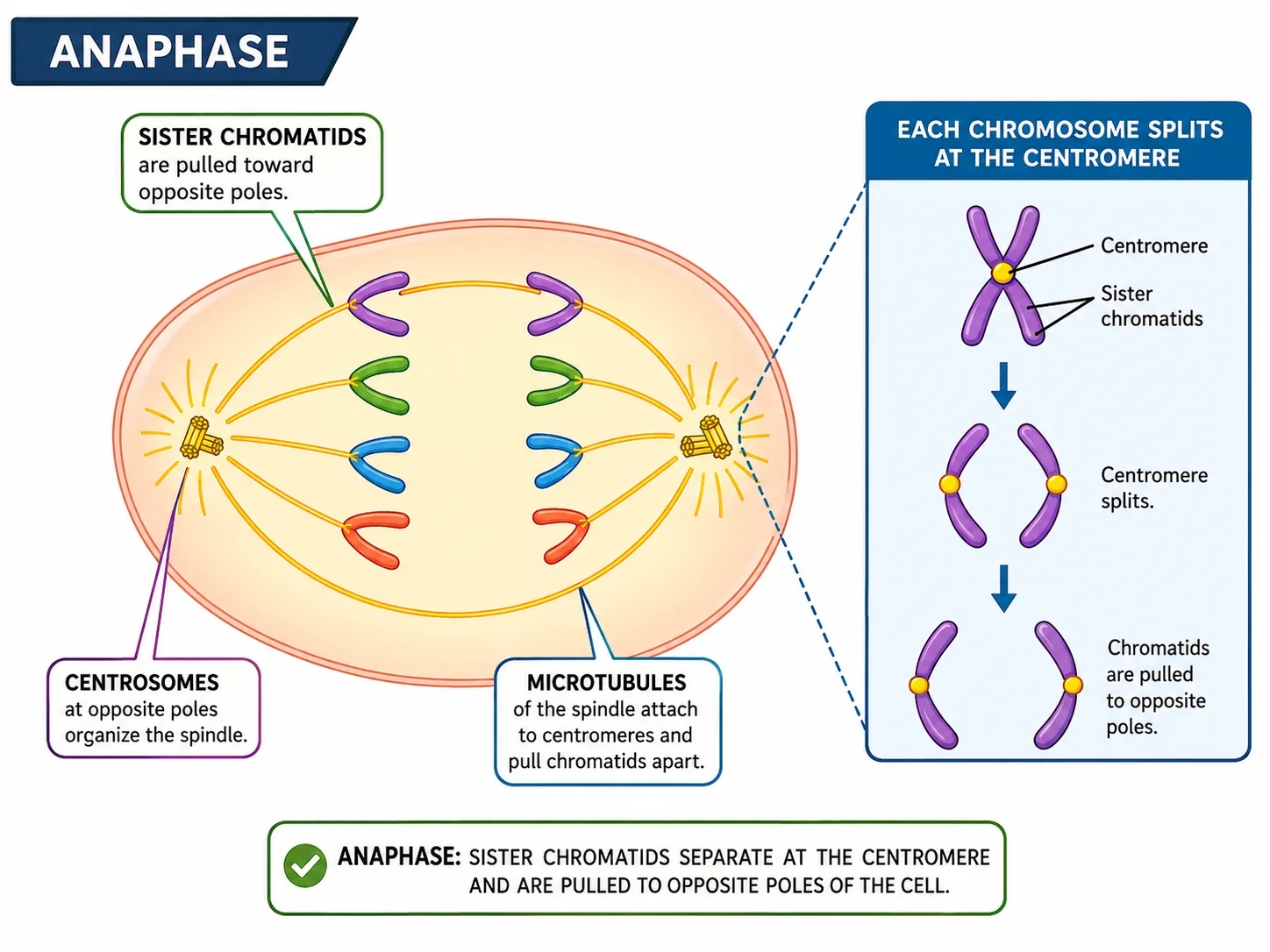
these separate in meiosis (anaphase I)so each gamete carries one. Fertilisation restores two alleles.
Law of independent assortment
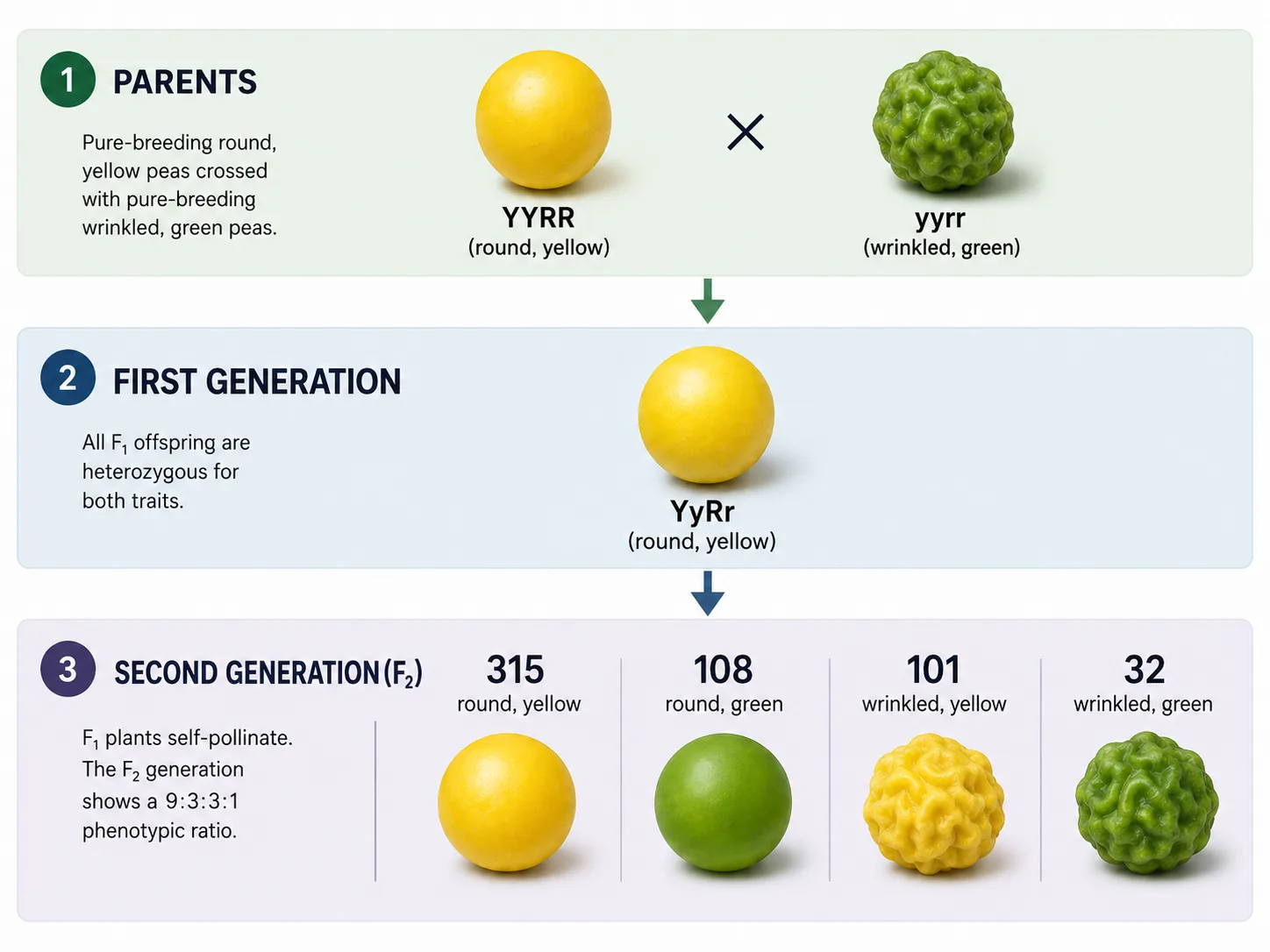
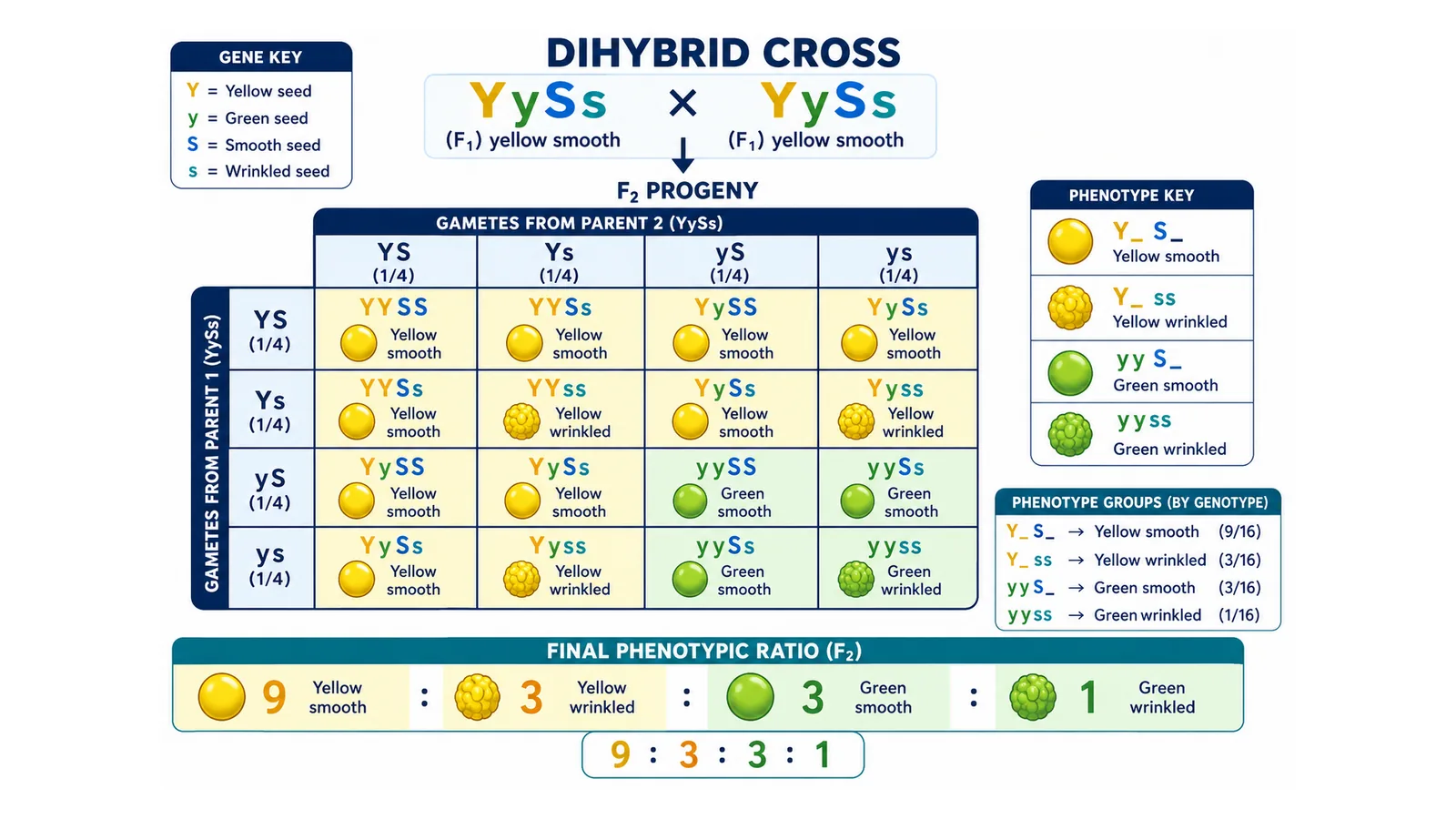
in a dihybrid cross, genes on different chromosomes assort independently because homologous pairs orient randomly at metaphase I
giving a 9:3:3:1 F
ratio.
Probability
each gamete from Aa has a
◀ Previous9 / 13Next ▶
Essential knowledge
Essential knowledge
⁄
chance of carrying A. Complex crosses can be broken into single-gene problems and multiplied, e.g. AaBbCc × AaBbCc: P(aabbcc) =
4
×
=
64
◀ Previous10 / 13Next ▶
Essential knowledge
1
.
2
Beyond simple dominance
3
incomplete dominance and codominance, multiple alleles (ABO), pleiotropy (one gene affecting many traits, e.g. sickle-cell disease), epistasis, polygenic inheritance and environmental effects (norm of reaction, e.g. hydrangea colour depending on soil pH).
4
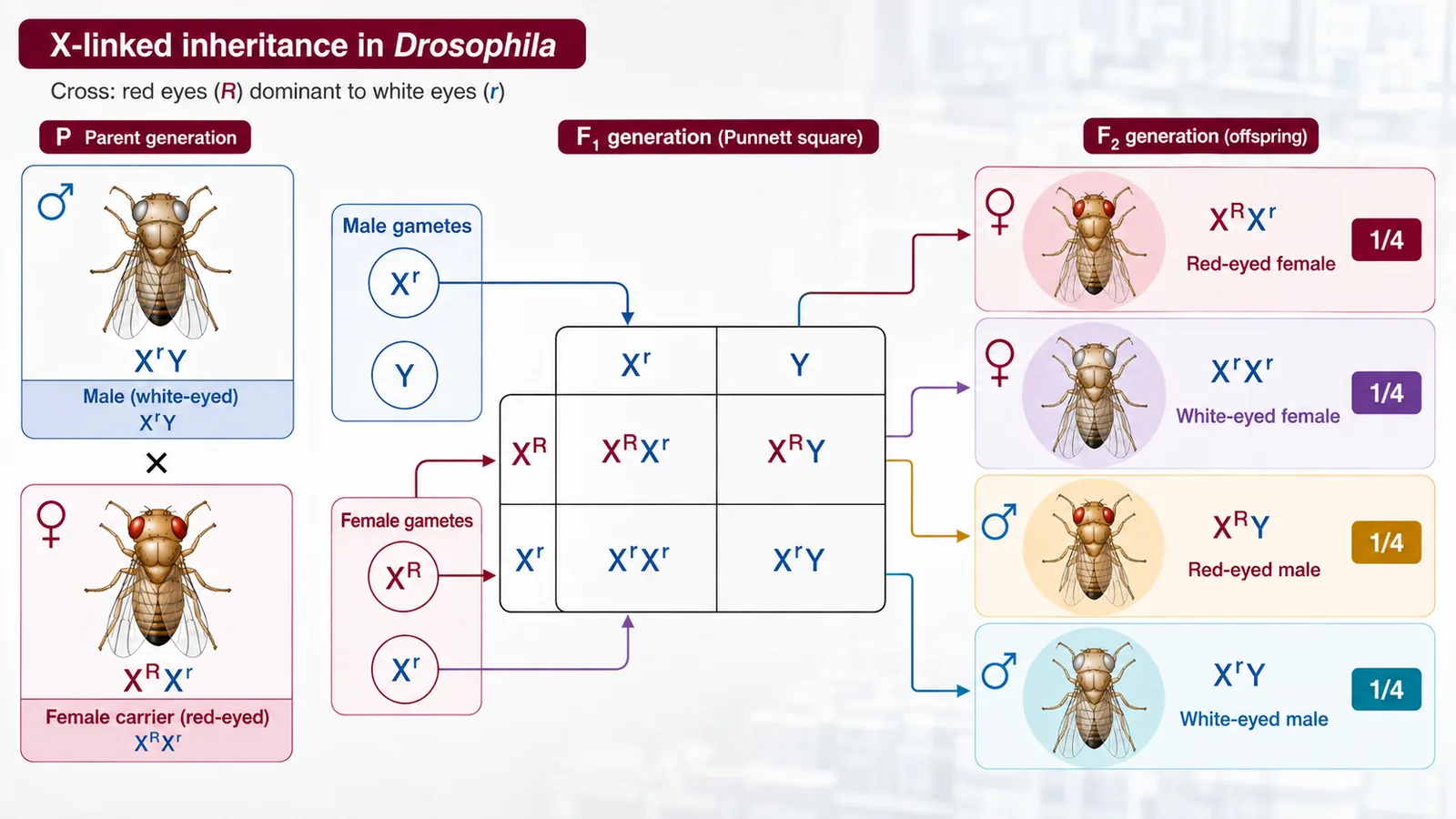
Morgan’s Drosophila work showed white eye colour is on the X chromosome. Males (XY) express any X-linked allele they inherit from their mother. Carrier females (X
5
A
6
X
◀ Previous11 / 13Next ▶
Essential knowledge
1
a
2
) pass the allele to half their sons.
3
Linkage and mapping
4
genes close together on one chromosome tend to be inherited together. Crossing over produces recombinant offspring
the further apart two genes are, the higher the recombination frequency (max ~50%). These frequencies are used to build genetic maps.
5
Pedigrees
6
symbols show males (squares), females (circles), affected (shaded). Clues: two unaffected parents with an affected child → recessive
affected father passing to all daughters but no sons → X-linked dominant.
◀ Previous12 / 13Next ▶
Essential knowledge
Essential knowledge
Human genetic disorders
recessive (cystic fibrosis, sickle-cell, Tay-Sachs), dominant (Huntington’s, achondroplasia), X-linked (haemophilia, Duchenne muscular dystrophy), chromosomal (trisomy 21, Turner XO, Klinefelter XXY).
◀ Previous13 / 13
1Process & sequence2Process & sequence3Process & sequence4Process & sequence5Process & sequence

Process & sequence
 ⤢ Enlarge
Process & sequence
1
Assign letters to alleles and write the parental genotypes.
2
Work out all possible gametes (segregation
independent assortment for two genes).
3
Draw a Punnett square or use probability rules.
◀ Previous2 / 5Next ▶
Process & sequence
Process & sequence
4
Combine gametes to find offspring genotypes.
5
Convert genotypes to phenotypes and write ratios.
6
Compare observed and expected ratios (e.g. with chi-square).
◀ Previous3 / 5Next ▶
Process & sequence
1
Solving a genetics cross — write these steps in this order
each step is a marking point.
2
Define allele symbols
3
Write parent genotypes
4
List possible gametes
5
Punnett square or probability
6
State genotype and phenotype ratios
◀ Previous4 / 5Next ▶
Process & sequence
Process & sequence
Test fit with chi-square
◀ Previous5 / 5
1Worked examples2Worked examples3Worked examples
Worked examples
 ⤢ Enlarge
Worked examples
In pea plants, tall (T) is dominant to dwarf (t) and yellow seeds (Y) are dominant to green (y). Two TtYy plants are crossed. What fraction of offspring are tall with green seeds? Out of 320 offspring, how many is this expected to be?
P(tall) = 3⁄4 (TT or Tt)
P(green) = 1⁄4 (yy). P(tall and green) = 3⁄4 × 1⁄4 = 3⁄16. Expected number = 3⁄16 × 320 = 60 offspring.
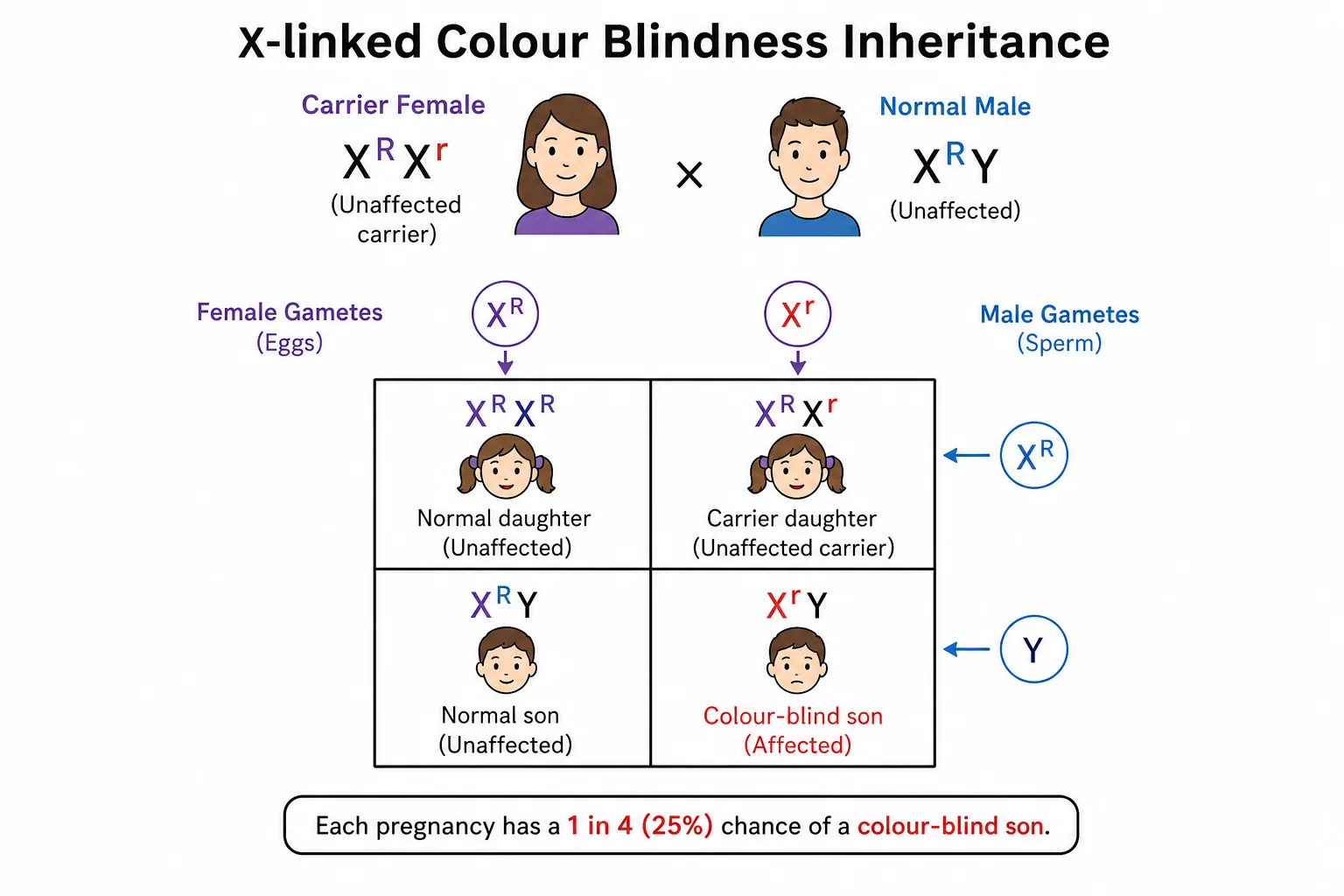
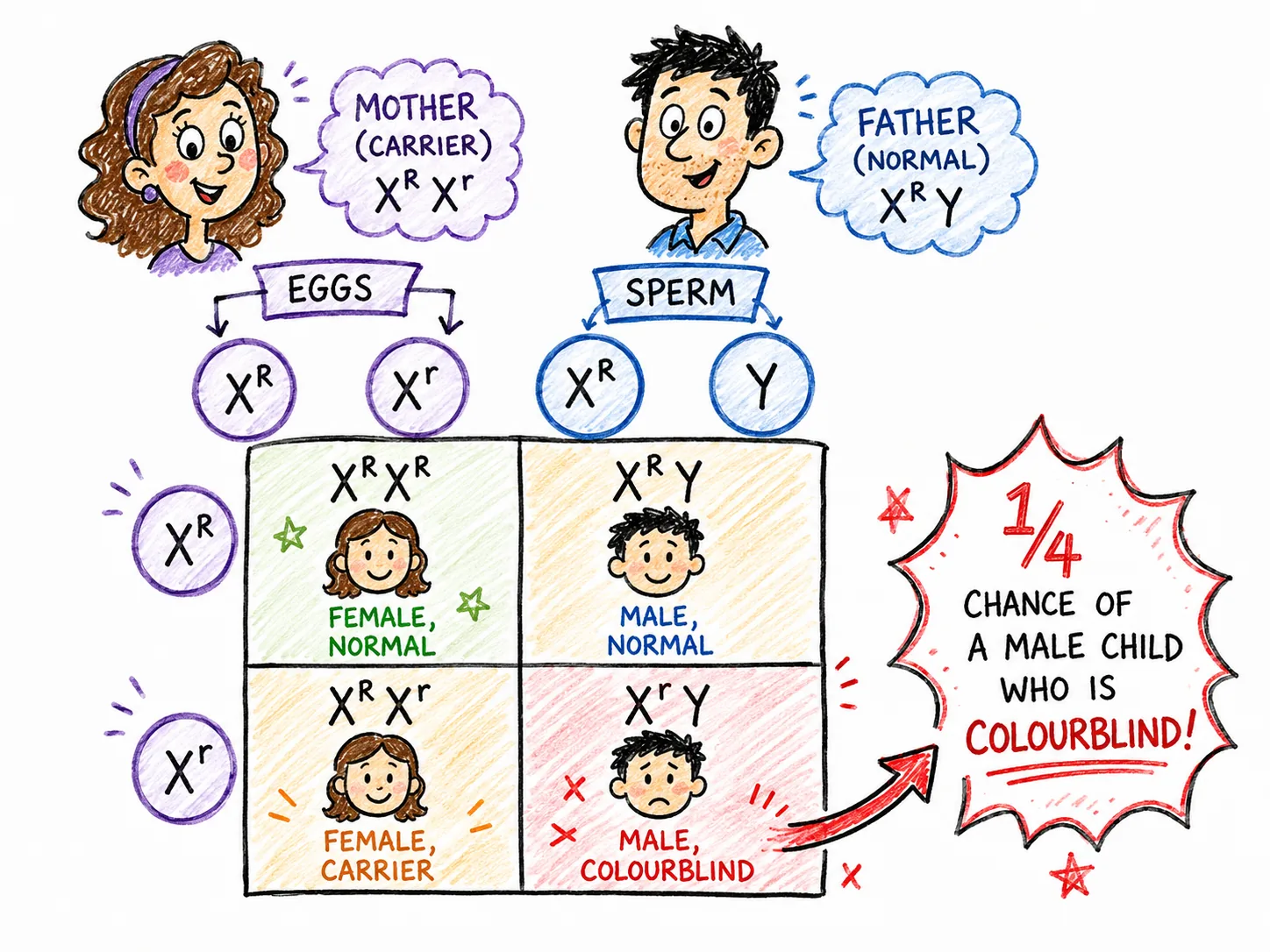
A woman who is a carrier for haemophilia (X
H
X
h
1 / 3Next ▶
Worked examples
1
) has children with an unaffected man (X
2
Y). What is the probability that a son will have haemophilia? That any child will be an affected boy?
3
Sons get Y from the father and one X from the mother: 1/2 XHY, 1/2 XhY
so P(affected | son) = 1⁄2.For any child: P(boy) = 1⁄2 × P(Xh) = 1⁄2, giving 1⁄4.Daughters are all unaffected.(half are carriers)
4
A monohybrid F
5
2
6
produced 290 dominant and 110 recessive phenotypes. Do these fit a 3:1 ratio?
◀ Previous2 / 3Next ▶
Worked examples
Worked examples
Total 400
expected 300 : 100. χ2 = (290 – 300)2/300 + (110 – 100)2/100 = 0.333 + 1.0 = 1.33. df = 1, critical value 3.84.1.33 < 3.84, so we fail to reject the null hypothesis: the data fit a 3:1 ratio.
◀ Previous3 / 3
1Summary2Summary3Summary4Summary
1Check yourself2Check yourself3Check yourself4Check yourself5Check yourself6Check yourself7Check yourself8Check yourself9Check yourself10Check yourself11Check yourself12Check yourself13Check yourself14Check yourself

Check yourself
 ⤢ Enlarge
Check yourself
Q1. A cross between Aa and Aa gives what proportion of heterozygous offspring?
A. 1/4
B. 1/2
C. 3/4
D. 1
Show answer
◀ Previous8 / 14Next ▶
Check yourself
Check yourself
B. Genotypic ratio is 1 AA : 2 Aa : 1 aa
so 2⁄4 = 1⁄2 are Aa.
Q2. A test cross is performed by crossing an individual with:
1
A. a homozygous dominant
2
B. a heterozygote
◀ Previous9 / 14Next ▶
Check yourself
1
3
2
C. a homozygous recessive
3
4
4
D. its sibling
5
C. A homozygous recessive reveals which alleles the unknown parent contributes.
6
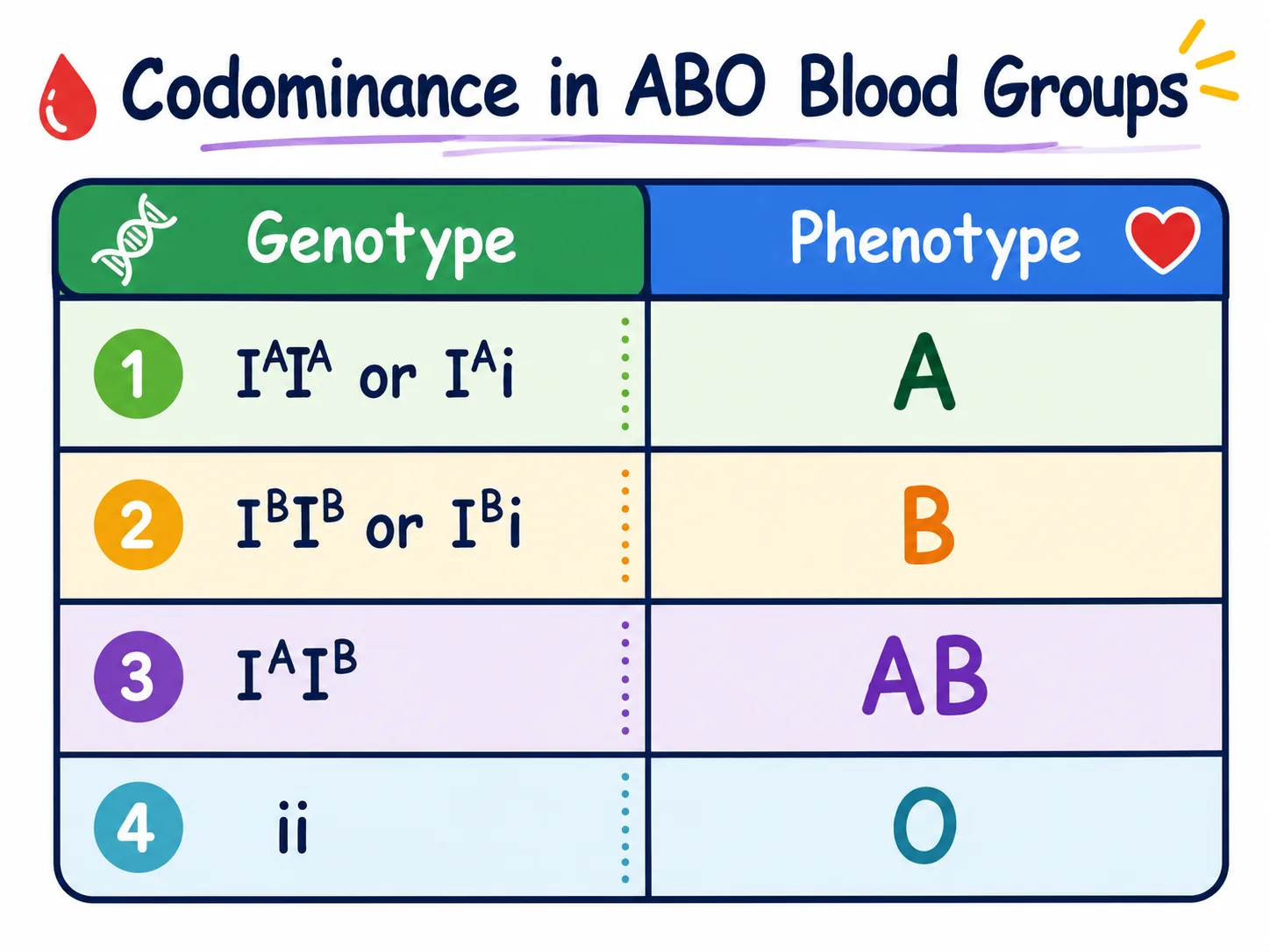
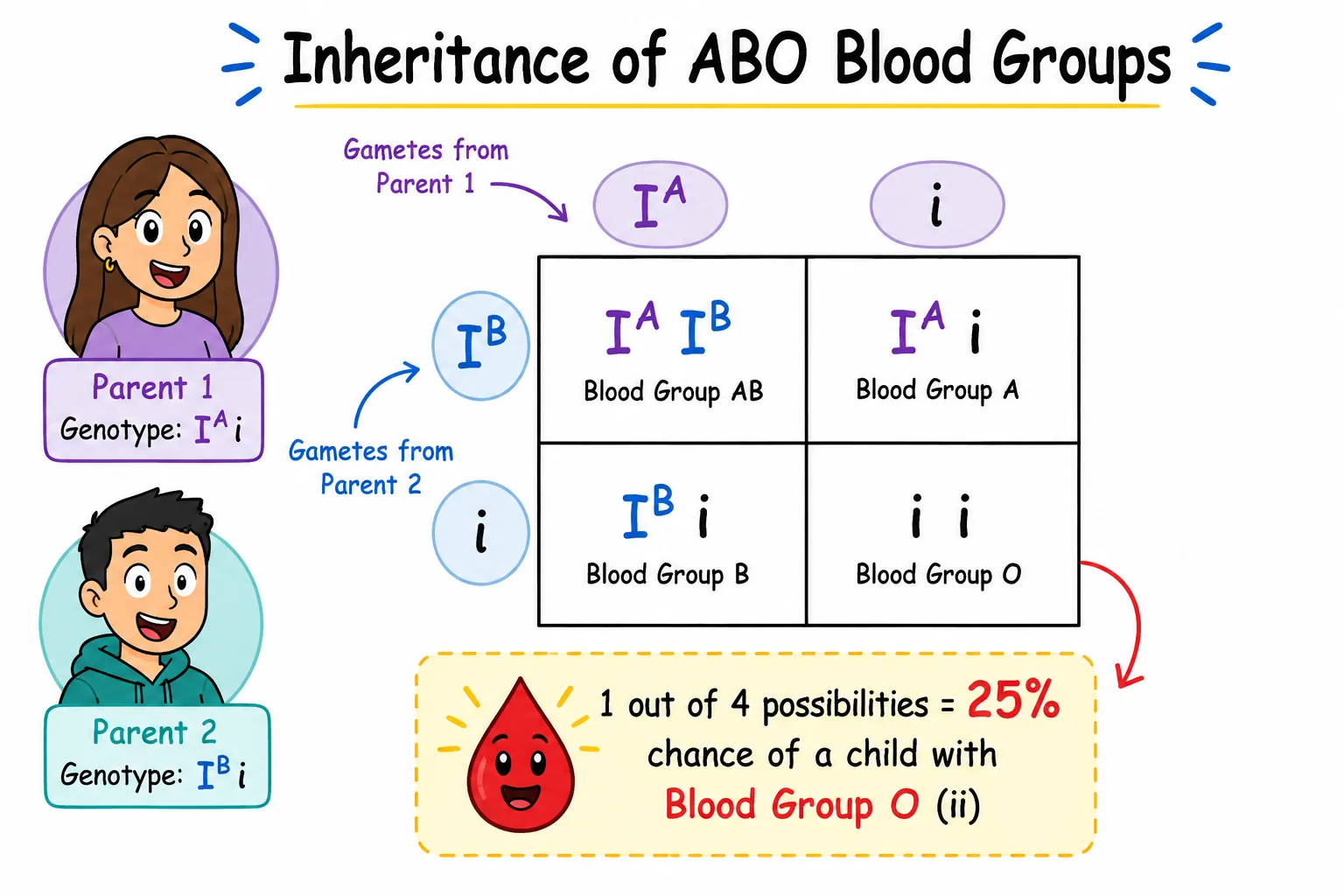
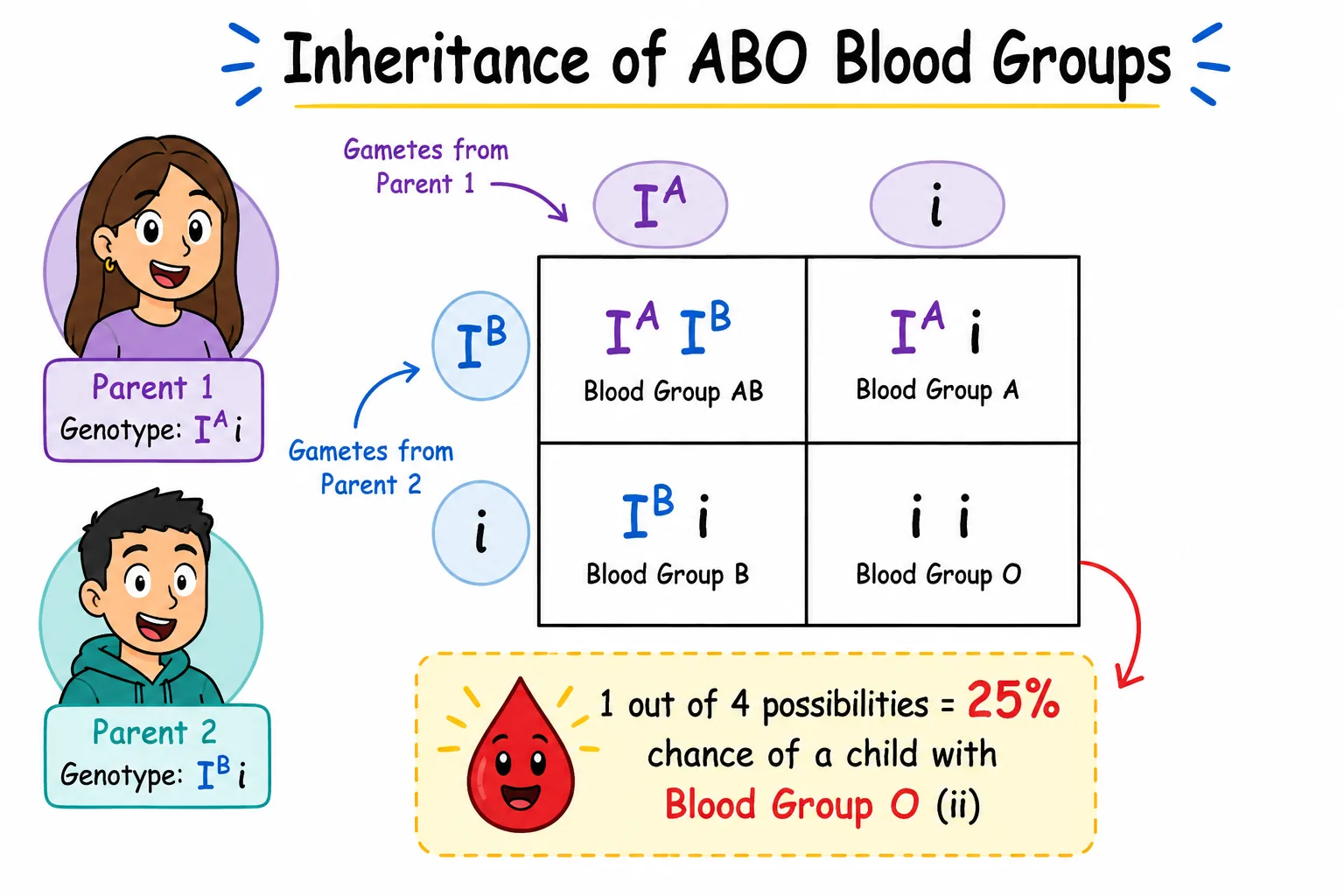
Q3. A person with blood type AB illustrates:
◀ Previous10 / 14Next ▶
Check yourself
1
A. incomplete dominance
2
B. epistasis
3
C. polygenic inheritance
4
D. codominance
5
D. Both IA and IB antigens are fully expressed.
6
Q4. The probability that AaBbCc × AaBbCc produces an aabbcc offspring is:
◀ Previous11 / 14Next ▶
Check yourself
Check yourself
A. 1/64
B. 1/16
C. 1/8
D. 3/64
A. 1⁄4 × 1⁄4 × 1⁄4 = 1⁄64.
Q5. Why are X-linked recessive disorders more common in males?
◀ Previous12 / 14Next ▶
Check yourself
1
A. Males have two X chromosomes
2
B. Males have only one X
so one recessive allele is expressed
3
C. The Y chromosome carries the allele
4
D. Females cannot inherit them
5
B. Males are hemizygous
there is no second X allele to mask the recessive one.
6
Q6. Two genes show a recombination frequency of 12%. This means they are:
◀ Previous13 / 14Next ▶
Check yourself
Check yourself
A. on different chromosomes
B. unlinked
C. the same gene
D. 12 map units apart on the same chromosome
D. Recombination frequency of 1% corresponds to 1 map unit
12% = 12 cM apart.
◀ Previous14 / 14
Gene
A sequence of DNA at a particular locus that codes for a trait.
Allele
An alternative version of a gene.
Genotype
The genetic makeup of an organism, e.g. Aa.
Phenotype
The observable characteristics of an organism, resulting from genotype and environment.
Homozygous
Having two identical alleles for a gene (AA or aa).
Heterozygous
Having two different alleles for a gene (Aa).
Law of segregation
The two alleles for a gene separate during gamete formation so each gamete gets one allele.
Law of independent assortment
Alleles of different genes on different chromosomes assort independently into gametes.
Test cross
Crossing an individual of dominant phenotype with a homozygous recessive to find its genotype.
Sex-linked gene
A gene located on a sex chromosome, usually the X chromosome.
| Pattern | Description | Example | F2 phenotype ratio (Aa × Aa) |
|---|---|---|---|
| Complete dominance | Heterozygote looks like dominant homozygote | Mendel’s purple vs white flowers | 3:1 |
| Incomplete dominance | Heterozygote is intermediate | Red × white snapdragons → pink | 1:2:1 |
| Codominance | Both alleles fully expressed | AB blood group; roan cattle | 1:2:1 |
| Multiple alleles | More than two alleles in the population | ABO blood groups (IA, IB, i) | Varies |
| Epistasis | One gene masks another | Labrador coat colour | 9:3:4 (dihybrid) |
| Polygenic | Many genes add to one trait | Human height, skin colour | Continuous variation |
| Cross | Genotypic ratio | Phenotypic ratio |
|---|---|---|
| Aa × Aa | 1 AA : 2 Aa : 1 aa | 3 dominant : 1 recessive |
| Aa × aa (test cross) | 1 Aa : 1 aa | 1 : 1 |
| AaBb × AaBb | 9 genotypic classes | 9 : 3 : 3 : 1 |
| AaBb × aabb | 1 : 1 : 1 : 1 | 1 : 1 : 1 : 1 (if unlinked) |
Command terms
Identify / Describe (FRQ)
A short, specific statement; describing requires relevant characteristics, not a single word.
Explain / Justify (FRQ)
Give the cause-and-effect reasoning or evidence; a restated fact does not score.
Calculate
Show setup, substitution and the answer with units.
Predict
State the expected outcome; add a reason only if asked to justify.
MCQ technique
Read every option; eliminate distractors that are true statements but do not answer the question; watch for NOT/EXCEPT.
Keywords the mark scheme looks for in this lesson
Keywords the mark scheme looks for in this lesson
Gene · Allele · Genotype · Phenotype · Homozygous · Heterozygous · Law of segregation · Law of independent assortment · Test cross · Sex-linked gene
Learn each definition in the Key words tab exactly; a missing keyword in a definition usually loses the mark.
How to get full marks (examiner guidance)
1
Answer exactly what is asked; extra correct material does not earn credit, and contradictory statements can cancel credit (AP FRQ).
2
Use precise vocabulary (e.g. “active site”, “concentration gradient”, “allele”), never “it/stuff/things”.
3
Show units and working in calculations.
4
In MCQs, predict the answer before reading the options, then eliminate.