Curriculum
NAFS Grade 6 Science
Start here: About NAFS Grade 6 Science
0/2
Unit 1: Forces and Motion
0/19
Unit 2: Energy
0/17
-
2.1 Forms of energy, kinetic and potential energy, energy conservation
 Preview
-
Quiz 2.1: Forms of energy (Part 1)
 Preview
-
Quiz 2.1: Forms of energy (Part 2)
Preview
-
Quiz 2.1: Forms of energy (Part 3)
Preview
-
2.2 Heat transfer: conduction, convection, radiation, insulation
Preview
-
Quiz 2.2: Heat transfer: conduction
Preview
-
2.3 Work, power and simple machines
Preview
-
2.3 Work, power and simple machines (Part 2)
Preview
-
2.3 Work, power and simple machines (Part 3)
Preview
-
2.3 Work, power and simple machines (Part 4)
Preview
-
2.3 Work, power and simple machines (Part 5)
Preview
-
2.3 Work, power and simple machines (Part 6)
Preview
-
2.3 Work, power and simple machines (Part 7)
Preview
-
2.3 Work, power and simple machines (Part 8)
Preview
-
2.3 Work, power and simple machines (Part 9)
Preview
-
2.3 Work, power and simple machines (Part 10)
Preview
-
Quiz 2.3: Work
Preview
Unit 3: Sound
0/2
Unit 4: Light
0/8
Unit 5: Electricity and Magnetism
0/19
Unit 6: Earth, Moon and Sun
0/15
Unit 7: Space
0/14
Unit 8: Weather and Climate
0/11
Unit 9: Earth's Structure and Plate Tectonics
0/5
Unit 10: Rocks, Minerals, Soil and Fossils
0/11
Unit 11: Changing Earth's Surface
0/5
Unit 12: Volcanoes and Earthquakes
0/6
Unit 13: Life Science
0/32
Unit 14: Matter
0/9
Text lesson
2.3 Work, power and simple machines (Part 2)
Kinetic and Gravitational Potential Energy and Conservation of Energy — NAFS Grade 6 Science notes: Calculate kinetic and gravitational potential energy and apply the principle of conservation of energy with flow diagrams.
1Equation · Common errors · Unit2Example
1Definition · Why it changes · Equation2Example
Definition · Why it changes · Equation
Definition
the energy an object has because of its height in a gravitational field.
Why it changes
work is done against the weight force when an object is lifted
so energy is transferred to the gravitational store.
Equation
ΔEp = m g Δh, with m in kg, g in N/kg and Δh the change in height in metres.What the symbols mean: Ep = gravitational potential energy gained (J) · m = mass (kg) · g = 9.81 N kg−1 · h = change in height (m)
1 / 2Next ▶
Potential energy of a system: Work lifting a mass is stored as gravitational potential energy and released as it falls.
Example
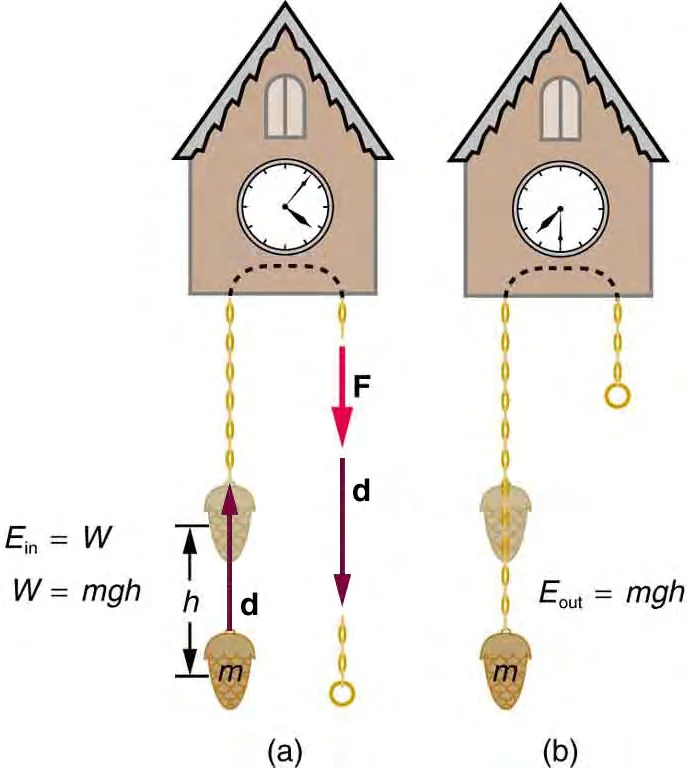 ⤢ Enlarge
Example
lifting a 21 kg load through 10 m with g = 10 N/kg gives ΔEp = 21 × 10 × 10 = 2100 J.
◀ Previous2 / 2
Rule · Example · Exam
Rule
an answer can only be as precise as the least precise input value
so round to the lowest number of significant figures in the data.
Example
with inputs of 2 significant figures the answer ΔEp = 2100 J is given to 2 significant figures.
Exam
in IGCSE theory papers any answer given to two or more significant figures is generally accepted unless the question says otherwise.
Graph of gravitational potential energy and kinetic energy against distance fallen for a 2 kg object in a vacuum
Conservation of energy
 ⤢ Enlarge
Principle
energy cannot be created or destroyed
it can only be transferred from one store to another.
Closed system
the total amount of energy is constant
so energy transferred in equals energy transferred away.
Exam wording
if you are asked to state the principle, you must say that energy cannot be created or destroyed, only transferred between stores.
Bat hitting a ball · Kettle boiling water · Wasted energy
Bat hitting a ball
an energy flow diagram shows the energy from the bat’s kinetic store going to the ball’s kinetic store, with some wasted as thermal energy and sound.
Kettle boiling water
energy is transferred electrically from the mains supply to the thermal store of the heating element
and then to the water.
Wasted energy
always say which store the wasted energy ends up in, usually the thermal store of the surroundings.
Energy flow diagrams
Stores in boxes
each store is a labelled box and each transfer pathway is an arrow between boxes.
Example
a nuclear power plant diagram shows the nuclear store, the thermal store, kinetic energy of turbine and electrical energy output.
Conserved
energy is always conserved in these diagrams
this is useful for calculations but is not itself a statement of the principle.
Missing labels
you may be asked to complete a diagram.
1Moving object · Lifted object · Falling object2Example
1Worked examples2Worked examples3Worked examples4Worked examples
Worked examples
1
Worked example 1. A cyclist and bicycle have mass 70 kg and kinetic energy 1400 J. Calculate the speed [3].
2
Ek = ½mv2
so v2 = 2 × 1400 / 70 = 40.
3
v = √40.
4
v = 6.3 m/s.
5
Worked example 2. Calculate the gain in gravitational potential energy when a 21 kg load is lifted 10 m (g = 10 N/kg) [2].
1 / 4Next ▶
Worked examples
1
ΔE
2
p
3
= m g Δh = 21 × 10 × 10.
4
= 2100 J.
5
Worked example 3. State the principle of conservation of energy [2].
6
Energy cannot be created or destroyed.
◀ Previous2 / 4Next ▶
Worked examples
Worked examples
It can only be transferred from one store to another.
Worked example 4. A ball of mass 0.50 kg moves at 6.0 m/s. Calculate its kinetic energy [2].
Ek = ½ × 0.50 × 6.02.
Ek = 9.0 J.
◀ Previous3 / 4Next ▶
Worked examples: A toy car is pushed by a compressed spring and coasts up a frictionless slope. Its spring energy first becomes kinetic energy, then a mix of kinetic and gravitational potential energy as it rises. Both paths give the same final speed because all the forces are conservative.
Worked examples
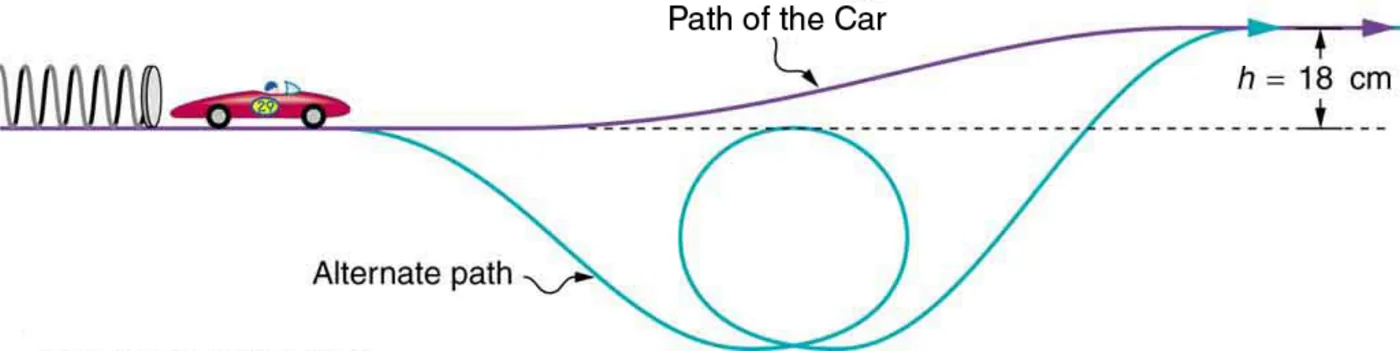
◀ Previous4 / 4
Key terms
| Term | Meaning |
|---|---|
| Kinetic energy | The energy of a moving object, ½mv2. |
| Gravitational potential energy | Energy stored because of height in a gravitational field. |
| Conservation of energy | Energy is not created or destroyed, only transferred. |
| Energy store | A place where energy is held, such as kinetic or thermal. |
| Joule (J) | The unit of energy. |
| Energy flow diagram | A diagram showing stores and transfer pathways. |
1Avoid these mistakes2Avoid these mistakes