Curriculum
NAFS Grade 6 Science
Start here: About NAFS Grade 6 Science
0/2
Unit 1: Forces and Motion
0/19
Unit 2: Energy
0/17
-
2.1 Forms of energy, kinetic and potential energy, energy conservation
 Preview
-
Quiz 2.1: Forms of energy (Part 1)
 Preview
-
Quiz 2.1: Forms of energy (Part 2)
Preview
-
Quiz 2.1: Forms of energy (Part 3)
Preview
-
2.2 Heat transfer: conduction, convection, radiation, insulation
Preview
-
Quiz 2.2: Heat transfer: conduction
Preview
-
2.3 Work, power and simple machines
Preview
-
2.3 Work, power and simple machines (Part 2)
Preview
-
2.3 Work, power and simple machines (Part 3)
Preview
-
2.3 Work, power and simple machines (Part 4)
Preview
-
2.3 Work, power and simple machines (Part 5)
Preview
-
2.3 Work, power and simple machines (Part 6)
Preview
-
2.3 Work, power and simple machines (Part 7)
Preview
-
2.3 Work, power and simple machines (Part 8)
Preview
-
2.3 Work, power and simple machines (Part 9)
Preview
-
2.3 Work, power and simple machines (Part 10)
Preview
-
Quiz 2.3: Work
Preview
Unit 3: Sound
0/2
Unit 4: Light
0/8
Unit 5: Electricity and Magnetism
0/19
Unit 6: Earth, Moon and Sun
0/15
Unit 7: Space
0/14
Unit 8: Weather and Climate
0/11
Unit 9: Earth's Structure and Plate Tectonics
0/5
Unit 10: Rocks, Minerals, Soil and Fossils
0/11
Unit 11: Changing Earth's Surface
0/5
Unit 12: Volcanoes and Earthquakes
0/6
Unit 13: Life Science
0/32
Unit 14: Matter
0/9
Text lesson
2.3 Work, power and simple machines (Part 5)
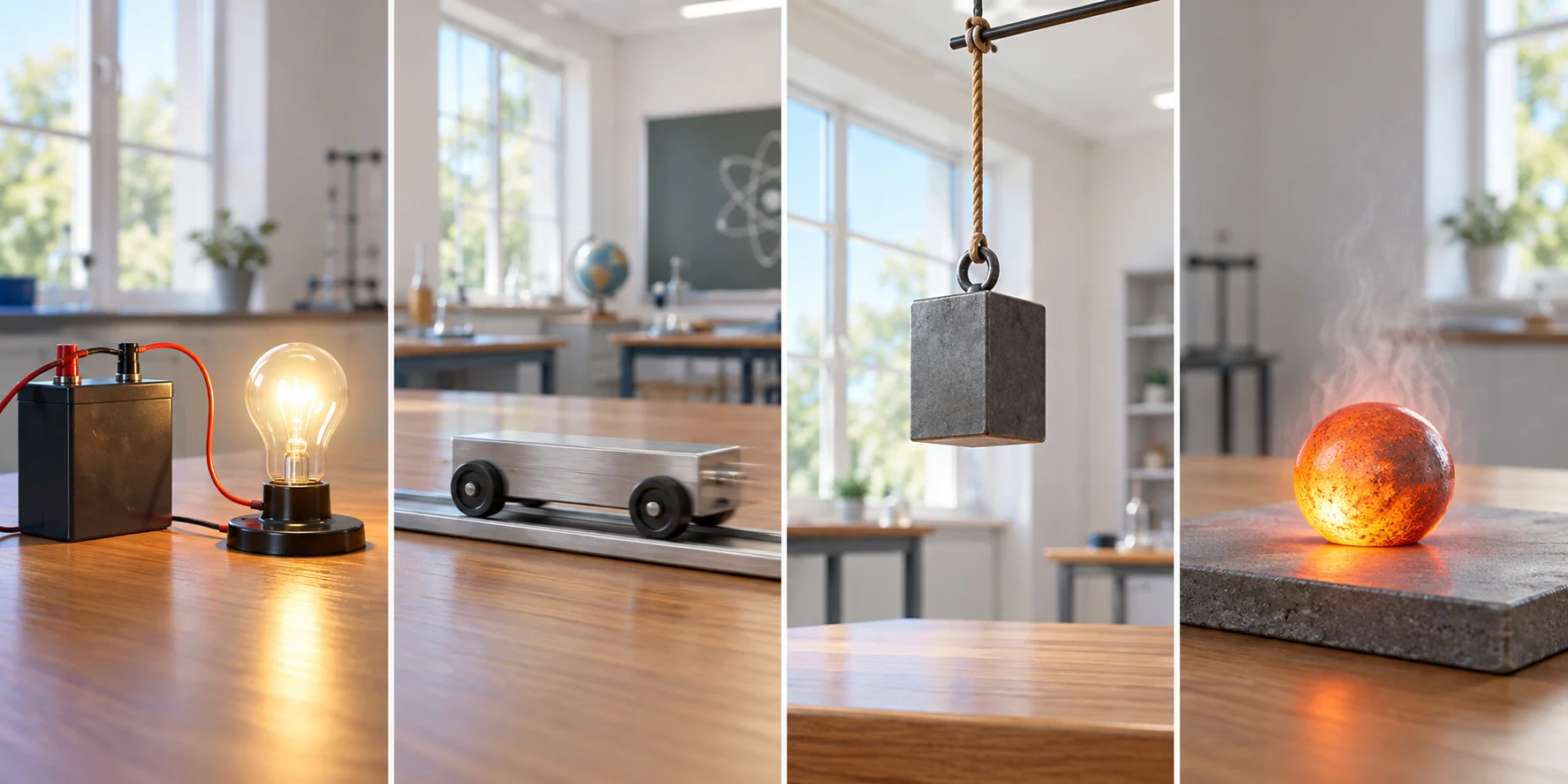
Energy Stores, Transfer Pathways and Kinetic Energy — NAFS Grade 6 Science notes: Name energy stores and transfer pathways and explain how kinetic energy depends on mass and speed.
Types of energy: Water held behind a dam stores potential energy because of its height, and moving water in a waterfall or fast river has kinetic energy.
Energy stores

| Store | Description |
|---|---|
| Kinetic | Moving objects have energy in their kinetic store |
| Gravitational potential | Objects gain energy in this store when lifted through a gravitational field |
| Chemical | Chemical reactions transfer energy into or away from a substance’s chemical store |
| Thermal | Energy of the particles of a substance, higher when it is hotter |
| Elastic potential | Energy stored when an object is stretched or compressed |
Transfer pathways
Transfer pathways
Energy is also transferred by waves such as light and sound.
| Pathway | Description |
|---|---|
| Mechanical work done | A force acts on an object, for example pulling, pushing, stretching or squashing |
| Electrical work done | A charge moves through a potential difference, as in a current |
| Heating (by particles) | Energy is transferred from a hotter object to a colder one, for example by conduction |
1Naming the stores in a system2Naming the stores in a system
Naming the stores in a system
Naming the stores in a system
Define the system, for example the battery and the torch.
Identify the store energy is transferred away from.
Identify the pathway and the store energy is transferred to.
a) A battery powering a torch: energy begins in the chemical store of the cells and is transferred electrically to the lamp,
then to light and the thermal store of the surroundings.
b) A falling object: energy is transferred mechanically from the gravitational potential store to the kinetic store.
1 / 2Next ▶
1Definition · Speeding up · Doubling the speed2Doubling the energy
1Equation · Checks · Worked example2Unit
1Using stores and pathways in answers2Using stores and pathways in answers
1Car · Lorry and car · Braking2Falling
Practice identifying stores
| Situation | Store that is increasing |
|---|---|
| A car speeding up | Kinetic |
| A book lifted onto a shelf | Gravitational potential |
| A bowl of soup cooling down: the room | Thermal (of the surroundings) |
| A spring being stretched | Elastic potential |
1Key reminders2Key reminders
1Worked examples2Worked examples3Worked examples4Worked examples
Key terms
| Term | Meaning |
|---|---|
| Energy store | A place where energy is held, for example kinetic or chemical. |
| Transfer pathway | The way energy moves between stores. |
| Mechanical work done | Energy transferred by a force moving an object. |
| Electrical work done | Energy transferred by charge moving through a potential difference. |
| Heating | Energy transferred from a hotter to a colder object. |
| Kinetic energy | Energy of motion, ½mv2. |
1Avoid these mistakes2Avoid these mistakes