Curriculum
NAFS Grade 6 Science
Start here: About NAFS Grade 6 Science
0/2
Unit 1: Forces and Motion
0/19
Unit 2: Energy
0/17
-
2.1 Forms of energy, kinetic and potential energy, energy conservation
 Preview
-
Quiz 2.1: Forms of energy (Part 1)
 Preview
-
Quiz 2.1: Forms of energy (Part 2)
Preview
-
Quiz 2.1: Forms of energy (Part 3)
Preview
-
2.2 Heat transfer: conduction, convection, radiation, insulation
Preview
-
Quiz 2.2: Heat transfer: conduction
Preview
-
2.3 Work, power and simple machines
Preview
-
2.3 Work, power and simple machines (Part 2)
Preview
-
2.3 Work, power and simple machines (Part 3)
Preview
-
2.3 Work, power and simple machines (Part 4)
Preview
-
2.3 Work, power and simple machines (Part 5)
Preview
-
2.3 Work, power and simple machines (Part 6)
Preview
-
2.3 Work, power and simple machines (Part 7)
Preview
-
2.3 Work, power and simple machines (Part 8)
Preview
-
2.3 Work, power and simple machines (Part 9)
Preview
-
2.3 Work, power and simple machines (Part 10)
Preview
-
Quiz 2.3: Work
Preview
Unit 3: Sound
0/2
Unit 4: Light
0/8
Unit 5: Electricity and Magnetism
0/19
Unit 6: Earth, Moon and Sun
0/15
Unit 7: Space
0/14
Unit 8: Weather and Climate
0/11
Unit 9: Earth's Structure and Plate Tectonics
0/5
Unit 10: Rocks, Minerals, Soil and Fossils
0/11
Unit 11: Changing Earth's Surface
0/5
Unit 12: Volcanoes and Earthquakes
0/6
Unit 13: Life Science
0/32
Unit 14: Matter
0/9
Text lesson
2.3 Work, power and simple machines (Part 6)
Gravitational Potential Energy Calculations and Energy Flow Diagrams — NAFS Grade 6 Science notes: Calculate changes in gravitational potential energy to the right precision and use energy flow diagrams for the conservation of energy.
1Definition · Work against weight2Equation
Definition · Work against weight
Definition
the energy an object has because of its height in a gravitational field.
Work against weight
work is done against the weight force when an object is lifted
so energy is transferred to the store.
1 / 2Next ▶
Potential energy of a system: Work lifting a mass is stored as gravitational potential energy and released as it falls.
Equation
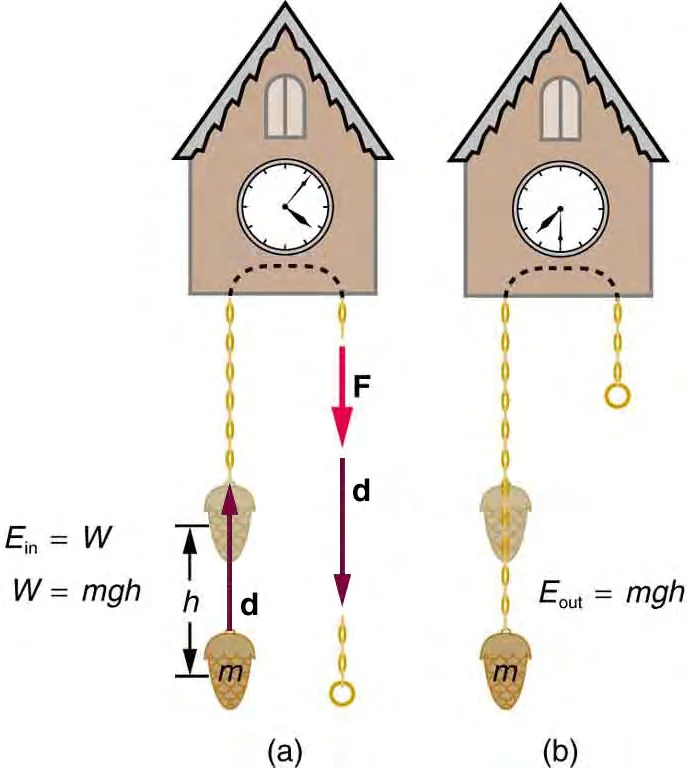 ⤢ Enlarge
1
ΔEp = m g Δh.What the symbols mean: Ep = gravitational potential energy gained (J) · m = mass (kg) · g = 9.81 N kg−1 · h = change in height (m)
2
ΔEp is the change in gravitational potential energy in J, m is mass in kg, g is gravitational field strength in N/kg and Δh is the change in height in m.
◀ Previous2 / 2
1Worked method2Worked method
1Rule · Example2Exam
Rule · Example
Rule
the answer can only be as precise as the least precise value in the data.
Example
if the inputs have 2 significant figures, quote ΔEp = 2100 J to 2 significant figures.
1 / 2Next ▶
Counting significant figures: Counting significant figures from the first nonzero digit: 1267 m has four, and 55.0 g has three because the zero after the decimal point was measured.
Exam
 ⤢ Enlarge
Exam
answers to two or more significant figures are generally accepted unless the question says otherwise.
◀ Previous2 / 2
Conservation of energy
Conservation of energy
Principle energy cannot be created or destroyed
it can only be transferred from one store to another.
Closed system the total energy stays constant
energy transferred in equals energy transferred away.
Examples with flow diagrams
1
Bat and ball the energy flow diagram shows energy from the bat’s kinetic store going to the ball and some wasted as sound and heating.
2
Kettle energy is transferred electrically from the mains to the thermal store of the heating element,
3
then to the water, and always say where the wasted energy goes.
4
Nuclear power plant stores are shown in labelled boxes and transfers as arrows.
5
Remember energy is always conserved in these diagrams
but stating the principle needs the words “cannot be created or destroyed”.
1At the top · Travelling down to B · At the lowest point2Climbing again
At the top · Travelling down to B · At the lowest point
At the top
the rollercoaster is raised above the ground
so it has energy in its gravitational potential store.
Travelling down to B
energy is transferred mechanically to its kinetic store.
At the lowest point
kinetic energy is at its maximum.
1 / 2Next ▶
Worked examples: A roller coaster descends from rest and converts gravitational potential energy into kinetic energy. Its speed is greatest at the lowest point, and the finish is 20.0 m below the start.
Climbing again
 ⤢ Enlarge
Climbing again
kinetic energy is transferred back to the gravitational potential store, apart from losses to friction.
◀ Previous2 / 2
Energy transfer examples
| Situation | Start store | End store |
|---|---|---|
| Ball rolling down a hill | Gravitational potential | Kinetic |
| Stretched spring released | Elastic potential | Kinetic |
| Lamp lit by a battery | Chemical | Light and thermal |
| Brakes stopping a car | Kinetic | Thermal |
1Units · g · Check2Rounding
1Size · Direction2Link to kinetic energy
1Worked examples2Worked examples3Worked examples4Worked examples
Key terms
| Term | Meaning |
|---|---|
| ΔEp | The change in gravitational potential energy. |
| Gravitational field strength (g) | The force per kilogram in a gravitational field, about 10 N/kg on Earth. |
| Closed system | A system where no energy enters or leaves. |
| Significant figures | The digits in a number that carry meaning about its precision. |
| Energy flow diagram | A diagram of stores and transfer pathways. |
| Wasted energy | Energy transferred to a store that is not useful. |
1Avoid these mistakes2Avoid these mistakes