Curriculum
NAFS Grade 6 Science
Start here: About NAFS Grade 6 Science
0/2
Unit 1: Forces and Motion
0/19
Unit 2: Energy
0/17
-
2.1 Forms of energy, kinetic and potential energy, energy conservation
 Preview
-
Quiz 2.1: Forms of energy (Part 1)
 Preview
-
Quiz 2.1: Forms of energy (Part 2)
Preview
-
Quiz 2.1: Forms of energy (Part 3)
Preview
-
2.2 Heat transfer: conduction, convection, radiation, insulation
Preview
-
Quiz 2.2: Heat transfer: conduction
Preview
-
2.3 Work, power and simple machines
Preview
-
2.3 Work, power and simple machines (Part 2)
Preview
-
2.3 Work, power and simple machines (Part 3)
Preview
-
2.3 Work, power and simple machines (Part 4)
Preview
-
2.3 Work, power and simple machines (Part 5)
Preview
-
2.3 Work, power and simple machines (Part 6)
Preview
-
2.3 Work, power and simple machines (Part 7)
Preview
-
2.3 Work, power and simple machines (Part 8)
Preview
-
2.3 Work, power and simple machines (Part 9)
Preview
-
2.3 Work, power and simple machines (Part 10)
Preview
-
Quiz 2.3: Work
Preview
Unit 3: Sound
0/2
Unit 4: Light
0/8
Unit 5: Electricity and Magnetism
0/19
Unit 6: Earth, Moon and Sun
0/15
Unit 7: Space
0/14
Unit 8: Weather and Climate
0/11
Unit 9: Earth's Structure and Plate Tectonics
0/5
Unit 10: Rocks, Minerals, Soil and Fossils
0/11
Unit 11: Changing Earth's Surface
0/5
Unit 12: Volcanoes and Earthquakes
0/6
Unit 13: Life Science
0/32
Unit 14: Matter
0/9
Text lesson
2.3 Work, power and simple machines (Part 8)
Power, Efficiency and Turning Effects: Introducing Moments — NAFS Grade 6 Science notes: Use power and efficiency equations and explain the turning effect of a force with moment = force × perpendicular distance.
Power values and units
| Quantity | Value |
|---|---|
| A star like the Sun | About 1 × 1026 W |
| 1 kilowatt (kW) | 1000 W |
| 1 megawatt (MW) | 1 000 000 W |
1Power equations2Power equations
1Definition · High · Low2Power station example
1Data · Useful energy · Output power2Input power
1Pivot · Examples2Direction
Pivot · Examples
Pivot
a force applied away from a pivot makes an object turn about it.
Examples
a crane moving building supplies and a screwdriver used to open a tin of paint.
1 / 2Next ▶
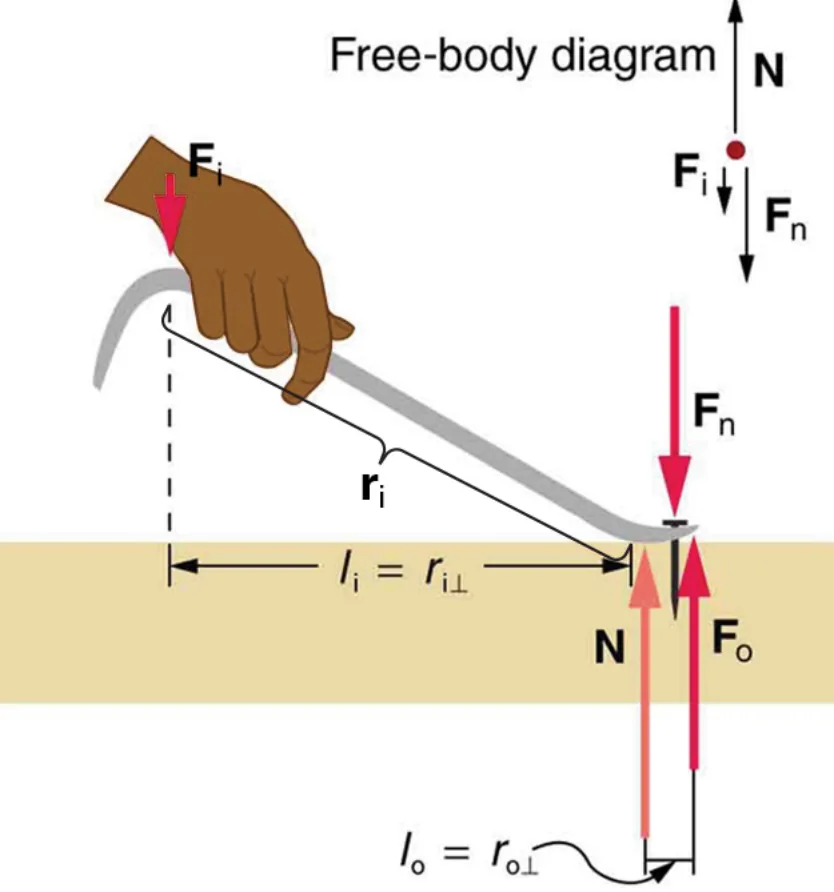
Levers: A nail puller used as a lever. The input force is applied at the handle, the output force pulls the nail, and the pivot sits on the board, with the perpendicular lever arms of both forces marked.
Direction
 ⤢ Enlarge
Direction
the force may make the object turn clockwise or anticlockwise.
◀ Previous2 / 2
1Equation · Perpendicular · Effect of distance2Door example
Equation · Perpendicular · Effect of distance
Equation
moment = force × perpendicular distance from the pivot, unit newton-metre (N m).
Perpendicular
the distance must be measured at right angles to the line of action of the force.
Effect of distance
increasing the distance from the pivot reduces the force needed for the same moment.
1 / 2Next ▶
Wheelbarrows and shovels: Part (a) shows a wheelbarrow pivoting on its wheel axle, and part (b) shows a shovel pivoting at the handle end, with the perpendicular lever arms and free-body diagrams of each.
Door example
 ⤢ Enlarge
Door example
pushing a door next to the hinge needs a lot of force
but pushing at the far side needs much less.
◀ Previous2 / 2
Linking power to everyday devices
| Device | Typical power |
|---|---|
| LED lamp | 5 to 10 W |
| Kettle | 2000 to 3000 W |
| Car engine | 50 000 to 100 000 W |
| Power station | 500 MW or more |
| Sun | 1 × 1026 W |
1Spanner · Wheelbarrow · Crane2Scissors
1Power problem · Moment problem · Using the lever2Check
Terminology
| Term | Definition |
|---|---|
| Clockwise moment | A turning effect in the same direction as clock hands |
| Anticlockwise moment | A turning effect in the opposite direction |
| Lever | A rigid bar that turns about a pivot |
1Worked examples2What the symbols mean:3What the symbols mean:4Worked examples5Worked examples
Key terms
| Term | Meaning |
|---|---|
| Moment | The turning effect of a force, force × perpendicular distance from the pivot. |
| Pivot | The point about which an object turns. |
| Newton-metre | The unit of moment. |
| Efficiency | Useful output divided by total input. |
| Power | Energy transferred per second. |
| Perpendicular distance | The shortest distance from the pivot to the line of action of the force. |
1Avoid these mistakes2Avoid these mistakes