6.9Chapter 6: Nutrition, Health and Movement
The human skeleton — Alhussan Biology - Stage 8 Revision Notes & Topical Questions
5 min read 6 parts Lesson 9 of 12 2 quizzes
Lesson summary
Biology 6.9 The human skeleton — Bones, Joints and Support — Alhussan International Academy — Biology (Stages 7–9) notes: Describe the functions of the skeleton, the structure of bone and the main joints.Skeleton = all the bones of the body together, and humans are vertebrates bu…
- Importance
- Living tissue
- Protection
- Making blood cells
- Mineral store
- Compact bone
Part 1 of 4The skeleton
Skeleton
Skeleton all the bones of the body together, and humans are vertebrates built around bones of different sizes and shapes.
Number
- Number the average adult has 206 bones.
Importance
- Importance without a skeleton a person would be like a giant jellyfish and moving would be very difficult.
Living tissue
- Living tissue a museum skeleton is dry, white and dead, but bone in the body is a strong, slightly flexible, living tissue with a good blood supply.
- It grows and changes all the time, responding to what you do, and can repair itself when damaged.
- It is hard because of calcium phosphate and slightly flexible because of the protein collagen.
Diet
- Diet plenty of calcium and vitamin D in a balanced diet is needed to grow healthy bone.
Part 2 of 4Functions of the skeleton
Functions of the skeleton
Support
- Support it supports the weight of the body against gravity, is the framework to which muscles are attached and holds internal organs in place.
- The vertebral column (backbone) is made of many small bones called vertebrae and holds the body upright.
Protection
- Protection hard, strong bones protect vital organs.
- The skull protects the brain, and bony eye sockets protect the eyes.
- The ribs protect the heart and lungs and move during breathing.
- The backbone protects the spinal cord, the large bundle of nerves carrying messages to and from the brain.
- The pelvis supports the lower body and protects organs in the abdomen.
Movement
- Movement individual bones are hard but the skeleton is not rigid, with joints wherever two bones meet,
- and muscles pulling on bones move them at joints.
Making blood cells
- Making blood cells some bones have a space filled with soft bone marrow.
- Bone marrow makes red blood cells, which carry oxygen, and white blood cells, which protect against infection.
- The long bones of the arms and legs contain a lot of marrow.
Mineral store
- Mineral store bones store calcium and phosphate.
Part 3 of 4Structure of a long bone
Structure of a long bone
Compact bone
- Compact bone strong, rigid bone on the outside.
Spongy bone
- Spongy bone it is on the inside so the bone is not too heavy.
Marrow
- Marrow soft tissue in the central space.
Part 4 of 4Joints
Joint
Joint a structure where two or more bones meet, giving flexibility and movement.
Fixed joints
- Fixed joints such as those between the bones of the skull, which allow no movement.
Synovial joints
- Synovial joints they allow free movement and have several parts:
- cartilage covers the bone ends, reducing friction and absorbing shock;
- synovial fluid lubricates the joint so bones slide easily, made by the synovial membrane;
- ligaments join bone to bone, hold the joint together and stop it dislocating;
- tendons join muscle to bone and transmit the muscle's pull.
| Joint type | Movement | Example |
|---|---|---|
| Ball and socket | Rotation and movement in all directions | Shoulder, hip |
| Hinge | Back and forth in one plane only | Elbow, knee |
Comparison
- Comparison the shoulder has a greater range of movement than the elbow, but a hinge joint is more stable.
Levers
- Levers the skeleton works as a system of levers, with muscles supplying the force, the joint the pivot and the bone the lever.
Key terms
| Term | Meaning |
|---|---|
| Skeleton | All the bones of the body together. |
| Joint | A place where two or more bones meet. |
| Ligament | Strong, slightly stretchy tissue that connects bone to bone. |
| Tendon | Tough tissue that connects muscle to bone and does not stretch. |
| Cartilage | Smooth, rubbery tissue that covers bone ends and reduces friction. |
| Synovial fluid | Liquid in a joint that acts as a lubricant. |
| Bone marrow | Soft tissue inside some bones that makes blood cells. |
Avoid these mistakes
1
Confusing ligaments and tendons — ligaments join bone to bone and tendons join muscle to bone.
2
Saying bones are dead and non-living — bone is living tissue with blood vessels and cells.
3
Saying a hinge joint allows rotation — it allows movement in one plane only.
4
Thinking the skeleton only gives support — it also protects organs, makes blood cells and stores minerals.
Marked practiceQuizzes for this lesson
?What do you want to solve now?
✓Checkpoint Quiz
1 multiple-choice questions from real exam papers on this lesson.
Question 1 of 1 1:30
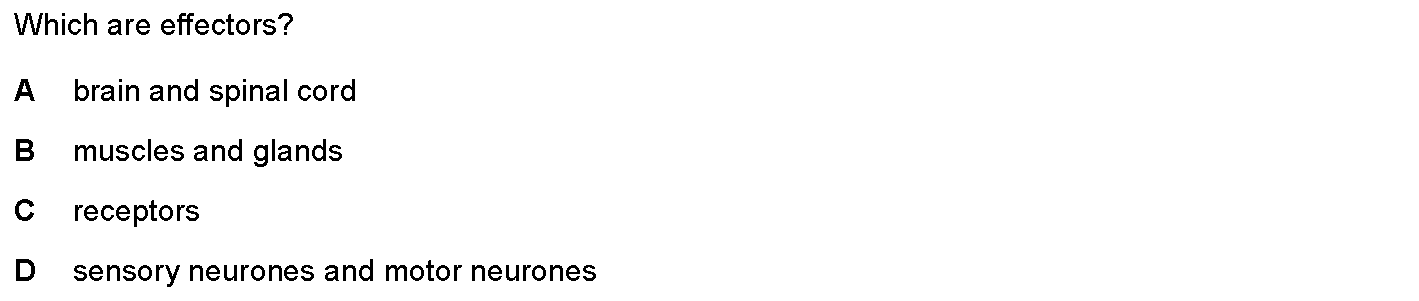
Score: 0 / 1
Answer key
1 B
Last updated: