12.10Chapter 12: Chemical Reactions 3 and Rates
Concentration and reaction rate — Alhussan Chemistry - Stage 9 Revision Notes & Topical Questions
5 min read 8 parts Lesson 10 of 13 2 quizzes
12.10 Concentration and reaction rate — Collision Theory — Alhussan International Academy — Chemistry (Stages 7–9) notes: Describe and explain how concentration affects reaction rate using collision theory.Collisions — substances can only react when their particles hit each other…
- Effective collision
- Activation energy
- Higher concentration
- Speed of particles
- Independent variable
- Control variables
Part 1 of 6Collision theory
- Collisions substances can only react when their particles hit each other, or collide.
- Not every collision leads to a reaction, because the particles must have enough energy to break bonds.
- Rate the more frequent the effective collisions, the faster the rate.
Part 2 of 6Effect of concentration
- Higher concentration more reactant particles are in the same volume, so they are closer together and collide more often.
- This gives more effective collisions per second, so the rate increases.
- Gases increasing the pressure has the same effect because it packs particles into a smaller space.
- Speed of particles the speed does not change, only the number of particles in the space.
- Rule for reactions involving solutions, the higher the concentration of solution, the faster the reaction.
Part 3 of 6Planning the investigation
- Question in acid reactions, how does the concentration of acid affect reaction rate?
- Apparatus a stopwatch to measure time accurately, a measuring cylinder to measure volume accurately, a conical flask, hydrochloric acid and magnesium ribbon.
- Independent variable the concentration of acid.
- Dependent variable the time for the magnesium ribbon to finish reacting.
- Control variables the length of magnesium ribbon, the temperature and the volume of acid.
- The students used relative concentration values between 1 and 2 and collected data for five values in this range.
- Other methods react sodium thiosulfate with acid and time how long a cross under the beaker takes to disappear.
Part 4 of 6Presenting and analysing results
- Graph plot a line graph with a line of best fit, because both variables are continuous.
- Pattern as acid concentration increases, the time for the magnesium to finish reacting decreases, so the reaction rate is faster.
| Concentration of acid | Time for ribbon to disappear (s) |
|---|---|
| 0.5 | 120 |
| 1.0 | 60 |
| 2.0 | 30 |
- Relationship doubling the concentration halves the time, so the rate doubles.
- Explanation a conclusion should include the scientific reason using collision theory.
- Different acid to check whether results are similar with a different acid, repeat the investigation with another acid and keep the other variables the same.
Part 5 of 6Explaining graphs and results
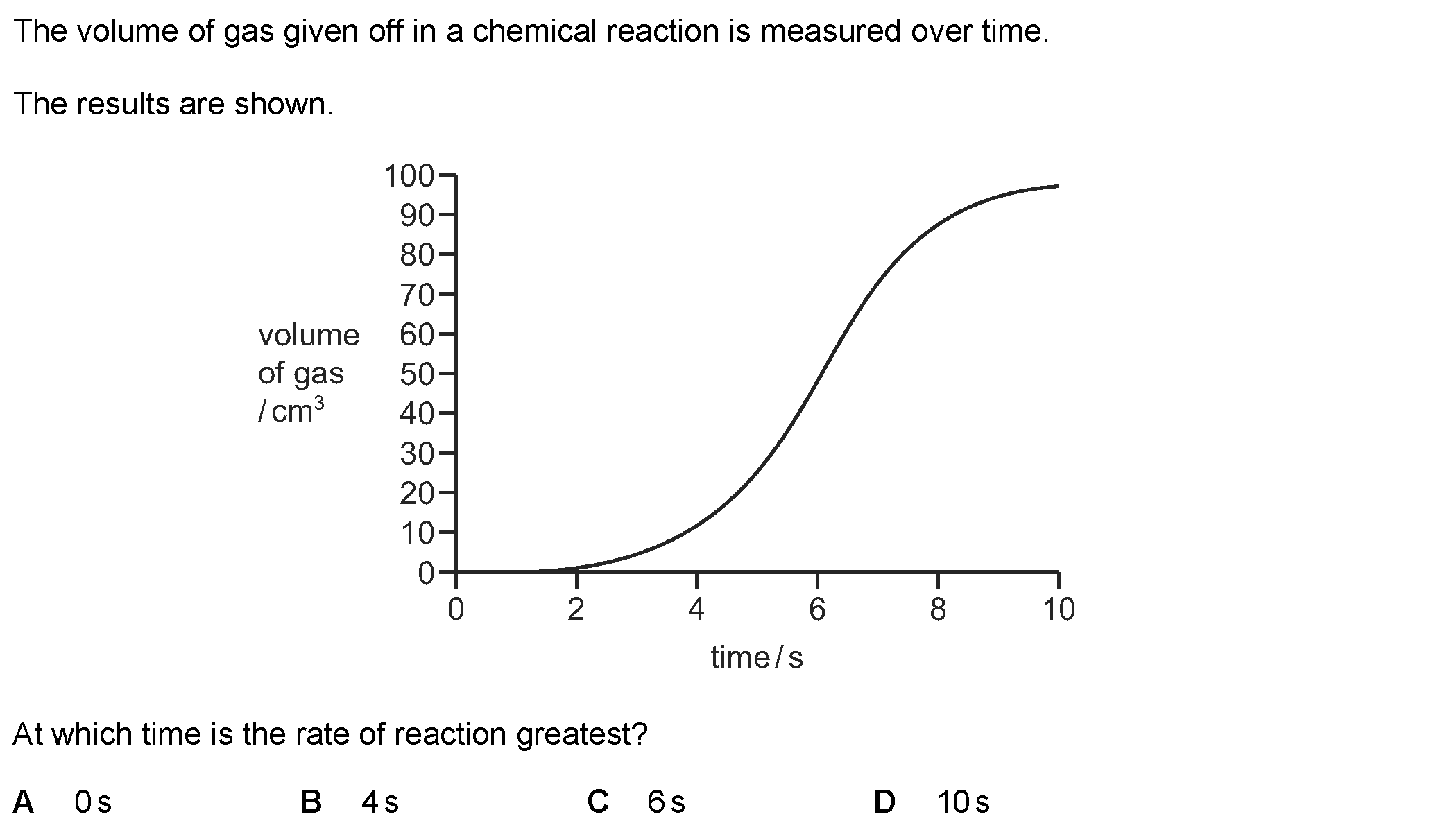
- Volume against time the curve for the highest concentration starts steepest.
- Final volume all curves level at the same height if the same amount of limiting reactant is used,
- because the final volume depends on the amount of reactant, not on the concentration of acid when acid is in excess.
- Effect concentration changes the rate, not the total amount made.
Part 6 of 6Industry and safety
- Industry a medicine company wants to make medicines quickly and cheaply, so it studies conditions that speed up reactions.
- Trade-off concentrated solutions or high-pressure gases increase output,
- but they cost more and create hazards,
- so concentration is chosen to balance cost and safety.
- Laboratory dilute solutions are used for safety.
Key terms
| Term | Meaning |
|---|---|
| Collision theory | the idea that reactions need collisions with enough energy. |
| Concentration | the amount of solute per unit volume. |
| Activation energy | the minimum energy needed for a reaction. |
| Effective collision | a collision that leads to a reaction. |
| Range | the difference between the lowest and highest values of a variable. |
| Control variable | a variable kept the same in a fair test. |
Avoid these mistakes
Marked practiceQuizzes for this lesson
?What do you want to solve now?
✓Checkpoint Quiz
11 multiple-choice questions from real exam papers on this lesson.
Question 1 of 11 1:30

Question 2 of 11 1:30
Question 3 of 11 1:30

Question 4 of 11 1:30
Question 5 of 11 1:30

Question 6 of 11 1:30
Question 7 of 11 1:30

Question 8 of 11 1:30

Question 9 of 11 1:30

Question 10 of 11 1:30

Question 11 of 11 1:30

Answer key
1 B2 C3 C4 D5 B6 D7 C8 B9 D10 D11 D
Last updated: