12.11Chapter 12: Chemical Reactions 3 and Rates
Temperature and reaction rate — Alhussan Chemistry - Stage 9 Revision Notes & Topical Questions
5 min read 8 parts Lesson 11 of 13 2 quizzes
Lesson summary
12.11 Temperature and reaction rate — Particle Kinetic Energy and Collisions — Alhussan International Academy — Chemistry (Stages 7–9) notes: Describe and explain how temperature affects reaction rate using collision theory.Faster at higher temperatures — reactions go faster at h…
- Rule of thumb
- More frequent collisions
- More successful collisions
- What does not change
- Hypothesis
- Prediction
Part 1 of 6Effect of temperature
Effect of temperature
Faster at higher temperatures
- Faster at higher temperatures reactions go faster at higher temperatures.
- Potatoes cook in 15 minutes in boiling water at 100 °C but more quickly in boiling oil at 200 °C.
- Food spoils more slowly in a fridge and cooks faster in a hot oven.
Rule of thumb
- Rule of thumb a 10 °C rise roughly doubles the rate for many reactions, although this is not exact.
Pattern
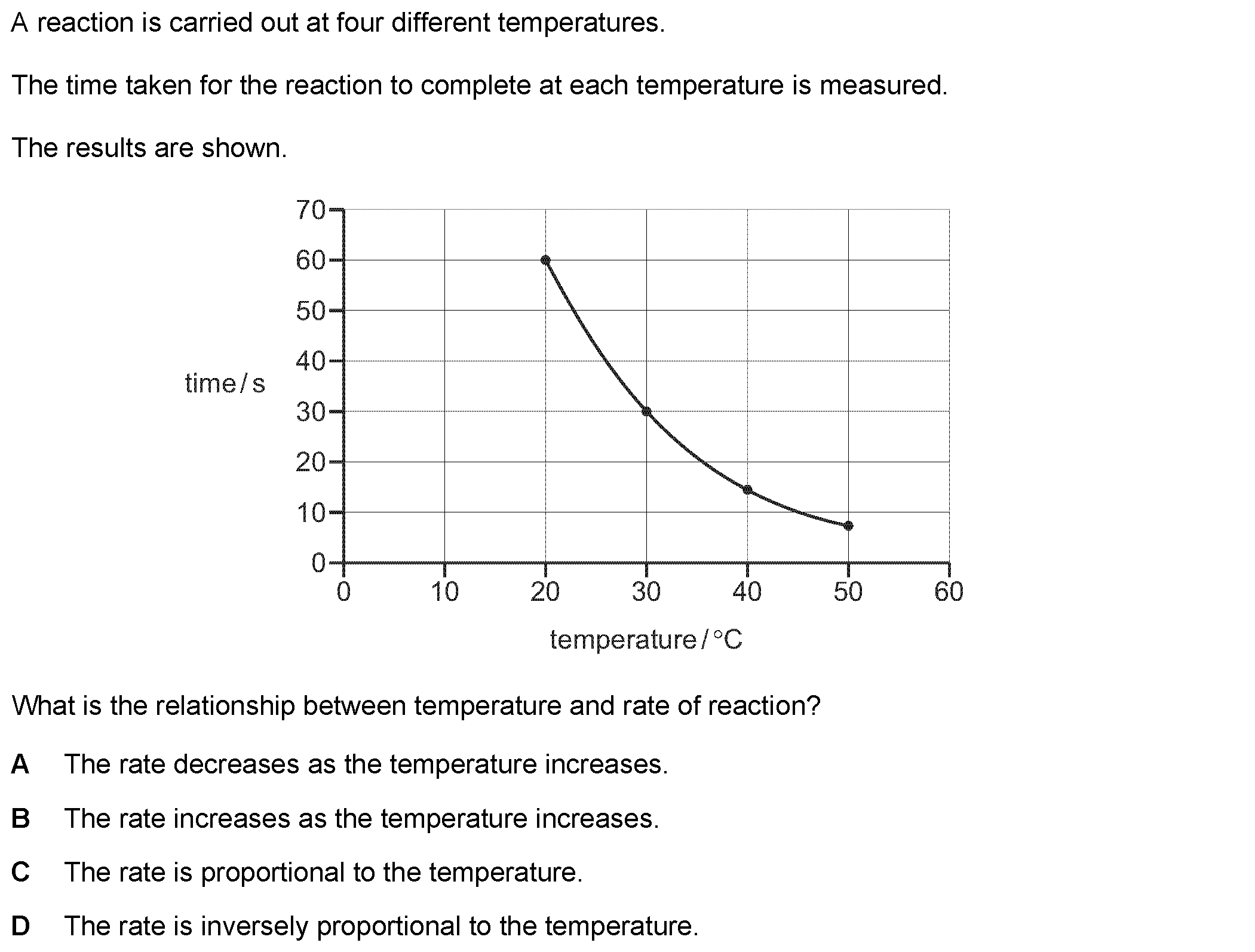
- Pattern as temperature increases, the rate of reaction increases.
Part 2 of 6Explaining with particles
Explaining with particles
Kinetic energy
- Kinetic energy heating gives particles more kinetic energy, so they move faster.
More frequent collisions
- More frequent collisions faster particles collide more often.
More successful collisions
- More successful collisions a greater proportion of collisions have energy greater than or equal to the activation energy,
- so more collisions are effective.
- This second effect is the more important one, because even a small rise in temperature greatly increases the fraction of particles with enough energy.
What does not change
- What does not change particles do not get bigger and the activation energy does not change.
Part 3 of 6Farai's investigation
Hypothesis
- Hypothesis reactions happen when particles collide, and at higher temperatures particles move faster and collide more frequently,
- so as temperature increases the reaction rate increases.
Reaction
- Reaction sodium thiosulfate + hydrochloric acid → sodium chloride + water + sulfur dioxide + sulfur.
- Sulfur is insoluble, so it forms as a precipitate of tiny solid pieces that make the mixture cloudy.
Method
- Method pour sodium thiosulfate solution into a flask placed over a cross, add hydrochloric acid, start a timer and stop it when the cross can no longer be seen.
- At 20 °C the cross disappeared after about 244 seconds.
Variables
- Variables the independent variable is the temperature of the acid, the dependent variable is the time to cover the cross,
- and the volumes and concentrations are controlled.
Repeats
- Repeats repeat each temperature three times to reduce error and obtain reliable results.
Prediction
- Prediction at higher temperatures the reaction will be quicker, so the cross will disappear after a shorter time.
Part 4 of 6Results and analysis
Temperatures
- Farai repeated the experiment at 20, 30, 40, 50 and 60 °C and recorded the mean time at each.
Anomalous result
- Anomalous result the first result at 50 °C was very different from the others, probably because the acid had cooled before use,
- so he left it out of the mean.
Graph
- Graph both variables are continuous, so he drew a line graph.
Conclusion
- Conclusion the higher the temperature, the faster the reaction, so his prediction and hypothesis were supported.
Rate from time
- Rate from time rate = 1 ÷ time, and a graph of rate against temperature curves upward.
Errors
- Errors judging when the cross disappears is subjective, so using the same observer or a light sensor improves it.
Part 5 of 6Comparing factors that affect rate
| Factor | Collision frequency | Energy of collisions |
|---|---|---|
| Concentration | Higher | Same |
| Surface area | Higher | Same |
| Temperature | Higher | Higher |
| Catalyst | Same | Lower activation energy needed |
Rate graph
- Rate graph the curve for a higher temperature starts steeper and reaches the plateau sooner,
- but the final volume is the same if the amounts of reactants are the same.
Not the same
- Not the same reaction rate is not the same as the amount of product.
Exothermic reactions
- Exothermic reactions heating them does not stop them working.
Part 6 of 6Applications
Pressure cookers
- Pressure cookers they cook food faster by raising the temperature.
Refrigerators
- Refrigerators they slow bacteria.
Industry
- Industry it chooses a temperature that gives a fast rate without wasting energy or risking safety.
Safety
- Safety handle hot acids and flasks with care.
Key terms
| Term | Meaning |
|---|---|
| Kinetic energy | the energy of movement. |
| Activation energy | the minimum energy needed for particles to react. |
| Rate | how fast a reaction proceeds. |
| Frequency | how often something happens. |
| Precipitate | an insoluble solid formed in a reaction. |
| Anomalous result | a result that does not fit the pattern. |
Avoid these mistakes
1
Saying only collision frequency changes — the proportion of effective collisions also increases.
2
Saying activation energy decreases with temperature — it stays the same.
3
Saying the particles get larger — they only move faster.
4
Forgetting that the rule of thumb is only approximate — a 10 °C rise does not exactly double the rate.
Marked practiceQuizzes for this lesson
?What do you want to solve now?
✓Checkpoint Quiz
3 multiple-choice questions from real exam papers on this lesson.


Last updated: