D1.1Theme D — Continuity and change
DNA replication — IB Biology HL Revision Notes & Topical Questions
5 min read 11 parts Lesson 2 of 18 2 quizzes
Curriculum Equation Key قوانين الرقم الهيدروجيني والاتزان الأيوني - pH & Acid-Base Equilibrium FormulasFast Exam Solution
pH = -log[H⁺] | pOH = -log[OH⁻] | pH + pOH = 14 | [H⁺][OH⁻] = 10⁻¹⁴
Word Equation & Conditions: الرقم الهيدروجيني = -لوغاريتم تركيز أيون الهيدروجين | pH + pOH = 14
Location & Specifications: الاتزان الأيوني، كيمياء 3 ثانوي، التحصيلي، و AP Chemistry.
Lesson summary
D1.1 DNA replication — IB BIOLOGY HL notes: Explain semi-conservative DNA replication, its enzymes and directionality, and the uses of PCR, gel electrophoresis and DNA profiling.Purpose — before a parent cell divides, its DNA is copied so both daughter cells receive a full copy.R…
- Complementary base pairing
- Importance
- DNA polymerase
- Antiparallel strands
- Preparing DNA
- Thermal cycler
Part 1 of 9Semi-conservative replication
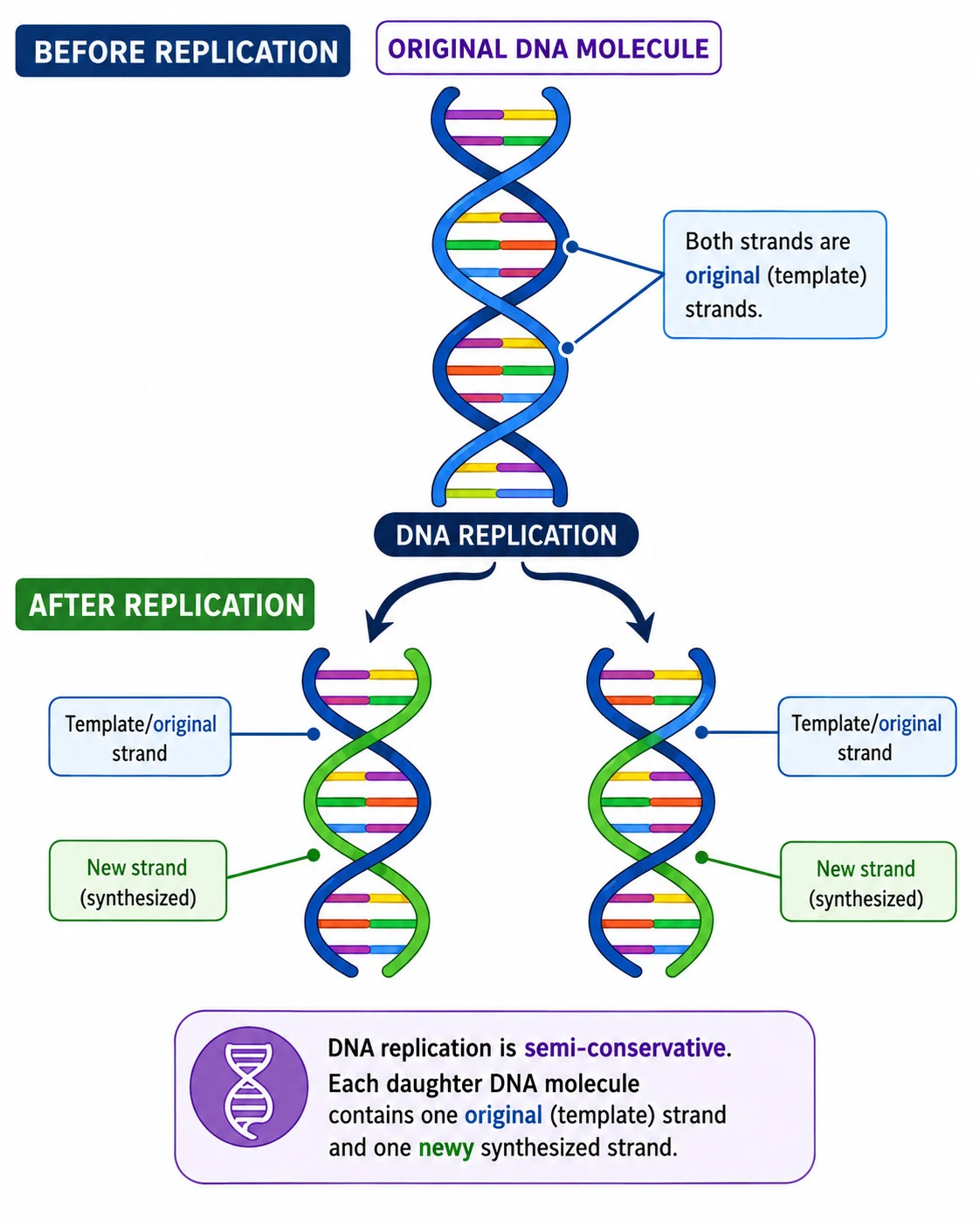
Semi-conservative replication
Purpose
- Purpose before a parent cell divides, its DNA is copied so both daughter cells receive a full copy.
- Replication is important for growth, replacement of old or damaged cells and tissues, and reproduction.
- A parent cell is any cell that divides, not the parent organism.
Semi-conservative
- Semi-conservative each new DNA molecule keeps one original strand (the template) and has one newly made strand.
Complementary base pairing
- Complementary base pairing free nucleotides in the nucleus are added one by one to the template.
- Adenine pairs with thymine and cytosine pairs with guanine.
- Hydrogen bonds form only between correctly paired bases.
Importance
- Importance keeping one original strand ensures genetic continuity with high accuracy, so new cells inherit all genes with the correct base sequence.
Evidence
- Watson and Crick proposed the semi-conservative model, and Meselson and Stahl later provided the supporting evidence.
Part 2 of 9Helicase and DNA polymerase
Timing
- Timing replication occurs before mitosis so that two genetically identical daughter cells can form.
Helicase unwinds the helix like untwisting a rope ladder and breaks the hydrogen bonds between bases like unzipping a zipper, exposing bases on each strand.
Each strand acts as a template, and free nucleotides are attracted to the exposed bases by base pairing.
DNA polymerase
- DNA polymerase it catalyses condensation reactions between the deoxyribose sugar and phosphate of adjacent nucleotides,
- forming the sugar-phosphate backbone of the new strand.
- It always builds in the 5' to 3' direction, reading the template in the 3' to 5' direction.
- Hydrogen bonds then form between the template and new strand bases.
Part 3 of 9Directionality, leading and lagging strands
Directionality
- DNA polymerase adds nucleotides only to the free 3' –OH of a growing strand, and the incoming nucleotide's 5' phosphate bonds to it.
Antiparallel strands
- Antiparallel strands the two strands run in opposite directions, so each new strand forms differently as the fork opens one way.
| Feature | Leading strand | Lagging strand |
|---|---|---|
| Synthesis | Continuous, following the fork | Discontinuous, in short Okazaki fragments away from the fork |
| RNA primer | Needed once | Needed for each fragment |
| Joining | Not needed | DNA ligase joins the fragments |
- Primer
- an RNA primer gives DNA polymerase III a binding point before nucleotides are added.
Part 4 of 9Enzymes of replication
| Enzyme | Role |
|---|---|
| Helicase | Unwinds the double helix at the replication fork and breaks hydrogen bonds |
| Single-stranded binding proteins | Keep the separated strands apart while the template is copied |
| DNA primase | Makes a short RNA primer to start synthesis |
| DNA polymerase III | Starts next to the primer and adds nucleotides in the 5' to 3' direction |
| DNA polymerase I | Removes RNA primers on both strands and replaces them with DNA |
| DNA ligase | Joins Okazaki fragments by forming sugar-phosphate bonds |
Part 5 of 9Proofreading
Scale
- Scale each human cell replication makes 3 billion new base pairs.
Errors
- Errors copying mistakes are mutations, which can harm the new cell and cause diseases such as cancer.
Proofreading in prokaryotes
Proofreading
DNA polymerase III recognises an incorrect nucleotide in the daughter strand.
It reverses direction and removes the incorrect nucleotide from the 3' end.
The correct nucleotide is inserted and replication continues.
Part 6 of 9Gel electrophoresis
Gel electrophoresis
Gel electrophoresis separating DNA, RNA or proteins by size and net charge using an electric current.
- DNA is negatively charged because of its phosphate groups, so it moves towards the anode (positive pole).
- Smaller molecules move faster through the tiny pores of the gel, and larger molecules move slowly.
- Agarose gel is used for DNA and polyacrylamide for proteins, and pore size affects speed.
Preparing DNA
- DNA is collected from sources such as a hair root or saliva, amplified by PCR and cut into fragments with restriction enzymes.
Method
1
Make an agarose gel plate in a tank with wells cut at one end.
2
Submerge the gel in electrolyte solution.
3
Load DNA fragments into the wells with a micropipette.
4
Apply an electric current with the negative electrode at the well end.
5
Shorter fragments move faster and further than larger fragments.
6
Transfer the invisible fragments to absorbent paper or nitrocellulose and heat to separate the strands.
7
Add probes, either radioactive (X-ray film darkens in bands) or fluorescent such as ethidium bromide (bands fluoresce under UV light).
Part 7 of 9Polymerase chain reaction (PCR)
1
PCR
PCR in vitro amplification of DNA or RNA, producing billions of identical copies of a specific fragment from very small amounts in hours.
- Uses are DNA profiling, genetic engineering and diagnostic tests that amplify small amounts of viral RNA, as in COVID-19.
2
Requirements
- Target DNA or RNA, with only specific sections copied, identified by primers that bind to them.
- DNA polymerase, usually Taq polymerase from the thermophilic bacterium Thermus aquaticus, which does not denature at high temperature.
- Free nucleotides.
- Buffer solution for the optimum pH.
3
Thermal cycler
- Thermal cycler it provides the temperature and time for each stage automatically.
Polymerase chain reaction (PCR)
Denaturation: heat to 95 °C to break the hydrogen bonds between the strands.
Annealing: cool to 50–60 °C so primers bind to the ends of the single strands.
Elongation: raise to 72 °C for at least a minute so Taq polymerase builds the complementary strands.
- Amplification
- DNA doubles each cycle, so 20 cycles give about a million molecules and 30 cycles give about 230 (over 1 billion) copies from one molecule.
Part 8 of 9DNA profiling
DNA profiling
DNA profiling (genetic fingerprinting)
DNA profiling (genetic fingerprinting) identifying individuals from the pattern of VNTRs, used to identify suspects, victims and relatives.
VNTRs (variable number tandem repeats)
VNTRs (variable number tandem repeats) short, repeating, non-coding DNA regions 20–50 bases long.
- Every person except identical twins has a unique combination.
Method
1
Extract DNA from a hair root, blood, semen or saliva.
2
Amplify it by PCR.
3
Cut it into fragments with restriction endonucleases.
4
Separate fragments by size with gel electrophoresis.
5
Add radioactive or fluorescent probes complementary to the VNTRs.
6
Visualise the probes by X-ray film or UV light.
7
Analyse and compare the band patterns.
Part 9 of 9Applications of DNA profiling
Ancestry and paternity
- Everyone inherits VNTRs from both parents, so band patterns are compared with those of possible parents.
- A parent shares about 50% of the child's bands.
- Every band in the child's profile must be present in the mother's or the father's profile, otherwise that man is not the father.
Forensics
- Samples from the crime scene or victim are profiled and compared with samples from the suspect (or database), victim and controls.
- Contamination must be avoided.
- Profiling can identify victims and eliminate innocent people.
- The suspect with the most fragments in common with the crime scene DNA is the likely match.
Nature of science
- Nature of science reliability is raised by more measurements, which matters in court.
- Using more VNTR markers lowers the chance of a false match.
Key terms
| Term | Meaning |
|---|---|
| Semi-conservative replication | replication in which each new molecule has one original and one new strand. |
| Okazaki fragment | a short segment of the lagging strand made discontinuously. |
| Helicase | the enzyme that unwinds DNA and breaks hydrogen bonds between strands. |
| Primer | a short RNA sequence that starts DNA synthesis. |
| PCR | polymerase chain reaction, the in vitro amplification of DNA. |
| Gel electrophoresis | separation of molecules by size and charge in a gel. |
| VNTR | a variable number tandem repeat, a repeated non-coding DNA region used in profiling. |
| Taq polymerase | a heat-stable DNA polymerase from Thermus aquaticus. |
Avoid these mistakes
1
Semi-conservative means half the DNA is copied — the whole molecule is copied and each new molecule keeps one old strand.
2
DNA polymerase builds in the 3' to 5' direction — it builds new strands 5' to 3'.
3
DNA moves to the cathode in electrophoresis — it is negatively charged and moves to the anode.
4
PCR needs the whole genome — only the target section marked by primers is copied.
Marked practiceQuizzes for this lesson
Last updated:
—
- RNA: 5′ → 3′ 3′ → 5′.
- : AUG UAC .
- : UAA, UAG, UGA tRNA (Release Factor) .