D3.2Theme D — Continuity and change
Inheritance — IB Biology HL Revision Notes & Topical Questions
15 min read 12 parts Lesson 9 of 18 2 quizzes
Curriculum Equation Key قوانين الرقم الهيدروجيني والاتزان الأيوني - pH & Acid-Base Equilibrium FormulasFast Exam Solution
pH = -log[H⁺] | pOH = -log[OH⁻] | pH + pOH = 14 | [H⁺][OH⁻] = 10⁻¹⁴
Word Equation & Conditions: الرقم الهيدروجيني = -لوغاريتم تركيز أيون الهيدروجين | pH + pOH = 14
Location & Specifications: الاتزان الأيوني، كيمياء 3 ثانوي، التحصيلي، و AP Chemistry.
Lesson summary
D3.2 Inheritance — IB BIOLOGY HL notes: Explain gametes, Mendelian crosses, dominance patterns, sex linkage, pedigrees, variation, dihybrid crosses, gene linkage and chi-squared testing.Gametes = sex cells formed by meiosis, haploid with one copy of each chromosome and so one all…
- Fertilisation
- Homozygous
- Monohybrid cross
- Plant crosses
- Dominant allele
- Phenotypic plasticity
Part 1 of 10Gametes and fertilisation, mendel's experiments and monohybrid crosses
Gametes
Gametes sex cells formed by meiosis, haploid with one copy of each chromosome and so one allele of each gene.
- Human sperm and egg have 23 chromosomes, against 46 in diploid cells.
- The egg is larger and holds food for the embryo, and the sperm has many mitochondria for movement.
Fertilisation
Fertilisation fusion of gamete nuclei to give a diploid zygote with two alleles of each gene, from different parents, so offspring vary.
Homozygous
Homozygous two identical alleles of a gene, and heterozygous = two different alleles.
Mendel
- Mendel the Austrian monk used pea plants and carefully transferred pollen between plants, so he knew which pollen fertilised each plant.
- He studied height, flower colour and seed coat smoothness, and collected seeds and grew offspring.
- First-generation plants all showed one parental characteristic, and second-generation plants showed both in a 3:1 ratio.
- He identified 'units of inheritance' (genes) with dominant and recessive forms.
Monohybrid cross
- Monohybrid cross it starts with pure-breeding homozygous parents with different phenotypes, giving the F1 generation, then the F2.
- (the P generation)
Punnett grid steps
1
Write the parental phenotypes and genotypes.
2
Write the possible gametes of each parent, circled to show they are haploid.
3
Place the gametes on the axes of a 2 × 2 grid.
4
Combine gametes in the boxes to give offspring genotypes.
5
State the genotype and phenotype ratios.
Results
- Results homozygous dominant × homozygous recessive gives all heterozygous F1 with the dominant phenotype,
- and crossing two heterozygotes gives 3:1 dominant:recessive phenotypes and 1:2:1 genotypes.
Plant crosses
- Plant crosses plants may have male and female parts in one flower, separate male and female flowers, or separate male and female plants.
- Growers self-pollinate plants to keep desirable traits and cross-pollinate to combine traits.
Part 2 of 10Terminology: genotype and phenotype
Terminology: genotype and phenotype
Gene
Gene a short length of DNA on a chromosome that codes for a characteristic through a specific protein.
Allele
Allele a variant of a gene, and each individual has two (one from each parent) at the same locus.
Genotype
Genotype the combination of alleles inherited, and phenotype = the observable characteristics.
Phenotype is determined by
- The genotype only, such as blood group.
- The environment only, such as scars and accent.
- Both together, such as height and skin colour.
Dominant allele
Dominant allele expressed in the phenotype if inherited from one parent, and recessive allele = expressed only if inherited from both parents.
- Homozygous dominant has two dominant alleles, homozygous recessive has two recessive alleles.
Gene and allele are not interchangeable terms.
Part 3 of 10Codominance and incomplete dominance, phenotypic plasticity, autosomal recessive inheritance: phenylketonuria
| Pattern | Description | Example |
|---|---|---|
| Codominance | Both alleles are expressed equally | Chickens CWCW white, CBCB black, CWCB speckled |
| Incomplete dominance | Both alleles are partially expressed, giving an intermediate blend | Marvel of Peru CWCW white, CRCR red, CWCR pink |
- Species may be named by common or scientific name.
- Phenotypic plasticity = the genotype stays fixed but its phenotypic expression varies during life because the internal or external environment changes gene expression.
- Regulatory proteins and transcription factors respond to stimuli such as light, drugs and hormones.
- UV radiation activates enzymes that raise melanin production and skin pigmentation.
- The Himalayan rabbit's pigment gene is inactive above 35 °C and active at 15–25 °C, so cooler ears, feet and nose become black.
PKU
PKU an inherited condition caused by a recessive allele on an autosome.
- A non-functional enzyme (phenylalanine hydroxylase, coded by the PAH gene) cannot break down phenylalanine,
- which builds up and causes mental disorders and seizures.
- About 1 in 10 000 people in the UK have PKU.
Inheritance
- Inheritance a child needs two recessive alleles, one from each parent.
- Two unaffected carriers (heterozygotes) have a 25% chance of an affected child and a 75% chance of an unaffected child.
- Cystic fibrosis follows the same pattern.
Screening
- Screening babies are screened a few days after birth with a blood prick from the heel.
Use clearly different letters for alleles, and exaggerate the difference between upper and lower case if letters look similar.
Part 4 of 10Multiple alleles and SNPs
Multiple alleles and SNPs
Multiple alleles
- Multiple alleles many genes have more than two alleles, but a diploid individual inherits only two.
- Alleles differ by one or a few bases yet occupy the same locus, and a small change can have a large effect on function.
SNPs (single nucleotide polymorphisms)
SNPs (single nucleotide polymorphisms) exact positions where bases differ between alleles, analysed by techniques developed since the Human Genome Project.
ABO blood group
- ABO blood group codominance with three alleles, IA, IB and i.
- IA makes antigen A, IB makes antigen B, and i makes no antigen.
| Genotype | Phenotype |
|---|---|
| IAIA or IAi | Group A |
| IBIB or IBi | Group B |
| IAIB | Group AB |
| ii | Group O |
Multiple alleles and SNPs
A group A and a group B parent who are both heterozygous can have group O children.
The wrong blood group causes an immune response that coagulates blood, leading to clots, illness or death.
Part 5 of 10Sex determination and sex linkage, pedigree charts
Sex determination and sex linkage, pedigree charts
Sex determination in humans
- Sex determination in humans an entire chromosome pair (pair 23) decides sex.
- Females are XX and males are XY (true of mammals but not all species), and pairs 1–22 are autosomes.
- Only the father passes on Y, so he determines the child's sex: half of his sperm carry X and half carry Y, daughters get his X and sons get his Y.
X and Y chromosomes
- The X is larger and carries about 16 times more genes than the Y.
- The X carries non-sex genes such as blood clotting factors.
- The Y carries male genes, including SRY, which causes testes to develop and testosterone production;
- without it, ovaries develop.
Sex-linked genes lie on one sex chromosome only, usually the X.
- Males (XY) have one copy of an X-linked gene, so they have two phenotypes: normal or affected.
- Females (XX) have three phenotypesnormal, carrier or affected.
Haemophilia
- Haemophilia a gene on the X chromosome codes for clotting factor VIII.
- F is the dominant allele for normal factor VIII, and f is the recessive allele giving no factor VIII.
- Males with f have haemophilia, and heterozygous females are carriers, so it affects males more.
- Notation uses X and Y with superscript alleles, such as XFXf (carrier female) and XfY (affected male).
- A carrier female and a normal male give a ratio of 1 normal female : 1 carrier female : 1 normal male : 1 haemophiliac male.
Show gametes and state phenotypes as well as genotypes, and check whether a probability is for all children or one sex.
Pedigree chart
Pedigree chart a family tree tracing a characteristic, usually a disease, to work out the probability of inheriting a disorder.
- Males are squares and females are circles.
- Affected individuals are shaded.
- A horizontal line joins parents and children hang below, with Roman numerals for generations and the eldest child on the left.
Close relatives
- Close relatives breeding with close relatives raises the chance that both carry harmful recessive alleles,
- which is why such marriages are often prohibited.
Reading a pedigree
- Affected children of unaffected parents mean a recessive allele and carrier parents.
- The trait skipping generations suggests a recessive allele.
- Both sexes affected makes sex linkage unlikely.
- Unaffected individuals have at least one dominant allele, so they are AA or Aa.
Nature of science
- Nature of science inductive reasoning draws general conclusions from a small sample,
- and deductive reasoning draws specific deductions from known evidence.
- If two unaffected parents have an affected child, deduce a recessive allele and carrier parents.
Part 6 of 10Continuous and discrete variation, box plots
Discrete variation
Discrete variation clear categories with no in-between, such as blood groups (8 distinct groups with Rhesus factor).
Continuous variation
Continuous variation a range of values between extremes, with quantitative differences and a normal (bell-shaped) distribution,
- such as height and birth mass.
- It results from genes and the environment: phenotype = genotype + environment.
- Polygenes are many genes with additive effects, and alleles at one locus have small effects.
- Skin colour is polygenic, as several genes control melanin, and UV exposure also darkens the skin.
- Shoe size looks discrete but foot size varies continuously.
| Feature | Discrete | Continuous |
|---|---|---|
| Categories | Distinct | A range of values |
| Genes | One or few genes | Many genes (polygenic) |
| Environment | Little effect | Often large |
| Graph | Bar chart | Histogram, normal curve |
Continuous and discrete variation, box plots
Box plot (box-and-whisker diagram)
Box plot (box-and-whisker diagram) a diagram of data in quartiles, showing low, middle and high points and extremes.
Five values needed
- Five values needed the lowest value, first quartile, median, third quartile and highest value.
- The box is the interquartile range (the middle 50% of the data), with the median inside it.
- Whiskers join the lowest and highest values to the box, representing the lowest and highest 25%.
- The range and interquartile range can be read off.
Outliers
Outliers points more than 1.5 × the interquartile range above the third quartile or below the first quartile, plotted separately from the whiskers.
Part 7 of 10Independent assortment and dihybrid crosses
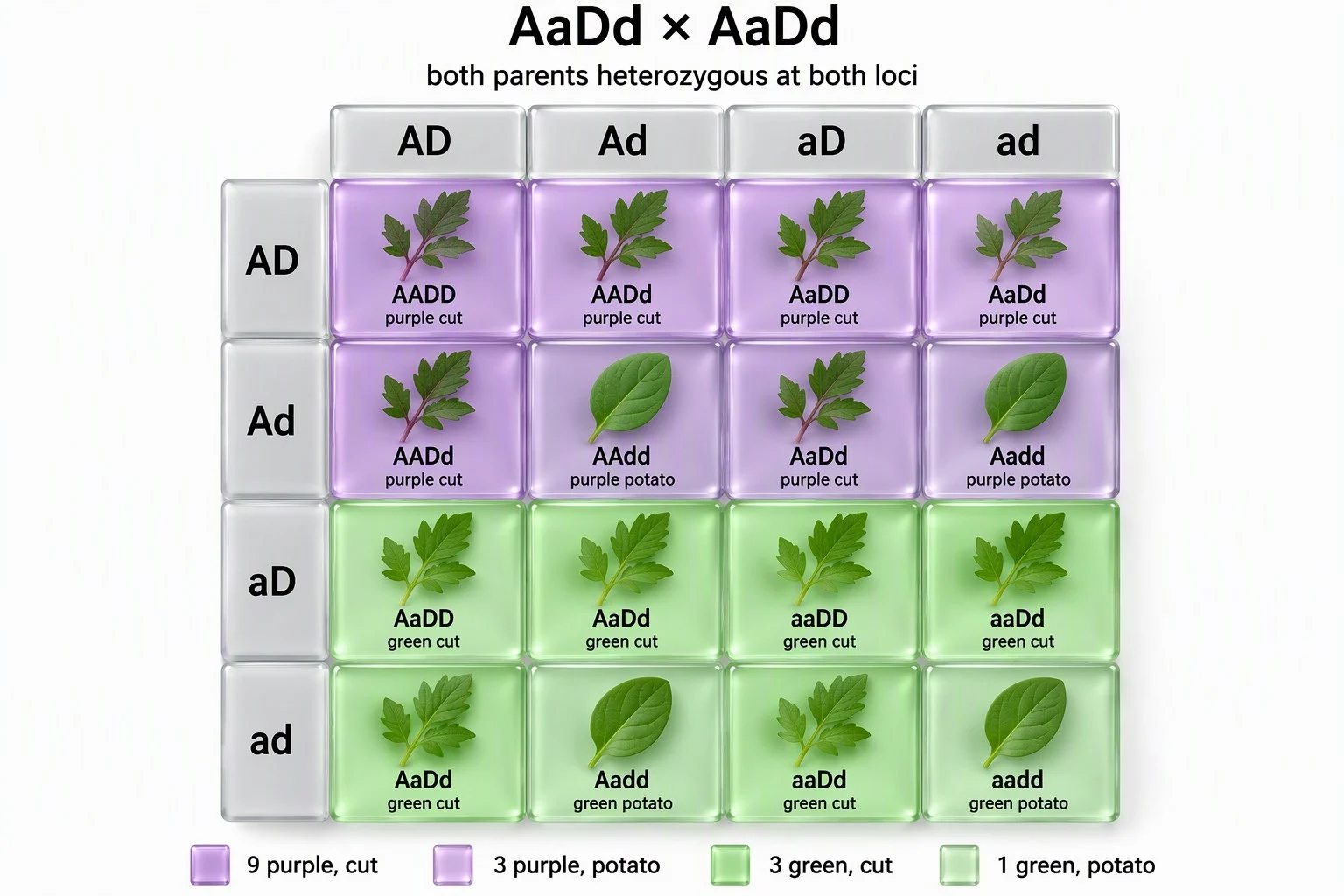
1Unlinked genes
Unlinked genes genes on separate (non-homologous) chromosomes, such as curly wings on chromosome 2 and mahogany eyes on chromosome 3 in Drosophila.
2Assortment
Assortment the alignment of bivalents in metaphase I, which is independent for each bivalent.
3Segregation
Segregation which pole whole chromosomes go to in anaphase I, set by assortment, deciding which allele combinations are in which gametes.
4Mendel's law of independent assortment
Mendel's law of independent assortment alleles of different genes are inherited independently,
- so inheriting one allele does not affect inheriting another.
- Linked genes on the same chromosome tend to be inherited together.
5Dihybrid cross
Dihybrid cross a cross showing the inheritance of two genes, with write-up of the two alleles of one gene followed by the two of the other,
- such as TtBb.
6Gametes
- Gametes find the possible gametes of each parent using the FOIL method.
- (first, outside, inside, last)
| Cross | Phenotype ratio |
|---|---|
| Double heterozygote × double heterozygote (unlinked) | 9 : 3 : 3 : 1 |
| Double heterozygote × double homozygous recessive | 1 : 1 : 1 : 1 |
- Nature of science
- the 9:3:3:1 and 1:1:1:1 ratios rest on Mendel's second law, which is not universal because linked genes do not follow it.
Part 8 of 10Chi-squared test for dihybrid crosses
Purpose
- Purpose the chi-squared test checks whether the difference between expected and observed results of categorical data is significant, perhaps showing linkage.
Calculation
1
Obtain observed and expected results; the expected count of each phenotype is its fraction of the total.
2
Find the difference between each pair of results.
3
Square each difference.
4
Divide each by the expected value and add them to get χ2.
5Find degrees of freedom
Find degrees of freedom number of classes − 1.
6Compare with the critical value at p
0.05 (7.82 for 3 degrees of freedom).
Hypotheses
- The null hypothesis (H0) is no significant difference between expected and observed, with differences due to chance.
- The alternative hypothesis (H1) is a significant difference.
Interpretation
- If χ2 is less than the critical value, differences are due to chance and the null hypothesis is accepted.
- If χ2 is greater, the difference is significant, the null hypothesis is rejected and something else, such as linkage, may be involved.
- At p = 0.05 chance accounts for five in every hundred experiments differing.
Nature of science
- Nature of science statistical tests use a sample to represent a population, and larger samples are more representative.
Part 9 of 10Genes and polypeptides: databases and loci, gene linkage
Locus
- Locus the Human Genome Project gave the exact locus of every gene, and databases such as EMBL can locate any known gene or allele.
- Examples are CFTR (cystic fibrosis) on chromosome 7 and HBB (sickle cell anaemia) on chromosome 11.
Uses
- Uses knowing a locus lets medicine find faulty alleles, which could be cut out by recombinant DNA technology or replaced in gene therapy.
- (often recessive)
- Databases of cancer-related genes help cancer genetics.
- They compare base and protein sequences between species.
Reading a locus such as 7q31.2: the number is the chromosome (7), the letter is the arm (q long, p short) and the number after it shows distance from the centromere, with smaller numbers closer.
- CFTR (7q31.2) and coagulation factor X (13q34) are on different chromosomes, so their inheritance is not linked.
Linkage likelihood
- Linkage likelihood genes on different chromosomes are not linked, genes on the same chromosome are likely linked,
- and genes on the same arm at similar distances from the centromere are the most likely to be linked.
Linked genes
Linked genes genes with loci on the same chromosome, inherited together.
- Sex-linked genes are on a sex chromosome, usually the X, as the Y has few genes (colour-blindness and haemophilia affect mainly males).
- Autosomal linkage is linkage on chromosomes 1–22.
- The extent of linkage is measured in centimorgans, named after Thomas Hunt Morgan.
Notation
- Notation linked alleles are joined by lines for the homologous chromosomes, such as (TG)(tg).
Effect on ratios
- Effect on ratios dihybrid predictions assume independent assortment, but linked genes stay in parental combinations.
- A test cross of linked genes in newts for tail length (T/t) and scale colour (G/g) gives a 1:1 ratio of parental types instead of 1:1:1:1.
- An unexpected phenotypic ratio shows linkage.
Part 10 of 10Recombinants and crossing over
Recombinants
Recombinants offspring with a combination of characteristics different from their parents, produced by crossing over that breaks linkage.
Parental types are usually more frequent than recombinants, because crossing over is random and chiasmata form in different places each meiosis.
Recombination frequency is higher for genes further apart on the chromosome, since more positions are available for a chiasma.
Identifying recombinants
- Identifying recombinants cross an individual with a homozygous recessive individual for both traits (a test cross).
- Offspring with a non-parental phenotype are recombinants.
Sweet pea example
- Crossing double homozygous dominant (PL)(PL) with double homozygous recessive (pl)(pl) gives a heterozygous F1.
- P is purple flowers and L is long seeds, with p red and l round.
- Interbreeding the F1 should give 9:3:3:1, but more parental types and fewer recombinants appear.
- Ratios that do not follow Mendel's pattern are non-Mendelian, and linkage explains them.
- Morgan later proved linkage in Drosophila melanogaster.
Autosomal linkage and sex linkage should be distinguished.
Key terms
| Term | Meaning |
|---|---|
| Genotype | the combination of alleles an individual has. |
| Phenotype | the observable characteristics of an organism. |
| Codominance | both alleles expressed equally in the heterozygote. |
| Sex-linked gene | a gene located on a sex chromosome, usually the X. |
| Locus | the position of a gene on a chromosome. |
| Linked genes | genes on the same chromosome that tend to be inherited together. |
| Recombinant | offspring with a new combination of characteristics formed by crossing over. |
| Polygenic | controlled by many genes with additive effects. |
| Test cross | a cross with a homozygous recessive individual to reveal genotype or recombinants. |
Avoid these mistakes
1
Gene and allele mean the same — an allele is one variant of a gene.
2
Recessive alleles are rare or weak — they are expressed only when two copies are present.
3
Linked genes assort independently — they stay together unless crossing over separates them.
4
A chi-squared value above the critical value means no difference — it means a significant difference and the null hypothesis is rejected.
Marked practiceQuizzes for this lesson
Last updated:
\n