D1.2Theme D — Continuity and change
Protein synthesis — IB Biology HL Revision Notes & Topical Questions
10 min read 12 parts Lesson 3 of 18 2 quizzes
Curriculum Equation Key قوانين الرقم الهيدروجيني والاتزان الأيوني - pH & Acid-Base Equilibrium FormulasFast Exam Solution
pH = -log[H⁺] | pOH = -log[OH⁻] | pH + pOH = 14 | [H⁺][OH⁻] = 10⁻¹⁴
Word Equation & Conditions: الرقم الهيدروجيني = -لوغاريتم تركيز أيون الهيدروجين | pH + pOH = 14
Location & Specifications: الاتزان الأيوني، كيمياء 3 ثانوي، التحصيلي، و AP Chemistry.
Lesson summary
D1.2 Protein synthesis — IB BIOLOGY HL notes: Explain transcription, post-transcriptional modification, translation, the genetic code, point mutations and the modification and recycling of polypeptides.Two stages — transcription makes mRNA from DNA in the nucleus, and translation…
- Stability of DNA
- Gene expression
- Regulation in eukaryotes
- Coding versus non-coding
- Prokaryotes
- Introns and exons
Section 1 of 12Overview and transcription
1Two stages
- Two stages transcription makes mRNA from DNA in the nucleus, and translation makes a polypeptide from mRNA in the cytoplasm.
2mRNA
mRNA a single-stranded RNA that carries information from the nucleus to the cytoplasm, made by RNA polymerase.
3
Transcription steps
1
Part of the DNA unwinds and its hydrogen bonds break, exposing the gene.
2
Free RNA nucleotides pair by hydrogen bonds with the exposed bases on the template strand only.
3
RNA polymerase bonds the sugar-phosphate groups of the nucleotides into the mRNA backbone.
4
When the gene is transcribed, the mRNA–DNA hydrogen bonds break and the double helix reforms.
5
The mRNA leaves the nucleus through a nuclear pore, because DNA is too large to do so.
- Enzymes
- RNA polymerase is used in transcription and DNA polymerase in replication.
Section 2 of 12Base pairing and DNA as a template
Pairing
- Pairing adenine in DNA pairs with uracil in RNA, since RNA has no thymine.
Strands
- Strands the template strand is transcribed, and the other is the coding strand with the same sequence as the mRNA except T for U.
Stability of DNA
- Stability of DNA hydrogen bonds between strands and strong phosphodiester bonds make DNA resistant to spontaneous change.
- Single strands act as reliable templates over many generations of cell replication.
- In non-dividing cells such as neurones and some muscle cells, the sequence is conserved and does not degrade.
Section 3 of 12Gene expression
Gene expression
- Gene expression about 20 000 protein-coding genes are in the human genome, but not every protein is needed in every cell.
- (insulin is not needed in heart muscle)
- Expressed genes are switched on and are transcribed and translated, and silenced genes are not.
Control
- Control transcription is the first stage of gene expression, so it is a key point of control.
- Essential genes such as those for respiratory enzymes or ATP synthase are expressed all the time.
- Others, such as the rhodopsin gene in light-sensitive eye cells, are expressed only when needed.
Section 4 of 12Promoters and non-coding DNA
Promoter
Promoter a non-coding sequence near a gene, not itself transcribed, where RNA polymerase binds to start transcription.
- Binding is controlled by regulatory proteins.
Regulation in eukaryotes
- Regulation in eukaryotes transcription factors bind specific DNA sequences so that genes are expressed in the right cells, at the right time and level, controlling differentiation and development.
- General transcription factors bind the promoter and help RNA polymerase attach.
Coding versus non-coding
- Coding versus non-coding only 1.5% of the human genome codes for polypeptides.
- Regulatory sequences (enhancers, silencers, promoters) enhance or suppress transcription.
- Some sequences make functional RNA such as tRNA and rRNA.
- Introns are non-coding sequences within genes, and different proteins can come from how they are removed.
- Telomeres are repeated sequences at chromosome ends that let an RNA primer bind so replication can reach the end; without them, chromosomes would shorten each division.
- Telomeres shorten with age through oxidative damage, accelerated by smoking, pollution, obesity, stress and poor diet,
- and antioxidants are claimed to slow it.
Section 5 of 12Mechanism of transcription
- Stages
Mechanism of transcription
Initiation: RNA polymerase binds near the promoter and the DNA strands separate into an open complex.
Elongation: RNA polymerase moves along the template, adding the 5' end of each free RNA nucleotide to the 3' end of the growing mRNA,
- so synthesis is 5' to 3'.
Termination: at a terminator sequence the polymerase and mRNA detach.
- Reading
- the mRNA is also read 5' to 3' during translation.
Section 6 of 12Post-transcriptional modification
Reasons
- Reasons modification helps prevent degradation of unstable single-stranded mRNA, raises the efficiency of protein synthesis and expands the proteome in eukaryotes.
Prokaryotes
- Prokaryotes translation occurs immediately, so little modification is needed.
Eukaryotes
- Eukaryotes transcription and translation are in separate places, so the pre-mRNA is modified to mature mRNA.
Post-transcriptional modification
A methylated cap is added at the 5' end to protect against exonucleases.
A poly-A tail of adenine nucleotides is added at the 3' end for protection and nuclear export.
Introns are removed and exons are joined (splicing).
Introns and exons
- Introns and exons the whole gene is transcribed, and only exons remain in mature mRNA.
- (expressed regions)
Alternative splicing
- Alternative splicing exons can be joined in different ways,
- so one gene codes for several proteins with different sequences, structures and functions,
- which is why the proteome is larger than the genome.
Section 7 of 12The genetic code
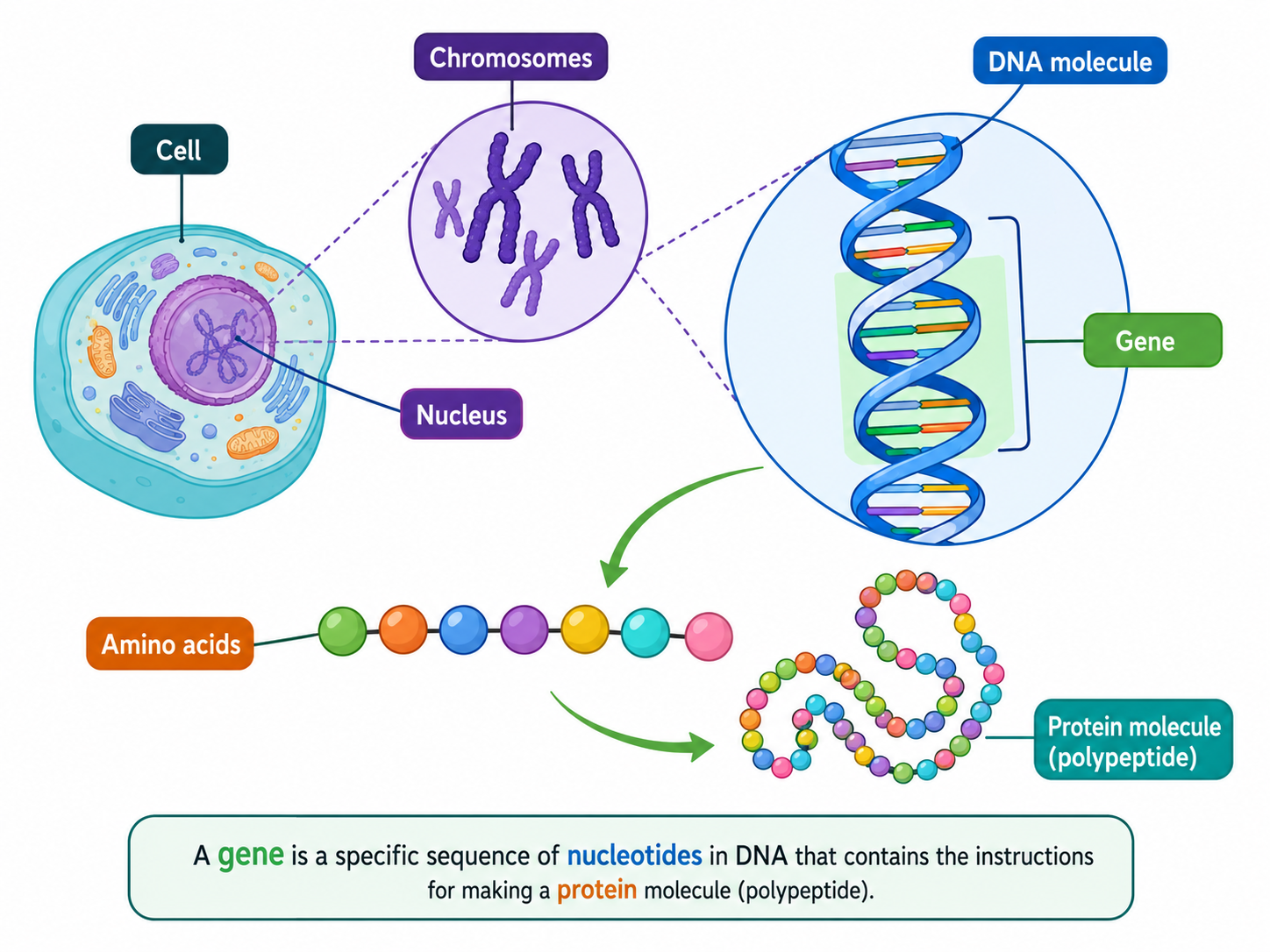
Triplet code
- Triplet code each triplet of bases codes for one amino acid, from 20 different amino acids.
- A triplet is three DNA bases, a codon is three mRNA bases, and an anticodon is three tRNA bases complementary to a codon.
- TAC on the template is the start signal for methionine, and stop codons end translation.
Non-overlapping
- Non-overlapping each base is read in one codon only.
Degenerate
- Degenerate there are 43 = 64 codons for only 20 amino acids, so several codons code for the same amino acid, which limits the effect of mutations.
Universal
- Universal almost all organisms use the same code, so genes can be transferred between species and genetic engineering is possible.
Deducing a sequence
The genetic code
Find the template strand by base pairing from the coding strand.
Write the complementary mRNA codons.
Look up each codon in the codon table.
Section 8 of 12Translation
Site
- Site the cytoplasm, after the mRNA leaves the nucleus and attaches to a ribosome.
Ribosome
- Ribosome a large and small subunit made of protein and rRNA.
- The mRNA binds to the small subunit.
- There are three tRNA binding sitesA (aminoacyl), P (peptidyl) and E (exit).
- At the A site the codon pairs with the tRNA anticodon.
- At the P site amino acids are joined by peptide bonds.
- At the E site the tRNA leaves.
tRNA
- tRNA a single strand of about 80 nucleotides folded into a clover shape by hydrogen bonds.
- There is a type for each of the 20 amino acids, with an amino-acid binding region and a three-base anticodon.
Initiation
1
A small ribosomal subunit attaches to the 5' end of the mRNA.
2
An initiator tRNA carrying methionine binds at the P site.
3
The ribosome moves along to the start codon AUG.
4
The large subunit binds and elongation begins.
- Elongation cycle
1
The next codon calls a tRNA with the matching anticodon into the A site.
2
A peptide bond forms between the two amino acids, a condensation reaction that is anabolic and uses ATP from mitochondria.
3
The ribosome moves one codon, so the first tRNA moves to the E site and leaves.
4
The tRNA with the peptide chain moves from the A site to the P site.
5
The cycle repeats until a stop codon, when the polypeptide is released.
Section 9 of 12Point mutations and sickle cell disease
Gene mutation
Gene mutation a change in the sequence of bases in DNA, which may give a new allele.
- Mutations are random copying errors made in S phase of interphase.
- Most are harmful or neutral, but some are beneficial.
- Mutations in gametes are inherited, while mutations in body cells are not.
Point mutation
Point mutation one base is changed, which may change an amino acid.
Sickle cell disease
- Sickle cell disease a single base substitution in the beta-globin gene of haemoglobin changes allele HbA to HbS.
1
The coding-strand triplet GAG changes to GTG.
2
The template triplet CTC becomes CAC.
3
The mRNA codon GAG becomes GUG.
4
Valine replaces glutamic acid at position 6 of the polypeptide.
- Effects
- Haemoglobin S distorts red cells into a sickle shape.
- Sickled cells carry less oxygen and block capillaries, causing pain, fatigue and anaemia.
- The distribution of sickle cell alleles matches malaria distribution, as HbS gives resistance to the malaria parasite.
Section 10 of 12Modification of polypeptides and recycling of amino acids
Folding
- Folding the primary structure must fold into secondary, tertiary and quaternary structure, with disulfide bonds, sometimes using molecular chaperones to prevent misfolding.
Insulin formation
1
Pre-proinsulin (110 amino acids) is attached to the endoplasmic reticulum wall.
2
An enzyme removes the signal peptide, giving proinsulin.
3
Proinsulin folds and disulfide bonds form.
4
It is packaged into vesicles at the Golgi apparatus.
5
The C peptide is cleaved from the middle, leaving A and B chains joined by two disulfide bonds, the mature insulin.
Proteolysis
- Proteolysis proteases break peptide bonds in unneeded, damaged or misfolded proteins, releasing amino acids for new proteins.
Proteasome
- Proteasome an organelle in eukaryotes where proteolysis occurs, containing the proteases so useful proteins are not broken down by mistake.
Ubiquitin
- Ubiquitin a chemical tag on proteins marked for breakdown.
Importance
- Importance it takes place constantly and is essential to sustain a functional proteome.
Section 11 of 12Key terms
| Term | Meaning |
|---|---|
| Transcription | making mRNA from a DNA template using RNA polymerase. |
| Translation | making a polypeptide from mRNA at a ribosome. |
| Codon | three mRNA bases that code for one amino acid. |
| Anticodon | three tRNA bases complementary to an mRNA codon. |
| Promoter | a non-coding DNA sequence where RNA polymerase binds. |
| Exon | a coding sequence retained in mature mRNA. |
| Intron | a non-coding sequence removed from pre-mRNA. |
| Proteasome | the organelle that breaks down tagged proteins. |
| Point mutation | a change in a single base of DNA. |
Section 12 of 12Exam technique
1
Both DNA strands are transcribed — only the template strand is transcribed.
2
Introns are translated — they are removed before translation.
3
Transcription happens in the cytoplasm — it happens in the nucleus and translation in the cytoplasm.
4
One gene makes only one protein — alternative splicing lets one gene code for several proteins.
Marked practiceQuizzes for this lesson
Last updated:
\n