D1.3Theme D — Continuity and change
Mutation and gene editing — IB Biology HL Revision Notes & Topical Questions
10 min read 12 parts Lesson 4 of 18 3 quizzes
Curriculum Equation Key قوانين الرقم الهيدروجيني والاتزان الأيوني - pH & Acid-Base Equilibrium FormulasFast Exam Solution
pH = -log[H⁺] | pOH = -log[OH⁻] | pH + pOH = 14 | [H⁺][OH⁻] = 10⁻¹⁴
Word Equation & Conditions: الرقم الهيدروجيني = -لوغاريتم تركيز أيون الهيدروجين | pH + pOH = 14
Location & Specifications: الاتزان الأيوني، كيمياء 3 ثانوي، التحصيلي، و AP Chemistry.
Lesson summary
D1.3 Mutation and gene editing — IB BIOLOGY HL notes: Explain the types, causes and consequences of mutations, their role in variation, gene editing, and conserved sequences.Gene mutation = a change in the sequence of base pairs in a DNA molecule, which may produce a new allele.M…
- Inheritance
- Point mutations
- Mutagenic agents
- Random errors
- Limited effect
- No intentional change
Part 1 of 10Gene mutations and types of mutation
Gene mutations and types of mutation
Gene mutation
Gene mutation a change in the sequence of base pairs in a DNA molecule, which may produce a new allele.
- Mutations occur all the time and at random, most often as copying errors in S phase of interphase.
- A mutation can change the polypeptide a gene codes for, because the base sequence decides the amino acid sequence.
- Most mutations are harmful or neutral, and a few are beneficial.
Inheritance
- Inheritance mutations in body cells are not inherited and are lost when the cells die,
- while mutations in gametes are inherited and may cause genetic disease.
| Type | Change | Effect |
|---|---|---|
| Substitution | One base swapped for another | Changes the amino acid only in the triplet affected, with no knock-on effect |
| Insertion | A nucleotide with a new base is added | Changes that triplet and shifts later triplets (frameshift) |
| Deletion | A nucleotide is removed | Changes that triplet and shifts later triplets (frameshift) |
- Point mutations mutations at a single location, which include substitutions, insertions and deletions.
Part 2 of 10Causes of mutation and randomness of mutation
Mutagenic agents
Mutagenic agents environmental factors that raise the mutation rate.
- High-energy radiation such as UV light.
- Ionising radiation such as X-rays, gamma rays and alpha particles.
- Chemicals such as benzo[a]pyrene and nitrosamines in tobacco smoke, and mustard gas used in World War I.
- Internal mutagens, such as enzymes that break down DNA or produce mutagenic substrates.
Random errors
- Random errors they occur most often in DNA replication and repair when proofreading by DNA polymerase misses an error.
- If polymerase detects a wrong nucleotide, it removes it and replaces it before continuing.
Limited effect
- Limited effect most mutations do not alter the polypeptide or alter it only slightly, because the genetic code is degenerate.
Location
- Location mutations can occur anywhere in the genome of any organism, which is how new strains of viruses or bacteria arise.
- Uncoiled DNA mutates more than DNA coiled round histones because it is more exposed.
- Many mutations occur in non-coding regions such as satellite DNA.
Hotspots
- Hotspots regions with more frequent mutations.
- A CpG site is cytosine followed by guanine.
- Methylation of C here can lead to a C to T substitution.
- Repeated CpG sites form a CpG island, associated with cancers such as colorectal cancer.
No intentional change
- No intentional change cells have no mechanism to deliberately change a base or sequence to alter a trait, only proofreading to restore the original sequence.
Part 3 of 10Consequences of base substitutions
- Single nucleotide polymorphisms (SNPs) = single nucleotide differences between individuals, such as C replaced by T.
- They occur about once every 300 nucleotides, giving roughly 10 million SNPs in the human genome.
- They are common in non-coding regions between genes.
- They act as biological markers that help locate disease genes.
| Substitution | Effect | Example |
|---|---|---|
| Silent | Amino acid unchanged because the code is degenerate | Different codon for the same amino acid |
| Missense | One amino acid changed | Sickle cell anaemia |
| Nonsense | Premature stop codon, giving an incomplete polypeptide | Cystic fibrosis (not always the only cause) |
Part 4 of 10Consequences of insertions and deletions, mutations in germ and somatic cells
1Impact
- Impact they are often more harmful than substitutions because they affect how the rest of the sequence is read.
2Frameshift mutation
- Frameshift mutation adding or removing 1 or 2 nucleotides shifts the reading frame.
- The ribosome reads mRNA in triplet codons, so every codon after the mutation changes.
- The result may be wrong amino acids or a premature stop codon, so the protein ceases to function.
3Rate
- Rate frameshifts in translation are rare (10−5 to 10−7 per codon) but effects are catastrophic, and large insertions and deletions act similarly.
1
Germ cells use meiosis to make gametes, and the germ line includes eggs, sperm and the zygote.
- A mutation in sperm can affect the zygote and every cell derived from it.
- A female's inherited mutation is in the germ cells of her ovaries and passes to later offspring.
2
Somatic cells use mitosis to make body cells, and their mutations are not inherited but are linked with cancers.
- Cancer arises from uncontrolled mitosis forming a tumour.
- It starts when a mutation affects genes that control cell division, and a cancer-causing gene is an oncogene.
- Most mutations do not cause cancer, because they cause early cell death or the immune system destroys the cell, and cells are easily replaced.
- Cancerous cells avoid early death and immune destruction.
Part 5 of 10Mutations and genetic variation
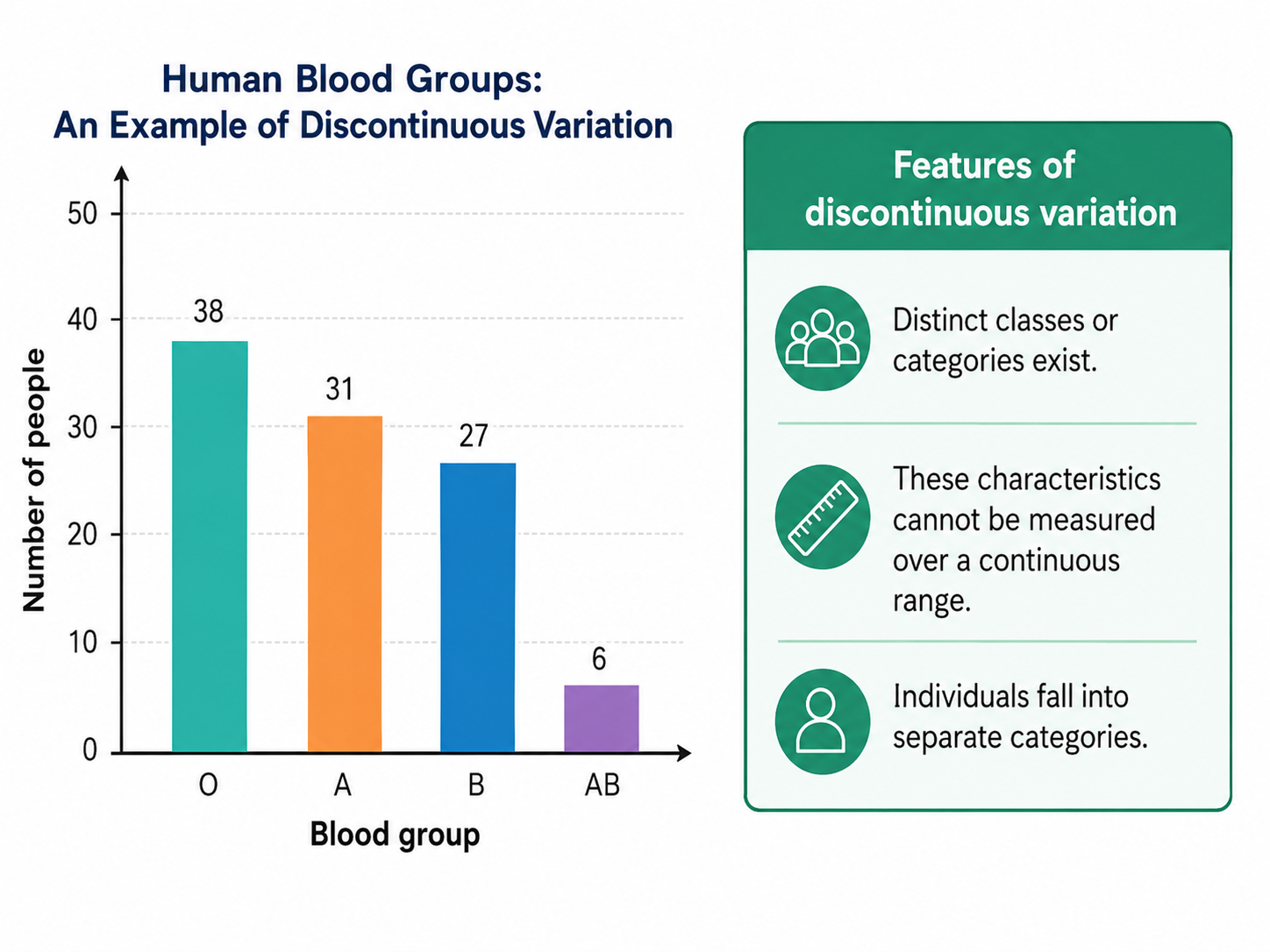
Variation
Variation differences between organisms of one species, such as coat colour in mammals, body length in fish and flower colour in plants.
Sources
- Sources mutation, meiosis and random fertilisation in sexual reproduction.
Mutation
- Mutation the original source of variation, producing new alleles.
- Mutations in dividing cells of sex organs change the alleles of gametes.
- An advantageous allele is more likely to be passed on, and a disadvantageous one is more likely to die out.
- Mutations are essential in the long term for evolution by natural selection.
- Somatic mutations are not passed on and do not affect natural selection.
- Mutation is the only source of variation in asexual species.
Part 6 of 10Genetic testing
- Nature of science
- commercial genetic tests give information about future health risk, which can be problematic without expert interpretation.
| Type | Features |
|---|---|
| Clinical or medical testing | Healthcare providers choose the test, collect the sample, send it to a laboratory, share the results and ensure understanding of the implications for the individual and family |
| Commercial testing | Kits are sold online or in stores and customers send a sample and receive results directly |
- Problems with commercial tests
- They are not scientifically validated and can give inaccurate results.
- Unexpected information about health, family or ancestry may be stressful.
- People may make treatment decisions on inaccurate or misunderstood results.
- Genetic counselling is often not provided.
Part 7 of 10Investigating gene function
Investigating gene function
Genome
Genome the entire genetic material of an organism, and the Human Genome Project (completed in 2003) sequenced the whole human genome.
- Scientists now want to know what each gene codes for, to treat and prevent disease.
Gene knockout
- Gene knockout removing a gene or making it unusable to learn its function.
- The organism is a knockout organism, commonly laboratory mice, and it is a genetic engineering technique.
- A genetic library of knockout yeast (Saccharomyces cerevisiae) helps study drug action and target specific processes.
- Conditions studied include obesity, diabetes, cancer likelihood, addiction and cardiovascular disease.
Part 8 of 10Gene editing techniques
1Gene editing
Gene editing altering an organism's own DNA by inserting, deleting or replacing DNA at specific sites, unlike genetic engineering,
- which inserts DNA from another organism.
- It gives more accurate genome manipulation.
2
Older methods
- Modified viruses inserted DNA but sometimes placed it in other genes with unforeseen consequences.
- Liposomes with the normal gene sprayed into the nose were short-term because nasal epithelial cells are short-lived.
3CRISPR (clustered regularly interspaced short palindromic repeats)
- CRISPR (clustered regularly interspaced short palindromic repeats) the most common current method.
- It uses a bacterial defence mechanism in which a guide RNA attached to the enzyme Cas9 cuts DNA at a specific point.
- Scientists then insert, delete or replace faulty DNA with normal DNA.
4Gene therapy
Gene therapy treating a genetic disease by altering the person's genotype, such as treatments for cystic fibrosis and sickle cell anaemia.
- Knowledge of the genome and proteome and computational biology show which genes cause diseases and what base changes are needed.
Part 9 of 10Ethics of gene editing
Nature of science
- Nature of science uses of CRISPR raise ethical issues to be addressed before implementation.
- Consent for genetic data.
- Insurance companies requiring genetic testing results.
- Legal control of data use, especially human genomes.
Oversight
- Ethics committees approve all experiments with advice from experts.
- Countries have laws protecting research participants.
- International committees, such as the International Commission on the Clinical Use of Human Germline Genome Editing, make recommendations.
- The World Health Organization issues guidance and guidelines.
- Policymakers must coordinate regulations, which apply to all gene editing, including CRISPR.
Part 10 of 10Conserved sequences
1
Conserved sequence
Conserved sequence a DNA or RNA section showing minimal mutation over time, identical or similar across a species or group of species.
- Highly conserved sequences show little to no change over long periods of evolution.
- Examples are sequences for DNA replication, transcription and translation (DNA helicases, tRNA, ribosomes) and respiratory proteins (cytochrome c, ferredoxin).
2
Functional requirements hypothesis
- Functional requirements hypothesis genes for essential proteins cannot mutate without the cell dying,
- so natural selection maintains the sequence by removing mutations.
3
Slower mutation rate hypothesis
- Slower mutation rate hypothesis some sections are less prone to mutation, with a lower rate than elsewhere.
- Mutation rate is base pair changes in a gene per generation or division, or in the whole genome per generation.
- Proofreading and repair are very active in coding regions and highly functional genes, so mutations are corrected and do not show in sequences.
- Error correction is weaker in non-coding DNA, where mutation rates are higher.
Key terms
| Term | Meaning |
|---|---|
| Frameshift mutation | an insertion or deletion that shifts the reading frame of all later codons. |
| Silent mutation | a substitution that does not change the amino acid. |
| Missense mutation | a substitution that changes one amino acid. |
| Nonsense mutation | a substitution that creates a premature stop codon. |
| SNP | a single nucleotide polymorphism, a one-base difference between individuals. |
| Gene knockout | removing or disabling a gene to study its function. |
| CRISPR-Cas9 | a gene editing method using guide RNA and Cas9 to cut DNA at a chosen site. |
| Conserved sequence | a sequence that shows minimal mutation over evolutionary time. |
Avoid these mistakes
1
Cells can deliberately mutate genes to adapt — mutations are random and no mechanism makes a purposeful change.
2
All mutations are harmful — many are silent or neutral and a few are beneficial.
3
Substitutions cause frameshifts — insertions and deletions do, substitutions change only one codon.
4
Somatic mutations are inherited — only mutations in germ cells pass to offspring.
Marked practiceQuizzes for this lesson
Last updated:
\n