D3.1Theme D — Continuity and change
Reproduction — IB Biology HL Revision Notes & Topical Questions
15 min read 12 parts Lesson 8 of 18 2 quizzes
Curriculum Equation Key قوانين الرقم الهيدروجيني والاتزان الأيوني - pH & Acid-Base Equilibrium FormulasFast Exam Solution
pH = -log[H⁺] | pOH = -log[OH⁻] | pH + pOH = 14 | [H⁺][OH⁻] = 10⁻¹⁴
Word Equation & Conditions: الرقم الهيدروجيني = -لوغاريتم تركيز أيون الهيدروجين | pH + pOH = 14
Location & Specifications: الاتزان الأيوني، كيمياء 3 ثانوي، التحصيلي، و AP Chemistry.
Lesson summary
D3.1 Reproduction — IB BIOLOGY HL notes: Explain sexual and asexual reproduction, gamete formation, the menstrual cycle, fertilisation, pregnancy hormones, the placenta, plant reproduction and hormone replacement therapy.Sexual reproduction = fusion of the nuclei of two gametes f…
- Male and female gametes
- Reproductive systems
- Gametogenesis
- Spermatogenesis
- Polyspermy
- Early embryo
Section 1 of 12Sexual and asexual reproduction
Sexual reproduction
Sexual reproduction fusion of the nuclei of two gametes from two parents to form a zygote, giving offspring that differ genetically from each other.
- Gametes are haploid, such as sperm and ovum in animals and pollen nucleus and ovum in plants.
- Humans have 46 chromosomes in body cells and 23 in gametes, and the zygote is diploid with 46.
Asexual reproduction
Asexual reproduction reproduction by one parent without gametes or fertilisation, giving offspring that are genetically identical clones.
- Many plants reproduce this way, and bacteria use binary fission.
| Feature | Sexual | Asexual |
|---|---|---|
| Parents | Two | One |
| Cell division | Meiosis then fertilisation | Mitosis |
| Genetic similarity | Offspring differ | Offspring identical |
| Variation | Meiosis and random fertilisation | Only mutation |
| Number of offspring | Fewer | Many |
| Speed | Slower | Faster |
| Advantage | Variation helps adaptation to change | Fast, with no mate needed |
| Disadvantage | Slower and needs a mate | No variation, so vulnerable to change |
Section 2 of 12Meiosis, fertilisation and gamete differences, menstrual cycle
1Meiosis
- Meiosis it makes haploid gametes from diploid cells in two divisions, in the testes and ovaries of animals and the anthers and ovaries of flowering plants.
2
Sources of variation
- Crossing over exchanges alleles between non-sister chromatids in meiosis I.
- Independent assortment gives different allele combinations through random alignment of homologous pairs.
- Random fertilisation gives millions of sperm and egg combinations.
3Gametes
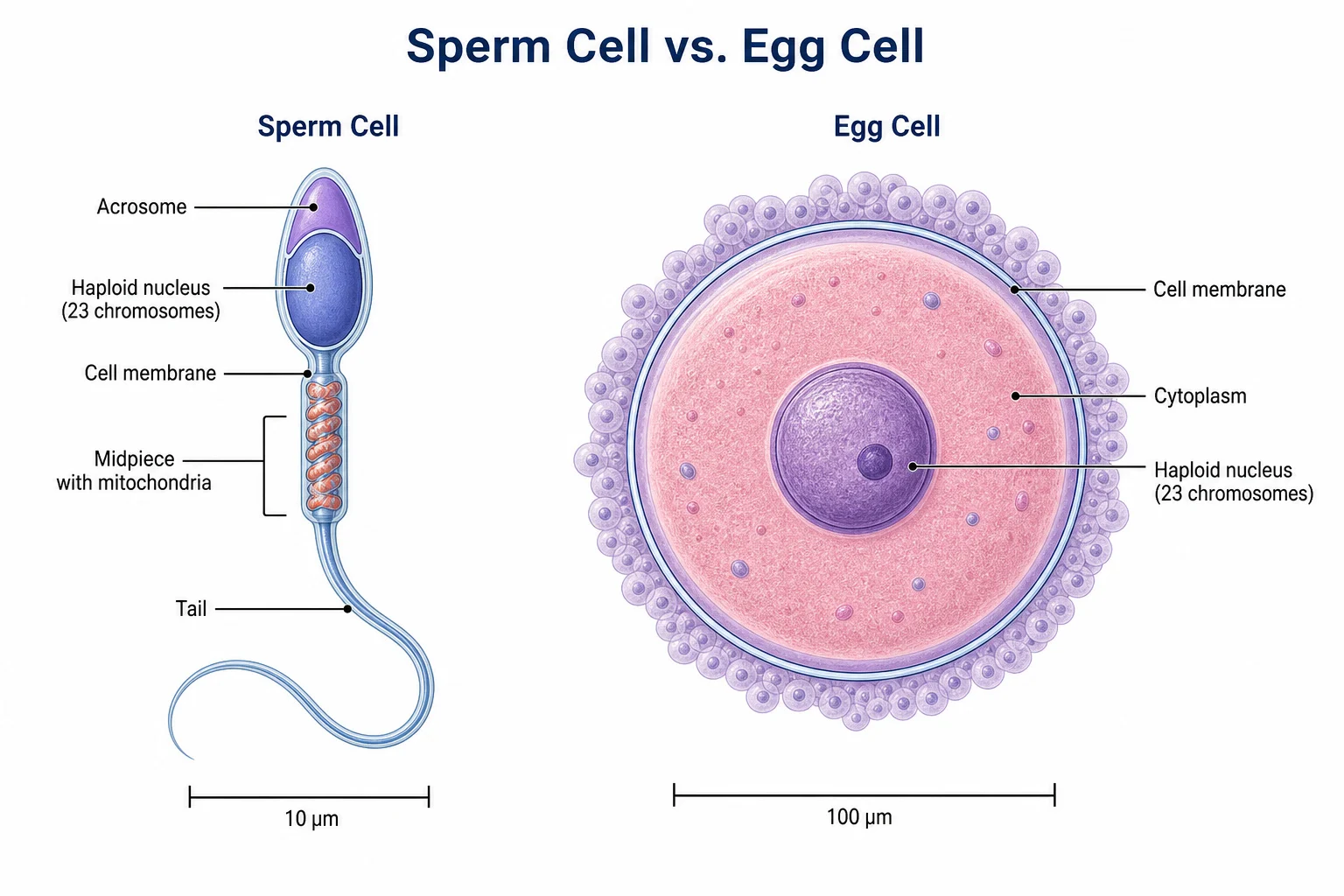
- Gametes spermatozoa in male animals and ova in female animals,
- while plant male gametes are in pollen grains and female gametes in ovules in the ovary.
4Male and female gametes
- Male and female gametes meiosis is the same, but the gametes differ greatly.
- Human females release one egg per menstrual cycle,
- while males release many thousands of sperm per ejaculation because most never reach the egg and only one fertilises it.
5Reproductive systems
- Reproductive systems draw and annotate male and female systems and state the function of each structure.
1
Menstrual cycle
Menstrual cycle changes in the female body before and after release of an egg, beginning in early adolescence and averaging 28 days.
2
Events
- Days 1–7: menstruation, loss of blood from the breakdown of the endometrium after an egg is not fertilised.
- From day 7 to 28: the endometrium thickens to receive a fertilised egg.
- About day 14: ovulation, release of the egg from its follicle, which becomes the corpus luteum, and the egg travels down the oviduct to the uterus.
Section 3 of 12Hormones of the menstrual cycle and in vitro fertilisation (IVF) and human fertilisation
| Hormone | Source | Role |
|---|---|---|
| FSH | Pituitary gland | Stimulates development of several follicles and secretion of oestrogen by the follicle wall |
| LH | Pituitary gland | Released when oestrogen peaks; causes ovulation, leaves the corpus luteum and stimulates progesterone production |
| Oestrogen (oestradiol) | Follicle, then corpus luteum | Rises to peak before day 14; thickens the endometrium and matures the egg |
| Progesterone | Corpus luteum | Low on days 1–14, rises after ovulation; keeps the endometrium thick, and its fall causes menstruation |
- Feedback
- FSH stimulates the follicle to make oestrogen, which increases FSH receptors in the follicles, positive feedback.
- High oestrogen inhibits FSH, negative feedback.
- A high oestrogen peak stimulates LH release, which causes ovulation and makes the corpus luteum secrete more oestrogen, positive feedback.
- Progesterone maintains the endometrium and inhibits FSH and LH, negative feedback.
1Reasons
- Reasons couples may have low reproductive hormones or reproductive system problems.
2
Steps
1
A drug inhibits FSH and LH secretion, which stops oestrogen and progesterone and temporarily halts the menstrual cycle.
2
Injections of FSH and LH cause superovulation, with many follicles maturing.
3
Eggs are collected and fertilised with sperm in sterile laboratory conditions.
4
The embryos, about 48 hours old as tiny balls of cells, are placed in the uterus.
5
Extra progesterone maintains the endometrium.
- Success rate is about 30% and improving with medical advances.
- Fertilisation fusion of a sperm nucleus and an egg nucleus to give a diploid zygote.
1
Many sperm are attracted to the egg by chemical signals.
2
The first sperm membrane fuses with the egg membrane and the sperm nucleus enters, while egg vesicles destroy the sperm tail and mitochondria.
3
Temporary membranes enclose the two haploid sets of chromosomes as pronuclei.
4
DNA replicates in preparation for mitosis.
5
The pronuclei come together and their membranes break down.
6
The condensed chromosomes undergo the first mitotic division, and further divisions form a blastocyst.
Section 4 of 12Gametogenesis
Gametogenesis
Gametogenesis formation of gametes in the gonads (testes and ovaries) by mitosis, growth and differentiation, then meiosis.
Spermatogenesis
- Spermatogenesis in the seminiferous tubules of the testes from puberty.
1
Germinal epithelium cells divide by mitosis into diploid spermatogonia; one daughter stays and one develops.
2
Spermatogonia move between Sertoli cells towards the lumen and become primary spermatocytes.
3
Meiosis I forms secondary spermatocytes and meiosis II forms spermatids.
4
Spermatids mature attached to Sertoli cells into spermatozoa.
5
The sperm detach, pass through the coiled epididymis and reach the sperm duct.
- Interstitial (Leydig) cells between the tubules make testosterone.
- Oogenesis
- begins in the foetal ovary.
1
Germinal epithelium divides by mitosis for the first 7 months of foetal development to form millions of oogonia, all that a woman will ever have.
2
Before birth, oogonia grow and enter meiosis I, surrounded by follicle cells, forming primary follicles, and oogenesis pauses until puberty.
3
At puberty FSH stimulates several primary follicles, but only one matures.
4
Meiosis I finishes, forming a secondary oocyte and a small polar body by unequal cytoplasm division.
5
The secondary oocyte begins meiosis II and is ovulated.
6
Meiosis II finishes only after a sperm enters, giving the ovum briefly and a second polar body.
- The remaining follicle becomes the corpus luteum.
Section 5 of 12Preventing polyspermy and blastocyst and implantation, pregnancy hormones and tests
Polyspermy
Polyspermy entry of more than one sperm into an oocyte.
Sequence
1
The oocyte is surrounded by follicle cells and a glycoprotein layer, the zona pellucida.
2
Sperm release digestive enzymes from the acrosome (the acrosome reaction) to digest through the zona pellucida.
3
Complementary receptors on the sperm head bind proteins on the oocyte membrane, the membranes fuse and the sperm nucleus enters.
4
Meiosis II continues, releasing the second polar body and forming the mature ovum.
5
Membrane fusion triggers cortical granules to release enzymes by exocytosis, the cortical reaction.
6
The enzymes digest the binding proteins and harden the zona pellucida, so no more sperm can enter.
7
The male and female nuclei fuse inside the ovum.
Early embryo
- Early embryo the fertilised ovum divides by mitosis into a two-cell and four-cell embryo until a hollow ball called a blastocyst, with an internal group of blastomeres that will form the foetus.
After about 7 days
- After about 7 days the blastocyst has about 125 cells, has reached the uterus and loses the zona pellucida.
Implantation
- Implantation it has used the egg's nutrients, so it needs an external supply.
- Finger-like projections from the outer layer penetrate the endometrium.
- Nutrient and oxygen exchange with the mother's blood begins, and the embryo grows rapidly.
1hCG (human chorionic gonadotropin)
- hCG (human chorionic gonadotropin) secreted by the embryo shortly after implantation, in the first 8–10 weeks.
- It stimulates the corpus luteum to keep secreting oestrogen and progesterone to develop the endometrium.
- It stimulates growth of the placenta and enlargement of the uterus and inhibits menstruation.
- After about 12 weeks it declines and the placenta takes over oestrogen and progesterone secretion.
2
Pregnancy tests detect hCG in urine using monoclonal antibodies on the test strip.
- hCG in the urine binds the antibodies and causes a colour change.
- No colour change means hCG is absent or too low.
Section 6 of 12Hormones of birth
Progesterone
- Progesterone secreted by the placenta throughout pregnancy.
- It inhibits oxytocin production by the pituitary and inhibits contractions of the uterine wall (myometrium).
Oestrogen
- Oestrogen at the end of pregnancy the foetus and placenta produce it.
- It signals the placenta to stop making progesterone and makes the uterine wall more sensitive to oxytocin.
Labour
- Labour a positive feedback loop.
1
Oxytocin from the pituitary stimulates contractions of the myometrium.
2
Stretch receptors in the cervix detect the contractions and signal the pituitary to release more oxytocin.
3
More oxytocin gives stronger contractions, increasing slowly and rhythmically.
- Birth
1
The cervix relaxes and dilates.
2
Contractions burst the amniotic sac and release the amniotic fluid.
3
The baby is pushed out through the cervix and vagina, and the cut umbilical cord separates it from the mother.
4
Contractions continue and the placenta separates and is delivered with the cord remains.
Section 7 of 12The placenta and pollen, ovules and pollination
The placenta and pollen, ovules and pollination
Mammal types
- Mammal types placental mammals such as humans, monotremes and marsupials (young develop in a pouch, such as kangaroos).
- (egg-laying, such as the platypus)
Function
- Function the placenta exchanges materials and makes oestrogen and progesterone,
- allowing the foetus to stay in the uterus to a later stage of development.
- The foetus is connected by the umbilical cord and contained in the amniotic sac with protective amniotic fluid.
Structure
- Structure blood vessels are arranged in placental (chorionic) villi, which increase in number as the foetus grows and give a large surface area.
- Maternal blood pools in the inter-villous spaces and never mixes with foetal blood.
- A thin placental barrier is selectively permeable and gives a short distance for exchange.
| Direction | Substances |
|---|---|
| Mother to foetus | Oxygen, water, glucose, antibodies (by endocytosis) |
| Foetus to mother | Carbon dioxide, water, urea |
- Harmful substances such as alcohol, drugs and small viruses can cross, but bacteria are too large.
Gamete production in flowering plants
- The anther's pollen sacs contain diploid mother cells that undergo meiosis to form four haploid pollen grains, and mitosis makes more male gametes.
- In the ovule, one diploid cell undergoes meiosis to give four haploid cells, of which one survives and divides by mitosis to form the female gametes.
Pollination
Pollination transfer of pollen from an anther to a stigma.
- Self-pollination occurs within a flower or between flowers of one plant, and cross-pollination transfers pollen between plants.
- Pollination is sexual reproduction because gametes are made by meiosis and fuse.
Fertilisation
1
A pollen tube grows from the pollen grain down the style to the ovary.
2
Two male nuclei travel to the ovule.
3
One fuses with the ovule nucleus to form the zygote, and the other forms the embryo's food store.
4
The ovule becomes the seed and the ovary becomes the fruit.
Section 8 of 12Flower structure and pollination adaptations, preventing self-pollination
| Structure | Function |
|---|---|
| Sepal | Protects the developing flower in the bud |
| Petal | Colourful to attract pollinators |
| Anther | Part of the stamen that produces male gametes |
| Filament | Stalk holding up the anther |
| Stigma | Top of the carpel, where pollen lands |
| Style | Part of the carpel that supports the stigma |
| Ovary | Contains the ovules |
| Ovule | Chamber in the ovary where female gametes develop |
1Insect-pollinated flowers
- Insect-pollinated flowers insects seek nectar, brush against the anthers and pick up sticky pollen, then deposit it on the stigma of another flower.
2Wind-pollinated flowers
- Wind-pollinated flowers anthers shed pollen into the air and it lands on a stigma by chance.
3
Cross-pollination improves genetic variation but relies on pollinators, such as bees pollinating many food crops,
- which does not apply to wind-pollinated plants.
1
Methods
- Different maturation times for pollen and ovules in one flower.
- Self-incompatibility, in which chemicals stop a pollen tube growing from pollen of the same plant.
- Flowers with only male or only female parts, or separate male and female plants.
- Wind carrying pollen far from the parent.
2
Disadvantage of self-pollination
- Disadvantage of self-pollination little variation and no new alleles, so offspring are poorly suited if conditions change.
3
Self-incompatibility stages
- The pollen grain fails to germinate.
- The pollen tube grows but does not enter the style.
- The pollen nucleus enters the ovule but degenerates before fertilisation.
- Fertilisation occurs but the embryo degenerates.
Section 9 of 12Seed dispersal and germination, puberty hormones
Seed dispersal reduces competition between offspring and parent, which differs from pollination.
- Wind or water carry parachute- or wing-shaped light seeds.
- Animals eat fleshy fruit and egest the seeds, or carry sticky or hooked seeds on fur and feathers.
- Some pods explode to throw seeds away.
Germination
Germination the start of growth in a seed after dormancy when conditions are favourable.
Requirements
- Water swells the seed, bursts the testa and activates enzymes.
- Oxygen is needed for respiration.
- Warmth raises enzyme-controlled reactions up to a limit.
Process
1
Imbibition replaces water lost in dormancy, activating the embryo.
2
Respiration and protein synthesis rise and food passes from the endosperm to the embryo through the cotyledons.
3
The radicle emerges first and grows downward in response to gravity.
4
The curved hypocotyl grows upward.
5
First leaves appear and photosynthesis begins.
Trigger
- Trigger the hypothalamus secretes GnRH, which the pituitary detects and responds to by secreting LH and FSH in both sexes.
Effect
- LH and FSH enhance the effects of oestrogen and testosterone, which cause secondary sexual characteristics.
Section 10 of 12Menopause and hormone replacement therapy
Menopause
Menopause when a woman has had no periods for over 12 months, usually at 45–55 years.
- The ovaries stop ovulating and make little oestrogen and progesterone because they no longer respond to FSH and LH.
- Negative feedback to the pituitary is lost, so LH and FSH rise.
- Symptoms include hot flushes, breast tenderness, headaches, sleep problems and emotional changes.
HRT
HRT replacing oestrogen and progesterone, with synthetic oestrogen as a tablet, patch, cream or gel.
- Oestrogen acts on blood vessels, bone strength, skin, urinary tract, uterus and brain.
Nature of science
- HRT and coronary heart disease (CHD).
- About 40 years ago, observational studies suggested HRT slightly reduced CHD risk, taken as cause and effect.
- Randomised controlled trials in the 1990s showed HRT may increase CHD risk.
- The timing hypothesis says HRT started early in menopause benefits the heart, while the trials included women years after menopause.
- The earlier correlation was not causal because HRT users tended to be better educated, wealthier and healthier,
- and a meta-analysis found the reduced risk fell once socioeconomic status was included.
Section 11 of 12Key terms
| Term | Meaning |
|---|---|
| Gametogenesis | formation of gametes by mitosis and meiosis in the gonads. |
| Ovulation | release of a secondary oocyte from the ovary. |
| Corpus luteum | the empty follicle that secretes progesterone. |
| Polyspermy | entry of more than one sperm into an oocyte. |
| Blastocyst | a hollow ball of cells that implants in the endometrium. |
| hCG | a hormone from the embryo that maintains the corpus luteum in early pregnancy. |
| Pollination | transfer of pollen from anther to stigma. |
| Germination | the start of growth of a seed. |
| Menopause | the end of menstrual cycles and ovulation in a woman. |
Section 12 of 12Exam technique
1
Meiosis differs between males and females — the process is the same but the gametes differ.
2
Progesterone causes ovulation — LH causes ovulation, and progesterone maintains the endometrium.
3
Pollination and seed dispersal are the same — pollination moves pollen and dispersal moves mature seeds.
4
Maternal and foetal blood mix in the placenta — they flow either side of a barrier and never mix directly.
Marked practiceQuizzes for this lesson
Last updated:
\n