D4.3Theme D — Continuity and change
Climate change — IB Biology HL Revision Notes & Topical Questions
10 min read 12 parts Lesson 14 of 18 1 quiz
Curriculum Equation Key قوانين الرقم الهيدروجيني والاتزان الأيوني - pH & Acid-Base Equilibrium FormulasFast Exam Solution
pH = -log[H⁺] | pOH = -log[OH⁻] | pH + pOH = 14 | [H⁺][OH⁻] = 10⁻¹⁴
Word Equation & Conditions: الرقم الهيدروجيني = -لوغاريتم تركيز أيون الهيدروجين | pH + pOH = 14
Location & Specifications: الاتزان الأيوني، كيمياء 3 ثانوي، التحصيلي، و AP Chemistry.
Lesson summary
D4.3 Climate change — IB BIOLOGY HL notes: Explain the causes of climate change, positive feedback, its impacts on ecosystems and species, carbon sequestration, phenology and evolution.Greenhouse effect — radiation from the sun is re-radiated from Earth's surface, and greenhouse …
- Anthropogenic climate change
- Methane (CH4)
- Correlation
- Boreal forests (taiga)
- Tipping point
- Legacy carbon combustion
Part 1 of 10Greenhouse effect and human causes
1Greenhouse effect
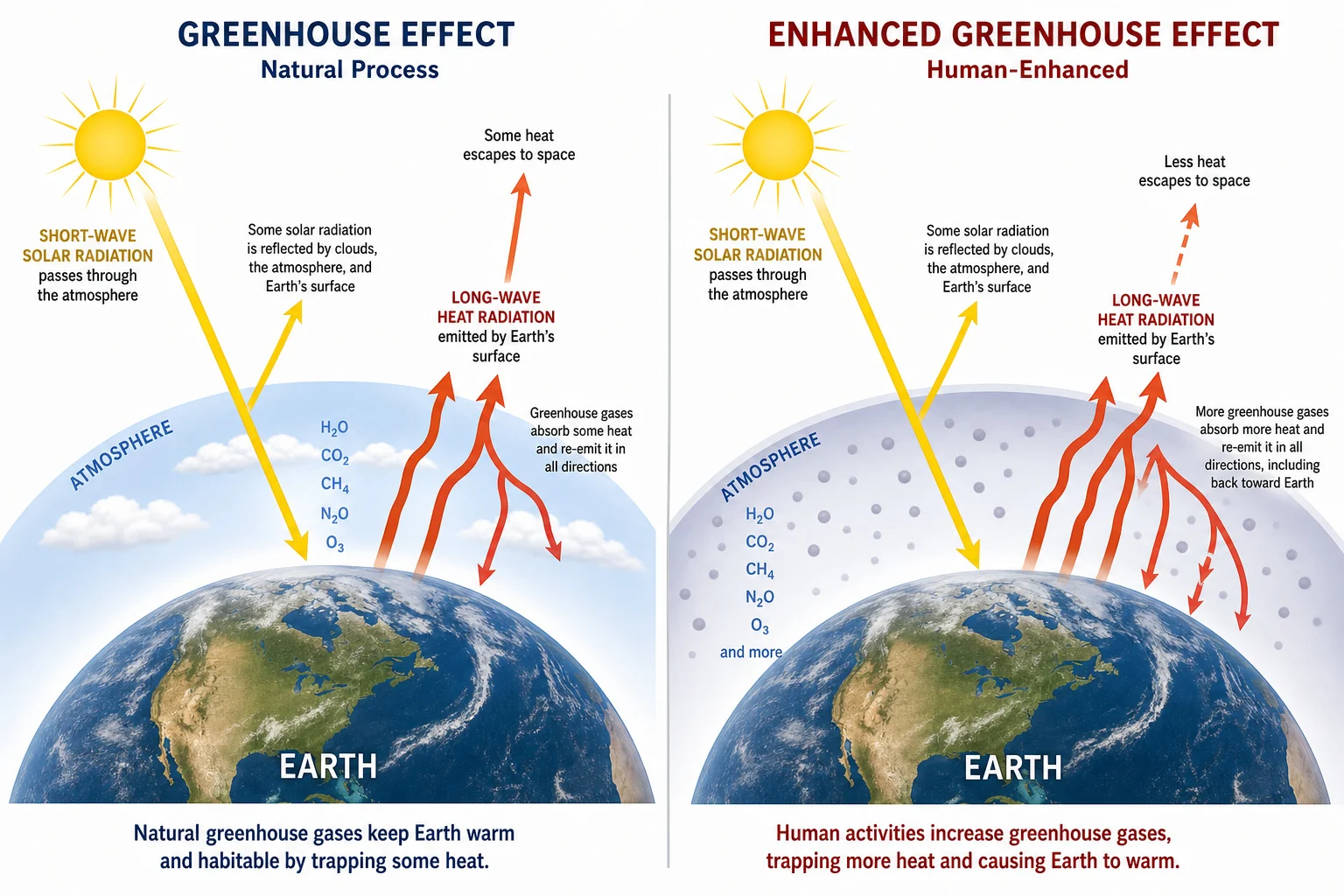
- Greenhouse effect radiation from the sun is re-radiated from Earth's surface, and greenhouse gases absorb it, trapping it in the atmosphere.
- It keeps Earth warm enough for life;
- without it Earth would have extreme temperature swings, like Mars, which ranges from 20 °C to −153 °C.
- Greenhouse gases include carbon dioxide and methane.
2Anthropogenic climate change
Anthropogenic climate change atmospheric warming and climate change caused by human activities.
3
Carbon dioxide
- Levels have varied through Earth's history because of volcanic eruptions and weathering of limestone.
- Since the industrial revolution (late 1700s) combustion of fossil fuels has raised levels to their highest ever.
- Carbon dioxide also enters the air when carbon sinks (trees, soils, peat bogs, oceans) are damaged: deforestation, soil degradation, peat harvesting and ocean warming.
- A correlation between carbon dioxide and global temperature supports human causes, alongside other evidence.
4Methane (CH4)
- Methane (CH4) the main component of natural gas, with levels risen significantly in the last 150 years.
- Ruminant mammals such as cattle release it from their guts, and intensive farming has increased this.
- Landfill sites release it as food waste decomposes.
- Fossil fuel extraction releases it.
- Anaerobic bacteria in waterlogged rice paddies release it.
- Polar warming releases it from permafrost (ground frozen all year).
Part 2 of 10Correlation and terminology
Correlation
- Correlation measuring two variables for an association.
- Positive correlationboth variables rise.
- Negative correlationone rises as the other falls.
- Antarctic ice cores show a positive correlation between global temperature and atmospheric carbon dioxide over hundreds of thousands of years.
Causation
- Causation correlation alone does not show that one variable caused the change in the other.
- It is not possible to say which variable influenced the other, and an unknown third variable may be involved.
- Extra evidence supports a causal link for carbon dioxide and temperature.
| Term | Meaning |
|---|---|
| Greenhouse effect | The natural, constant trapping of heat by the atmosphere and sunlight |
| Global warming | Rise in global temperatures mainly from increasing greenhouse gases |
| Climate change | Long-term changes in climate measures such as precipitation, temperature and wind, often a consequence of global warming |
Part 3 of 10Positive feedback in global warming
Positive feedback
Positive feedback a mechanism that causes additional change away from equilibrium, destabilising the system and driving it towards a tipping point where it shifts to a new equilibrium.
Global warming causes more global warming through
- Loss of reflective snow and icealbedo is how much light a surface reflects, high for snow and ice and low for rock, soil and dark ocean.
- Melting polar ice lowers Earth's albedo, so more energy is absorbed and warming increases.
- Accelerating decompositionenzyme-controlled reactions of bacteria and fungi are faster in warmth,
- so respiration of decay microorganisms releases more carbon dioxide.
- Peat bogs, stable carbon sinks, release huge amounts when decomposition speeds.
- Permafrost holds organic material that cannot decompose when cold, and thawing releases carbon dioxide.
- Methane releasemethanogenic archaea in thawing permafrost produce methane, a potent greenhouse gas.
- Drought and forest firesextreme weather brings more droughts, dry vegetation burns, combustion releases carbon dioxide and fewer plants remain to remove it.
Part 4 of 10Boreal forests and polar habitat change
Boreal forests (taiga)
- Boreal forests (taiga) they cover much of North America, Europe and Russia and have low productivity,
- but are an important carbon sink because of their size.
Tipping point
- Tipping point they risk switching from carbon sink to carbon source, which strengthens positive feedback.
1
Higher temperatures bring less snowfall and less snow melt water.
2
Drought reduces photosynthesis in the coniferous trees.
3
Water shortage causes loss of green pigment (forest browning) and eventually death.
4
Dead trees dry out, raising fire risk.
5
Photosynthesis removes less carbon dioxide and combustion releases more.
- Legacy carbon combustion = burning of carbon locked up for many years in living trees, dead needles and soil,
- which can tip the forest to a source and may be irreversible.
Boreal forests and polar habitat change
Sea ice forms when the ocean freezes, and landfast ice is attached to land.
- Warming reduces sea ice, and ice breaks up and detaches earlier in the year, harming breeding animals.
Emperor penguins breed on Antarctic sea ice, and early melting leaves too little time to raise chicks.
Walruses use Arctic sea ice to alternate nursing and hunting,
- and early ice loss makes mothers care for young further from the water's edge, leaving them unprotected for longer when mothers hunt.
Part 5 of 10Changes in ocean currents and range shifts of temperate species
Ocean currents redistribute heat and nutrients, driven by wind, temperature and salinity gradients.
- Warm currents carry heat from the tropics towards the poles and moderate coastal temperatures,
- such as the Gulf Stream that makes Europe warmer than Canada at a similar latitude.
- Cold currents carry cold water from the poles towards the tropics, cooling coasts.
Upwelling
- Upwelling wind moves surface water away, so cold, nutrient-rich deep water rises, supporting abundant marine life and productive fisheries.
El Niño
- El Niño part of the El Niño–Southern Oscillation (ENSO) cycle.
- Warming of the central Pacific, with warm surface water preventing nutrient upwelling off Central and South America,
- reducing primary production and energy flow in marine food chains.
- It shifts atmospheric circulation, causing droughts, floods and other extreme weather.
Changes in ocean currents and range shifts of temperate species
Tolerance limits
- Tolerance limits species survive only where conditions are within their range of tolerance,
- such as marine species within certain seawater temperatures.
- If a habitat changes beyond tolerance, the species must migrate or become extinct.
- Shifts may be poleward (towards the poles) or upslope (to higher altitude), where it is cooler.
Upslope shifts in montane birds
- Upslope shifts in montane birds altitude affects temperature and oxygen, and so plant growth and aerobic respiration.
- Fifty years of evidence in the Papua New Guinea mountains show many bird species moved to higher altitudes, though a few stayed or moved downslope.
- On Mt Karimui from 1965 to 2014, birds moved upslope by an average of more than 100 m.
Poleward shifts in North American trees
- Poleward shifts in North American trees the northern limit is set by temperature, where it is too cold for photosynthesis.
- Studies show range contraction and northward spread for many species.
Part 6 of 10Coral reefs and ocean acidification
Coral reefs
- Coral reefs hard calcium carbonate deposits secreted by reef-building coral polyps in symbiosis with algae.
- The algae provide carbon compounds by photosynthesis and the polyp gives shelter.
- Reefs are very diverse, with complex structures giving habitats, food chains and breeding sites, and about 25% of ocean fish species depend on them.
- Corals are highly sensitive to temperature and pH,
- and polyp death disrupts food webs, reduces niches and biodiversity,
- and can cause ecosystem collapse.
Ocean acidification
1
Oceans dissolve huge amounts of carbon dioxide, which reacts with water: CO2 + H2O ⇌ H2CO3.
2
Carbonic acid dissociates: H2CO3 ⇌ H+ + HCO3−.
3
Hydrogen carbonate dissociates further: HCO3− ⇌ H+ + CO32−.
4
At the right rate, the oceans stay slightly alkaline with a supply of carbonate ions for shell and exoskeleton building.
5
More atmospheric carbon dioxide gives more dissolved carbon dioxide and more hydrogen ions,
- so the pH falls (the oceans are still alkaline,
- but closer to neutral).
6
Hydrogen ions combine with carbonate ions (H+ + CO32− → HCO3−),
- reducing carbonate availability,
- and calcium carbonate exoskeletons weaken or dissolve.
Ocean acidification shares a cause with global warming (carbon dioxide) but is not a direct result of it.
Rising temperature
- Rising temperature coral polyps expel their algae,
- causing coral bleaching,
- and extended bleaching can kill them because they rely on the algae for carbon compounds.
Part 7 of 10Carbon sequestration
1Carbon sequestration
Carbon sequestration capturing and storing atmospheric carbon dioxide, for example in natural carbon sinks, which could slow global warming.
- Artificial carbon storage is still at research stage.
2Forest regeneration and afforestation
- Forest regeneration and afforestation reforestation plants trees in deforested areas, and afforestation creates new forests.
- Mature trees store huge amounts of carbon in their biomass.
- Costa Rica now plants seven times more trees than it cuts, which needed large government inputs in benefits to landowners.
3Peat bog restoration
- Peat bog restoration peat forms when plant matter cannot fully decompose in waterlogged, anaerobic, acidic conditions,
- so bogs are essential carbon sinks.
- Peatlands form in boreal and temperate ecosystems and rapidly in the tropics.
- Peat harvesting for fuel and drainage for development and agriculture release carbon by combustion or decomposition,
- and drying speeds decay organisms.
- Filling in drainage ditches and regulating harvesting lets bogs recover and deepen, increasing sequestration.
4Nature of science
- Nature of science scientists debate the best approach.
- Non-native fast-growing plantations sequester the most carbon in the shortest time.
- Rewilding with native species sequesters more slowly but is better for biodiversity.
Part 8 of 10Phenology
Phenology
Phenology the study of the timing of biological events,
- such as migration, egg laying, flowering and hibernation, used to assess the impact of climate change.
Deciduous trees
- Bud setting is leaf and flower bud development, bud bursting is the unfolding of buds into leaves and flowers,
- and a tree flowers when flower buds burst.
- Timing is crucial for reproduction: animal-pollinated trees must flower when pollinators emerge,
- and wind- or water-pollinated trees depend on weather, tides or seasonal river volume.
Birds
- Birds migration and nesting timing matter.
- Weather such as storms can blow birds off course.
- Birds migrating too early find unsuitable conditions or no resources, and those migrating too late find nesting sites taken or no mates.
- Hatching must coincide with food, such as caterpillars that depend on bud bursting, so events are linked in functional food webs.
Part 9 of 10Disruption of phenological events
- Cues
- climate change alters cues such as temperature and day length (photoperiod), so events happen at the wrong time.
- Species lack needed resources and food chains are disrupted.
- A missing trophic level is a trophic mismatch, and a time mismatch is a temporal mismatch.
| Example | Mismatch |
|---|---|
| Arctic mouse-ear chickweed and reindeer | Reindeer migrate by day length, which is unaffected, but the plant's peak productivity follows temperature, so food for breeding and raising young is mistimed |
| Great tits and caterpillars | Chicks need peak caterpillar biomass about 9 days after hatching; warming moves caterpillar peaks about 2 weeks earlier but hatching only about 1 week earlier, reducing breeding success |
- Spruce bark beetle
- It lays eggs under the bark of spruce and other conifers in Europe and North America.
- Eggs hatch into larvae that feed on phloem and other tissue, pupate into adults and emerge to repeat the cycle.
- Temperature decides whether the life cycle occurs once or twice a year, and warming makes two cycles more likely.
- More beetles and larval damage twice a year raise the chance that trees die and forest areas are killed.
Part 10 of 10Climate change and evolution
Selection pressures
- Selection pressures features of the environment such as a predator, lack of food or antibiotics that limit survival.
- Climate change adds new selection pressures, so it can drive evolution by natural selection.
Tawny owls
- Tawny owls they show polymorphism, with grey and brown morphs.
- A decades-long Finnish study found brown owls rising from about 30% to about 50%.
- Pale grey owls are less visible in snow, so were more successful.
- Milder winters mean less snow, so brown owls survive and reproduce more and pass on the brown allele.
- It is not known whether reduced visibility helps hunting, predator avoidance or both.
Key terms
| Term | Meaning |
|---|---|
| Greenhouse gas | a gas that absorbs radiation re-emitted from Earth's surface. |
| Albedo | the proportion of light a surface reflects. |
| Permafrost | ground that stays frozen all year. |
| Tipping point | a point at which a system shifts suddenly to a new equilibrium. |
| Ocean acidification | fall in ocean pH as dissolved carbon dioxide forms carbonic acid. |
| Carbon sequestration | capturing and storing atmospheric carbon dioxide. |
| Phenology | the study of the timing of biological events. |
| Trophic mismatch | a food chain disruption when peak food and peak need are out of step. |
| Range shift | movement of a species' distribution towards the poles or higher altitude. |
Avoid these mistakes
1
Greenhouse effect and global warming mean the same — the greenhouse effect is natural and global warming is the rise in temperature from more greenhouse gases.
2
Correlation proves climate causes — it shows association, and extra evidence supports the causal link.
3
Ocean acidification is caused directly by warming — it is caused by dissolved carbon dioxide.
4
Positive feedback stabilises the climate — it amplifies warming and drives the system to a tipping point.
Marked practiceQuizzes for this lesson
Last updated:
\n