Curriculum
SAAT (Tahsili)
Mathematics · Unit 1: Logic and Geometry
0/15
Mathematics · Unit 2: Functions and Matrices
0/12Mathematics · Unit 3: Sequences, Probability and Statistics
0/9Mathematics · Unit 4: Trigonometry
0/6Mathematics · Unit 5: Advanced Functions and Analytic Geometry
0/12Mathematics · Unit 6: Calculus
0/6Mathematics · Unit 7: Mathematics question bank with original diagrams
0/9Mathematics · Mock exams and full tests
0/10Physics · Unit 1: Physics and Motion
0/12Physics · Unit 2: Forces and Gravity
0/9Physics · Unit 3: Energy and Momentum
0/12Physics · Unit 4: Waves, Sound and Light
0/12Physics · Unit 5: Electricity and Magnetism
0/9Physics · Unit 6: Modern and Nuclear Physics
0/6Physics · Mock exams and full tests
0/10Chemistry · Unit 1: Introduction to Chemistry
0/6Chemistry · Unit 2: The Atom and the Periodic Table
0/6Chemistry · Unit 3: Chemical Bonds
0/9Chemistry · Unit 4: Chemical Calculations and Gases
0/6Chemistry · Unit 5: Energy, Reaction Rate and Equilibrium
0/9Chemistry · Unit 6: Mixtures, Acids and Bases
0/6Chemistry · Unit 7: Electrochemistry
0/6Chemistry · Unit 8: Organic Chemistry
0/9Chemistry · Unit 9: Chemistry question bank with original diagrams
0/10Chemistry · Mock exams and full tests
0/10Biology · Unit 1: Introduction to Biology and Classification
0/12Biology · Unit 2: The Animal Kingdom
0/6Biology · Unit 3: The Plant Kingdom
0/6Biology · Unit 4: The Cell
0/9Biology · Unit 5: Genetics
0/9Biology · Unit 6: Human Body Systems
0/12Biology · Unit 7: Ecology and Animal Behavior
0/9Biology · Mock exams and full tests
0/10
Text lesson
19.1.2 Stoichiometric calculations and solutions
Stoichiometric calculations and solutions
19.1.2 Key ideas
Key ideas
- Key ideas3Key ideas
- Key ideas
- Key ideas
- Stoichiometry uses the coefficients of a balanced equation as mole ratios between substances.
- convert the given mass to moles, use the mole ratio, convert moles of the wanted substance to mass.
- The limiting reactant is used up first and decides how much product forms
- the other reactant is in excess.
- 1 / 3Next ▶
- Key ideas
- 2To find the limiting reactant, calculate the product that each reactant could make
- the smaller amount is the answer.
- 4Theoretical yield is the calculated maximum
- percentage yield = actual yield / theoretical yield × 100%.
- M = n/V.
- ◀ Previous, 2 / 3Next ▶
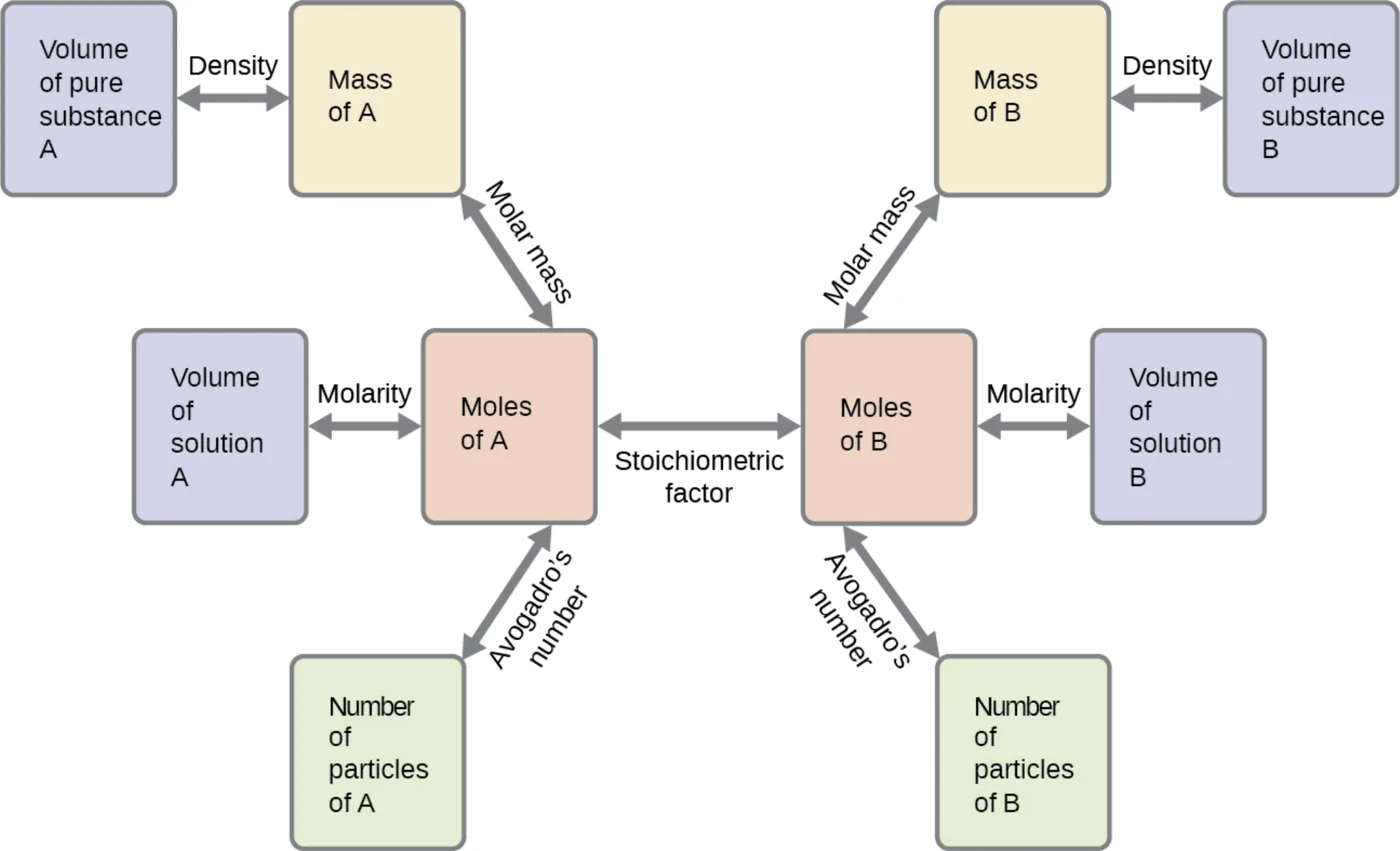
- A general map of the conversions used in stoichiometry: mass, volume and particle numbers are linked to moles, and moles of two substances are linked by the stoichiometric factor.
- Key ideas
- ⤢ Enlarge
- Key ideas
- M₁V₁ = M₂V₂
- because the moles of solute stay the same when water is added.
- ◀ Previous, 3 / 3
19.1.2 Stoichiometric calculations and solutions · 1 / 2
19.1.2 Worked examples
Worked examples

- Worked examples3Worked examples
- Worked examples
- Worked examples
- What mass of water forms from 4 g of hydrogen in 2H₂ + O₂ → 2H₂O?
- — 4 g = 2 mol H₂ → 2 mol H₂O = 36 g.
- N₂ + 3H₂ → 2NH₃. Which is limiting and how much NH₃ forms?
- — 6 mol H₂ needs only 2 mol N₂
- so H₂ is limiting, NH₃ formed = 4 mol.
- What volume of 2.0 M HCl is needed to make 500 mL of 0.40 M HCl?
- — V₁ = 0.40 ×
- 1 / 3Next ▶
- Worked examples
- 500
- ⁄
- .0 = 100 mL.
- ◀ Previous, 2 / 3Next ▶
- A flow chart from the mass of the barium sulfate precipitate, through its moles and the stoichiometric factor, to the mass of magnesium sulfate and finally its percentage of the sample.
- Worked examples
- ⤢ Enlarge
- ◀ Previous, 3 / 3
19.1.2 Stoichiometric calculations and solutions · 2 / 2
Well done! You finished this lesson
What would you like to do next?