13.6Chapter 13: Variation and Natural Selection
What can we do? — Alhussan Biology - Stage 9 Revision Notes & Topical Questions
5 min read 9 parts Lesson 6 of 8 2 quizzes
Lesson summary
13.6 What can we do? — Conservation, Seed Banks and Captive Breeding — Alhussan International Academy — Biology (Stages 7–9) notes: Describe and evaluate strategies for protecting endangered species and their habitats, including conservation and weighing the costs of solutions su…
- Biodiversity
- Ecological reasons
- Economic reasons
- Ethical reasons
- Two approaches
- Protected areas
Section 1 of 9Why conserve
Biodiversity
- Biodiversity conserving species protects it.
Ecological reasons
- Ecological reasons each species has a role in food webs, pollination and nutrient cycles.
Economic reasons
- Economic reasons tourism, medicines and genetic resources for crops.
Ethical reasons
- Ethical reasons all species have a right to exist.
Two approaches
- Two approaches in situ conservation protects wild populations in their natural habitat, and ex situ conservation works away from it.
Section 2 of 9In situ methods
In situ methods
Protected areas
- Protected areas national parks and nature reserves restrict building, farming and hunting, and wildlife corridors link habitat patches.
Laws and treaties
- CITES and similar agreements restrict trade in endangered species and products such as ivory.
Anti-poaching patrols and community involvement
- Anti-poaching patrols and community involvement local people benefit from tourism.
Habitat restoration
- Habitat restoration replanting forest and restoring wetlands.
Sustainable management
- Sustainable management fishing and forestry with quotas and replanting.
Section 3 of 9Captive breeding
Method
- Method animals are bred in zoos and wildlife parks and paired to maximise genetic variety and avoid inbreeding, using studbooks that record family trees.
Release
- Release young animals may be released into protected habitat, as with the Arabian oryx and the California condor.
Disadvantages
- Disadvantages it is costly, animals may lose survival skills and a suitable habitat must exist for release.
Section 4 of 9Seed banks
1Storage
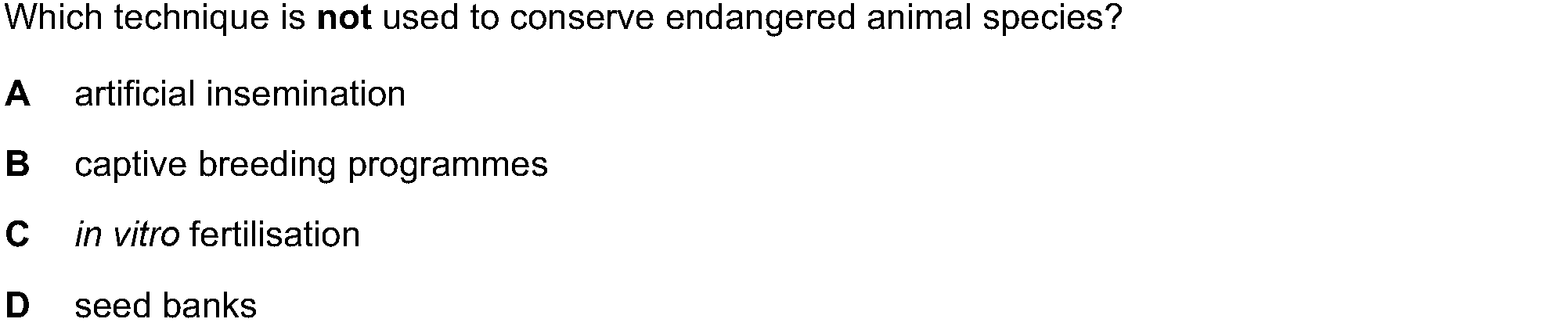
- Storage seeds of wild plants and crop varieties are kept at low temperature, around −20 °C, and low humidity so they stay alive for decades.
2Svalbard Global Seed Vault
- Svalbard Global Seed Vault in Norway it stores copies of seeds from around the world as insurance against disasters.
3Advantages
- Advantages seeds need less space than whole plants and can be grown later.
4Limits
- Limits not all seeds can be stored this way, and some plants must be kept as tissue cultures or in botanic gardens.
Section 5 of 9Evaluating conservation
| Strategy | Advantage | Limitation |
|---|---|---|
| Reserves | Protect an entire ecosystem | Need enforcement and land; animals may leave |
| Captive breeding | Boosts numbers; research | Expensive; loss of wild behaviour |
| Seed banks | Cheap, compact; preserve genetic variety | Do not protect habitats |
| Laws | Reduce hunting and trade | Hard to enforce |
- Best plans
- they combine methods and involve local communities, so people have a reason to protect wildlife.
Section 6 of 9Weighing solutions: hydroelectric power
Questions to ask
- Questions to ask we must ask whether we can do something and whether we should do it.
- A solution to one problem can produce another, so advantages and disadvantages must be weighed.
Benefits
- Benefits about two thirds of the world's electricity comes from burning fossil fuels, which add carbon dioxide and increase global warming.
- Hydroelectric power uses water, a renewable resource trapped behind dams, and produces no greenhouse gases.
- It provides relatively cheap electricity, and in Latin America 70% of electricity is hydroelectric.
- Four hydroelectric dams on the Mekong river in China produce more than 8800 megawatts, equivalent to burning over 7 million barrels of oil.
Costs
- Costs dams change river flows and may cause drought.
- They flood land in reservoirs, which can remove indigenous people and destroy ecosystems.
- They prevent fish moving up and down rivers to breed.
Section 7 of 9Threats to freshwater fish
Scale
- Scale nearly one third of freshwater fish species are threatened with extinction, and 16 species became globally extinct in 2020 alone.
- Populations of migratory fish such as salmon and eels have fallen by 75% in the last 50 years.
- Megafish, which weigh over 30 kg and live many years, such as the Mekong giant catfish, are seriously threatened.
Causes
- Causes dams, pollution by sewage, farming and industry, draining of rivers and wetlands, and overfishing.
- (which may destroy all life or cause bioaccumulation)
Wider effect
- Wider effect where fish go extinct, other species are threatened as well.
Section 8 of 9Key terms
| Term | Meaning |
|---|---|
| Conservation | Protecting species and habitats so they survive. |
| In situ | In the natural habitat. |
| Ex situ | Away from the natural habitat, such as in a zoo or seed bank. |
| Captive breeding | Breeding endangered animals under human care. |
| Seed bank | A store of seeds kept at low temperature and humidity. |
| Hydroelectric power | Electricity generated from flowing water trapped behind dams. |
Section 9 of 9Exam technique
1
Saying zoos can solve extinction alone.
2
Forgetting that habitats must be protected for release.
3
Thinking seed banks store plants rather than seeds.
4
Forgetting to involve local people.
Marked practiceQuizzes for this lesson
?What do you want to solve now?
✓Checkpoint Quiz
1 multiple-choice questions from real exam papers on this lesson.
Question 1 of 1 1:30
Score: 0 / 1
Answer key
1 D
Last updated: