A1.1Theme A — Unity and diversity
Water — IB Biology SL Revision Notes & Topical Questions
5 min read 12 parts Lesson 5 of 11 1 quiz
Curriculum Equation Key قوانين الرقم الهيدروجيني والاتزان الأيوني - pH & Acid-Base Equilibrium FormulasFast Exam Solution
pH = -log[H⁺] | pOH = -log[OH⁻] | pH + pOH = 14 | [H⁺][OH⁻] = 10⁻¹⁴
Word Equation & Conditions: الرقم الهيدروجيني = -لوغاريتم تركيز أيون الهيدروجين | pH + pOH = 14
Location & Specifications: الاتزان الأيوني، كيمياء 3 ثانوي، التحصيلي، و AP Chemistry.
Lesson summary
A1.1 Water — IB BIOLOGY SL notes: Explain how the polarity and hydrogen bonding of water give it the properties that make it the medium for life.Medium for life — the first cells evolved in a watery environment, probably in deep oceans near hydrothermal ventsSome water and solute…
- Liquid water
- Search for life
- Covalent bonds
- Partial charges
- Polar molecule
- Consequences
Part 1 of 10Water and the origin of life
Medium for life
- Medium for life the first cells evolved in a watery environment, probably in deep oceans near hydrothermal vents
- Some water and solutes became trapped within a membrane and chemical reactions began inside it.
Liquid water
- Liquid water lets dissolved molecules move, collide and react, so most life processes occur in water
Cytoplasm
- Cytoplasm mostly water, so enzymes and substrates meet in solution
Water in numbers
- Roughly 70-95% of cell mass is water.
- About 71% of the Earth's surface is covered by water, a vast habitat.
Search for life
- Search for life astronomers treat water on other planets and moons as a clue to possible life
Part 2 of 10Polarity of water
Polarity of water
Covalent bonds
- Covalent bonds one oxygen atom shares electrons with two hydrogen atoms, but unequally
- Oxygen is more electronegative, so it pulls the shared electrons closer.
Partial charges
- δ- on the oxygen and δ+ on each hydrogen
- The molecule is bent, with an angle of about 104.5°, so the charges do not cancel.
Dipole
Dipole a separation of charge within a molecule caused by unequal sharing of electrons
Polar molecule
Polar molecule a molecule with one slightly negative end and one slightly positive end
- Water is overall neutral but polar.
Part 3 of 10Hydrogen bonds
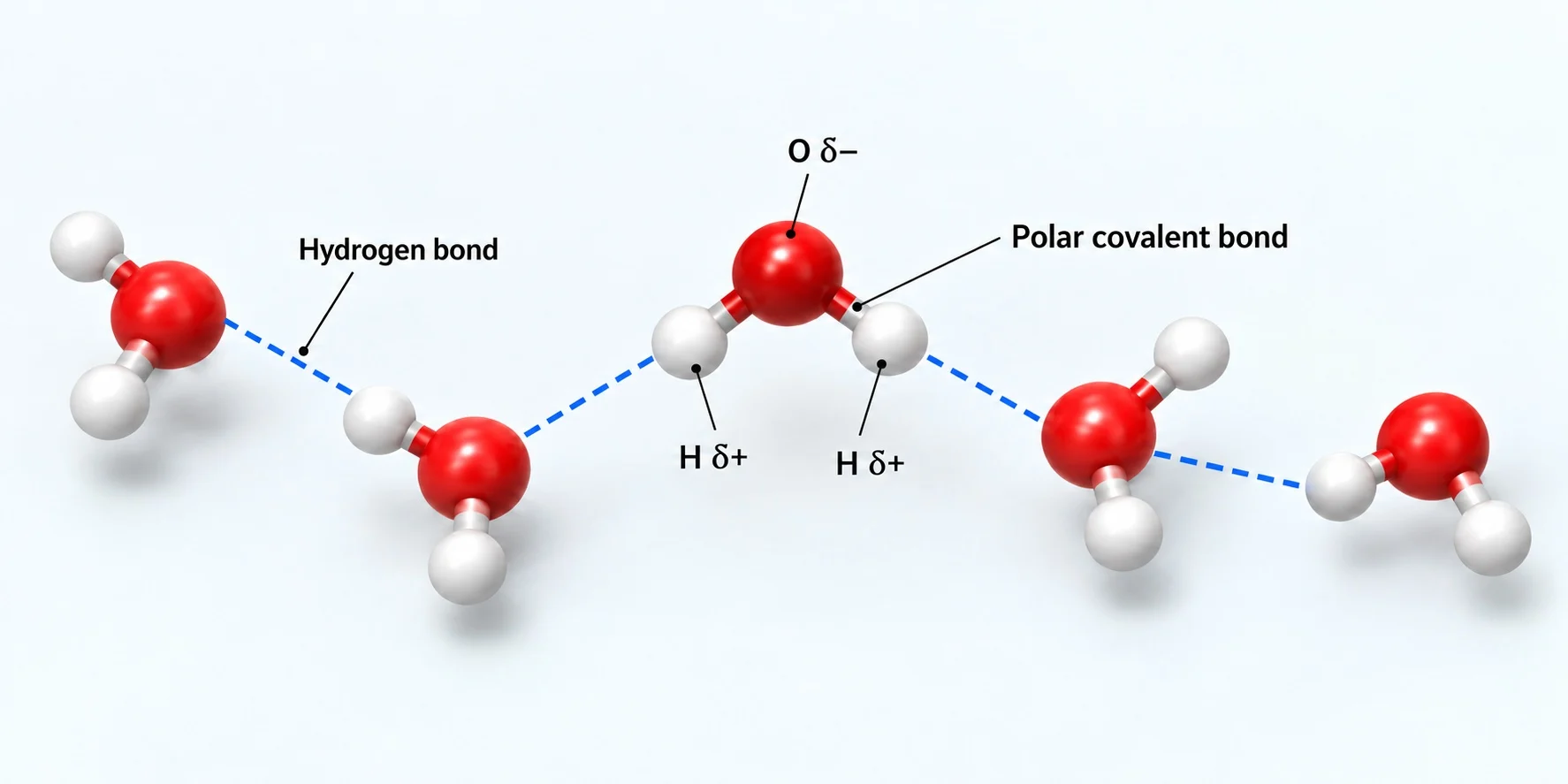
1Hydrogen bond
Hydrogen bond the attraction between the δ+ hydrogen of one molecule and the δ- oxygen of a neighbouring molecule
- Each water molecule can form up to four hydrogen bonds.
2Strength
- Strength one bond is weak, so bonds constantly break and reform in liquid water
- Huge numbers of bonds together give water strong collective properties.
3Consequences
- Consequences hydrogen bonds explain cohesion, adhesion, solvent action and the thermal properties of water
Part 4 of 10Hydrogen bonds in other molecules
DNA
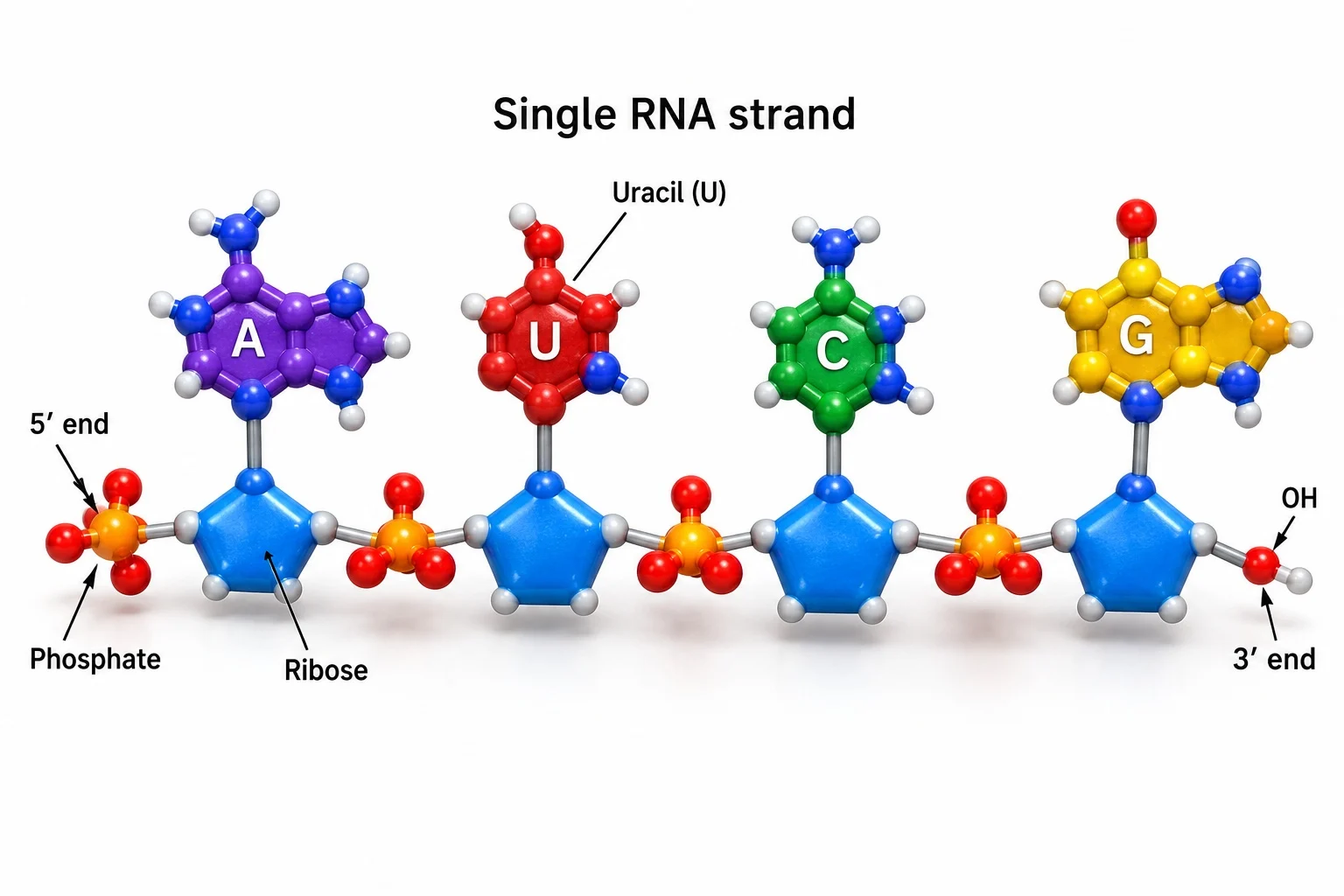
- DNA hydrogen bonds hold complementary bases together across the two strands
Proteins
- Proteins hydrogen bonds stabilise secondary and tertiary structure
Cellulose and collagen
- Cellulose and collagen many hydrogen bonds between chains give high tensile strength
Protein synthesis
- Protein synthesis tRNA anticodons attach to mRNA codons by hydrogen bonds
Membranes
- Membranes polar phosphate heads hydrogen-bond with the surrounding water
Part 5 of 10Cohesion, adhesion and capillary action
Cohesion
Cohesion attraction between water molecules
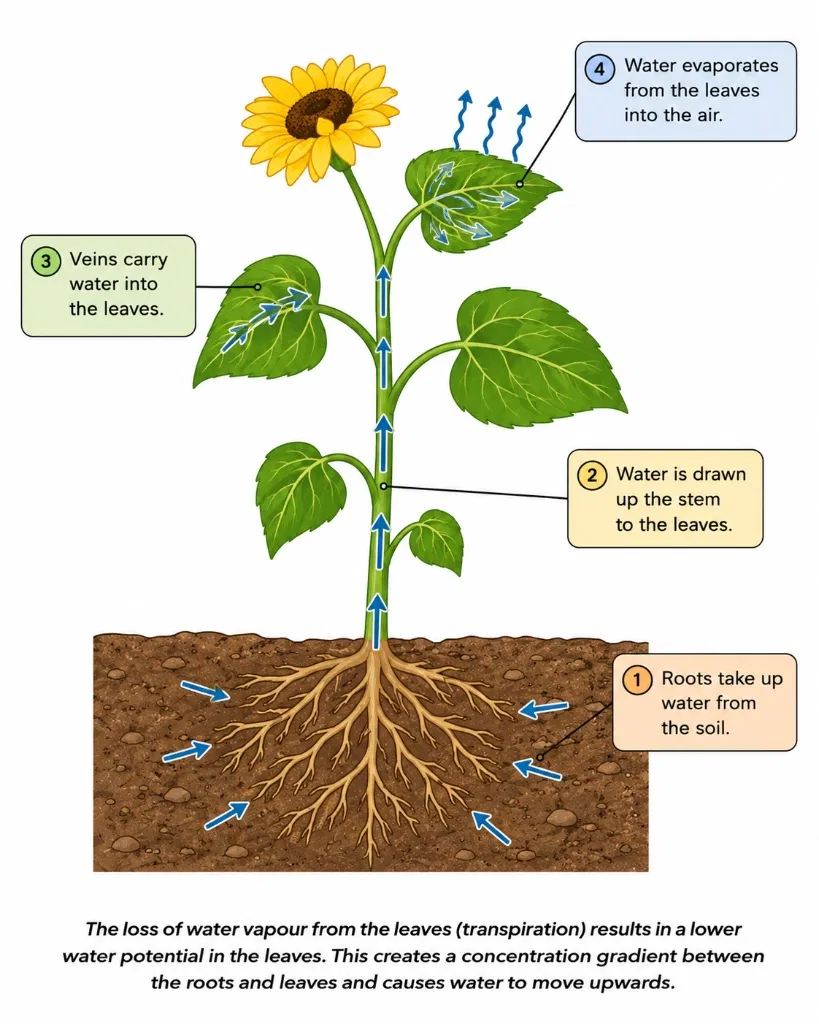
- It lets the xylem hold a continuous column of water under tension.
Surface tension
- Surface tension cohesion at an air-water boundary
- It forms a film that supports small insects such as pond skaters.
Adhesion
Adhesion attraction between water and other polar or charged surfaces, such as cellulose
- Adhesion keeps the cell walls of leaf mesophyll cells moist for gas exchange.
Capillary action
- Capillary action adhesion plus cohesion pulls water up narrow tubes and through soil pores
- Spaces between cellulose fibres in cell walls also draw water out of the xylem.
1
Water evaporates from the leaf cell walls.
2
This creates tension that pulls on the water column.
3
Cohesion keeps the column unbroken.
4
Adhesion to the xylem walls resists the water falling back.
5
More water is drawn up from the roots.
Part 6 of 10Water as a solvent
Hydrophilic
- Hydrophilic polar or charged substances such as ions, sugars and amino acids that dissolve readily
Hydrophobic
- Hydrophobic non-polar substances such as lipids that do not dissolve
- Hydrophobic interaction clusters non-polar molecules together because water bonds with itself and excludes them.
Hydration shell
- Hydration shell water molecules cluster around an ion or polar solute and keep the particles apart
Universal solvent
- Universal solvent most biological molecules are hydrophilic and dissolve in water
Metabolism
- Metabolism many reactions in cells take place in solution
- Hydrolysis and condensation involve water directly.
1
The crystal is placed in water.
2
The δ- oxygens face the positive sodium ions.
3
The δ+ hydrogens face the negative chloride ions.
4
Ions are pulled off the crystal lattice.
5
Hydration shells surround each ion.
6
The ions spread evenly through the solution.
Part 7 of 10Solubility and transport
| Substance type | Example | Solubility | How transported in blood |
|---|---|---|---|
| Ionic compound | Sodium chloride | Highly soluble | Dissolved in plasma |
| Small polar molecule | Glucose, amino acids | Soluble | Dissolved in plasma |
| Non-polar gas | Oxygen | Poorly soluble | Bound to haemoglobin |
| Lipid | Triglycerides, cholesterol | Insoluble | Packaged in lipoproteins |
Dissolved in plasma
- Dissolved in plasma glucose, ions, urea and CO2 as hydrogencarbonate
Oxygen
- Oxygen it is non-polar, so little dissolves, and it is less soluble at 37 °C than at 20 °C
- Enough dissolves for aquatic life to breathe.
- Haemoglobin binds oxygen so that enough is carried to all body cells.
Phospholipids
- Phospholipids their non-polar tails form the water-excluding core of membranes, so insolubility is essential here
Amino acids
- Amino acids even those with non-polar R groups dissolve enough to be transported
Enzymes
- Enzymes water holds their shape stable, and hydrogen bonds help the substrate bind the active site
Part 8 of 10Physical properties: water compared with air
| Property | Water | Air | Consequence for animals |
|---|---|---|---|
| Buoyancy | High | Very low | Aquatic animals need less skeletal support |
| Viscosity | High | Very low | Streamlined shapes save energy when swimming |
| Thermal conductivity | High, about 30 times that of air | Low | Aquatic mammals lose heat fast and need blubber |
| Specific heat capacity | High, about 4200 J kg-1 °C-1 | Low, about 1000 J kg-1 °C-1 | Water temperature stays stable and air temperature swings |
| Oxygen content | Low, falls as temperature rises | About 21% | Gills must extract oxygen efficiently |
- Specific heat capacity = the energy needed to raise 1 kg of a substance by 1 °C
- Many hydrogen bonds must be broken to warm water, so its temperature changes slowly.
- This gives stable aquatic habitats such as lakes and seas.
Part 9 of 10Adaptations of the ringed seal and black-throated loon
Floating ice
- Floating ice ice is less dense than water, so it floats
- It gives seals a resting surface and shelter below.
- It conducts heat poorly, so it insulates the water beneath from freezing solid.
Ringed seal
- Ringed seal blubber insulates against heat loss in Arctic water
- Blubber is less dense than water, so it also aids buoyancy.
- Flippers propel the seal.
Black-throated loon
- Black-throated loon feathers trap air, which conducts heat poorly
- Solid heavy bones and air squeezed from the feathers and lungs let it dive.
- Webbed feet set far back reduce drag.
- The low viscosity of air lets it fly with little resistance.
Part 10 of 10More from the specification
More from the specification
Polarity and dipolar nature
- The asymmetric distribution of electron density creates a partially negative charged region on oxygen and partially positive regions on hydrogen atoms.
Hydrogen bonding
- Electrostatic attraction between dipolar water molecules allows extensive hydrogen bond networks to form,
- giving water high specific heat capacity and cohesion.
Surface tension and habitats
- Cohesion allows water to form a resilient surface layer that small organisms can walk across.
Thermal buffering in living organisms
- High latent heat of vaporisation allows water to act as an effective coolant during transpiration and sweating.
Organism
- A living thing, such as a plant or an animal.
Key terms
| Term | Meaning |
|---|---|
| Polar molecule | A molecule with an uneven spread of charge, with the oxygen end of water slightly negative. |
| Hydrogen bond | A weak attraction between a slightly positive hydrogen and a slightly negative atom of a neighbouring molecule. |
| Cohesion | Water molecules sticking to one another through hydrogen bonds. |
| Adhesion | Water molecules sticking to other polar or charged surfaces. |
| Hydrophilic | Attracted to water, describing polar or charged substances. |
| Hydrophobic | Not attracted to water, describing non-polar substances such as fats. |
| Specific heat capacity | The energy needed to raise 1 kg of a substance by 1 °C. |
| Surface tension | The film at an air-water surface caused by cohesion that supports small organisms. |
Avoid these mistakes
1
Thinking hydrogen bonds are strong individually — each is weak and the strength comes from large numbers
2
Mixing up cohesion and adhesion — cohesion is water to water and adhesion is water to other surfaces
3
Saying water is polar because it is charged — it is neutral overall, with partial charges from unequal sharing
4
Saying all biological molecules dissolve in water — non-polar substances such as lipids do not
Marked practiceQuizzes for this lesson
Last updated:
\n