A1.2Theme A — Unity and diversity
Nucleic acids — IB Biology SL Revision Notes & Topical Questions
5 min read 12 parts Lesson 6 of 11 2 quizzes
Curriculum Equation Key pH & Acid-Base Equilibrium FormulasFast Exam Solution
pH = -log[H⁺] | pOH = -log[OH⁻] | pH + pOH = 14 | [H⁺][OH⁻] = 10⁻¹⁴
Word Equation & Conditions: pH + pOH = 14
Lesson summary
A1.2 Nucleic acids — IB BIOLOGY SL notes: Describe the structure of nucleotides, DNA and RNA and explain how base sequence stores and conserves genetic information.Nucleotide = the monomer of nucleic acids, made of a phosphate, a pentose sugar and a nitrogenous baseThe phosphate …
- Deoxyribose
- Four nucleotides
- Pyrimidine
- Helix width
- Solid line
- Dashed line
Part 1 of 10Structure of a nucleotide
Structure of a nucleotide
Nucleotide
Nucleotide the monomer of nucleic acids, made of a phosphate, a pentose sugar and a nitrogenous base
- The phosphate is acidic and carries a negative charge.
- The base and phosphate are covalently bonded to the sugar.
Phosphate
- Phosphate attached to carbon 5 of the sugar
Base
- Base attached to carbon 1 of the sugar
Deoxyribose
- Deoxyribose lacks one oxygen at carbon 2 compared with ribose
Four nucleotides
- Four nucleotides each nucleic acid has four different nucleotides, differing only by their base
Part 2 of 10Bases and drawing nucleotides
| Base | Ring type | Found in | Pairs with |
|---|---|---|---|
| Adenine | Purine | DNA and RNA | T in DNA, U in RNA |
| Guanine | Purine | DNA and RNA | Cytosine |
| Cytosine | Pyrimidine | DNA and RNA | Guanine |
| Thymine | Pyrimidine | DNA only | Adenine |
| Uracil | Pyrimidine | RNA only | Adenine |
1Purine
Purine a double-ring base
2Pyrimidine
Pyrimidine a single-ring base
3Helix width
- Helix width a purine always pairs with a pyrimidine, which keeps the width of the helix constant
4Pentagon
- Pentagon represents the pentose sugar
5Circle
- Circle represents the phosphate
6Rectangle
- Rectangle represents the base
7Solid line
- Solid line a covalent bond
8Dashed line
- Dashed line a hydrogen bond
1
Draw a pentagon for each sugar.
2
Add a circle phosphate to each sugar.
3
Join the phosphate to the next sugar.
4
Attach a rectangle base to each sugar.
5
Draw the second strand upside down.
6
Pair A with T and C with G.
7
Label the hydrogen bonds between the bases.
Part 3 of 10Forming a strand
Condensation reaction
- Condensation reaction the phosphate of one nucleotide bonds to the sugar of the next and one water molecule is released per bond
- The link is a phosphodiester bond.
Sugar-phosphate backbone
- Sugar-phosphate backbone strong covalent bonds give a stable, unbranched chain with a base on each sugar
- The bases stick out from the backbone and carry the information.
Polynucleotide
- Polynucleotide a chain of many nucleotides, called a strand
Strand ends
- Strand ends the carbons of the sugar are numbered 1′ to 5′, giving each strand a 5′ and a 3′ end
Part 4 of 10DNA structure
DNA structure
DNA
DNA a double helix of two antiparallel polynucleotide strands held together by hydrogen bonds between bases
- One strand runs 5′ to 3′ and its partner runs 3′ to 5′.
- The bases project inwards and the backbone faces outwards.
- The helix has about ten base pairs per turn.
Complementary base pairing
- Complementary base pairing adenine pairs with thymine and cytosine pairs with guanine
- A-T pairs have two hydrogen bonds and C-G pairs have three.
- The numbers of A and T are equal, and the numbers of C and G are equal.
Template
- Template the sequence of one strand decides the sequence of the other
- This allows DNA to be copied accurately during replication.
Pairing in gene expression
- Pairing in gene expression accurate pairing conserves information across generations
- In replication each new strand copies accurately from its template.
- In transcription mRNA bases pair with the DNA template strand.
- In translation tRNA anticodons pair with mRNA codons.
Part 5 of 10Genetic material and RNA
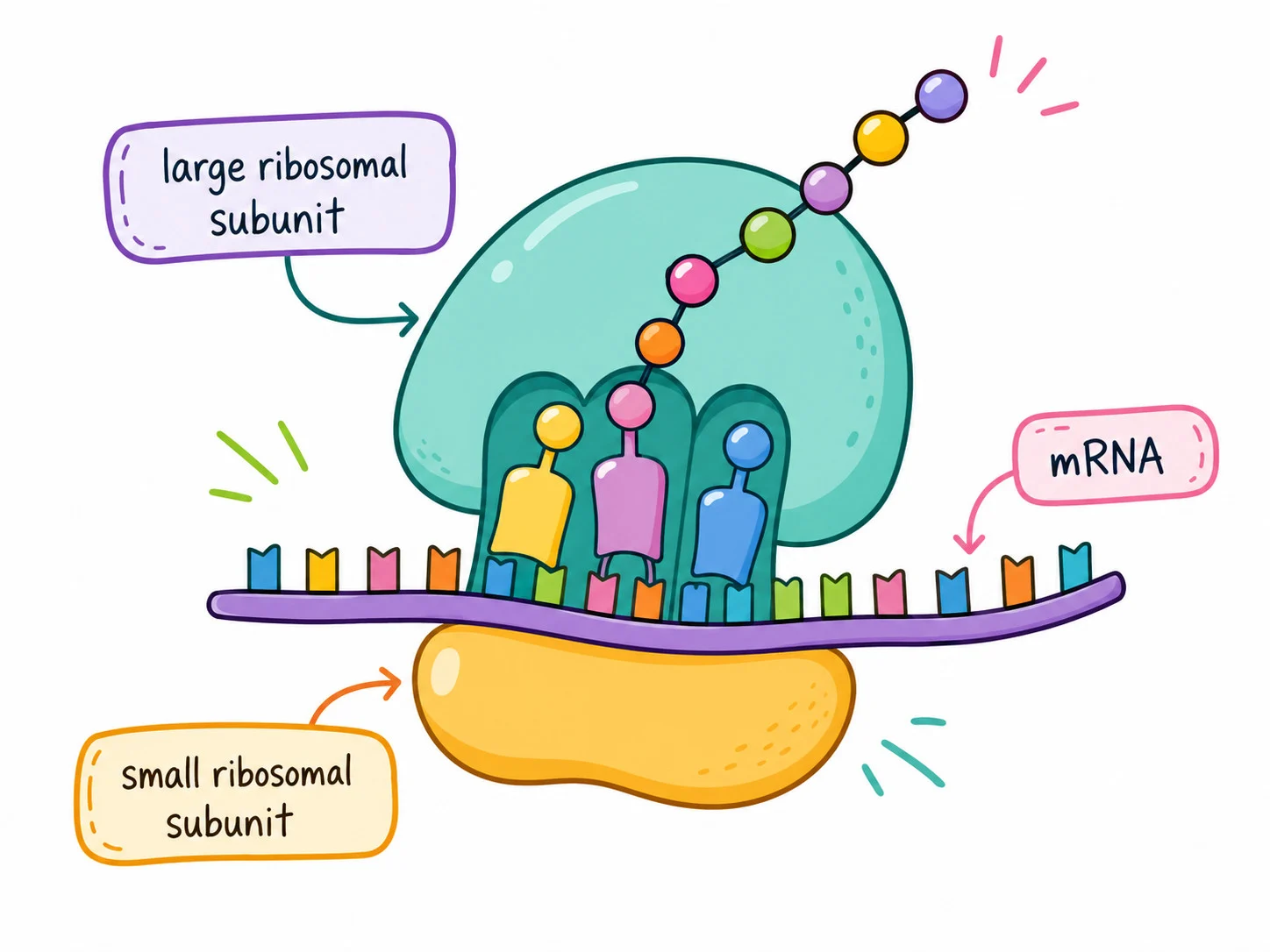
DNA
DNA the genetic material of all cellular life, so the genetic code is universal
- It is mostly in the nucleus as chromosomes and also inside mitochondria and chloroplasts.
RNA location
- RNA location found in the nucleus and cytoplasm and as the main material of ribosomes
RNA viruses
- RNA viruses some viruses, such as SARS-CoV-2 and influenza, store their genes as RNA
- Viruses have no cells and cannot reproduce alone, so they are not classed as living.
RNA
- RNA usually a single polynucleotide strand with ribose and uracil in place of thymine
- It is short, with about a hundred to a few thousand nucleotides, far shorter than DNA.
mRNA
- mRNA made in the nucleus and carries a copy of a gene to the ribosomes
tRNA
- tRNA brings specific amino acids to the ribosome
rRNA
- rRNA the structural and catalytic part of ribosomes
Part 6 of 10DNA compared with RNA
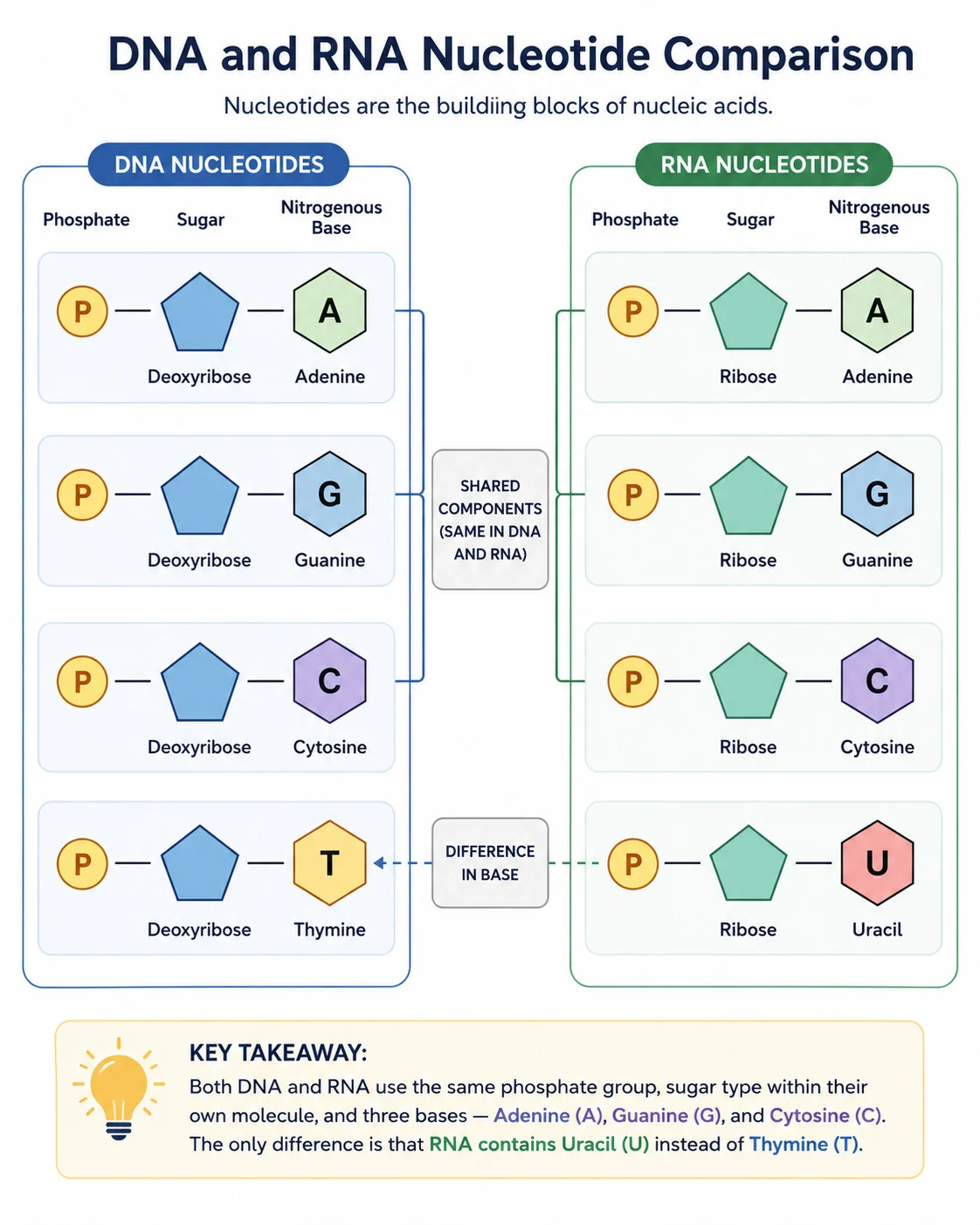
| Feature | DNA | RNA | Why it matters |
|---|---|---|---|
| Sugar | Deoxyribose | Ribose | Ribose has an extra -OH group |
| Bases | A, T, C, G | A, U, C, G | Uracil replaces thymine |
| Strands | Two | Usually one | Two strands protect the code |
| Shape | Double helix | Single chain that may fold | Folding allows tRNA shapes |
| Length | Very long | Short | RNA copies single genes |
| Main role | Long-term store of genes | Carries the code to ribosomes | Separates storage from use |
Part 7 of 10Genetic code
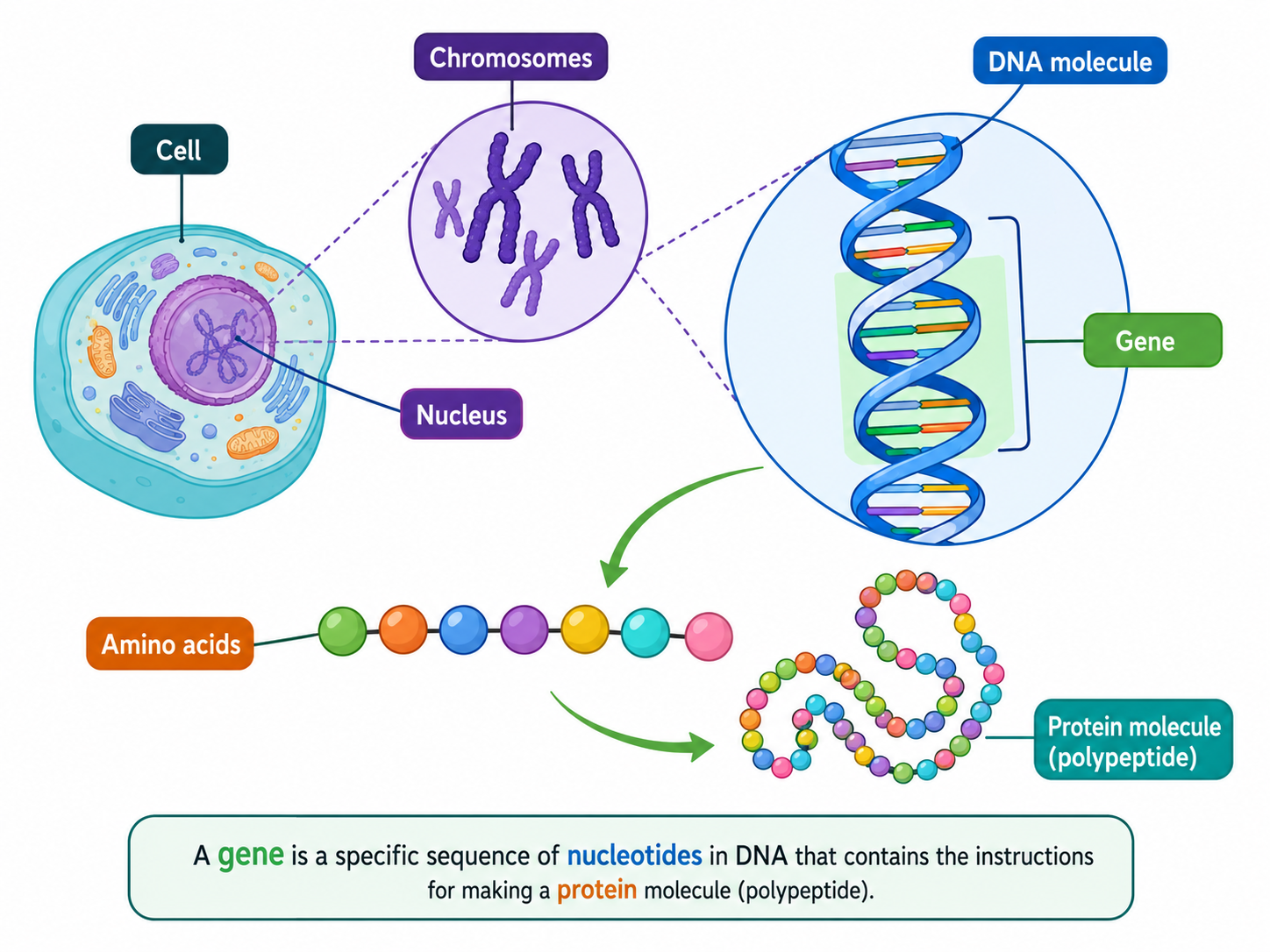
1Codon
Codon a sequence of three bases that codes for one amino acid or a stop signal
2Base sequence
- Base sequence any order is possible, so a strand of n bases has 4n possible sequences
3Gene
- Gene the base sequence decides the amino acid order, and the order decides protein shape and function
4Degenerate code
- 64 codons code for 20 amino acids, so some amino acids have several codons
5Coding strand
- Coding strand the strand whose sequence is read by enzymes
6Non-coding DNA
- Non-coding DNA large parts of genomes do not code for protein
Part 8 of 10Universal code and conserved sequences
1Universal code
- Universal code almost every organism uses the same code, with minor exceptions
- This is why genes can be transferred between species, such as human insulin made by bacteria.
- It supports a universal common ancestor.
2Conserved sequences
- Conserved sequences sequences that have stayed almost unchanged across species
- The most conserved genes are for transcription, translation and histone proteins.
- Ribosomal RNA genes also change very little.
3Comparing sequences
- Comparing sequences helps estimate how closely related species are
4Mutations
- Mutations alter sequences, but only those in gametes pass to offspring
5Diversity
- Diversity different base sequences give every species and individual a unique genome
Part 9 of 10Storage capacity of DNA
Human genome
- Human genome about 3.2 × 10⁹ base pairs per nucleus
- About 2 m of DNA fits inside a nucleus a few µm wide.
Gene numbers
| Organism | Group | Approximate genes | Point to notice |
|---|---|---|---|
| E. coli | Bacterium | 4300 | Thousands even in simple life |
| Human | Mammal | 20 000 | Fewer than some crops |
| Dog | Mammal | 19 000 | Similar to humans |
| Water flea | Crustacean | 31 000 | More than humans |
| Rice | Plant | 41 500 | Gene number is not linked to complexity |
Part 10 of 10More from the specification
More from the specification
Nucleotide building blocks
- Monomers that contain a pentose sugar, an inorganic phosphate group, and a nitrogenous base.
- (ribose or deoxyribose)
Phosphodiester bonds
- Covalent condensation links formed between the 5'-phosphate group of one nucleotide and the 3'-hydroxyl group of another, linking nucleotides into polynucleotide chains.
Hydrogen bonding in double helix
- Complementary base pairs form specific hydrogen bonds stabilizing double-stranded DNA.
- (A-T two bonds, G-C three bonds)
Role in protein synthesis
- DNA stores genetic instructions that are transcribed into messenger RNA (mRNA) and subsequently translated into polypeptides.
Protein synthesis
- Making proteins from amino acids using the DNA code.
Key terms
| Term | Meaning |
|---|---|
| Nucleotide | The monomer of nucleic acids, made of a phosphate, a pentose sugar and a nitrogenous base. |
| Purine | A double-ring base, adenine or guanine. |
| Pyrimidine | A single-ring base, cytosine, thymine or uracil. |
| Phosphodiester bond | The covalent link between the sugar of one nucleotide and the phosphate of the next. |
| Complementary base pairing | The specific pairing of A with T (or U) and C with G through hydrogen bonds. |
| Antiparallel | Running in opposite directions, as the two DNA strands do. |
| Codon | A triplet of bases on mRNA coding for one amino acid or a stop signal. |
| Conserved sequence | A base sequence that has stayed almost unchanged across many species. |
Avoid these mistakes
1
Saying the bases form the backbone — the backbone is sugar and phosphate and the bases project inwards
2
Pairing A with C or G with T — A pairs with T (or U in RNA) and C pairs with G
3
Saying hydrogen bonds join nucleotides in a strand — covalent bonds join them and hydrogen bonds join the two strands
4
Saying more genes means a more complex organism — gene number does not track complexity
Marked practiceQuizzes for this lesson
Last updated:
\n