Curriculum
Course: EST II Biology
Login

Curriculum

EST II Biology

Text lesson

4.7 Animal Behavior

Distinguish innate and learned behavior with examples.
1Key ideas2Key ideas3Key ideas
Key ideas
Key ideas
1
Ethology is the study of animal behavior in natural settings

Lorenz, Tinbergen and von Frisch shared a 1973 Nobel Prize.
2
Tinbergen’s stickleback males attack any red-bellied model: a sign stimulus releasing a fixed action pattern.
3
The waggle dance angle relative to vertical shows food direction relative to the sun

duration shows distance.
1 / 3Next ▶
Key ideas
1

4
2

Circadian rhythms run on roughly 24-hour cycles

circannual rhythms govern migration and hibernation.
3

5
4

Kin selection explains altruism toward relatives who share genes (Hamilton’s rule rB &gt

C).
5

6
6

Dominance hierarchies and territoriality reduce the cost of constant fighting.
◀ Previous2 / 3Next ▶
Key ideas
Key ideas
7
Migration may use the sun, stars, Earth’s magnetic field and landmarks.
8
Agonistic behavior includes threats and submission, often ritualized.
◀ Previous3 / 3
1Essential knowledge2Essential knowledge3Essential knowledge
Essential knowledge
Essential knowledge
Proximate vs ultimate causes
proximate questions ask how a behavior works (stimuli, hormones, nerves)

ultimate questions ask why it evolved (how it increases survival and reproduction).
Innate behaviors
include reflexes, fixed action patterns (egg-rolling in geese continues even if the egg is removed), taxes (moths flying toward light: phototaxis) and kineses (woodlice moving faster in dry conditions, ending up in damp places).
Learning
habituation saves energy

imprinting ensures young follow a parentclassical conditioning links stimulioperant conditioning links actions to outcomesinsight learning shows problem solving. Many behaviors, like bird song, combine innate templates with learning during a sensitive period.
1 / 3Next ▶
Essential knowledge
1

Rhythms
2

biological clocks keep internal timing even without cues but are reset by light. Photoperiod triggers seasonal breeding and migration.
3

Foraging
4

optimal foraging theory predicts animals maximize energy gain relative to cost and risk. Search images help predators find common prey.
5

Social behavior
6

territoriality secures resources

dominance hierarchies (pecking order) reduce fightingcooperation in groups aids defense and hunting. Eusocial insects (bees, ants) have sterile worker castesworkers share many genes with sistersso helping the queen spreads their genes.
◀ Previous2 / 3Next ▶
Essential knowledge
1

Reproductive behavior
2

courtship rituals ensure species recognition and signal mate quality. Mating systems include monogamy, polygyny and polyandry. Parental care increases offspring survival at a cost to parents.
3

Imitation is a form of learning in which an animal watches others and copies what they do.
4

Imprinting is limited to a certain period of life and, once it has happened, it cannot be reversed.
5

Innovation is a response to a new situation that uses inventive behavior, without trial and error or copying others.
6

Association is the form of learning in which an animal links a stimulus or response with a reward or punishment.
◀ Previous3 / 3
1Process & sequence2Process & sequence3Process & sequence4Process & sequence
Process & sequence
Process & sequence
1
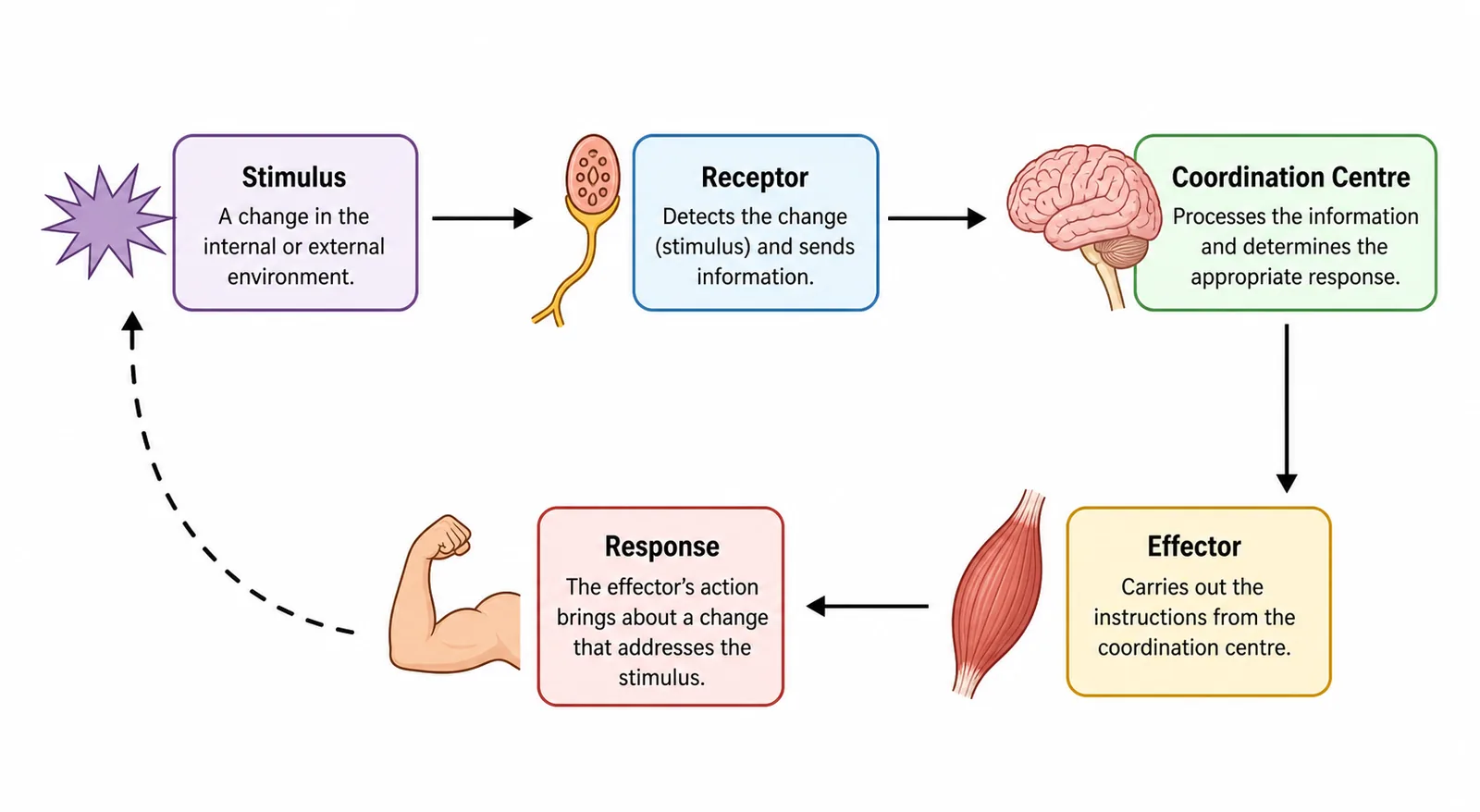
A stimulus is detected by sensory receptors.
2
The nervous system processes the information.
3
Innate programs or learned associations select a response.
1 / 4Next ▶
Process & sequence
1

4
2

Effectors (muscles, glands) produce behavior.
3

5
4

Consequences affect survival and reproduction.
5

6
6

Natural selection favors behaviors that raise fitness.
◀ Previous2 / 4Next ▶
Process & sequence
Process & sequence
How behavior evolves — write these steps in this order

each step is a marking point.
Stimulus detected
Nervous system processes
Innate or learned response
Behavior performed
Affects survival and reproduction
◀ Previous3 / 4Next ▶
Stimulus and Response
Process & sequence
Stimulus and Response" loading= - Dr Khaled Dabour Academy⤢ Enlarge
Process & sequence
Selection shapes behavior
◀ Previous4 / 4
Worked examples
1

A young duckling follows a researcher instead of its mother. Identify and explain the behavior.
2

This is imprinting: during a short critical period soon after hatching, the duckling learns to follow the first large moving object it sees.

Normally this is the mother, which gives protection and guidance, so the behavior raises survival.Lorenz demonstrated this with geese.
3

The worker is sterile

so it cannot pass on genes directly.Because of haplodiploidy, sisters share about 75% of genes.Defending the hive protects the queen and sisters, who carry copies of its genes, so the behavior increases its inclusive fitness (kin selection).
1Summary2Summary3Summary
Summary
1

1
2

Behavior may be
3

innate or learned
4

.
5

2
6

Fixed action patterns
1 / 3Next ▶
Summary
Summary
are triggered by sign stimuli.
3
Learning includes
habituation, imprinting and conditioning
4
Animals communicate with
◀ Previous2 / 3Next ▶
Summary
1

chemical, visual, auditory and tactile
2

signals.
3

5
4

Behaviors evolve because they
5

increase fitness
◀ Previous3 / 3
1Check yourself2Check yourself3Check yourself4Check yourself5Check yourself6Check yourself7Check yourself
Check yourself
Check yourself
Q1. Birds that stop flying away from a harmless scarecrow show:
A. imprinting
B. habituation
C. classical conditioning
D. insight
Show answer
1 / 7Next ▶
Check yourself
Check yourself
B. They stop responding to a repeated, harmless stimulus.
Q2. A goose rolls an egg back to its nest even when the egg is removed midway. This is a:
A. fixed action pattern
B. learned response
C. kinesis
D. taxis
◀ Previous2 / 7Next ▶
Check yourself
1

A. Once triggered, a fixed action pattern runs to completion.
2

Q3. A rat learns to press a lever to obtain food. This is:
3

1
4

A. classical conditioning
5

2
6

B. imprinting
◀ Previous3 / 7Next ▶
Check yourself
1

3
2

C. habituation
3

4
4

D. operant conditioning
5

D. Behavior is associated with a reward: trial-and-error learning.
6

Q4. Honeybees communicate the location of food mainly by:
◀ Previous4 / 7Next ▶
Check yourself
Check yourself
A. pheromone trails
B. songs
C. the waggle dance
D. color changes
C. The waggle dance encodes direction and distance.
Q5. Altruism toward relatives is best explained by:
◀ Previous5 / 7Next ▶
Check yourself
1

A. kin selection
2

C. genetic drift
3

D. gene flow
4

A. Helping relatives spreads shared genes, increasing inclusive fitness.
5

Q6. Woodlice move faster in dry areas and slower in damp areas. This is:
6

A. phototaxis
◀ Previous6 / 7Next ▶
Check yourself
Check yourself
B. insight
D. imprinting
C. An undirected change in speed in response to a stimulus is kinesis.
◀ Previous7 / 7

Innate behavior

Genetically programmed behavior performed correctly the first time without experience.

Learned behavior

Behavior modified by experience.

Fixed action pattern

An unchangeable sequence of innate actions triggered by a sign stimulus and carried to completion.

Imprinting

Learning during a critical period early in life, such as goslings following the first moving object.

Habituation

Loss of response to a repeated stimulus that brings neither reward nor harm.

Classical conditioning

Associating a neutral stimulus with a meaningful one, as in Pavlov’s dogs.

Operant conditioning

Trial-and-error learning in which behavior is linked to reward or punishment.

Taxis

Directed movement toward or away from a stimulus.

Kinesis

Random, undirected change in rate of movement in response to a stimulus.

Altruism

Behavior that lowers an individual’s fitness while increasing that of others.

Types of learning
Type Description Classic example
Habituation Stops responding to harmless repeated stimulus Birds ignoring a scarecrow
Imprinting Rapid learning in a critical period Lorenz’s geese
Classical conditioning Links two stimuli Pavlov’s dogs salivate to a bell
Operant conditioning Links behavior to consequence Skinner’s rat pressing a lever
Insight Solves a new problem using reasoning Chimpanzee stacking boxes to reach bananas
Communication signals
Signal type Example
Chemical (pheromones) Ant trail markers, moth sex attractants
Visual Firefly flashes, courtship displays
Auditory Bird song, whale calls
Tactile Honeybee waggle dance in the dark hive
Command terms
Identify / Describe (FRQ)
A short, specific statement; describing requires relevant characteristics, not a single word.
Explain / Justify (FRQ)
Give the cause-and-effect reasoning or evidence; a restated fact does not score.
Calculate
Show setup, substitution and the answer with units.
Predict
State the expected outcome; add a reason only if asked to justify.
MCQ technique
Read every option; eliminate distractors that are true statements but do not answer the question; watch for NOT/EXCEPT.

Keywords the mark scheme looks for in this lesson

Keywords the mark scheme looks for in this lesson
Innate behavior · Learned behavior · Fixed action pattern · Imprinting · Habituation · Classical conditioning · Operant conditioning · Taxis · Kinesis · Altruism
Learn each definition in the Key words tab exactly; a missing keyword in a definition usually loses the mark.

How to get full marks (examiner guidance)

1

Answer exactly what is asked; extra correct material does not earn credit, and contradictory statements can cancel credit (AP FRQ).
2

Use precise vocabulary (e.g. “active site”, “concentration gradient”, “allele”), never “it/stuff/things”.
3

Show units and working in calculations.
4

In MCQs, predict the answer before reading the options, then eliminate.
Accepted payment methods