Curriculum
EST II Biology
1. Molecules & Cells
0/15


2. Genetics & Biotechnology
0/7
3. Evolution & Diversity
0/7
4. Organisms: Structure & Function
0/15
5. Ecology
0/5
6. Laboratory Skills
0/2
SAT Biology — Full Book Tests and Strategy
0/8
Text lesson
6.1 Laboratory & Data Skills
Design controlled experiments and identify variables.
1Key ideas2Key ideas3Key ideas
Key ideas
 ⤢ Enlarge
1
10x ocular with 40x objective gives 400x total magnification.
2
Moving the slide left moves the image right in a compound light microscope (image is inverted).
3
1 mm = 1000 µm
1 µm = 1000 nm.
4
Percent change = (new – original) / original x 100.
5
Rate = change in quantity / time (slope of a line graph).
6
Only one independent variable should be changed at a time.
◀ Previous2 / 3Next ▶
Key ideas
Key ideas
Correlation does not prove causation.
Safety
wear goggles, never point heated test tubes at people, dispose of biological waste properly.
◀ Previous3 / 3
1Essential knowledge2Essential knowledge3Essential knowledge4Essential knowledge5Essential knowledge6Essential knowledge7Essential knowledge


Essential knowledge
 ⤢ Enlarge
Essential knowledge
Scientific method
hypotheses must be testable and falsifiable. A prediction is often written ‘If… then…’. Results can support or refute a hypothesis but never prove it absolutely. A theory (cell theory, evolution) is supported by extensive evidence.
Experimental design
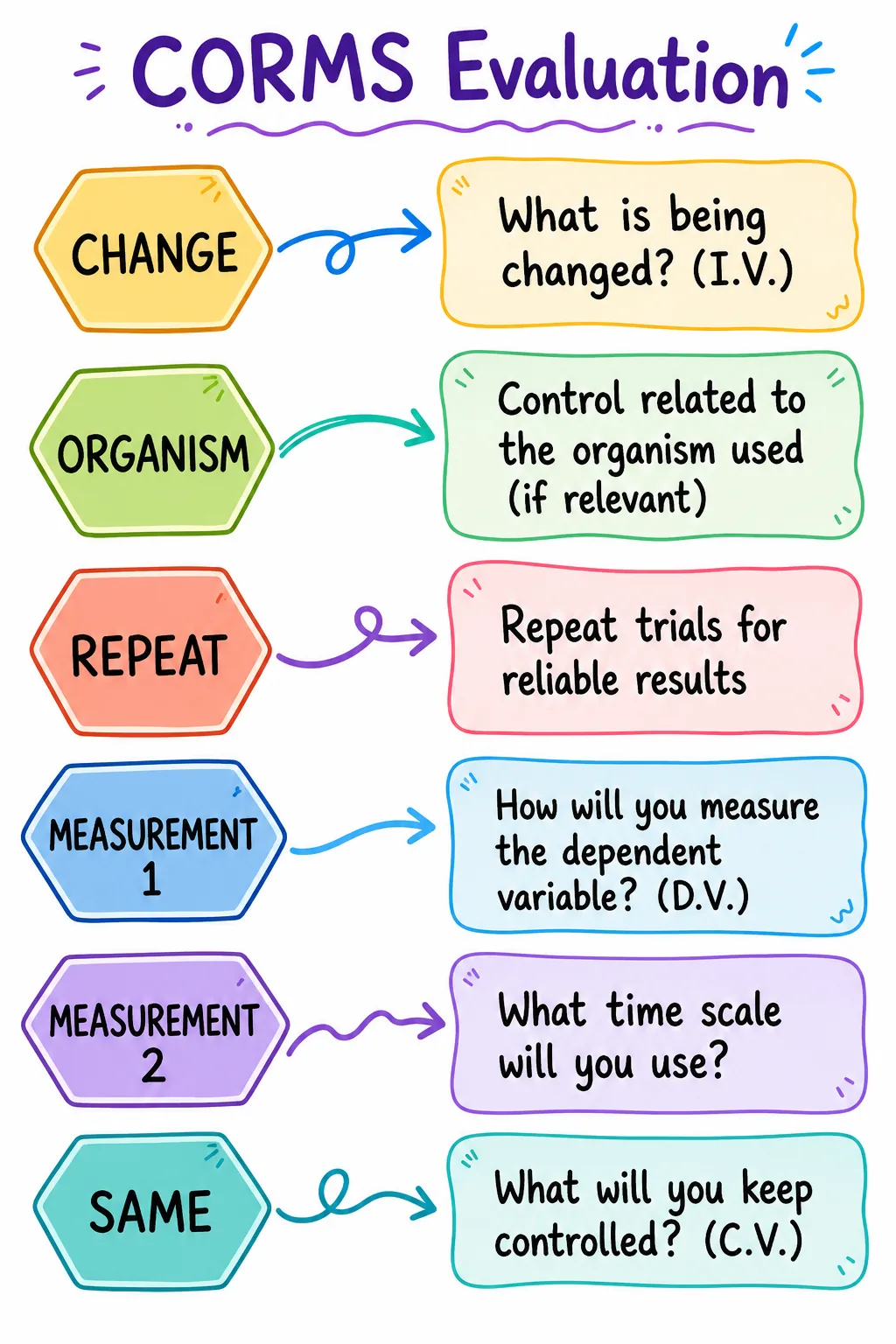
identify independent, dependent and controlled variables
use a control group (or placebo in human studies)apply the treatment randomlyuse large sample sizes and repeated trials. Double-blind designs reduce bias.
Data analysis
calculate mean, median and range
plot graphs with labeled axes and unitsinterpret slopes as ratesidentify trends and outliersinterpolate within and cautiously extrapolate beyond data.
◀ Previous4 / 7Next ▶
Essential knowledge
1
Standard deviation and error bars show spread
overlapping error bars suggest no significant difference.
2
Chi-square tests compare observed and expected results.
(e.g. genetic crosses)
3
Microscopy
4
start on low power, focus with the coarse knob
then use fine focus only at high power. Higher magnification shows a smaller field of view and dimmer image. Electron microscopes have much higher resolution but cannot view living cells.
5
Classic lab investigations
6
enzyme activity (catalase and H
◀ Previous5 / 7Next ▶
Essential knowledge
Essential knowledge
2
O
, measuring O
production vs temperature or pH)
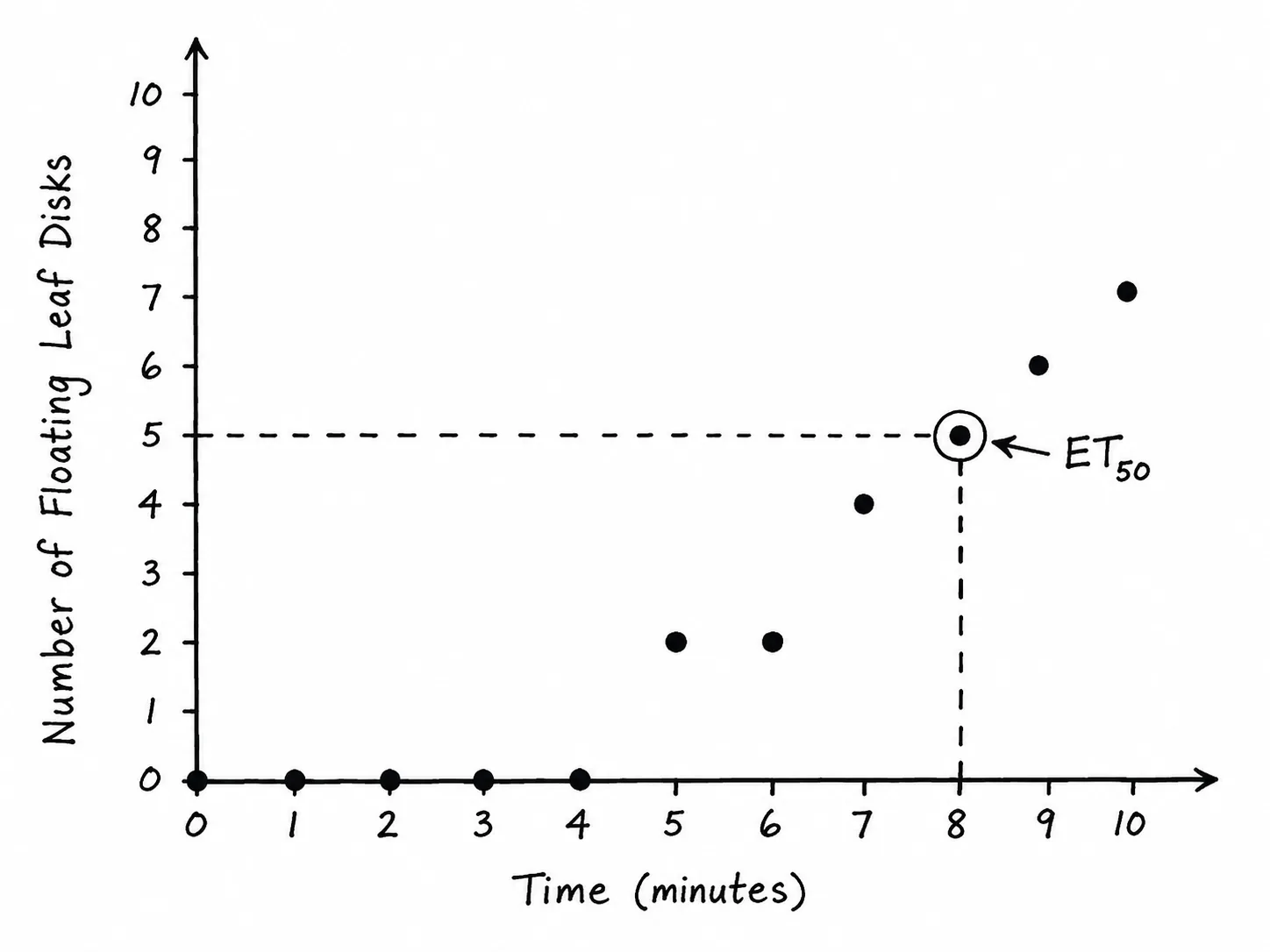
osmosis (potato cores or dialysis tubing in sucrose solutions)photosynthesis rate (floating leaf disks or bubbles from
Elodea
)
respiration (respirometer with germinating peas, KOH absorbing CO
◀ Previous6 / 7Next ▶
Essential knowledge
Essential knowledge
)
transpiration (potometer)mitosis (onion root tip squash)population genetics simulations.
Molecular techniques
gel electrophoresis separates DNA cut by restriction enzymes
PCR amplifies DNA using heat cyclingDNA fingerprinting compares band patternsbacterial transformation uses plasmids and antibiotic-resistance markers to select transformed cells.
Errors
random errors affect precision and are reduced by repetition
systematic errors (miscalibrated instruments) affect accuracy. Always evaluate whether the sample was representative.
◀ Previous7 / 7
1Process & sequence2Process & sequence3Process & sequence4Process & sequence
1Worked examples2A cell measures 2 mm across in a drawing at 400x magnificati
1Summary2Summary3Summary4Summary
1Check yourself2Check yourself3Check yourself4Check yourself5Check yourself6Check yourself7Check yourself8Check yourself9Check yourself10Check yourself


Check yourself
 ⤢ Enlarge
1
Q1. In an experiment on the effect of light intensity on photosynthesis rate, the dependent variable is:
2
1
3
A. light intensity
4
2
5
B. temperature
6
3
◀ Previous4 / 10Next ▶
Check yourself
Check yourself
C. type of plant
4
D. rate of O
production
Show answer
D. The measured outcome is the dependent variable.
◀ Previous5 / 10Next ▶
Check yourself
1
Q2. A 10x ocular and 40x objective give total magnification of:
2
A. 50x
3
B. 400x
4
C. 4000x
5
D. 40x
6
B. 10 x 40 = 400x.
◀ Previous6 / 10Next ▶
Check yourself
Check yourself
Q3. In gel electrophoresis, the smallest DNA fragments are found:
A. farthest from the wells
B. closest to the wells
C. at the negative electrode
D. evenly spread
A. Small fragments move fastest through the gel toward the positive electrode.
◀ Previous7 / 10Next ▶
Check yourself
Check yourself
Q4. Repeating trials mainly improves:
A. accuracy of instruments
B. the hypothesis
C. reliability of results
D. the independent variable
C. Replication reduces the effect of random error.
◀ Previous8 / 10Next ▶
Check yourself
1
Q5. Which graph is best for comparing mean heights of four plant species?
2
A. Line graph
3
B. Pie chart
4
C. Scatter plot
5
D. Bar graph
6
D. Categories are compared with a bar graph.
◀ Previous9 / 10Next ▶
Check yourself
1
Q6. A pigment moves 3 cm while the solvent moves 6 cm. Its Rf value is:
2
A. 0.5
3
B. 2.0
4
C. 3.0
5
D. 18
6
A. Rf = 3⁄6 = 0.5.
◀ Previous10 / 10
Hypothesis
A testable, falsifiable explanation or prediction.
Independent variable
The factor the experimenter deliberately changes.
Dependent variable
The factor measured in response to the independent variable.
Controlled variables
Factors kept constant so they do not affect the result.
Control group
A group not given the experimental treatment, used for comparison.
Replication
Repeating trials or using many subjects to increase reliability.
Accuracy
How close a measurement is to the true value.
Precision
How close repeated measurements are to each other.
Theory
A well-supported, broad explanation backed by many lines of evidence.
Chromatography
A technique that separates mixtures, such as plant pigments, by differing solubility and attraction.
| Technique | Purpose | Key point |
|---|---|---|
| Light microscopy | View cells | Total magnification = ocular x objective |
| Gel electrophoresis | Separate DNA fragments by size | DNA is negative, moves to + electrode; small fragments travel farthest |
| Paper chromatography | Separate pigments | Rf = distance moved by pigment / distance moved by solvent |
| Spectrophotometry | Measure absorbance / light transmission | Used for enzyme rates, pigment spectra |
| Indicator tests | Identify molecules | Benedict’s (reducing sugar), iodine (starch), biuret (protein) |
| Data type | Graph |
|---|---|
| Continuous variable vs continuous variable | Line graph (or scatter plot) |
| Categories compared | Bar graph |
| Parts of a whole | Pie chart |
| Frequency distribution | Histogram |
Independent variable goes on the x-axis; dependent on the y-axis.
Command terms
Identify / Describe (FRQ)
A short, specific statement; describing requires relevant characteristics, not a single word.
Explain / Justify (FRQ)
Give the cause-and-effect reasoning or evidence; a restated fact does not score.
Calculate
Show setup, substitution and the answer with units.
Predict
State the expected outcome; add a reason only if asked to justify.
MCQ technique
Read every option; eliminate distractors that are true statements but do not answer the question; watch for NOT/EXCEPT.
Keywords the mark scheme looks for in this lesson
Keywords the mark scheme looks for in this lesson
Hypothesis · Independent variable · Dependent variable · Controlled variables · Control group · Replication · Accuracy · Precision · Theory · Chromatography
Learn each definition in the Key words tab exactly; a missing keyword in a definition usually loses the mark.
How to get full marks (examiner guidance)
1
Answer exactly what is asked; extra correct material does not earn credit, and contradictory statements can cancel credit (AP FRQ).
2
Use precise vocabulary (e.g. “active site”, “concentration gradient”, “allele”), never “it/stuff/things”.
3
Show units and working in calculations.
4
In MCQs, predict the answer before reading the options, then eliminate.