Curriculum
EST II Biology
1. Molecules & Cells
0/15
-
McGraw-Hill SAT Biology — Chapter 5: Understanding Molecular and Cellular Biology
 Preview
-
1.1 Chemistry of Life
Preview
-
1.1 Chemistry of Life (SAT Biology) - Check yourself
 Preview
-
1.2 Cell Structure & Organelles
Preview
-
1.2 Cell Structure & Organelles (SAT Biology) - Check yourself
Preview
-
1.3 Membrane Transport
Preview
-
1.3 Membrane Transport (SAT Biology) - Check yourself
Preview
-
1.4 Enzymes & Metabolism
Preview
-
1.4 Enzymes & Metabolism (SAT Biology) - Check yourself
Preview
-
1.5 Cellular Respiration
Preview
-
1.5 Cellular Respiration (SAT Biology) - Check yourself
Preview
-
1.6 Photosynthesis
Preview
-
1.6 Photosynthesis (SAT Biology) - Check yourself
Preview
-
1.7 Cell Division: Mitosis & Meiosis
Preview
-
1.7 Cell Division: Mitosis & Meiosis (SAT Biology) - Check yourself
Preview
2. Genetics & Biotechnology
0/7
3. Evolution & Diversity
0/7
4. Organisms: Structure & Function
0/15
5. Ecology
0/5
6. Laboratory Skills
0/2
SAT Biology — Full Book Tests and Strategy
0/8
1.4 Enzymes & Metabolism
Distinguish anabolic and catabolic, exergonic and endergonic reactions.

 ⤢ Enlarge
 ⤢ Enlarge
 ⤢ Enlarge


 ⤢ Enlarge
Metabolism
The total of all chemical reactions in an organism, including building (anabolic) and breaking down (catabolic) pathways.
Enzyme
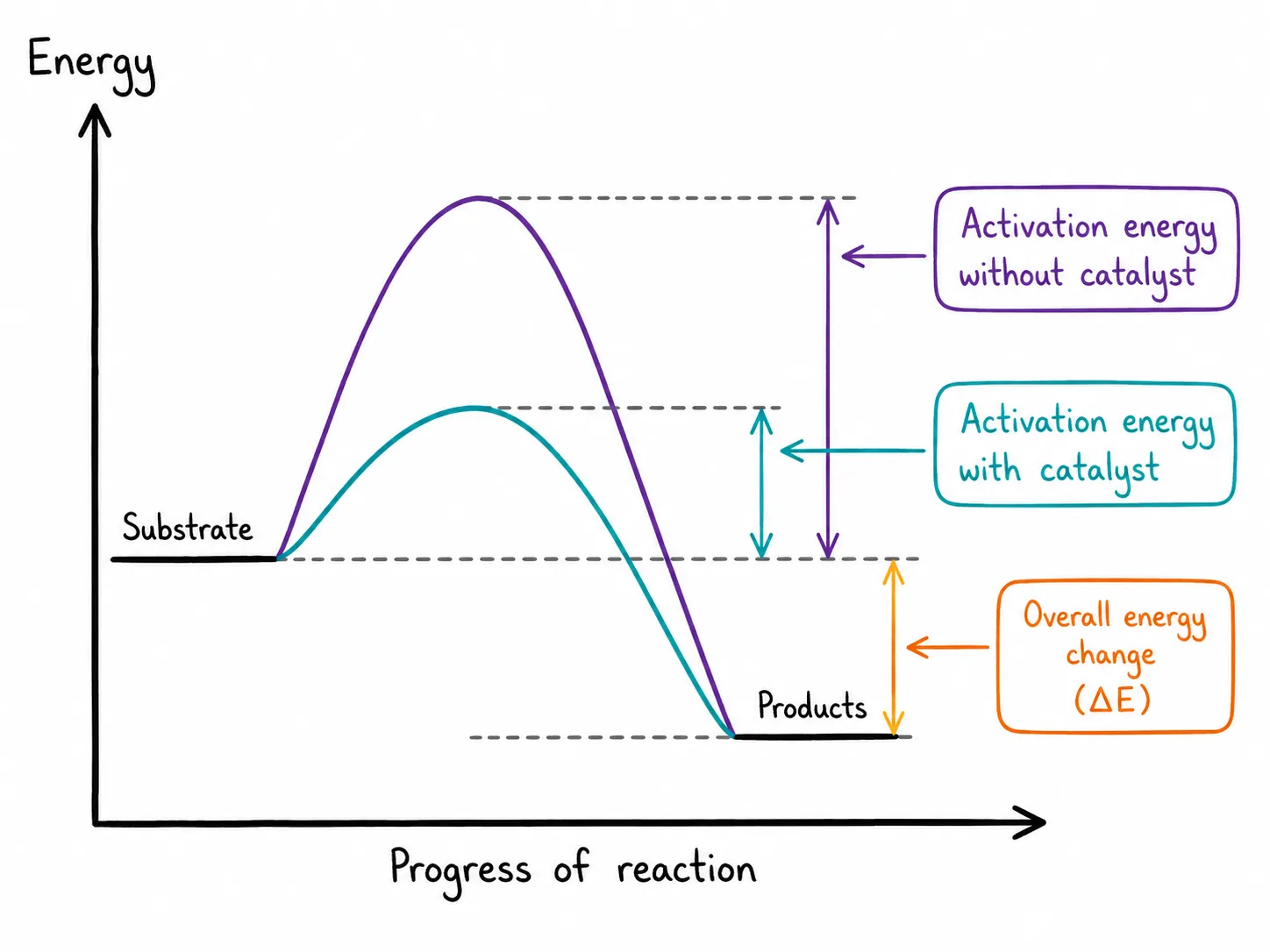
A biological catalyst, usually a protein, that speeds up a reaction without being consumed.
Activation energy
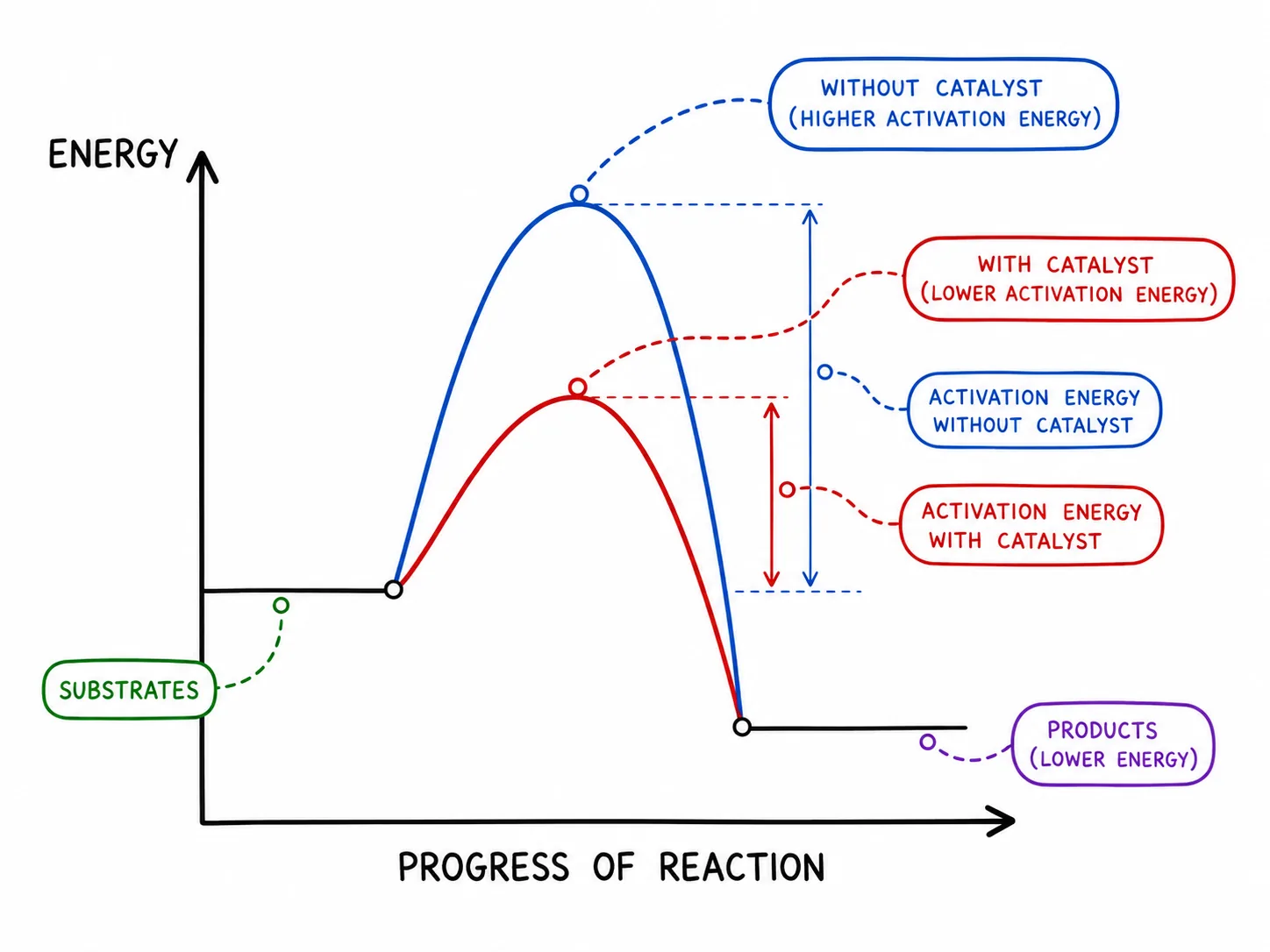
The minimum energy that reactants must absorb to start a reaction.
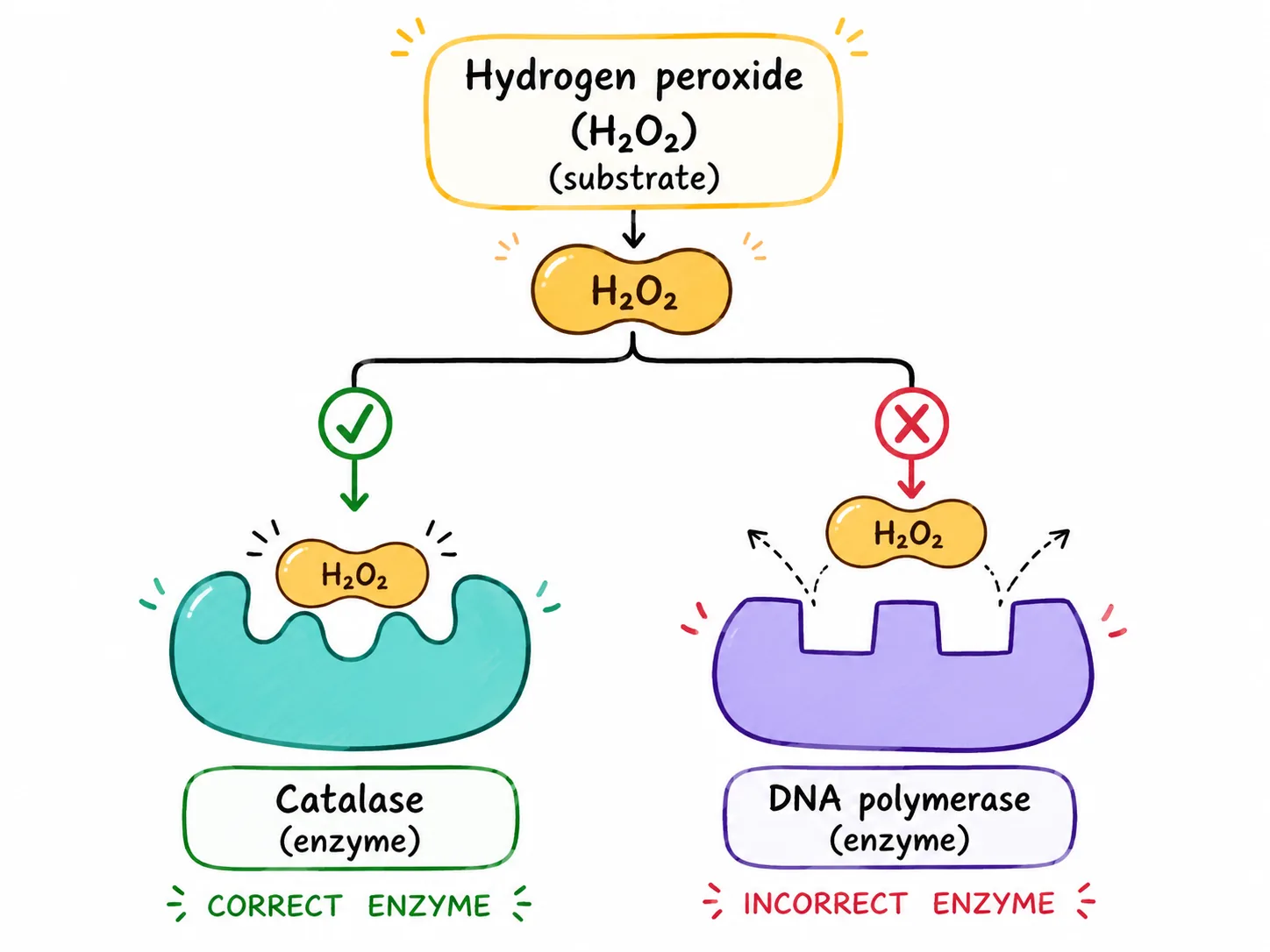
Substrate
The reactant that binds to an enzyme’s active site.
Active site
The region of an enzyme whose shape and chemistry allow it to bind a specific substrate.
Induced fit
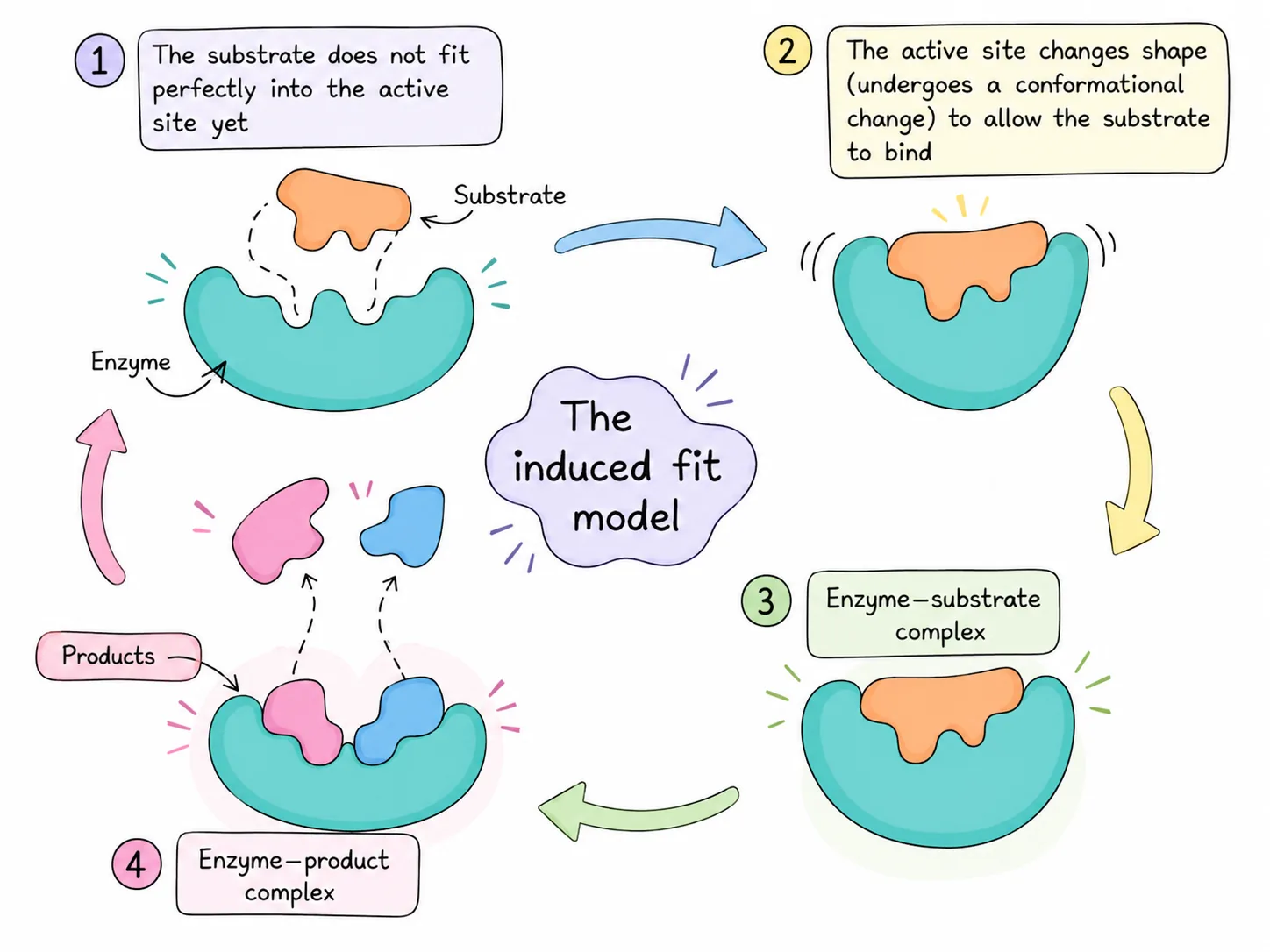
The model in which the active site changes shape slightly to grip the substrate more tightly once it binds.
Cofactor
A non-protein helper, such as a metal ion or a coenzyme (e.g. NAD+), required for enzyme activity.
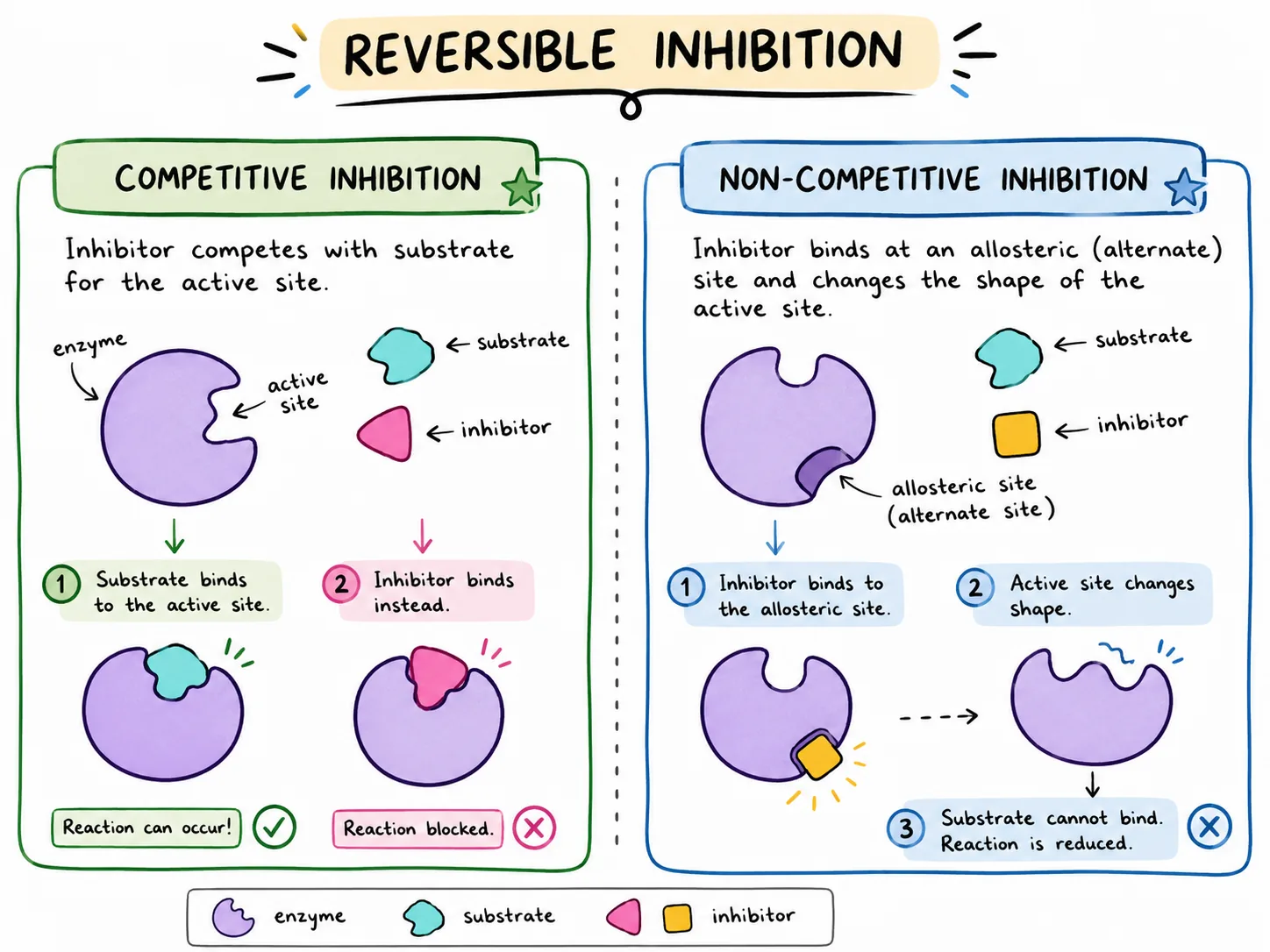
Competitive inhibitor
A molecule resembling the substrate that binds the active site and blocks the substrate.
Allosteric regulation
Control of an enzyme by a molecule binding at a site other than the active site, changing the enzyme’s shape.
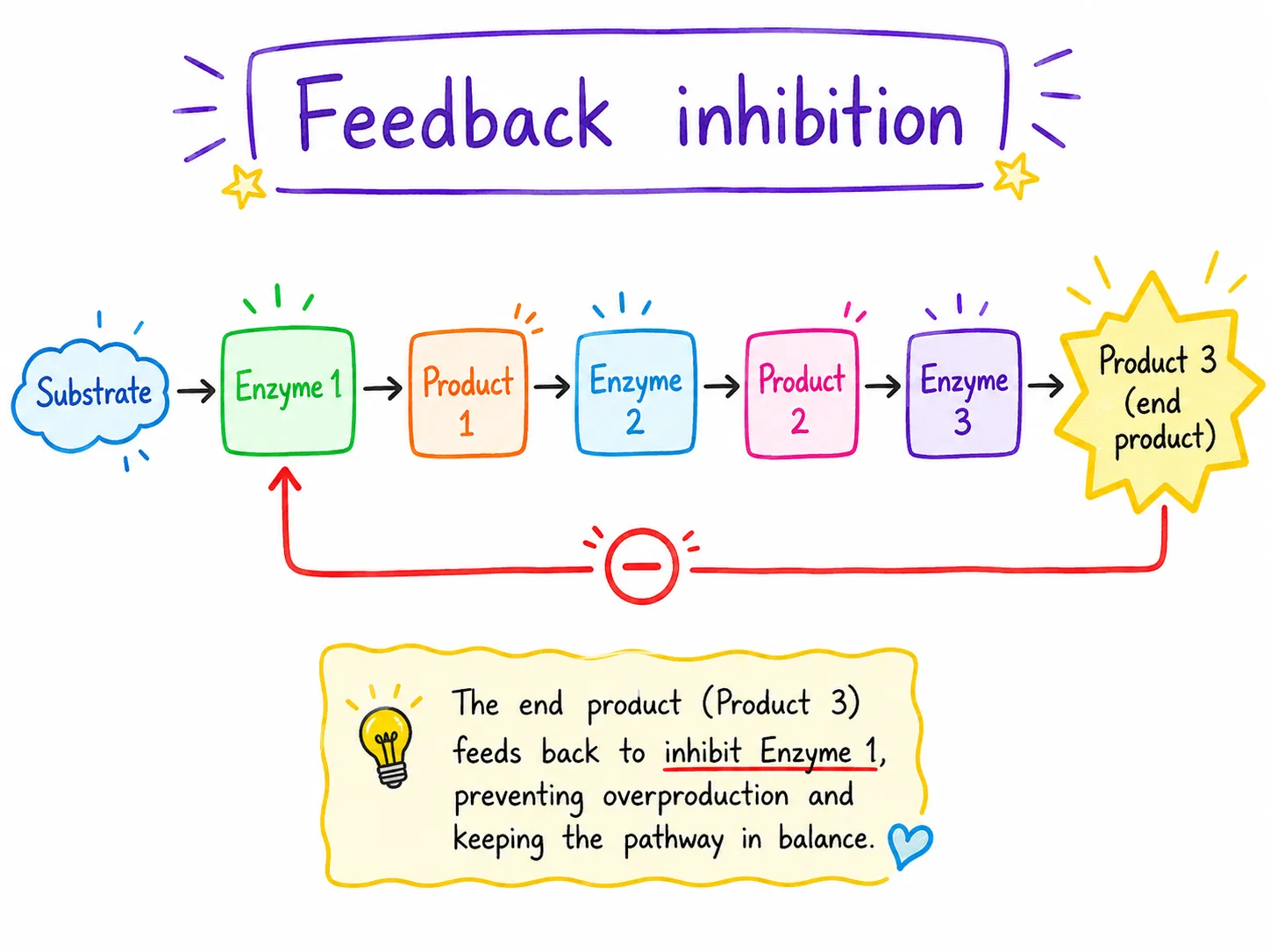
Feedback inhibition
Regulation in which the end product of a pathway inhibits an enzyme early in that pathway.
| Factor | Effect | Reason |
|---|---|---|
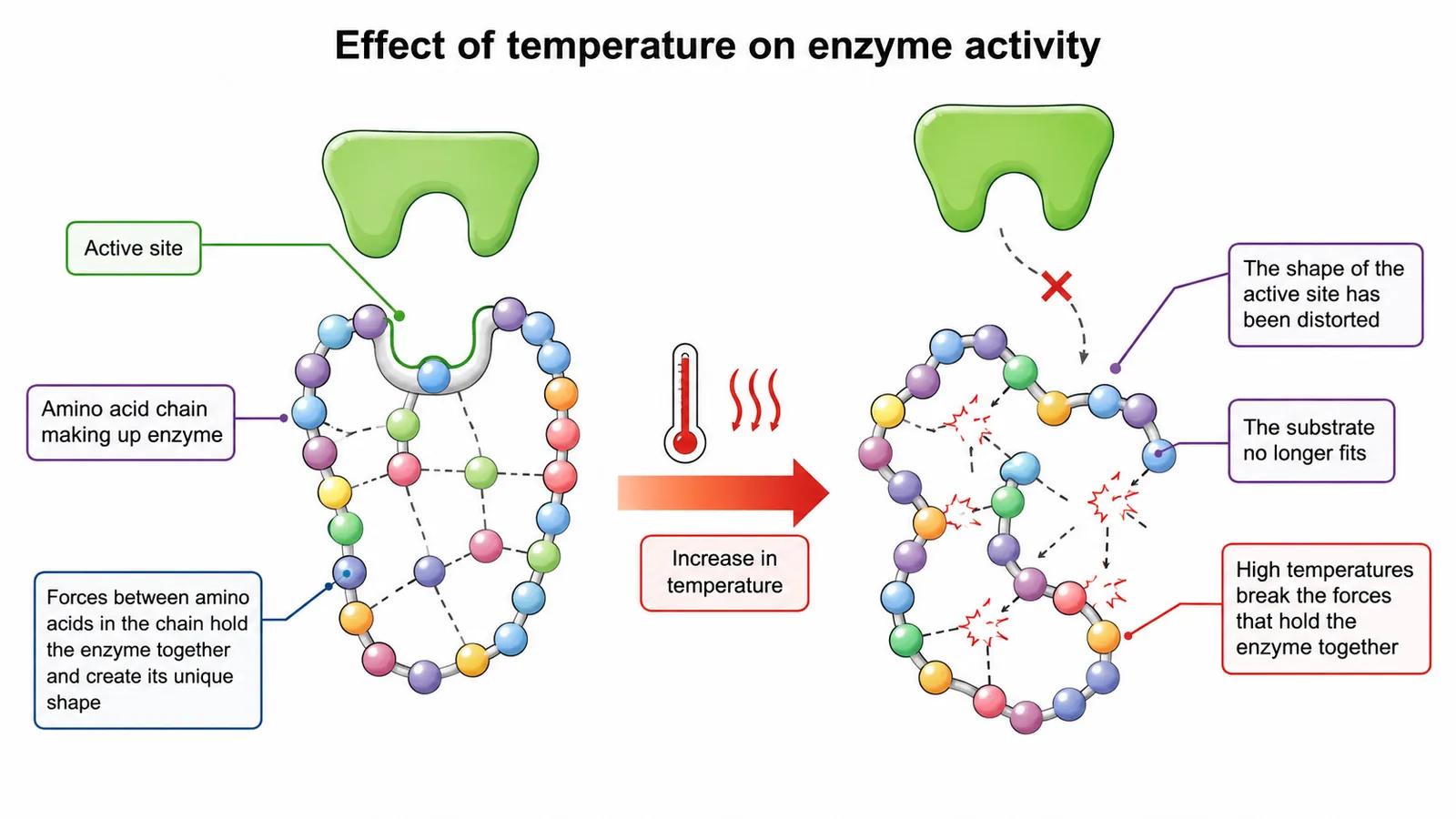
| Temperature | Rate rises to an optimum (about 37 °C in humans), then falls sharply | More collisions at first; above optimum, bonds break and the enzyme denatures |
| pH | Each enzyme has an optimum (pepsin ~2, trypsin ~8) | Changes in H+ alter charges on R groups and the active site |
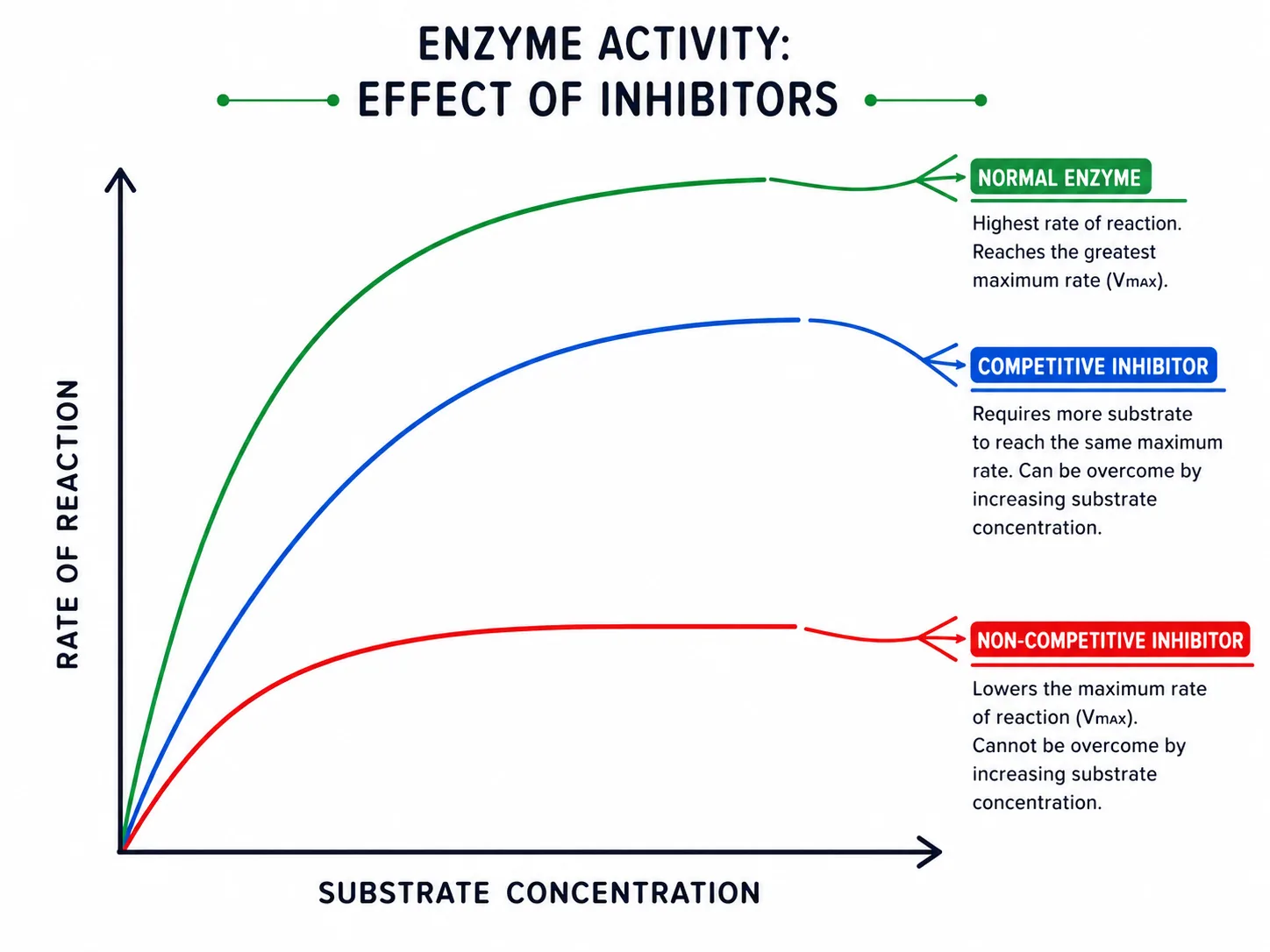
| Substrate concentration | Rate rises then levels off (plateau) | All active sites become occupied (saturation) |
| Enzyme concentration | Rate rises in proportion if substrate is plentiful | More active sites available |
| Inhibitors | Reduce rate | Block or distort active site |
| Feature | Competitive | Noncompetitive |
|---|---|---|
| Binding site | Active site | Allosteric (other) site |
| Resembles substrate? | Yes | No |
| Overcome by more substrate? | Yes | No |
| Effect on maximum rate | Unchanged at very high substrate | Lowered |
| Example | Malonate inhibiting succinate dehydrogenase | Cyanide binding cytochrome oxidase; heavy metals |