Curriculum
EST II Physics
1. Mechanics
0/19
-
1. Mechanics
 Preview
-
1.1 Kinematics in One Dimension
Preview
-
1.1 Kinematics in One Dimension - Check yourself
 Preview
-
1.2 Projectile Motion and Motion in Two Dimensions
Preview
-
1.2 Projectile Motion and Motion in Two Dimensions - Check yourself
Preview
-
1.3 Forces and Newton’s Laws
Preview
-
1.3 Forces and Newton’s Laws - Check yourself
Preview
-
1.4 Statics and Friction
Preview
-
1.4 Statics and Friction - Check yourself
Preview
-
1.5 Work, Energy and Power
Preview
-
1.5 Work, Energy and Power - Check yourself
Preview
-
1.6 Impulse and Momentum
Preview
-
1.6 Impulse and Momentum - Check yourself
Preview
-
1.7 Circular Motion
Preview
-
1.7 Circular Motion - Check yourself
Preview
-
1.8 Simple Harmonic Motion
Preview
-
1.8 Simple Harmonic Motion - Check yourself
Preview
-
1.9 Gravitation, Orbits and Kepler’s Laws
Preview
-
1.9 Gravitation, Orbits and Kepler’s Laws - Check yourself
Preview
2. Electricity and Magnetism
0/15
3. Waves and Optics
0/13
4. Heat and Thermodynamics
0/7
5. Modern Physics
0/11
6. Measurement, Analysis and Contemporary Physics
0/5
Text lesson
1.1 Kinematics in One Dimension
1.1 Kinematics in One Dimension — EST II PHYSICS notes: You will be able to define displacement, velocity, speed and acceleration for motion along a straight line, use the constant-acceleration equations, and read slopes and areas on position-time and velocity-time graphs.
In one dimension, an object moves along a straight line, and its position is its location measured from a chosen origin.
Position is written as x and is measured in metres (m).
Positive and negative positions tell you which side of the origin the object is on.
Displacement is the change in position, Δx = xfinal − xinitial.
It is a vector, so its sign gives its direction, and its SI unit is the metre (m).
Distance is the total length of the path travelled.
It is a scalar, is never negative, and is not the same as displacement when the object turns back.
Average velocity is the displacement divided by the time interval, vavg = Δx/Δt.
Its unit is metres per second (m/s).
If a cyclist moves 30 m in the negative direction in 6 s, her average velocity is −5 m/s.
Instantaneous velocity is the velocity at a single moment; it is found from the slope of the position-time graph at that moment.
Speed is a scalar and has no direction.
Average speed and the magnitude of average velocity are equal only when the object does not change direction.
A runner who goes 100 m away from the start and 100 m back in 40 s has an average speed of 5 m/s but an average velocity of zero.
Acceleration is the rate of change of velocity, a = Δv/Δt.
What the symbols mean a = acceleration (m s−2) · v = final velocity · u = initial velocity (m s−1) · Δv = change in velocity · t = time taken (s), It is a vector measured in metres per second squared (m/s2).
An object speeds up when its velocity and acceleration have the same sign, and slows down when they have opposite signs.
For example, a car moving in the positive direction with a = −3 m/s2 is slowing down, and a car moving in the negative direction with a = −3 m/s2 is speeding up.
Uniform acceleration means the acceleration is constant. Only in that case may the equations in the next part be used.
Here x0 and v0 are the initial position and velocity, and x and v are the position and velocity at time t.
v = v0 + at, which gives the velocity after a time t. Velocity is in m/s, a in m/s2 and t in seconds (s).
x − x0 = v0t + ½at2, which gives the displacement. Each term is in metres (m).
x − x0 = ½(v0 + v)t, which gives the displacement from the average of the initial and final velocities.
v2 = v02 + 2a(x − x0), which gives the velocity without needing the time.
To solve a problem, list the known quantities, identify the unknown, and choose the equation that contains the known quantities and the unknown but not the quantity that you do not know.
Take one direction as positive and use the sign of each quantity consistently.
Near the surface of the Earth every such object has the same downward acceleration, g.
This course uses g = 10 m/s2, directed downward, so that calculations can be done without a calculator.
Mass does not change the acceleration of free fall.
If upward is taken as positive, the acceleration of a freely falling object is a = −g = −10 m/s2.
An object released from rest has v0 = 0, so its speed after time t is v = −gt.
An object thrown upward slows down until it reaches its highest point, where its velocity is zero.
The time to reach the highest point is t = v0/g.
Because the motion is symmetrical, the object returns to its launch point after twice this time, with the same speed but in the opposite direction.
A straight line means the velocity is constant.
A horizontal line means the object is at rest.
A curved line means the velocity is changing, and the slope of the tangent at a point gives the instantaneous velocity at that point.
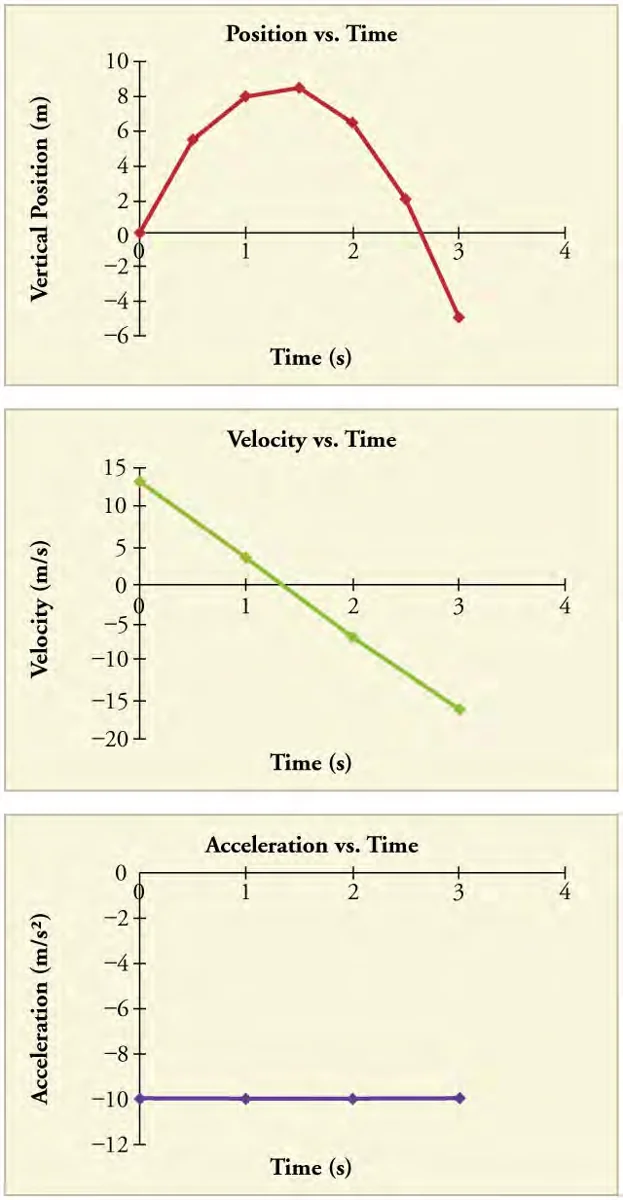
On a velocity-time graph, the slope is the acceleration, so a straight sloping line means constant acceleration and a horizontal line means constant velocity.
Area above the axis counts as positive displacement and area below the axis counts as negative displacement.
A useful check is to compare the two graphs.
The area between the graph and the time axis gives the displacement.
For a uniformly accelerating object, the area is a rectangle, a triangle or a trapezium, and these shapes give the same results as the constant-acceleration equations.
A position-time graph that curves upward shows a velocity that is increasing, and the corresponding velocity-time graph slopes upward, showing positive acceleration.
Example 1
A car speeding up from rest
1
The acceleration is a = Δv/Δt = (20 m/s − 0)/8.0 s = 2.5 m/s2.
2
To find the distance, use v2 = v02 + 2a(x − x0) with v0 = 0: 202 = 2(2.5)(x − x0), so 400 = 5(x − x0) and x − x0 = 80 m.
3
Check The average velocity is (0 + 20)/2 = 10 m/s
4
Check and 10 m/s × 8.0 s = 80 m
Answer
The acceleration is 2.5 m/s2 and the car travels 80 m.
Example 2
A ball thrown upward
1
At the highest point v = 0, so 0 = 30 − 10t and t = 3.0 s.
2
Using v2 = v02 − 2gh at the top gives 0 = 302 − 2(10)h, so h = 900/20 = 45 m.
3
The ball returns after 2 × 3.0 s = 6.0 s, and its speed then equals the launch speed, 30 m/s, directed downward.
Answer
3.0 s to the top, a maximum height of 45 m, and a velocity of 30 m/s downward when it returns.
Example 3
Displacement and average speed from a velocity-time graph
1
The area under the graph is the sum of three shapes.
2
The first triangle has area ½ × 4 s × 8 m/s = 16 m.
3
The rectangle has area 6 s × 8 m/s = 48 m.
4
The last triangle has area ½ × 2 s × 8 m/s = 8 m.
5
The total displacement is 16 + 48 + 8 = 72 m.
6
Every part of the motion is in the positive direction, so the distance equals the displacement.
Answer
The displacement is 72 m and the average speed is 72 m/12 s = 6 m/s. The acceleration is 2 m/s2 during the first 4 s and −4 m/s2 from 10 s to 12 s.
Treating speed and velocity as the same quantity
Velocity has a direction and can be negative, while speed is always zero or positive.
Using the average of the initial and final velocities when the acceleration is not constant
The averaging equation only holds for uniform acceleration.
Reading the area on a velocity-time graph as distance when part of the area lies below the axis
Area below the axis is negative displacement.
Avoid
Forgetting that an object thrown upward has a velocity of zero at the top but still has a nonzero acceleration of 10 m/s2 downward
Avoid
Mixing up the slope and the height of a graph, for example reading the height of a position-time graph as the velocity
Avoid
Applying a constant-acceleration equation with a sign convention that changes partway through the problem