Curriculum
EST II Physics
1. Mechanics
0/19
2. Electricity and Magnetism
0/15
3. Waves and Optics
0/13
-
3. Waves and Optics
 Preview
-
3.1 General Wave Properties
Preview
-
3.1 General Wave Properties - Check yourself
 Preview
-
3.2 Sound and the Doppler Effect
Preview
-
3.2 Sound and the Doppler Effect - Check yourself
Preview
-
3.3 Superposition and Standing Waves
Preview
-
3.3 Superposition and Standing Waves - Check yourself
Preview
-
3.4 Reflection and Refraction
Preview
-
3.4 Reflection and Refraction - Check yourself
Preview
-
3.5 Mirrors, Lenses and Image Formation
Preview
-
3.5 Mirrors, Lenses and Image Formation - Check yourself
Preview
-
3.6 Physical Optics
Preview
-
3.6 Physical Optics - Check yourself
Preview
4. Heat and Thermodynamics
0/7
5. Modern Physics
0/11
6. Measurement, Analysis and Contemporary Physics
0/5
Text lesson
3.6 Physical Optics
3.6 Physical Optics — EST II PHYSICS notes: You will be able to explain single-slit diffraction, double-slit interference and fringe spacing, the action of diffraction gratings, the basic idea of thin-film interference, the polarization of transverse light waves, and the link between colour and wavelength in the visible spectrum.
Physical optics explains the effects that rays cannot explain, such as the spreading of light at edges, the bright and dark bands formed by two sources, and the alignment of the oscillations of light, called polarization.
These effects all show that light has a wave nature.
The effects are clearest when the size of the apertures or the separations are comparable to the wavelength of light, which is about 400 nm to 700 nm for visible light.
When light passes through a single slit of width a, it forms a central bright band that is wider than the slit, with dimmer bands on each side.
The dark positions where the light cancels are the minima.
Each part of the slit acts as a source of waves, and the waves from different parts of the slit interfere with each other.
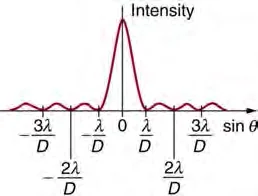
The minima of a single slit are at angles θ given by: a sin θ = mλ, m = ±1, ±2, ±3, …, where a is the slit width in metres, θ is the angle from the central axis, m is the order of the minimum and λ is the wavelength in metres.
A narrower slit gives a wider spread of the pattern, and a slit much wider than the wavelength gives a very small spread.
The central maximum has its first minima at m = ±1.
Diffraction is therefore most noticeable when the slit width is comparable to the wavelength.
When light from a single source passes through two narrow slits separated by a distance d, the two sets of waves overlap on a distant screen and form a pattern of equally spaced bright and dark fringes.
This is double-slit interference.
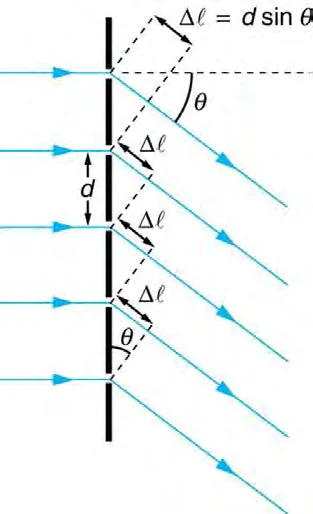
The bright fringes are at angles where the path difference from the two slits is a whole number of wavelengths:
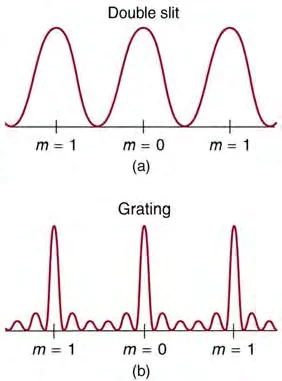
d sin θ = mλ, m = 0, ±1, ±2, …, where d is the slit separation in metres and θ is the angle of the fringe measured from the centre of the pattern.
The dark fringes are at (m + ½)λ.
When the screen is at distance L from the slits and the fringes are close to the centre, the distance y of a bright fringe from the centre is approximately y = mλL/d.
Fringe spacing
The distance between adjacent bright fringes, the fringe spacing, is:
where Δy is the fringe spacing in metres, L is the distance from the slits to the screen in metres and d is the slit separation in metres.
The fringe spacing increases when the wavelength or the screen distance increases, and decreases when the slit separation increases.
1
A diffraction grating is a plate with a very large number of equally spaced parallel slits.
2
The spacing between adjacent slits is d = 1/N, where N is the number of lines per metre.
3
The bright maxima of a grating occur at the same angles as for double-slit interference, but because many slits contribute, the maxima are much sharper and brighter:
1
d sin θ = mλ, m = 0, ±1, ±2, …, A grating separates light into its wavelengths, with the largest angle for the longest wavelengths in each order.
2
More lines per metre spread the maxima further apart and make them sharper.
Light reflects from the top surface and from the bottom surface of the film, and the two reflected waves superpose.
The path difference depends on the thickness of the film and on the wavelength of the light in the film.
In addition, a wave reflected from a boundary with a medium of higher refractive index is shifted by half a wavelength.
4Constructive or destructive interference, and so the colour seen, depends on the film thickness, and for a film of thickness that varies across its surface, a pattern of coloured bands appears.
At the level of this course, you need only to describe the origin of these colours qualitatively.
A transverse wave can have its oscillation in one plane, which is called polarization.
Light from an ordinary source, such as the Sun or a light bulb, is unpolarized, because its oscillations point in all directions perpendicular to the direction of travel.
Polarizer
A polarizer is a filter that transmits only the component of the electric field parallel to its transmission axis.
Polarization is a property of transverse waves only.
Longitudinal sound waves cannot be polarized.
Light reflected from a flat, non-metallic surface, such as a road or the surface of water, is partly polarized, so polarized sunglasses reduce glare.
When polarized light of intensity I0 passes through a polarizer whose axis is at angle θ to its plane of polarization, the transmitted intensity is given by Malus’s law:
I = I0 cos2 θ
Two polarizers with their axes at 90° to each other transmit no light, because cos2 90° = 0.
Each wavelength in this range corresponds to a colour that the eye perceives, and a mixture of many wavelengths is seen as white light.
The colour of an object depends on which wavelengths it absorbs and which it reflects or transmits.
A red object reflects mainly long wavelengths and absorbs most of the others.
Colour in diffraction and interference effects also depends on wavelength.
Because the angle of a fringe depends on the wavelength, a diffraction grating or a double slit spreads white light into a spectrum, with red at the largest angle and violet at the smallest.
Example 1
Fringe spacing in a double-slit experiment
1
Δy = λL/d = (6.0 × 10⁻⁷ m)(2.0 m)/(6.0 × 10−4 m) = (6.0 × 2.0)/6.0 × 10−3 m = 2.0 × 10⁻³ m.
Answer
Δy = 2.0 mm
Example 2
First-order maximum of a grating
1
500 lines/mm = 5.0 × 10⁵ lines/m, so d = 1/(5.0 × 105) m = 2.0 × 10⁻⁶ m.
2
For m = 1, sin θ = λ/d = (5.0 × 10⁻⁷ m)/(2.0 × 10−6 m) = 0.25.
Answer
sin θ = 0.25, so the first-order maximum is at about 14.5°.
Example 3
Polarizers
1
I = I0 cos2 θ = 40 W/m2 × cos2 60° = 40 W/m2 × (½)2 = 40 × ¼ = 10 W/m2.
Answer
10 W/m2.
Using the double-slit formula for a single slit
A single slit has minima at a sin θ = mλ, with the slit width a, not the slit separation d.
Forgetting to convert units
Wavelengths in nanometres and separations in millimetres must be converted to metres before using Δy = λL/d.
Thinking that a grating with more lines per metre gives a wider spacing of the bright maxima
More lines make the spacing smaller (d is smaller), so the maxima spread further apart.
Believing that sound waves can be polarized
Only transverse waves, such as light, can be polarized.
Avoid
Using cos θ instead of cos2 θ in Malus’s law, or taking θ from the surface instead of from the polarization axis