Curriculum
EST II Physics
1. Mechanics
0/19
-
1. Mechanics
 Preview
-
1.1 Kinematics in One Dimension
Preview
-
1.1 Kinematics in One Dimension - Check yourself
 Preview
-
1.2 Projectile Motion and Motion in Two Dimensions
Preview
-
1.2 Projectile Motion and Motion in Two Dimensions - Check yourself
Preview
-
1.3 Forces and Newton’s Laws
Preview
-
1.3 Forces and Newton’s Laws - Check yourself
Preview
-
1.4 Statics and Friction
Preview
-
1.4 Statics and Friction - Check yourself
Preview
-
1.5 Work, Energy and Power
Preview
-
1.5 Work, Energy and Power - Check yourself
Preview
-
1.6 Impulse and Momentum
Preview
-
1.6 Impulse and Momentum - Check yourself
Preview
-
1.7 Circular Motion
Preview
-
1.7 Circular Motion - Check yourself
Preview
-
1.8 Simple Harmonic Motion
Preview
-
1.8 Simple Harmonic Motion - Check yourself
Preview
-
1.9 Gravitation, Orbits and Kepler’s Laws
Preview
-
1.9 Gravitation, Orbits and Kepler’s Laws - Check yourself
Preview
2. Electricity and Magnetism
0/15
3. Waves and Optics
0/13
4. Heat and Thermodynamics
0/7
5. Modern Physics
0/11
6. Measurement, Analysis and Contemporary Physics
0/5
Text lesson
1.6 Impulse and Momentum
1.6 Impulse and Momentum — EST II PHYSICS notes: You will be able to calculate momentum and impulse, use the impulse-momentum theorem and force-time graphs, apply conservation of momentum to collisions and explosions in one and two dimensions, and decide whether a collision is elastic or inelastic.
It is a vector quantity that points in the same direction as the velocity.
Its SI unit is the kilogram metre per second (kg·m/s), which is the same as the newton second (N·s).
A heavy object moving slowly and a light object moving quickly can have the same momentum.
The momentum of a system is the vector sum of the momenta of the objects in it.
Momentum is conserved when no net external force acts on the system, because each internal force that acts on one object is matched by an equal and opposite force on another object, as Newton’s third law requires.
The impulse of a force is the product of the force and the time for which it acts, J = FΔt, when the force is constant.
The impulse-momentum theorem states that the impulse on an object equals its change in momentum, J = Δp = mΔv = m(vf − vi).
Impulse is a vector in the direction of the force, and it is measured in newton seconds (N·s).
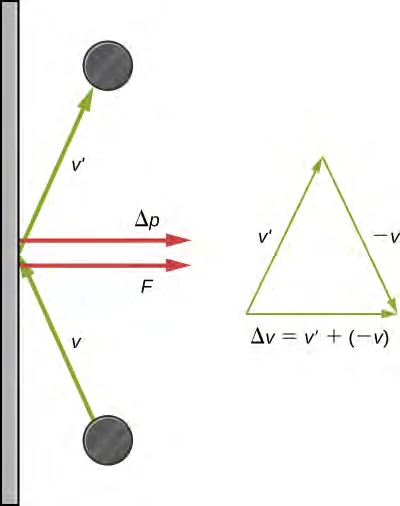
Because the impulse equals the change in momentum, the same change in momentum can be produced by a large force for a short time or a small force for a long time.
The average force during a collision is Favg = Δp/Δt.
Airbags, crumple zones and padded landing mats increase the time of an impact, which lowers the average force on a person.
Area above the axis is a positive impulse and area below the axis is a negative impulse.
For a force that rises linearly from zero to a maximum and then falls to zero, the impulse is the area of a triangle, ½ × base × height.
The average force over the interval is the impulse divided by the time interval.
1
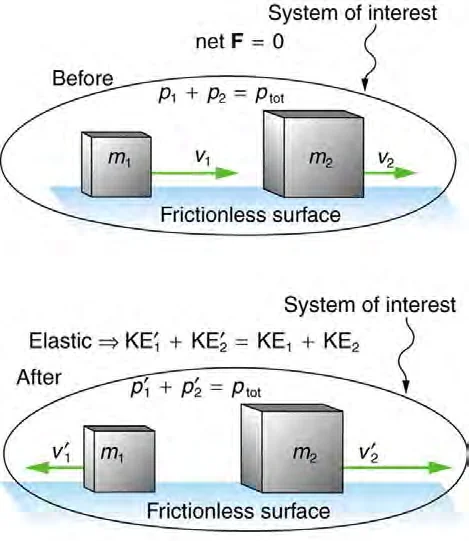
In any collision or explosion of an isolated system, the total momentum before equals the total momentum after: Σpbefore = Σpafter.
2
In one dimension, choose a positive direction and use signed velocities.
3
In two dimensions, conserve the momentum components along each perpendicular axis separately.
1
1A collision is elastic when the total kinetic energy is the same before and after.
2
A collision is inelastic when some kinetic energy is transferred into thermal energy, sound or deformation.
3
In a perfectly inelastic collision the objects stick together and move with a common velocity; this loses the greatest possible amount of kinetic energy for the given momenta.
4
Momentum is conserved in both types, but kinetic energy is conserved only in elastic collisions.
5
2When two equal masses collide elastically in one dimension, with one mass initially at rest, the moving mass stops and the other mass moves off with the original velocity.
6
In general, an elastic collision between a moving mass and a mass at rest transfers velocity from the faster object to the slower one in a way that depends on the two masses.
7
3In two dimensions an elastic collision obeys the same two rules, applied separately along each axis, together with conservation of the total kinetic energy.
8
For two equal masses, one initially at rest and a glancing (non-head-on) collision, the two objects leave at right angles to each other.
9
This follows because the two final momenta add to the original momentum, while the kinetic energy requires the sum of the squares of the two final speeds to equal the square of the original speed, which is only possible when the two final velocities are perpendicular.
10
4An explosion is the reverse of a perfectly inelastic collision.
11
A system that starts at rest has zero total momentum, so the fragments of an explosion move in opposite directions, with momenta of equal size.
12
The lighter fragment moves faster, because its momentum is the same as that of the heavier one.
Example 1
Average force on a bouncing ball
1
Take the direction towards the wall as positive.
2
The initial momentum is 0.20 kg × 10 m/s = +2.0 kg·m/s and the final momentum is 0.20 kg × (−10 m/s) = −2.0 kg·m/s.
3
The impulse is Δp = −2.0 − 2.0 = −4.0 N·s, which points away from the wall.
4
The average force is F = Δp/Δt = −4.0 N·s/0.020 s = −200 N.
Answer
The impulse is 4.0 N·s away from the wall, and the average force is 200 N away from the wall.
Example 2
A perfectly inelastic collision in one dimension
1
Momentum is conserved: 4.0 kg × 6.0 m/s = (4.0 kg + 2.0 kg) v, so 24 kg·m/s = 6.0 kg × v and v = 4.0 m/s.
2
The kinetic energy before is ½ × 4.0 × 6.02 = 72 J.
3
The kinetic energy after is ½ × 6.0 × 4.02 = 48 J.
4
The energy lost is 72 J − 48 J = 24 J.
Answer
The trolleys move together at 4.0 m/s, and 24 J of kinetic energy is lost.
Example 3
An elastic collision of equal masses
1
Momentum conservation gives 2.0 × 6.0 = 2.0 v1 + 2.0 v2, so v1 + v2 = 6.0 m/s.
2
Kinetic energy conservation gives ½ × 2.0 × 6.02 = ½ × 2.0 × (v12 + v22), so v12 + v22 = 36.
3
The solutions are v1 = 0 and v2 = 6.0 m/s, which is the physically possible result, because the first ball must stop and the second ball moves off.
4
Check: 0 + 6.0 = 6.0 m/s and 0 + 36 = 36
Answer
The first ball stops and the second moves off at 6.0 m/s. The kinetic energy, 36 J, is the same before and after
Example 4
A two-dimensional perfectly inelastic collision
1
The total momentum east is 1.0 × 4.0 = 4.0 kg·m/s and the total momentum north is 1.0 × 3.0 = 3.0 kg·m/s.
2
The combined mass is 2.0 kg, so the velocity components are 2.0 m/s east and 1.5 m/s north.
3
Its speed is √(2.02 + 1.52) = √6.25 = 2.5 m/s.
4
The kinetic energy before is ½ × 1.0 × 4.02 + ½ × 1.0 × 3.02 = 8.0 + 4.5 = 12.5 J.
5
After the collision it is ½ × 2.0 × 2.52 = 6.25 J.
Answer
The combined object moves at 2.5 m/s in the direction 37° north of east, and 6.25 J of kinetic energy is lost.
Forgetting the direction when a ball rebounds
The change in velocity is the final velocity minus the initial velocity, so a rebound gives a larger change than a stop.
Assuming that kinetic energy is conserved in every collision
Only elastic collisions conserve it; momentum is conserved in all collisions of an isolated system.
Adding speeds instead of momenta in a two-dimensional collision
Momentum must be added as vectors, component by component.
Writing the impulse as the force alone
The impulse includes the time, and the average force is found by dividing the change in momentum by the time.
Avoid
Using the speed instead of the signed velocity when the momentum of a rebounding object is calculated
Avoid
Forgetting that in an explosion the total momentum is zero when the system starts at rest, so the fragments must move in opposite directions