Curriculum
EST II Physics
1. Mechanics
0/19
2. Electricity and Magnetism
0/15
3. Waves and Optics
0/13
4. Heat and Thermodynamics
0/7
5. Modern Physics
0/11
-
5. Modern Physics
 Preview
-
5.1 Photons and the Photoelectric Effect
Preview
-
5.1 Photons and the Photoelectric Effect - Check yourself
 Preview
-
5.2 Atomic Models and Spectra
Preview
-
5.2 Atomic Models and Spectra - Check yourself
Preview
-
5.3 Nuclear Physics and Radioactivity
Preview
-
5.3 Nuclear Physics and Radioactivity - Check yourself
Preview
-
5.4 Fundamental Particles
Preview
-
5.4 Fundamental Particles - Check yourself
Preview
-
5.5 Special Relativity
Preview
-
5.5 Special Relativity - Check yourself
Preview
6. Measurement, Analysis and Contemporary Physics
0/5
Text lesson
5.2 Atomic Models and Spectra
5.2 Atomic Models and Spectra — EST II PHYSICS notes: You will be able to describe the Rutherford nuclear model and the Bohr model of hydrogen, use the hydrogen energy levels to find the photon energy for a transition, and explain how emission and absorption spectra show the energy levels of atoms.
In 1909 Hans Geiger and Ernest Marsden, working under Ernest Rutherford, fired alpha particles at a very thin gold foil.
Most alpha particles passed straight through or were deflected by only small angles, but a few were deflected through very large angles, and some were turned almost back on themselves.
Rutherford concluded that the positive charge and almost all of the mass of an atom are concentrated in a tiny central region, the nucleus, and that the rest of the atom is mostly empty space.
The nucleus is positively charged, so it repels the positively charged alpha particles.
A close approach to the nucleus produces a large deflection, and a head-on approach produces an almost complete reversal.
The number of large deflections is small because the nucleus is very small compared with the atom.
The nuclear model replaced the earlier plum-pudding model, in which positive charge was spread evenly through the atom.
The nuclear model had a serious problem.
A negatively charged electron orbiting a nucleus would accelerate, and an accelerating charge radiates energy, so the electron should spiral into the nucleus in a fraction of a second.
Atoms are stable, and their spectra consist of sharp lines.
Niels Bohr resolved this problem in 1913.
The Bohr model keeps the nuclear picture of the atom but adds two postulates.
First, an electron can move in certain circular orbits without radiating energy.
These are called stationary states, and each has a definite energy.
Second, the angular momentum of the electron is quantised, so only orbits with angular momentum nh/2π, where n = 1, 2, 3, … is an integer, are allowed.
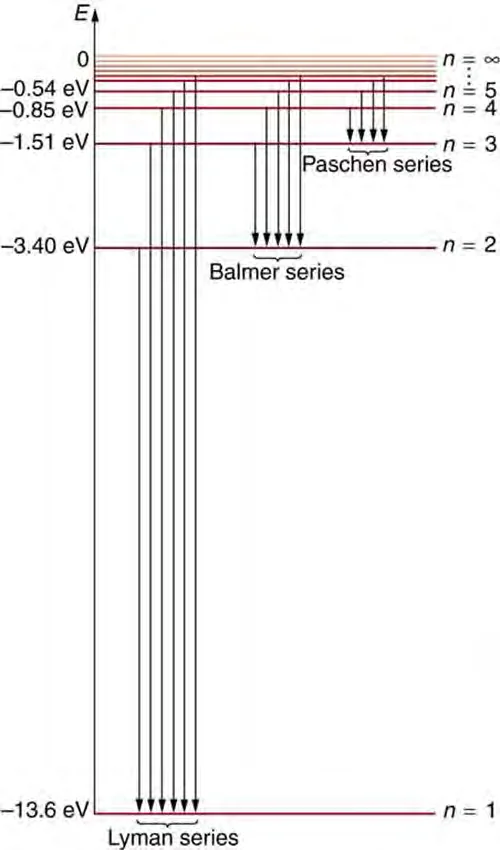
For the hydrogen atom, the allowed energies of the electron are given by En = −13.6 eV/n2, where n is the principal quantum number.
The state with n = 1 is the ground state, with energy −13.6 eV.
Higher values of n correspond to higher energies, closer to zero.
The orbit radius grows as n2, so the electron is farther from the nucleus in higher states.
The negative sign means that the electron is bound to the proton.
An electron with energy 0 eV is free, with no bound state.
The energy needed to remove an electron from a state with quantum number n is therefore |En|.
From the ground state this is 13.6 eV, which is the ionisation energy of hydrogen.
An atom can change from one energy level to another, called a transition.
When an electron drops from a higher level Ehigh to a lower level Elow, it emits one photon with energy hf = Ehigh − Elow.
When an electron rises to a higher level, it absorbs a photon of exactly the same energy difference.
The energy of the transition is the energy difference between the two levels, not the energy of either level alone.
Because each transition has a definite energy difference, only photons of exactly the right energy are absorbed or emitted.
A photon that has too little energy to lift the electron to any allowed level passes through the atom unchanged, and a photon with more energy than needed to reach a level, but less than the ionisation energy, is also not absorbed.
A photon with energy equal to or greater than the ionisation energy can remove the electron completely.
The wavelength of a transition photon is found from hc/λ = Ehigh − Elow.
For hydrogen the transitions to the level n = 2 have wavelengths in the visible range, and this series is called the Balmer series.
The transitions to n = 1 give ultraviolet light, and those to n = 3 give infrared light.
A hot, low-pressure gas emits light only at certain discrete wavelengths.
The light is separated by a prism or diffraction grating into a line emission spectrum, which consists of bright lines on a dark background.
Each line corresponds to one transition between two energy levels of the atom.
Each element has its own set of lines, so a line spectrum acts as a fingerprint of the element.
If white light, which contains all wavelengths, passes through a cool gas, the gas absorbs the photons whose wavelengths match its transitions.
The result is an absorption spectrum a continuous spectrum with dark lines at the same wavelengths as the emission lines of the same gas.
Absorption and emission spectra therefore tell the same story about the energy levels of an atom.
A solid, liquid or dense gas emits a continuous spectrum, with light at all wavelengths and a smooth variation of intensity with wavelength.
A continuous spectrum does not show the discrete energy levels of individual atoms, so it is not a line spectrum.
Question
An electron in a hydrogen atom falls from the n = 2 level to the n = 1 level. Find the energy of the photon emitted and its wavelength.
1
E2 = −13.6/22 = −3.40 eV and E1 = −13.6 eV.
2
The photon energy is hf = E2 − E1 = −3.40 eV − (−13.6 eV) = 10.2 eV.
3
The wavelength is λ = 1240 eV·nm/10.2 eV = 122 nm.
Answer
The photon has energy 10.2 eV and wavelength 122 nm, which is in the ultraviolet.
Question
Find the energy needed to ionise a hydrogen atom that is in the n = 2 state.
1
The energy of the state is E2 = −3.40 eV.
2
Ionisation takes the electron to E = 0 eV, a free electron at rest.
3
The energy needed is 0 eV − (−3.40 eV) = 3.40 eV.
Answer
3.4 eV.
Question
A hydrogen atom in its ground state is hit by a photon of energy 12.0 eV. Will the photon be absorbed?
1
The allowed energy differences from the ground state are En − (−13.6 eV) = 13.6 eV(1 − 1/n2).
2
For n = 2 this is 10.2 eV; for n = 3 it is 12.1 eV; for n = ∞ it is 13.6 eV.
3
None of these equals 12.0 eV, and 12.0 eV is less than the ionisation energy of 13.6 eV.
Answer
No. The photon has the wrong energy to match any transition, so it passes through the atom unabsorbed.
Question
A hydrogen atom emits a photon of energy 2.55 eV. Find the quantum number of the upper level if the lower level is n = 2
1
The lower level has energy −3.40 eV.
2
The upper level energy is −3.40 eV + 2.55 eV = −0.85 eV.
3
Since −0.85 eV = −13.6 eV/n2, we have n2 = 13.6/0.85 = 16, so n = 4.
Answer
The upper level is n = 4. This transition is a visible line of the Balmer series
Using the energy of one level as the energy of a photon
The photon energy is the difference between two levels, so subtract the lower energy from the higher one.
Forgetting the sign of the energy levels
Hydrogen levels are negative, so the transition from −3.40 eV to −13.6 eV releases +10.2 eV.
Thinking that any photon above a transition energy can be absorbed
Only photons with exactly the energy difference are absorbed, unless the photon is energetic enough to ionise the atom.
Confusing a line spectrum with a continuous spectrum
Discrete lines show the energy levels of atoms, and continuous spectra do not.
Writing the Bohr energies as E = −13.6 n eV
The energy depends on 1/n2, not n.
Assuming that the nuclear model explains the stability of atoms without Bohr’s postulates
Classical physics predicts that an orbiting electron would radiate energy and collapse into the nucleus.