Curriculum
EST II Physics
1. Mechanics
0/19
-
1. Mechanics
 Preview
-
1.1 Kinematics in One Dimension
Preview
-
1.1 Kinematics in One Dimension - Check yourself
 Preview
-
1.2 Projectile Motion and Motion in Two Dimensions
Preview
-
1.2 Projectile Motion and Motion in Two Dimensions - Check yourself
Preview
-
1.3 Forces and Newton’s Laws
Preview
-
1.3 Forces and Newton’s Laws - Check yourself
Preview
-
1.4 Statics and Friction
Preview
-
1.4 Statics and Friction - Check yourself
Preview
-
1.5 Work, Energy and Power
Preview
-
1.5 Work, Energy and Power - Check yourself
Preview
-
1.6 Impulse and Momentum
Preview
-
1.6 Impulse and Momentum - Check yourself
Preview
-
1.7 Circular Motion
Preview
-
1.7 Circular Motion - Check yourself
Preview
-
1.8 Simple Harmonic Motion
Preview
-
1.8 Simple Harmonic Motion - Check yourself
Preview
-
1.9 Gravitation, Orbits and Kepler’s Laws
Preview
-
1.9 Gravitation, Orbits and Kepler’s Laws - Check yourself
Preview
2. Electricity and Magnetism
0/15
3. Waves and Optics
0/13
4. Heat and Thermodynamics
0/7
5. Modern Physics
0/11
6. Measurement, Analysis and Contemporary Physics
0/5
Text lesson
1.8 Simple Harmonic Motion
1.8 Simple Harmonic Motion — EST II PHYSICS notes: You will be able to identify a restoring force that produces simple harmonic motion, calculate the period and frequency of a mass on a spring and of a simple pendulum, describe how displacement, velocity and acceleration vary over a cycle, and use the conservation of energy in simple harmonic motion.
1
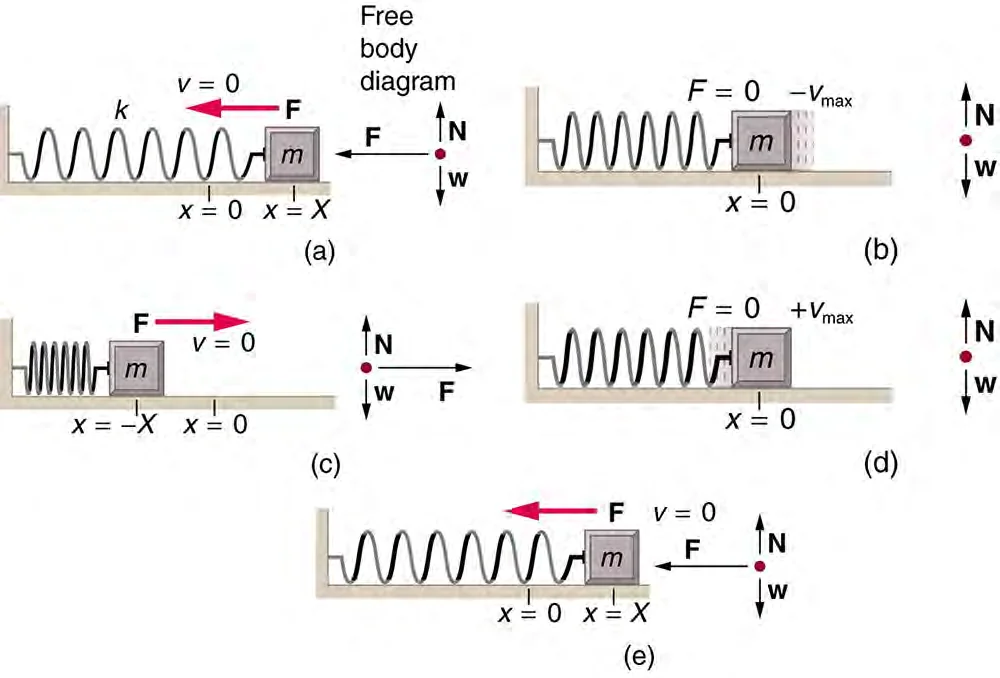
Simple harmonic motion (SHM) is oscillation about an equilibrium position in which the restoring force is directly proportional to the displacement from equilibrium and is directed towards that position.
2
For a spring, this is Hooke’s law, F = −kx, where k is the spring constant in newtons per metre (N/m), x is the displacement in metres (m) from the natural length, and the minus sign shows that the force opposes the displacement.
3
Equivalently, the acceleration is a = −ω2x, which is proportional to the displacement and opposite to it.
1
Any system whose acceleration satisfies this condition oscillates with simple harmonic motion.
2
Amplitude A is the maximum displacement from equilibrium, measured in metres.
3
Period T is the time for one complete oscillation, in seconds (s), and frequency f = 1/T is the number of oscillations per second, in hertz (Hz).
4
The angular frequency is ω = 2π/T = 2πf, in radians per second (rad/s).
Its period is therefore T = 2π√(m/k).
A stiffer spring or a lighter mass oscillates more rapidly.
The period does not depend on the amplitude, provided the spring obeys Hooke’s law.
A simple pendulum is a point mass hung from a light string of length L, measured in metres (m).
For small angles of swing, the restoring force is the component of weight tangent to the path, which is proportional to the displacement, so the motion is approximately simple harmonic.
Its period is T = 2π√(L/g), where g = 10 m/s2 in this course.
The period does not depend on the mass of the bob, and for small amplitudes it does not depend on the amplitude either.
If the oscillation starts with the mass at its maximum displacement A, the displacement at time t is x = A cos(ωt).
The velocity is v = −Aω sin(ωt) and the acceleration is a = −ω2x.
The velocity is in metres per second (m/s) and the acceleration in metres per second squared (m/s2).
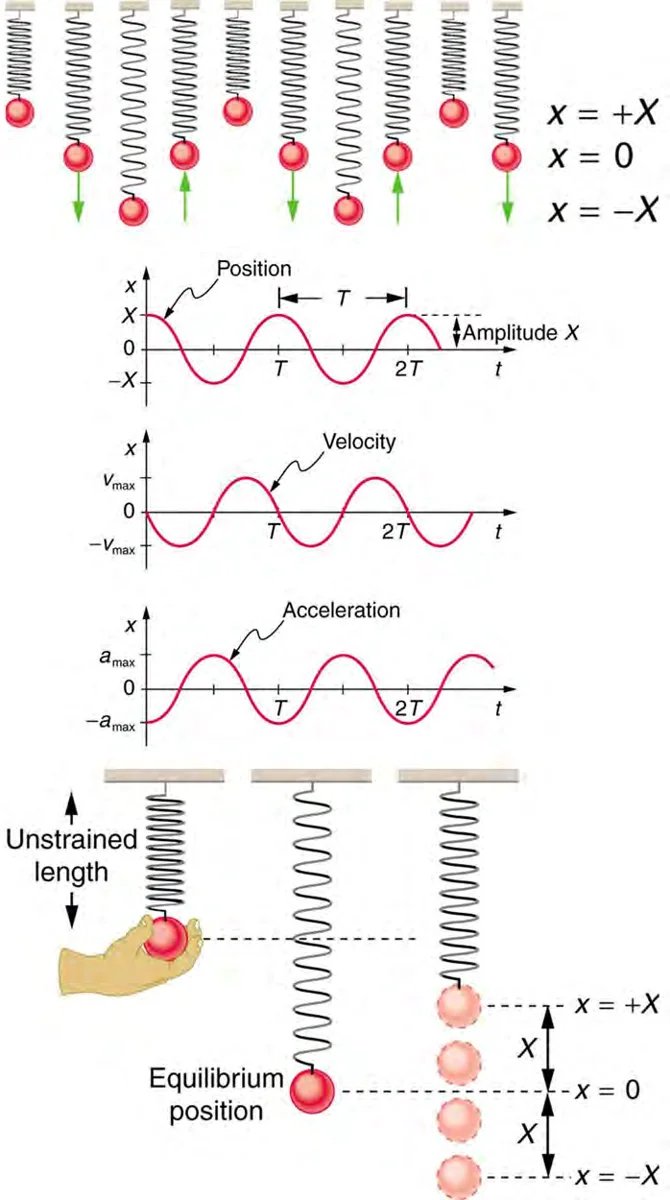
Displacement, velocity and acceleration over a cycle, At maximum displacement, x = ±A, the velocity is zero, and the acceleration has its largest magnitude, amax = Aω2, directed towards the equilibrium position.
At the equilibrium position, x = 0, the acceleration is zero and the speed is greatest, vmax = Aω.
The speed at any displacement is v = ω√(A2 − x2), which gives the speed directly from the position.
The velocity and the displacement are a quarter of a cycle out of phase: when the displacement is zero the speed is maximum, and when the displacement is maximum the speed is zero.
The acceleration is always in the opposite direction to the displacement, so it is greatest when the mass is furthest from equilibrium.
The total energy is E = ½kA2, measured in joules (J).
At any displacement, E = ½mv2 + ½kx2, so the energy is shared between kinetic energy and elastic potential energy.
At the equilibrium position all the energy is kinetic, and at the extremes all of it is potential.
The kinetic and potential energies each oscillate at twice the frequency of the motion.
The energy relation also links the maximum speed to the amplitude: ½mvmax2 = ½kA2.
This is the same result as vmax = Aω, because ω2 = k/m.
Example 1
Period of a mass on a spring
1
ω2 = k/m = 160/0.40 = 400 s−2, so ω = 20 rad/s.
2
The period is T = 2π/ω = 2π/20 = π/10 s, which is about 0.31 s.
Answer
20 rad/s and a period of π/10 s.
Example 2
Period of a simple pendulum
1
T = 2π√(L/g) = 2π√(2.5/10) = 2π√0.25 = 2π × 0.5 = π s.
2
The frequency is f = 1/π Hz, about 0.32 Hz
Answer
A period of π s (about 3.1 s) and a frequency of 1/π Hz.
Example 3
Energy and extreme values for a spring
1
The total energy is E = ½kA2 = ½ × 200 × 0.202 = 4.0 J.
2
The angular frequency is ω = √(200/2.0) = 10 rad/s.
3
The maximum speed is vmax = Aω = 0.20 × 10 = 2.0 m/s; check: ½ × 2.0 × 2.02 = 4.0 J.
4
The maximum acceleration is amax = Aω2 = 0.20 × 100 = 20 m/s2.
Answer
4.0 J, 2.0 m/s and 20 m/s2.
Example 4
Finding the time to reach a displacement
1
The displacement is x = A cos(ωt).
2
Here ω = 2π/1.2 s, and the condition is 0.050 = 0.10 cos(ωt), so cos(ωt) = 0.5.
3
The first solution is ωt = π/3.
4
Then t = (π/3)/(2π/1.2) = 1.2/6 = 0.20 s.
Answer
0.20 s after release, which is one sixth of the period.
Assuming that the velocity is greatest where the displacement is greatest
The speed is greatest at equilibrium, where the displacement is zero, and it is zero at the extremes.
Assuming that the acceleration is zero at the extremes
The acceleration is zero at equilibrium and largest at the extremes.
Using the mass of the pendulum bob in T = 2π√(L/g)
The period does not depend on the bob’s mass.
Quoting the amplitude as the total distance moved in one oscillation
The distance travelled in one full period is 4A.
Using E = ½kA2 when friction or air resistance is present
That expression holds only when the mechanical energy is conserved.
Avoid
Confusing the period with the angular frequency, or forgetting the factor 2π when converting between them