Curriculum
EST II Physics
1. Mechanics
0/19
-
1. Mechanics
 Preview
-
1.1 Kinematics in One Dimension
Preview
-
1.1 Kinematics in One Dimension - Check yourself
 Preview
-
1.2 Projectile Motion and Motion in Two Dimensions
Preview
-
1.2 Projectile Motion and Motion in Two Dimensions - Check yourself
Preview
-
1.3 Forces and Newton’s Laws
Preview
-
1.3 Forces and Newton’s Laws - Check yourself
Preview
-
1.4 Statics and Friction
Preview
-
1.4 Statics and Friction - Check yourself
Preview
-
1.5 Work, Energy and Power
Preview
-
1.5 Work, Energy and Power - Check yourself
Preview
-
1.6 Impulse and Momentum
Preview
-
1.6 Impulse and Momentum - Check yourself
Preview
-
1.7 Circular Motion
Preview
-
1.7 Circular Motion - Check yourself
Preview
-
1.8 Simple Harmonic Motion
Preview
-
1.8 Simple Harmonic Motion - Check yourself
Preview
-
1.9 Gravitation, Orbits and Kepler’s Laws
Preview
-
1.9 Gravitation, Orbits and Kepler’s Laws - Check yourself
Preview
2. Electricity and Magnetism
0/15
3. Waves and Optics
0/13
4. Heat and Thermodynamics
0/7
5. Modern Physics
0/11
6. Measurement, Analysis and Contemporary Physics
0/5
Text lesson
1.2 Projectile Motion and Motion in Two Dimensions
1.2 Projectile Motion and Motion in Two Dimensions — EST II PHYSICS notes: You will be able to resolve a velocity into horizontal and vertical components, treat the two directions of projectile motion separately, find the time of flight, maximum height and range, and add velocities using relative velocity.
1
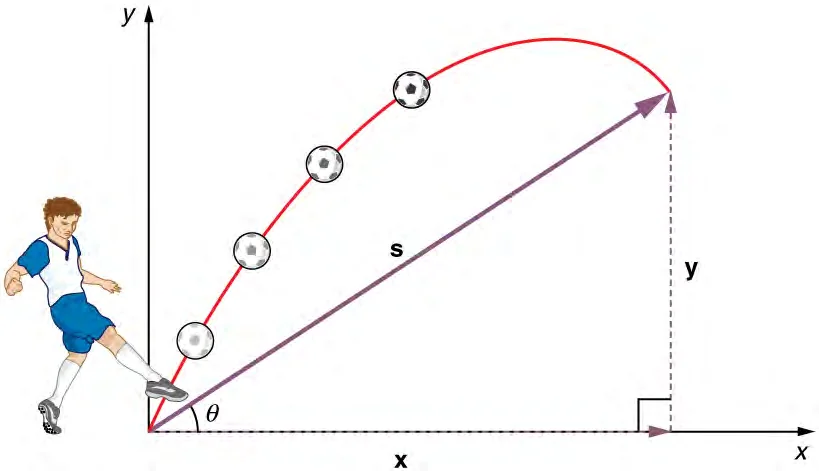
A vector quantity has both a size and a direction, and it can be split into two perpendicular parts called components.
2
A velocity v at an angle θ above the horizontal has a horizontal component vx = v cos θ and a vertical component vy = v sin θ.
3
Both components are measured in metres per second (m/s), and the magnitude of the velocity is given by Pythagoras’ theorem, v2 = vx2 + vy2.
1
In this course, trigonometric values are given in the question when they are needed.
2
For example, sin 37° = 0.6 and cos 37° = 0.8 allow answers to be found without a calculator.
3
Always draw the vector triangle first, label the angle from the horizontal, and check that the components add up to the magnitude when you square and add them.
Its motion can be analysed as two separate one-dimensional motions that happen at the same time.
The horizontal motion has no acceleration, because gravity acts only vertically.
The vertical motion has constant acceleration g = 10 m/s2 downward.
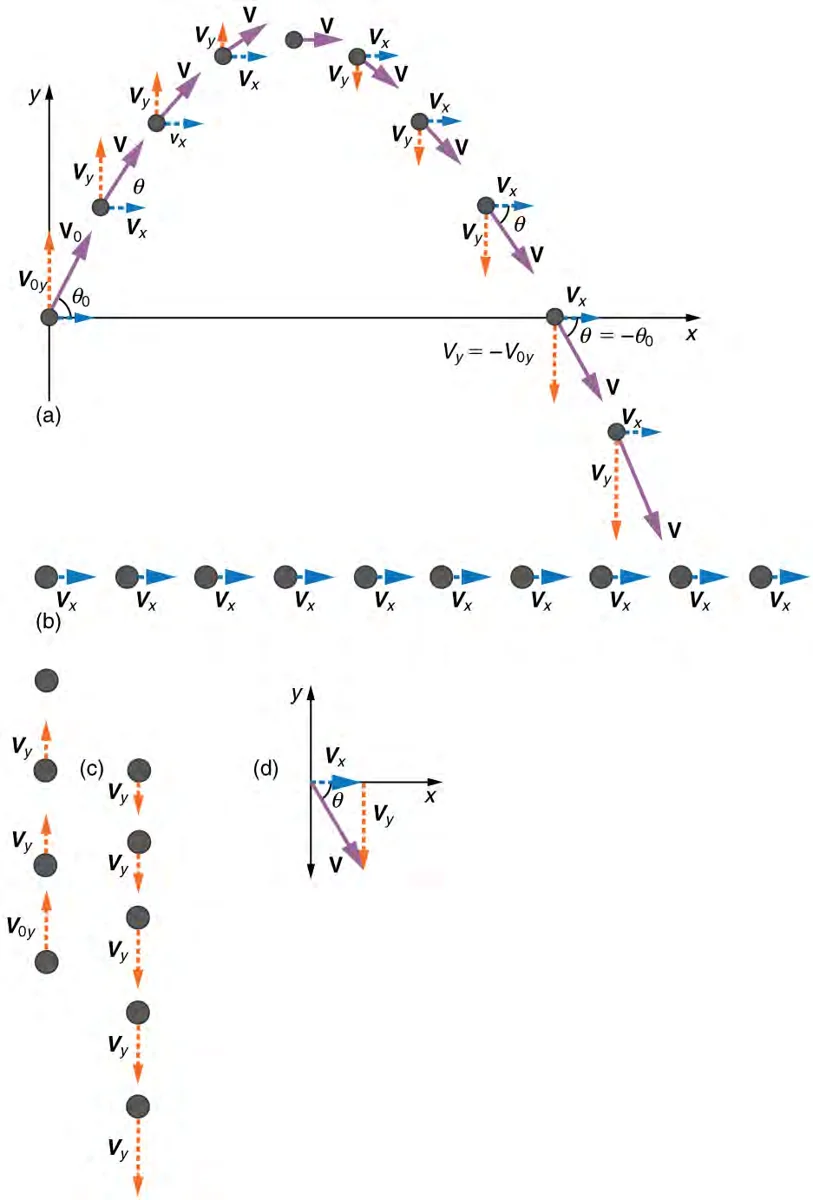
Because the two directions are independent, the time for the projectile is the same in both directions.
This is the key idea for every projectile problem.
Horizontal: vx is constant, and x = vxt.
The horizontal distance is found from the horizontal velocity and the time, while the vertical motion determines the time.
A ball dropped from rest and a ball launched horizontally from the same height reach the ground at the same moment, because their vertical motions are identical.
Vertical: vy = vy0 − gt, and y = vy0t − ½gt2, where upward is positive.
For a projectile launched at speed v at angle θ above the horizontal, from and to the same level ground, the initial velocity components are vx = v cos θ and vy0 = v sin θ.
At the highest point the vertical velocity is zero.
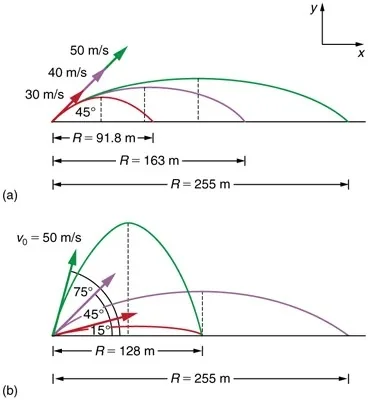
Launch at an angle time of flight, maximum height and range, Time of flight the vertical velocity reverses during the motion, so the time to go up equals the time to come down.
The total time of flight is T = 2vy0/g = 2v sin θ/g, in seconds (s).
Maximum height H = vy02/(2g) = v2 sin2 θ/(2g), in metres (m).
Range the horizontal distance travelled is R = vxT = 2vxvy0/g, in metres (m).
The range is greatest for a launch angle of 45° when the launch and landing heights are equal, because sin 2θ is largest at 45°.
Two launch angles that add to 90°, such as 30° and 60°, give the same range from the same speed, but the higher angle gives a longer time of flight and a greater maximum height.
A projectile launched horizontally from a height h has an initial vertical velocity of zero.
Its time of fall is found from h = ½gt2, so t = √(2h/g).
Its range is R = vxt.
Its vertical velocity on landing is gt, directed downward, and does not depend on the horizontal launch speed.
The velocity of object A relative to object C is the vector sum of the velocity of A relative to B and the velocity of B relative to C.
In symbols, vAC = vAB + vBC.
Each quantity is measured in metres per second (m/s).
In one dimension, relative velocities add or subtract along the same line, with signs showing direction.
In two dimensions, add the components separately.
A swimmer whose speed in still water is 2 m/s, swimming across a current of 1.5 m/s that flows perpendicular to the swimmer’s path, has a resultant velocity of 2.5 m/s relative to the bank, because 22 + 1.52 = 6.25 and √6.25 = 2.5.
Example 1
A projectile launched at an angle
1
The initial components are vx = 50 × 0.8 = 40 m/s and vy0 = 50 × 0.6 = 30 m/s.
2
The time of flight is T = 2 × 30/10 = 6 s.
3
The maximum height is H = 302/(2 × 10) = 900/20 = 45 m.
4
The range is R = 40 × 6 = 240 m.
5
6 s, 45 m and 240 m.
Example 2
A horizontal launch from a cliff
1
The vertical motion starts from rest, so 20 = ½ × 10 × t2, giving t2 = 4 and t = 2 s.
2
The horizontal distance is 10 m/s × 2 s = 20 m.
3
The vertical velocity is vy = 10 × 2 = 20 m/s downward.
Answer
2 s; 20 m from the base of the cliff; 20 m/s downward.
Example 3
Crossing a river with a current
1
The crossing time depends only on the component across the river, so t = 60 m/4 m/s = 15 s.
2
The downstream drift is 3 m/s × 15 s = 45 m.
3
The velocity relative to the bank has components 3 m/s along the river and 4 m/s across it, so its magnitude is √(32 + 42) = 5 m/s.
Answer
The boat takes 15 s, is carried 45 m downstream, and moves at 5 m/s relative to the bank.
Using the full launch speed as the horizontal component
Only v cos θ is horizontal and only v sin θ is vertical.
Assuming the horizontal velocity changes during the flight
With air resistance ignored, vx stays constant.
Using the total speed to find the time of flight
The time comes from the vertical motion alone.
Setting the vertical velocity to zero at the landing point
The vertical velocity is zero only at the highest point; at landing it is nonzero and, for equal launch and landing heights, has the same size as the launch vertical velocity.
Adding relative speeds as plain numbers when the motions are perpendicular
Components or Pythagoras’ theorem must be used.
Forgetting that a projectile launched horizontally from a height has an initial vertical velocity of zero
So the time of fall depends only on the height.