Curriculum
EST II Physics
1. Mechanics
0/19
-
1. Mechanics
 Preview
-
1.1 Kinematics in One Dimension
Preview
-
1.1 Kinematics in One Dimension - Check yourself
 Preview
-
1.2 Projectile Motion and Motion in Two Dimensions
Preview
-
1.2 Projectile Motion and Motion in Two Dimensions - Check yourself
Preview
-
1.3 Forces and Newton’s Laws
Preview
-
1.3 Forces and Newton’s Laws - Check yourself
Preview
-
1.4 Statics and Friction
Preview
-
1.4 Statics and Friction - Check yourself
Preview
-
1.5 Work, Energy and Power
Preview
-
1.5 Work, Energy and Power - Check yourself
Preview
-
1.6 Impulse and Momentum
Preview
-
1.6 Impulse and Momentum - Check yourself
Preview
-
1.7 Circular Motion
Preview
-
1.7 Circular Motion - Check yourself
Preview
-
1.8 Simple Harmonic Motion
Preview
-
1.8 Simple Harmonic Motion - Check yourself
Preview
-
1.9 Gravitation, Orbits and Kepler’s Laws
Preview
-
1.9 Gravitation, Orbits and Kepler’s Laws - Check yourself
Preview
2. Electricity and Magnetism
0/15
3. Waves and Optics
0/13
4. Heat and Thermodynamics
0/7
5. Modern Physics
0/11
6. Measurement, Analysis and Contemporary Physics
0/5
Text lesson
1.3 Forces and Newton’s Laws
1.3 Forces and Newton’s Laws — EST II PHYSICS notes: You will be able to draw free-body diagrams, state and apply Newton’s first, second and third laws, distinguish mass from weight, and solve problems involving normal force, tension, connected bodies, pulleys and apparent weight in a lift.
Force is a vector quantity, so it has a magnitude and a direction.
Its SI unit is the newton (N), and one newton is the force that gives a mass of 1 kg an acceleration of 1 m/s2, so 1 N = 1 kg·m/s2.
When several forces act on one object, they combine by vector addition into the net force, ΣF, which is the single force that has the same effect as all of them together.
Mass is the quantity of matter in an object and is measured in kilograms (kg).
It is a scalar and is the same everywhere.
Weight is the gravitational force on an object, W = mg, measured in newtons (N). What the symbols mean: W = weight (N) · m = mass (kg) · g = gravitational field strength (9.81 N kg−1 on Earth), It is a vector that points towards the centre of the Earth, and it changes if the value of g changes.
A 5 kg object has a mass of 5 kg everywhere, but on Earth its weight is 5 kg × 10 m/s2 = 50 N.
The length of each arrow is roughly proportional to the force, and each arrow is labelled.
Forces that the object exerts on other objects are not drawn on its diagram.
A free-body diagram is the first step in almost every problem in mechanics.
Weight, mg, always acts vertically downward, from the centre of mass of the object.
2Normal force, N, is the support force from a surface.
It acts perpendicular to the surface and pushes the object away from it.
it is smaller than the weight on a slope and larger when the surface pushes upward on an accelerating object.
Tension, T, is the pulling force transmitted along a string, rope or cable.
It acts along the string, away from the object it is attached to.
Applied force, friction and air resistance are added in the same way when they act.
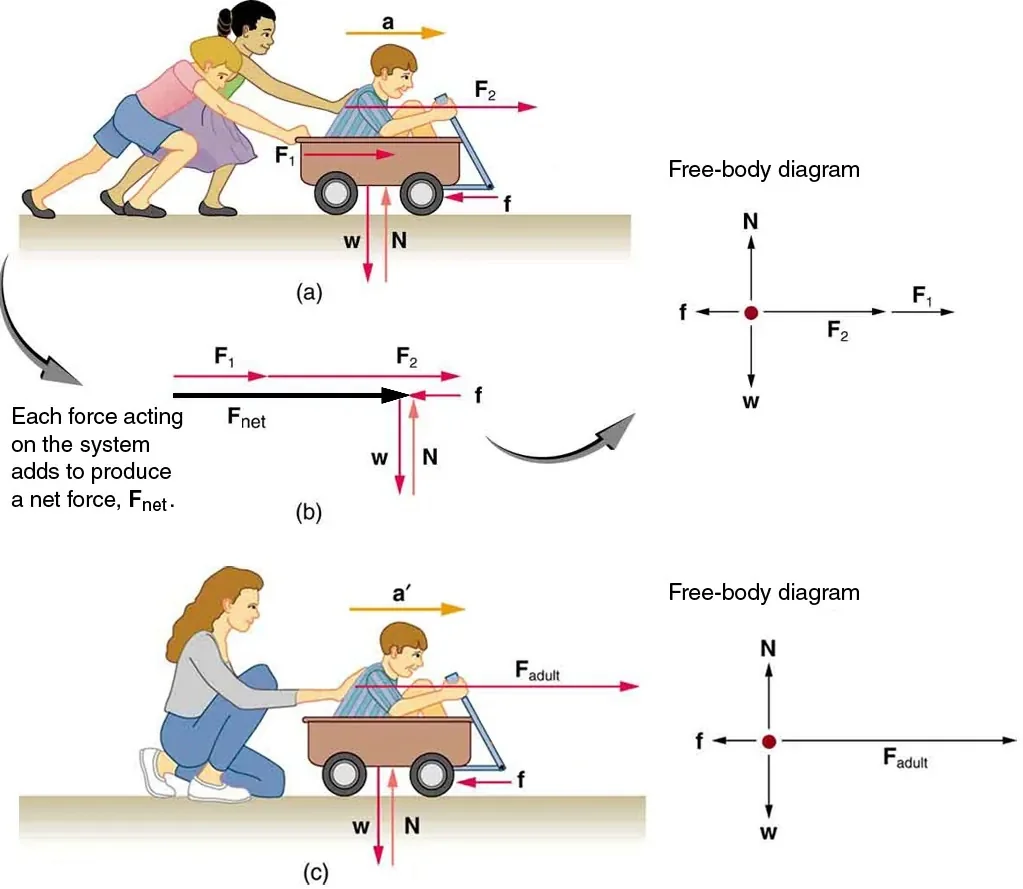
A wagon pushed by two people, then by one adult, with a free-body diagram of the forces for each case.
Image: OpenStax, College Physics 2e, CC BY 4.0.: Free-body diagrams and the contact forces
This tendency to keep the existing state of motion is called inertia, and it depends on mass.
An object with zero net force has zero acceleration, although it may still have forces acting on it that cancel.
Newton’s second law states that the net force on an object equals its mass multiplied by its acceleration, ΣF = ma.
The acceleration has the same direction as the net force.
Force is in newtons (N), mass in kilograms (kg) and acceleration in metres per second squared (m/s2).
For a single horizontal force, the acceleration is a = F/m.
For forces in two directions, apply the law separately along each direction.
Newton’s third law states that when object A exerts a force on object B, object B exerts a force of equal magnitude and opposite direction on object A.
The two forces form an action–reaction pair.
They act on different objects, so they never cancel each other when you draw a free-body diagram for one object.
A book resting on a table pushes down on the table with the same force as the table pushes up on the book, and the book’s weight is balanced by the table’s normal force, which is a separate pair of forces.
Under these conditions the tension is the same at every point along a string, and the string changes only the direction of the force.
Each object connected to the string moves with the same magnitude of acceleration, because the string does not stretch.
For two masses m1 and m2 (with m2 > m1) hanging either side of a frictionless pulley, the heavier mass accelerates downward and the lighter one accelerates upward.
Applying Newton’s second law to each mass gives an acceleration a = (m2 − m1)g/(m1 + m2) and a tension T = 2m1m2g/(m1 + m2).
When the same string is used on a horizontal table with a mass hanging over the edge, the mass on the table has the same acceleration, and the tension is then the force that accelerates it.
When two objects touch and are pushed together along a frictionless surface, they have the same acceleration.
The force that the first object exerts on the second is the mass of the second multiplied by the common acceleration, and the force the second exerts back on the first is equal and opposite.
It is not always equal to the true weight mg.
Taking upward as positive and applying Newton’s second law to the person gives N − mg = ma, so N = m(g + a), where a is the acceleration of the lift.
(positive upward), A lift accelerating upward, or decelerating while moving downward, gives N greater than mg, and the person feels heavier.
A lift accelerating downward, or decelerating while moving upward, gives N smaller than mg, and the person feels lighter.
A lift in free fall, with a = −g, gives N = 0, and the person is weightless. The true weight is unchanged.
Example 1
Net force and acceleration
1
The net force is 12 N − 6 N = 6 N to the right.
2
Newton’s second law gives a = F/m = 6 N/3.0 kg = 2.0 m/s2 to the right.
Answer
2.0 m/s2 to the right.
Example 2
Two masses over a pulley
1
The net driving force is (6.0 − 4.0) kg × 10 m/s2 = 20 N, and the total mass is 10 kg, so a = 20 N/10 kg = 2.0 m/s2.
2
For the 6.0 kg mass, 60 N − T = 6.0 kg × 2.0 m/s2 = 12 N, so T = 48 N.
3
Check with the 4.0 kg mass: T − 40 N = 4.0 kg × 2.0 m/s2 = 8 N, so T = 48 N.
Answer
The acceleration is 2.0 m/s2 (the 6.0 kg mass goes down) and the tension is 48 N.
Example 3
Apparent weight of a passenger
1
The true weight is 60 kg × 10 m/s2 = 600 N.
2
Upward acceleration gives N = m(g + a) = 60 × 12 = 720 N.
3
Downward acceleration gives N = m(g − a) = 60 × 8 = 480 N.
Answer
720 N when accelerating upward and 480 N when accelerating downward. The passenger’s true weight remains 600 N in both cases.
Example 4
Action and reaction
1
Treating the two blocks as one system, a = 12 N/6.0 kg = 2.0 m/s2.
2
For the 2.0 kg block alone, the only horizontal force is the push from the 4.0 kg block, so that force is 2.0 kg × 2.0 m/s2 = 4.0 N.
Answer
Both blocks accelerate at 2.0 m/s2, and the contact force on the 2.0 kg block is 4.0 N.
Confusing mass and weight
Mass is in kilograms and is the same everywhere; weight is in newtons and depends on g.
Assuming the normal force always equals the weight
It differs when there is an acceleration or when the surface is inclined.
Including the reaction force of a pair on a free-body diagram
Action and reaction act on different objects and must be drawn on separate diagrams.
Thinking a person in a lift that accelerates downward is lighter because the true weight has decreased
The true weight is unchanged; only the normal force changes.
Using the wrong sign for the acceleration in N = m(g ± a)
Choose upward as positive and substitute the acceleration with its correct sign.
Avoid
Forgetting that the force a block exerts on its neighbour in a chain of contacts must be found from that block’s own mass and acceleration