Curriculum
EST II Physics
1. Mechanics
0/19
-
1. Mechanics
 Preview
-
1.1 Kinematics in One Dimension
Preview
-
1.1 Kinematics in One Dimension - Check yourself
 Preview
-
1.2 Projectile Motion and Motion in Two Dimensions
Preview
-
1.2 Projectile Motion and Motion in Two Dimensions - Check yourself
Preview
-
1.3 Forces and Newton’s Laws
Preview
-
1.3 Forces and Newton’s Laws - Check yourself
Preview
-
1.4 Statics and Friction
Preview
-
1.4 Statics and Friction - Check yourself
Preview
-
1.5 Work, Energy and Power
Preview
-
1.5 Work, Energy and Power - Check yourself
Preview
-
1.6 Impulse and Momentum
Preview
-
1.6 Impulse and Momentum - Check yourself
Preview
-
1.7 Circular Motion
Preview
-
1.7 Circular Motion - Check yourself
Preview
-
1.8 Simple Harmonic Motion
Preview
-
1.8 Simple Harmonic Motion - Check yourself
Preview
-
1.9 Gravitation, Orbits and Kepler’s Laws
Preview
-
1.9 Gravitation, Orbits and Kepler’s Laws - Check yourself
Preview
2. Electricity and Magnetism
0/15
3. Waves and Optics
0/13
4. Heat and Thermodynamics
0/7
5. Modern Physics
0/11
6. Measurement, Analysis and Contemporary Physics
0/5
Text lesson
1.4 Statics and Friction
1.4 Statics and Friction — EST II PHYSICS notes: You will be able to apply the conditions for equilibrium to a particle and to a rigid body, use the static and kinetic friction laws with their coefficients, resolve forces on an inclined plane, calculate torques, and locate the centre of mass of a system of point masses.
Equilibrium of a particle
Equilibrium of a particle
An object is in equilibrium when the net force on it is zero. For a particle
which is an object whose size and rotation can be ignored, this means that the sum of the forces in each direction is zero: ΣFx = 0 and ΣFy = 0. An object in equilibrium is either at rest or moving with constant velocitybecause its acceleration is zero.
To solve an equilibrium problem, draw a free-body diagram, resolve every force into components along two perpendicular axes, and write one equation for each axis.
Three forces in equilibrium can also be drawn as a closed triangle of vectors, placed head to tail.
For example, a 20 N weight hung from two strings that each make 45° with the ceiling requires each string to carry a tension whose vertical component is 10 N,
so each tension is 10√2 N.
1Static and kinetic friction2Static and kinetic friction
1Inclined planes2Inclined planes
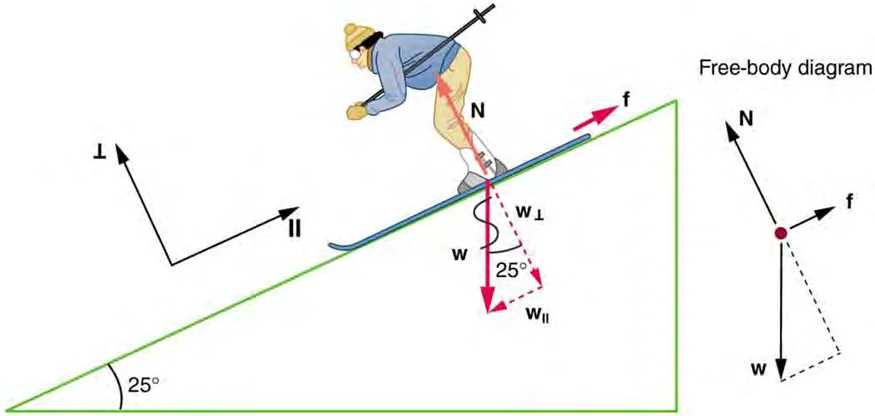
A skier on a slope with weight resolved into components parallel and perpendicular to the incline, plus normal force and friction. Image: OpenStax, College Physics for AP Courses, CC BY 4.0.
Inclined planes
 ⤢ Enlarge
Inclined planes
On a plane inclined at angle θ to the horizontal, the weight of an object is resolved into two components.
The component parallel to the slope is mg sin θ, pointing down the slope,
and the component perpendicular to the slope is mg cos θ, pressing into the surface.
If no other perpendicular force acts, the normal force is N = mg cos θ.
An object at rest on a slope needs a static friction force of at least mg sin θ up the slope to stay still.
Using the largest friction force, μsmg cos θ, gives the condition for it to remain at rest: tan θ ≤ μs.
If the object slides, its acceleration down the slope is a = g(sin θ − μk cos θ).
1 / 2Next ▶
Inclined planes
Inclined planes
Angles chosen in exam questions often have simple sine and cosine values, such as sin 37° = 0.6 and cos 37° = 0.8
so that the working can be done without a calculator.
◀ Previous2 / 2
1Torque and the equilibrium of a rigid body2Torque and the equilibrium of a rigid body
Centre of mass
1
The centre of mass of a system is the point at which the total weight of the system can be considered to act.
2
For a set of point masses along a line, the position of the centre of mass is xcm = (Σmx)/(Σm),
where each x is measured in metres (m) and each m in kilograms (kg).
3
A uniform object with a symmetrical shape has its centre of mass at its geometric centre.
4
An object is stable when its centre of mass lies above its base of support. A body tips over when a vertical line from its centre of mass falls outside the base. This explains why a tall, narrow object is easier to tip than a low, wide one.
1Example 1: A block held at rest on a rough slope2Example 2: A block sliding on a slope3Example 3: A seesaw in balance · Example 4: Centre of mass o
Key terms
| Term | Meaning |
|---|---|
| Equilibrium | The state of an object whose net force and, for a rigid body, net torque are both zero. |
| Static friction | The friction force on a non-sliding object, which has a magnitude up to μsN. |
| Kinetic friction | The friction force on a sliding object, equal to μkN. |
| Coefficient of friction | A number without units that gives the ratio of the friction force to the normal force for a pair of surfaces. |
| Inclined plane | A flat surface tilted at an angle to the horizontal, on which weight is resolved into parallel and perpendicular components. |
| Torque | The turning effect of a force about a pivot, equal to rF sin θ and measured in newton-metres. |
| Lever arm | The perpendicular distance from a pivot to the line of action of a force. |
| Rigid body | An object whose shape and size do not change when forces act on it. |
| Centre of mass | The point at which the total weight of an object or system can be considered to act. |
1Avoid these mistakes2Avoid these mistakes3Avoid these mistakes4Avoid these mistakes