Curriculum
EST II Physics
1. Mechanics
0/19
-
1. Mechanics
 Preview
-
1.1 Kinematics in One Dimension
Preview
-
1.1 Kinematics in One Dimension - Check yourself
 Preview
-
1.2 Projectile Motion and Motion in Two Dimensions
Preview
-
1.2 Projectile Motion and Motion in Two Dimensions - Check yourself
Preview
-
1.3 Forces and Newton’s Laws
Preview
-
1.3 Forces and Newton’s Laws - Check yourself
Preview
-
1.4 Statics and Friction
Preview
-
1.4 Statics and Friction - Check yourself
Preview
-
1.5 Work, Energy and Power
Preview
-
1.5 Work, Energy and Power - Check yourself
Preview
-
1.6 Impulse and Momentum
Preview
-
1.6 Impulse and Momentum - Check yourself
Preview
-
1.7 Circular Motion
Preview
-
1.7 Circular Motion - Check yourself
Preview
-
1.8 Simple Harmonic Motion
Preview
-
1.8 Simple Harmonic Motion - Check yourself
Preview
-
1.9 Gravitation, Orbits and Kepler’s Laws
Preview
-
1.9 Gravitation, Orbits and Kepler’s Laws - Check yourself
Preview
2. Electricity and Magnetism
0/15
3. Waves and Optics
0/13
4. Heat and Thermodynamics
0/7
5. Modern Physics
0/11
6. Measurement, Analysis and Contemporary Physics
0/5
Text lesson
1.7 Circular Motion
1.7 Circular Motion — EST II PHYSICS notes: You will be able to relate period, frequency and angular speed to the linear speed of an object in uniform circular motion, calculate centripetal acceleration and centripetal force, identify what provides the centripetal force in common situations, and solve problems on vertical, flat and banked curves.
The time for one complete revolution is the period T, measured in seconds (s).
The frequency f is the number of revolutions per second, f = 1/T, measured in hertz (Hz), where 1 Hz = 1 s−1.
The angular speed ω is the rate at which the angle swept out changes, ω = 2π/T = 2πf.
What the symbols mean ω = angular frequency (rad s−1) · f = frequency (Hz) · T = period (s), It is measured in radians per second (rad/s).
The linear speed of an object on the circle is v = 2πr/T = ωr, in metres per second (m/s).
An object on a rotating turntable has the same angular speed at every point, but a point near the outer edge has a larger linear speed because it travels a larger circle in the same time.
Although the speed is constant, the velocity is not.
The velocity is always tangent to the circle, so its direction keeps changing.
A change in velocity means an acceleration, and this is why uniform circular motion needs a net force.
The acceleration in uniform circular motion is directed towards the centre of the circle and is called the centripetal acceleration.
Doubling the speed quadruples the acceleration, and doubling the radius halves it.
Its magnitude is ac = v2/r = ω2r, in metres per second squared (m/s2).
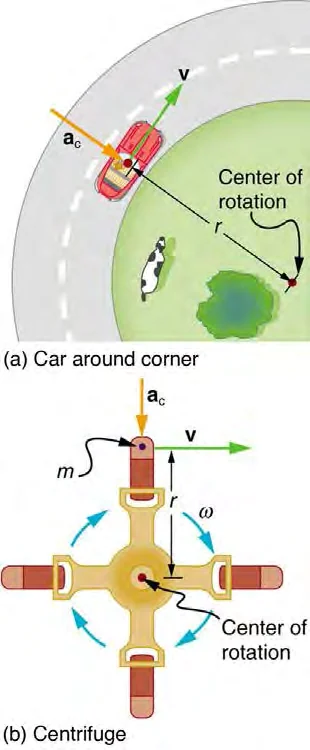
By Newton’s second law, the net force that produces this acceleration is the centripetal force, Fc = mv2/r = mω2r, in newtons (N).
It is the name given to whichever real force, or combination of forces, points towards the centre.
For a car on a flat curve, friction supplies the centripetal force.
For a satellite, gravity supplies the centripetal force.
The centripetal force is not a new kind of force.
Its direction is always towards the centre, and it does no work, because it is perpendicular to the velocity.
For a ball whirled on a string, the tension supplies the centripetal force.
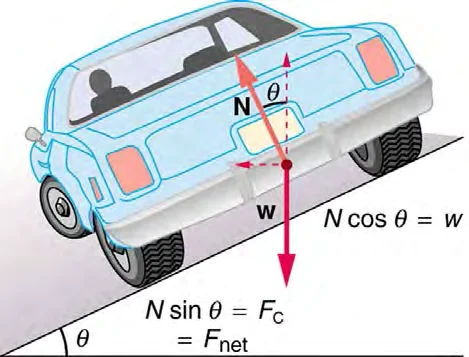
For a car on a banked curve, the horizontal component of the normal force supplies part or all of it.
At the top of the circle, both the weight and the tension (or normal force) point towards the centre, so T + mg = mv2/r.
At the bottom, the tension points upward and the weight points downward, away from the centre, so T − mg = mv2/r, and the tension is greater than the weight.
An object on a string can only be pushed inward, not pulled outward, so the tension cannot be negative.
At the top, the tension is zero when mg = mv2/r, which gives the minimum speed at the top of the circle, vmin = √(gr).
Below this speed, the object does not follow the circle and falls inward.
A bucket of water can be swung upside down without spilling only if its speed at the top is at least √(gr).
The friction cannot be larger than μsN = μsmg.
The maximum safe speed on a flat curve of radius r is therefore vmax = √(μsgr).
A wet road has a smaller coefficient of friction, so the safe speed is lower.
1
On a frictionless banked curve, the normal force is tilted inwards at the angle θ of the bank.
2
Its vertical component balances the weight, N cos θ = mg, and its horizontal component supplies the centripetal force, N sin θ = mv2/r.
3
Dividing these equations gives tan θ = v2/(gr), which gives the speed at which no friction is needed.
Example 1
Speed, period and acceleration of a rotating object
1
ac = v2/r = 102/5.0 = 20 m/s2.
2
The angular speed is ω = v/r = 10/5.0 = 2.0 rad/s.
3
The period is T = 2π/ω = 2π/2.0 = π s, and the frequency is f = 1/π Hz, about 0.32 Hz.
Answer
20 m/s2 towards the centre, 2.0 rad/s, a period of π s and a frequency of 1/π Hz.
Example 2
The minimum speed at the top of a vertical circle
1
At the minimum speed the tension at the top is zero, so mg = mv2/r, giving v2 = gr = 10 × 0.40 = 4.0 m2/s2 and v = 2.0 m/s.
2
Energy is conserved between the top and the bottom, so the speed at the bottom satisfies ½vb2 = ½v2 + g(2r).
3
Then vb2 = 4.0 + 4 × 10 × 0.40 = 20 m2/s2.
4
At the bottom, T − mg = mvb2/r, so T/m = 10 + 20/0.40 = 60 N/kg, which means T = 60m N, where m is in kilograms.
Answer
The minimum speed at the top is 2.0 m/s. The tension at the bottom is six times the weight mg; for a 1.0 kg ball it is 60 N.
Example 3
The maximum speed on a flat curve
1
The maximum friction force is μsmg, which supplies the centripetal force: μsmg = mv2/r.
2
So v2 = μsgr = 0.50 × 10 × 20 = 100 m2/s2, and vmax = 10 m/s.
3
The mass cancels, so the result does not depend on the mass of the car.
Answer
10 m/s (36 km/h).
Example 4
A banked curve with no friction
1
The normal force has components N cos θ = mg and N sin θ = mv2/r.
2
Dividing gives tan θ = v2/(gr) = 100/(10 × 20) = 100/200 = 0.50.
Answer
tan θ = 0.50, which corresponds to a bank angle of about 27°.
Drawing a separate outward force called the centrifugal force on the free-body diagram of an object in circular motion
In an inertial frame, only the real forces act, and their net inward component is the centripetal force.
Assuming that the tension at the top of a vertical circle is always positive
At the top, the tension can be zero, but it cannot be negative for a string.
Treating the centripetal force as an extra force added to the forces already on the diagram
It is the net force toward the centre, found from the real forces.
Using the mass in the flat-curve speed formula
The mass cancels, so vmax = √(μsgr) does not depend on it.
Avoid
Using the period instead of the frequency, or forgetting the factor 2π when converting between period and angular speed
Avoid
Using the radius instead of the diameter, or quoting the speed in km/h without converting it to m/s when the calculation requires SI units