Curriculum
EST II Physics
1. Mechanics
0/19
-
1. Mechanics
 Preview
-
1.1 Kinematics in One Dimension
Preview
-
1.1 Kinematics in One Dimension - Check yourself
 Preview
-
1.2 Projectile Motion and Motion in Two Dimensions
Preview
-
1.2 Projectile Motion and Motion in Two Dimensions - Check yourself
Preview
-
1.3 Forces and Newton’s Laws
Preview
-
1.3 Forces and Newton’s Laws - Check yourself
Preview
-
1.4 Statics and Friction
Preview
-
1.4 Statics and Friction - Check yourself
Preview
-
1.5 Work, Energy and Power
Preview
-
1.5 Work, Energy and Power - Check yourself
Preview
-
1.6 Impulse and Momentum
Preview
-
1.6 Impulse and Momentum - Check yourself
Preview
-
1.7 Circular Motion
Preview
-
1.7 Circular Motion - Check yourself
Preview
-
1.8 Simple Harmonic Motion
Preview
-
1.8 Simple Harmonic Motion - Check yourself
Preview
-
1.9 Gravitation, Orbits and Kepler’s Laws
Preview
-
1.9 Gravitation, Orbits and Kepler’s Laws - Check yourself
Preview
2. Electricity and Magnetism
0/15
3. Waves and Optics
0/13
4. Heat and Thermodynamics
0/7
5. Modern Physics
0/11
6. Measurement, Analysis and Contemporary Physics
0/5
Text lesson
1.9 Gravitation, Orbits and Kepler’s Laws
1.9 Gravitation, Orbits and Kepler’s Laws — EST II PHYSICS notes: You will be able to apply Newton’s law of gravitation, relate gravitational field strength to distance from a planet, derive and use the speed and period of circular orbits, explain weightlessness in a satellite, and apply Kepler’s three laws to orbiting bodies.
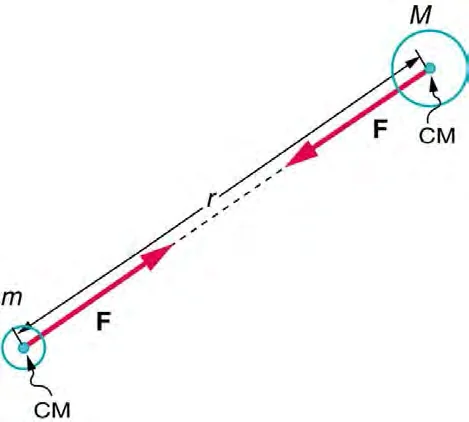
For masses m1 and m2 separated by a distance r, the force is F = Gm1m2/r2.
Here G = 6.67 × 10⁻¹¹ N·m2/kg2 is the universal gravitational constant, the masses are in kilograms (kg), the distance is in metres (m), and the force is in newtons (N).
The force is attractive and lies along the line joining the centres.
1
The inverse-square relationship is the key to most gravitation questions.
2
If the distance between two bodies doubles, the force falls to one quarter.
3
If the distance halves, the force rises fourfold.
4
Doubling one mass doubles the force, and the forces on the two bodies are equal and opposite, as Newton’s third law requires.
It is a vector, measured in newtons per kilogram (N/kg), which is equal to metres per second squared (m/s2).
For a planet or other body of mass M, and a point at distance r from its centre, the field strength is g = GM/r2.
The weight of a mass m at that point is mg.
On the surface of the Earth, where r is the Earth’s radius, the field strength is about 10 N/kg in this course.
Above the surface, the field strength falls with the square of the distance from the centre of the Earth.
At a distance of two Earth radii from the centre, the field strength is one quarter of its surface value, which is 2.5 N/kg.
This means that a 60 kg astronaut at that height has a weight of 150 N, not 600 N, although the gravitational force is still present.
Its centripetal acceleration is provided entirely by gravity.
Setting the gravitational force equal to the centripetal force gives GMm/r2 = mv2/r, so the orbital speed is v = √(GM/r).
The speed does not depend on the mass of the satellite, and it falls as the orbit becomes larger.
The period of a circular orbit is the circumference divided by the speed, T = 2πr/v.
Substituting the orbital speed gives T2 = 4π2r3/(GM), so the square of the period is proportional to the cube of the orbital radius.
A satellite close to the planet has a short period and a high speed, and a satellite far away has a long period and a low speed.
This does not mean that gravity is absent.
At the altitude of a space station the gravitational field is still most of its value at the surface.
The astronauts and the station fall freely together around the Earth, so there is no contact force between them, and their apparent weight, which is the normal force reading on a scale, is zero.
Weightlessness can be felt in any free-fall situation, including a lift whose cable has broken.
The true weight is never zero while the object is within the gravitational field; only the apparent weight is zero.
Kepler’s first law states that each planet moves in an ellipse with the Sun at one focus.
Circular orbits are a special case in which the two foci coincide at the centre.
The orbit of a satellite around a planet can be described in the same way.
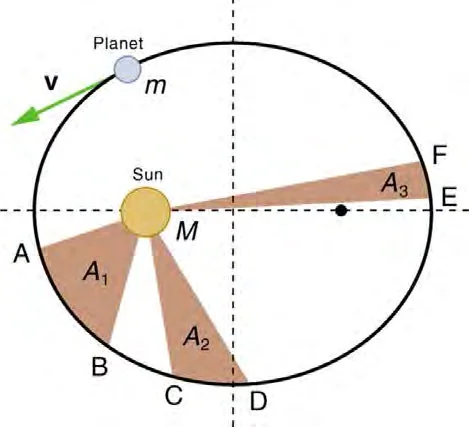
Kepler’s second law states that a line joining the planet to the Sun sweeps out equal areas in equal times.
The same law applies to a satellite that moves on an elliptical orbit around a planet.
For two orbits around the same central body, this gives T12/T22 = a13/a23.
A satellite with four times the orbital radius therefore has a period eight times as long, because 43/2 = 8.
Because of this, a planet moves fastest when it is closest to the Sun and slowest when it is furthest away.
Kepler’s third law states that the square of the period is proportional to the cube of the semi-major axis of the orbit, T2 ∝ a3.
For a circular orbit the semi-major axis is the radius r.
Example 1
Gravitational field strength at a height
1
The field strength falls with the square of the distance from the centre.
2
At r = 2RE, g = 10 N/kg × (RE/2RE)2 = 10 N/kg × 1/4 = 2.5 N/kg.
3
The weight is 40 kg × 2.5 N/kg = 100 N.
Answer
2.5 N/kg, giving a weight of 100 N for the 40 kg object.
Example 2
Kepler’s third law
1
By Kepler’s third law, T2 ∝ r3, so T2/T1 = (4r/r)3/2 = 43/2 = 8.
2
Then T2 = 8 × 3.0 days = 24 days.
Answer
24 days.
Example 3
Orbital speed at a larger radius
1
The orbital speed is v = √(GM/r), so v is proportional to 1/√r.
2
If the radius is multiplied by 4, the speed is multiplied by 1/√4 = 1/2.
3
The new speed is 8.0 km/s × 1/2 = 4.0 km/s
Answer
4.0 km/s
Example 4
Change in gravitational force
1
The original force is F = Gm × m/r2.
2
The new force is F′ = G(2m)(2m)/(r/2)2 = 4Gm2 × 4/r2 = 16Gm2/r2.
3
The ratio is F′/F = 16.
Answer
The new force is 16 times the original force.
Saying that an astronaut is weightless because there is no gravity
Gravity is still acting; the astronaut is in free fall, so the apparent weight is zero.
Assuming that a heavier satellite orbits faster
The orbital speed √(GM/r) does not depend on the mass of the satellite.
Thinking that a larger orbit has a larger speed
A larger orbit has a smaller speed and a longer period.
Assuming that Kepler’s second law means planets move at constant speed
The equal-area rule means the planet moves faster when it is closer to the central body.
Avoid
Using the distance from the surface instead of the distance from the centre of the planet in g = GM/r2 and in the inverse-square law
Avoid
Applying the factor 4 instead of 8 for Kepler’s third law when the radius quadruples; the period increases by 43/2 = 8