Curriculum
EST II Physics
1. Mechanics
0/19
2. Electricity and Magnetism
0/15
-
2. Electricity and Magnetism
 Preview
-
2.1 Electric Charge and Coulomb’s Law
Preview
-
2.1 Electric Charge and Coulomb’s Law - Check yourself
 Preview
-
2.2 Electric Fields and Electric Potential
Preview
-
2.2 Electric Fields and Electric Potential - Check yourself
Preview
-
2.3 Capacitance
Preview
-
2.3 Capacitance - Check yourself
Preview
-
2.4 Current, Resistance and DC Circuits
Preview
-
2.4 Current, Resistance and DC Circuits - Check yourself
Preview
-
2.5 Electrical Energy and Power
Preview
-
2.5 Electrical Energy and Power - Check yourself
Preview
-
2.6 Magnetic Fields and Magnetic Forces
Preview
-
2.6 Magnetic Fields and Magnetic Forces - Check yourself
Preview
-
2.7 Electromagnetic Induction
Preview
-
2.7 Electromagnetic Induction - Check yourself
Preview
3. Waves and Optics
0/13
4. Heat and Thermodynamics
0/7
5. Modern Physics
0/11
6. Measurement, Analysis and Contemporary Physics
0/5
Text lesson
2.2 Electric Fields and Electric Potential
2.2 Electric Fields and Electric Potential — EST II PHYSICS notes: You will be able to calculate the electric field of point charges and of groups of point charges, use the uniform field between parallel plates, relate field lines and equipotentials to the field, and use electric potential energy and work to find the energy of a charged particle moving in an electric field.
The electric field at a point is the electric force per unit positive charge placed at that point: E = F/q. What the symbols mean: E = electric field strength (N C−1) · F = force on the charge (N) · Q or q = charge (C), Here E is the electric field in newtons per coulomb (N/C), F is the force in newtons (N), and q is the test charge in coulombs (C).
The field is a vector, and its direction is the direction of the force on a positive test charge.
The force on a charge q placed in a field E is F = qE.
A negative charge experiences a force in the direction opposite to the field, because the field is defined using a positive test charge.
A point charge Q produces an electric field at distance r given by E = k|Q|/r2, where k = 9.0 × 10⁹ N·m2/C2.
The field points away from a positive charge and towards a negative charge, and its magnitude falls off with the square of the distance.
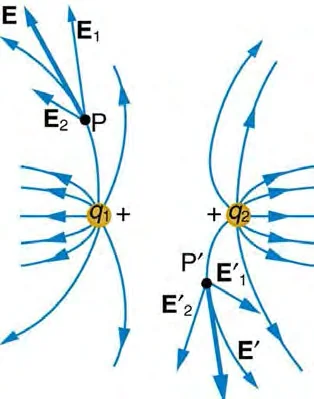
For a group of point charges, the field at a point is the vector sum of the fields produced by each charge separately.
Each field is calculated as if the other charges were absent, and the vectors are then added by components.
At a point exactly midway between two equal and opposite charges, the field points in the same direction as both fields add, and the field has a magnitude of twice the single-charge value.
This is the principle of superposition for fields.
Fields in the same direction add, and fields in opposite directions subtract.
A uniform electric field has the same magnitude and direction at every point.
It is produced between two large parallel conducting plates that carry equal and opposite charges.
The field points from the positive plate to the negative plate, and it is uniform except near the edges of the plates.
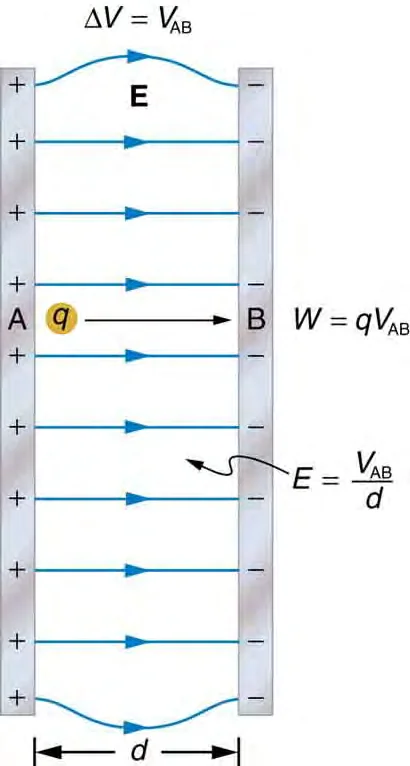
If the potential difference between the plates is ΔV and their separation is d, the magnitude of the field is E = ΔV/d.
Here ΔV is in volts (V), d is in metres (m), and E is in volts per metre (V/m), which is the same unit as N/C.
A charged particle placed between the plates experiences a constant force, so it moves with constant acceleration in the absence of other forces.
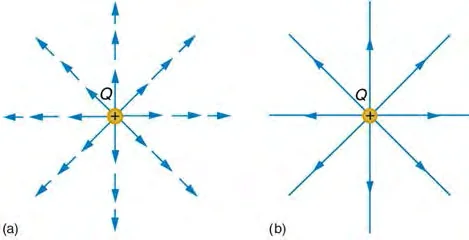
The direction of the field at any point is the direction of the tangent to the field line through that point.
Field lines start on positive charges and end on negative charges.
The lines are drawn with a density that is greatest where the field is strongest.
Field lines never cross, because the field has only one direction at any point.
1
An equipotential is a surface, or in two dimensions a line, on which every point has the same electric potential.
2
No work is done when a charge moves along an equipotential.
3
Equipotentials are always perpendicular to the field lines.
4
Equipotentials around a point charge are circles in a diagram (spheres in three dimensions), and between parallel plates they are straight lines parallel to the plates.
The electric potential at a point is the electric potential energy per unit charge at that point: V = U/q.
The unit of electric potential is the volt (V), which equals one joule per coulomb (J/C).
The potential difference between two points is the work done per unit charge by the field when a charge moves between them: ΔV = ΔU/q = −W/q.
Potential difference is a scalar, so it has a value and a sign but no direction.
A positive charge moves from a high-potential point to a low-potential point without any external work, gaining kinetic energy as its potential energy falls.
The potential of a point charge Q at distance r is V = kQ/r, with the potential taken as zero at infinity.
For a group of point charges, the potential is the scalar sum of the potentials of each charge, with each one keeping its own sign.
Potential is a scalar, so no vector addition is needed for potential.
Between two parallel plates, the potential changes uniformly with distance.
The magnitude of the change is Ed, and the field points from high potential to low potential.
This work equals the decrease in electric potential energy.
The energy transferred to a charge q by a potential difference is qV, which is the same expression as the kinetic energy gained by a particle released from rest through that potential difference.
For a particle that starts from rest and is accelerated through a potential difference, the work-energy theorem gives qV = (1/2)mv2.
For a particle of charge magnitude e and mass m, the speed is found directly from this relation.
In atomic physics the electron-volt (eV) is a convenient unit of energy: 1 eV = 1.60 × 10⁻¹⁹ J, which is the energy gained by an electron accelerated through a potential difference of 1 V.
Example 1
Field from a point charge
1
E = kQ/r2 = (9.0 × 10⁹)(6.0 × 10⁻⁶)/(0.30)2 = 5.4 × 10⁴/0.090 = 6.0 × 10⁵ N/C.
Answer
6.0 × 10⁵ N/C, directed away from the positive charge.
Example 2
Potential at a point due to two charges
1
The potentials add as scalars.
2
V = k(Q1/r1 + Q2/r2) = (9.0 × 10⁹)[(4.0 × 10⁻⁶)/0.20 + (−2.0 × 10⁻⁶)/0.40] = (9.0 × 10⁹)(2.0 × 10⁻⁵ − 5.0 × 10⁻⁶) = (9.0 × 10⁹)(1.5 × 10⁻⁵) = 1.35 × 10⁵ V.
Answer
1.35 × 10⁵ V. The positive charge gives the larger contribution, so the potential is positive.
Example 3
Electron accelerated through a potential difference
1
The kinetic energy gained is eV = (1.6 × 10⁻¹⁹ C)(500 V) = 8.0 × 10⁻¹⁷ J.
2
From (1/2)mv2 = 8.0 × 10⁻¹⁷ J, v2 = 2(8.0 × 10⁻¹⁷ J)/(9.1 × 10−31 kg) = 1.76 × 10¹⁴ m2/s2.
3
So v = 1.3 × 10⁷ m/s.
4
E = ΔV/d = 200 V/0.040 m = 5.0 × 10³ V/m.
5
The force on the proton is F = eE = (1.6 × 10⁻¹⁹ C)(5.0 × 10³ N/C) = 8.0 × 10⁻¹⁶ N, in the direction of the field, from the positive plate to the negative plate.
Answer
1.3 × 10⁷ m/s, which is about 4% of the speed of light. Two parallel plates are 0.040 m apart, and the potential difference between them is 200 V, Find the field between the plates and the force on a proton placed between them, 5.0 × 10³ V/m, and a force of 8.0 × 10⁻¹⁶ N directed from the positive plate towards the negative plate.
Adding electric potentials as vectors
Potential is a scalar, so the potentials of individual charges are added with their signs, while the fields must be added as vectors.
Assuming a negative charge moves along the field lines
A negative charge is pushed opposite to the field, so it moves against the field direction.
Confusing the field with the potential at a point
A point can have a zero field and a nonzero potential, as at the midpoint between two equal positive charges.
Using ΔV = Ed with the distance measured along a path that is not parallel to the field
The distance in this formula is the separation along the field direction.
Getting the energy direction wrong
A positive charge gains kinetic energy when it moves to a lower potential, while a negative charge gains kinetic energy when it moves to a higher potential.
Avoid
Using the separation in the field formula for a point charge without squaring it: E depends on 1/r2, not 1/r