Curriculum
EST II Physics
1. Mechanics
0/19
2. Electricity and Magnetism
0/15
-
2. Electricity and Magnetism
 Preview
-
2.1 Electric Charge and Coulomb’s Law
Preview
-
2.1 Electric Charge and Coulomb’s Law - Check yourself
 Preview
-
2.2 Electric Fields and Electric Potential
Preview
-
2.2 Electric Fields and Electric Potential - Check yourself
Preview
-
2.3 Capacitance
Preview
-
2.3 Capacitance - Check yourself
Preview
-
2.4 Current, Resistance and DC Circuits
Preview
-
2.4 Current, Resistance and DC Circuits - Check yourself
Preview
-
2.5 Electrical Energy and Power
Preview
-
2.5 Electrical Energy and Power - Check yourself
Preview
-
2.6 Magnetic Fields and Magnetic Forces
Preview
-
2.6 Magnetic Fields and Magnetic Forces - Check yourself
Preview
-
2.7 Electromagnetic Induction
Preview
-
2.7 Electromagnetic Induction - Check yourself
Preview
3. Waves and Optics
0/13
4. Heat and Thermodynamics
0/7
5. Modern Physics
0/11
6. Measurement, Analysis and Contemporary Physics
0/5
Text lesson
2.5 Electrical Energy and Power
2.5 Electrical Energy and Power — EST II PHYSICS notes: You will be able to calculate electrical power in the forms P = IV, P = I2R and P = V2/R, explain Joule heating, convert electrical energy into kilowatt-hours, and predict how the brightness of bulbs changes when they are connected in series or in parallel.
In a component with potential difference ΔV and current I, the power is P = IΔV.
Here P is the power in watts (W), I is the current in amperes (A), and ΔV is the potential difference in volts (V).
One watt is one joule per second, so 1 W = 1 J/s = 1 V·A.
1
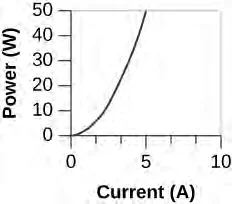
Because Ohm’s law gives ΔV = IR for a resistor, the same power can be written in two other forms: P = I2R and P = ΔV2/R.
2
The first form is most useful when the current is known, and the second is most useful when the voltage across the component is known.
3
The three forms are equivalent for an ohmic resistor, so any one of them gives the same answer when the other quantities are consistent.
4
Power in a resistor is always positive, because electrical energy is converted into thermal energy in the resistor.
5
In a source of emf, such as a battery supplying current, the power delivered is P = εI, and the power lost inside the source is I2r.
This is called Joule heating or the heating effect of current.
The energy converted to thermal energy in a time t is W = Pt = I2Rt, where W is in joules (J) and t is in seconds (s).
Joule heating shows that the heating effect depends on the square of the current.
Doubling the current in a resistor quadruples the rate at which energy is converted to thermal energy.
This is why a fuse or circuit breaker must be rated for the expected current, and why large currents in thin wires cause dangerous heating.
Joule heating is used in electric heaters, toasters, kettles and filament lamps.
The filament of a lamp is designed to have a high resistance so that it becomes hot enough to emit light.
Energy is measured in joules, but for household and utility use the kilowatt-hour (kWh) is more convenient.
One kilowatt-hour is the energy used by a 1000 W device operating for one hour: 1 kWh = (1000 W)(3600 s) = 3.6 × 10⁶ J.
The cost of electrical energy is found by multiplying the number of kilowatt-hours used by the price per kilowatt-hour.
For example, a 2000 W heater used for 3 h consumes 6 kWh of energy.
If the price is a fixed amount per kilowatt-hour, the cost is found directly from that number.
The bulb with the higher power is the brighter one.
In a series network, identical bulbs carry the same current, but the voltage divides between them.
Each bulb has half the voltage of the source and dissipates a quarter of the power of a single bulb across the full source, so the bulbs are dimmer than a single bulb connected to the same source.
If one bulb in a series string fails and breaks the circuit, all the bulbs go out.
In a parallel network, each bulb has the full potential difference of the source across it.
Each bulb therefore dissipates its full power V2/R, and all bulbs are as bright as a single bulb connected to the source.
Adding bulbs in parallel increases the total current drawn from the source, but it does not dim the existing bulbs.
If one bulb fails, the others stay lit.
When the bulbs have different resistances, the brighter bulb is the one with the smaller resistance in a parallel network, because it has the same voltage and the larger power V2/R.
In a series network the brighter bulb is the one with the larger resistance, because it carries the same current and has the larger power I2R.
Example 1
Power and energy used by a device
1
P = IΔV = (2.0 A)(120 V) = 240 W = 0.24 kW.
2
The energy is E = Pt = (0.24 kW)(5.0 h) = 1.2 kWh
Answer
240 W, and 1.2 kWh of energy
Example 2
Heater resistance and current
1
The current is I = P/ΔV = 600 W/120 V = 5.0 A.
2
The resistance is R = ΔV/I = 120 V/5.0 A = 24 Ω.
3
As a check, P = ΔV2/R = (120 V)2/(24 Ω) = 14 400/24 = 600 W.
Answer
5.0 A and 24 Ω.
Example 3
Two identical bulbs in series and in parallel
1
In series, the total resistance is 12 Ω, so the current is I = 12 V/12 Ω = 1.0 A.
2
Each bulb has P = I2R = (1.0 A)2(6.0 Ω) = 6.0 W.
3
In parallel, each bulb has the full 12 V across it, so P = ΔV2/R = (12 V)2/6.0 Ω = 144/6.0 = 24 W.
Answer
In series each bulb dissipates 6.0 W; in parallel each dissipates 24 W. The parallel arrangement gives the brighter bulbs.
Example 4
Energy used by a lamp over a month
1
The energy is E = Pt = (0.060 kW)(10 h × 30 days = 300 h) = 18 kWh.
2
In joules, E = (18)(3.6 × 10⁶ J) = 6.5 × 10⁷ J.
3
The resistance is R = ΔV2/P = (120 V)2/60 W = 14 400/60 = 240 Ω.
Answer
18 kWh, which is 6.5 × 10⁷ J; the lamp has a resistance of 240 Ω.
Using P = V2/R when the voltage across the component is not known
Or using P = I2R with the supply voltage instead of the current through the component.
Assuming that bulbs in series are equally bright because they carry the same current
Brightness depends on each bulb’s own power, I2R, so a bulb with a larger resistance in series is brighter.
Assuming that adding bulbs in parallel dims the existing bulbs
Each parallel bulb keeps the full source voltage, so its power is unchanged.
Thinking that doubling the current doubles the heating
Joule heating is proportional to the square of the current.
Avoid
Forgetting that power is a rate, so energy must be found by multiplying by time: E = Pt
Avoid
Converting energy to kilowatt-hours without using the time in hours and the power in kilowatts