Curriculum
EST II Physics
1. Mechanics
0/19
2. Electricity and Magnetism
0/15
-
2. Electricity and Magnetism
 Preview
-
2.1 Electric Charge and Coulomb’s Law
Preview
-
2.1 Electric Charge and Coulomb’s Law - Check yourself
 Preview
-
2.2 Electric Fields and Electric Potential
Preview
-
2.2 Electric Fields and Electric Potential - Check yourself
Preview
-
2.3 Capacitance
Preview
-
2.3 Capacitance - Check yourself
Preview
-
2.4 Current, Resistance and DC Circuits
Preview
-
2.4 Current, Resistance and DC Circuits - Check yourself
Preview
-
2.5 Electrical Energy and Power
Preview
-
2.5 Electrical Energy and Power - Check yourself
Preview
-
2.6 Magnetic Fields and Magnetic Forces
Preview
-
2.6 Magnetic Fields and Magnetic Forces - Check yourself
Preview
-
2.7 Electromagnetic Induction
Preview
-
2.7 Electromagnetic Induction - Check yourself
Preview
3. Waves and Optics
0/13
4. Heat and Thermodynamics
0/7
5. Modern Physics
0/11
6. Measurement, Analysis and Contemporary Physics
0/5
Text lesson
2.6 Magnetic Fields and Magnetic Forces
2.6 Magnetic Fields and Magnetic Forces — EST II PHYSICS notes: You will be able to describe the field lines of permanent magnets, calculate the magnetic field of a long straight wire, a loop and a solenoid, find the force on a moving charge and on a current-carrying wire, explain circular motion of charged particles in a magnetic field, and find the force between two parallel wires.
Magnetic field lines are a visual model of a magnetic field.
Outside a bar magnet they leave the north pole and enter the south pole.
Inside the magnet they run from south to north, so each field line is a closed loop.
Unlike poles attract and like poles repel.
A single magnetic pole has never been isolated: cutting a magnet in half produces two smaller magnets, each with its own north and south pole.
The Earth behaves like a large magnet, with its magnetic south pole near its geographic north pole, so the north end of a compass needle points roughly north.
The magnetic field B is a vector quantity.
Its direction at a point is the direction of a field line through that point, and its SI unit is the tesla (T).
One tesla equals one newton per ampere metre, N/(A·m).
The strength of the field is shown by how close the field lines are to each other.
For a long straight wire carrying a current I, the field lines are concentric circles around the wire.
The magnitude of the field at a distance r from the wire is B = μ0I/(2πr), where μ0 = 4π × 10−7 T·m/A is the permeability of free space.
The direction is given by the right-hand rule for wires point the thumb of the right hand along the current, and the fingers curl in the direction of the field.
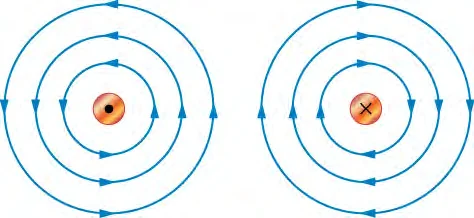
At the centre of a circular loop of radius R carrying a current I, the field is B = μ0I/(2R), and it points perpendicular to the plane of the loop.
A solenoid is a long coil of wire with many closely spaced turns.
Outside an ideal solenoid the field is negligible.
Curl the fingers of the right hand in the direction of the current; the thumb points in the direction of the field.
Inside a long, tightly wound solenoid, the field is uniform and parallel to the axis: B = μ0nI, where n = N/L is the number of turns per unit length in turns per metre (turns/m).
The end of the solenoid where the current runs anticlockwise is a north pole.
A charge q moving with velocity v through a magnetic field B experiences a magnetic force F = qvB sinθ, where θ is the angle between the velocity and the field.
Force is in newtons (N), q is in coulombs (C), v is in metres per second (m/s), and B is in tesla (T).
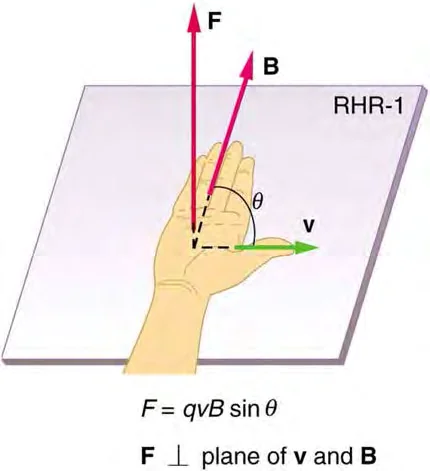
The magnetic force is zero when the charge moves parallel or antiparallel to the field, and it is largest when the charge moves perpendicular to the field.
The force is always perpendicular to both the velocity and the field, so it changes the direction of the velocity but not the speed of the particle.
Magnetic forces do no work on a charge.
To find the direction of the force on a positive charge, point the fingers of the right hand in the direction of the velocity and curl them towards the field; the thumb then points along the force.
For a negative charge the force is in the opposite direction.
Setting the magnetic force equal to the centripetal force gives qvB = mv2/r, so the radius of the circle is r = mv/(qB).
The period of the motion is T = 2πm/(qB), which does not depend on the speed of the particle.
Charged particles in a velocity selector pass undeflected when the electric force and the magnetic force balance: qE = qvB, so the speed of the particles that pass straight through is v = E/B.
This principle is used in mass spectrometers and in particle accelerators.
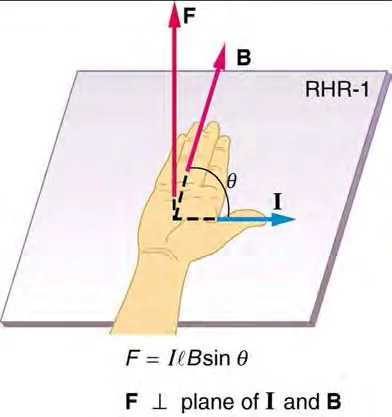
A straight wire of length L carrying a current I in a uniform field B experiences a force F = BIL sinθ, where θ is the angle between the wire and the field.
The direction of the force is found by the same right-hand rule as for a moving positive charge, with the fingers pointing in the direction of the current.
The force is largest when the wire is perpendicular to the field and zero when it is parallel to it.
Two long parallel wires carrying currents I1 and I2 a distance d apart exert a force on each other.
Currents in the same direction attract, and currents in opposite directions repel.
The force per unit length is F/L = μ0I1I2/(2πd).
This is the basis of the definition of the ampere.
Example 1
Field near a long straight wire
1
B = μ0I/(2πr) = (4π × 10−7)(5.0)/(2π)(0.10) = (2.0 × 10⁻⁷)(5.0)/(0.10) = 1.0 × 10⁻⁵ T.
Answer
1.0 × 10⁻⁵ T. This is about one fifth of the Earth’s field at the surface, which is roughly 5 × 10⁻⁵ T.
Example 2
Proton moving perpendicular to a field
1
F = qvB sin 90° = (1.6 × 10⁻¹⁹ C)(2.0 × 10⁶ m/s)(0.50 T) = 1.6 × 10⁻¹³ N.
2
The radius is r = mv/(qB) = (1.67 × 10⁻²⁷ kg)(2.0 × 10⁶ m/s)/[(1.6 × 10−19 C)(0.50 T)] = 4.2 × 10⁻² m.
Answer
The force is 1.6 × 10⁻¹³ N, and the path has a radius of 4.2 × 10⁻² m (4.2 cm).
Example 3
Field inside a solenoid
1
The number of turns per metre is n = 500/0.50 m = 1.0 × 10³ turns/m.
2
Then B = μ0nI = (4π × 10−7 T·m/A)(1.0 × 103/m)(2.0 A) = 2.5 × 10⁻³ T.
Answer
2.5 × 10⁻³ T, directed along the axis of the solenoid.
Example 4
Force between two parallel wires
1
F = μ0I1I2L/(2πd) = (2.0 × 10⁻⁷)(10)(10)(2.0)/(0.10) = 4.0 × 10⁻⁴ N.
Answer
4.0 × 10⁻⁴ N. The currents are in the same direction, so the wires attract each other.
Using the wrong right-hand rule for the direction of the force
For a moving positive charge the fingers point along the velocity, curl towards the field, and the thumb gives the force; for a negative charge reverse it.
Thinking that a magnetic force can change the speed of a charge
The magnetic force is always perpendicular to the velocity, so it changes only the direction.
Assuming that a charge moving parallel to a magnetic field feels a force
The force is zero when θ = 0° or 180°.
Confusing the direction of the field outside a bar magnet with the direction of the field inside it
Field lines run from north to south outside the magnet and from south to north inside.
Forgetting that the wire formula for force between parallel wires gives a force per unit length
So the total force must be multiplied by the length of the wires.
Avoid
Using μ0 without the 2π in the wire formula, or using the radius of the loop in the solenoid formula instead of the turns per unit length