Curriculum
EST II Physics
1. Mechanics
0/19
2. Electricity and Magnetism
0/15
3. Waves and Optics
0/13
-
3. Waves and Optics
 Preview
-
3.1 General Wave Properties
Preview
-
3.1 General Wave Properties - Check yourself
 Preview
-
3.2 Sound and the Doppler Effect
Preview
-
3.2 Sound and the Doppler Effect - Check yourself
Preview
-
3.3 Superposition and Standing Waves
Preview
-
3.3 Superposition and Standing Waves - Check yourself
Preview
-
3.4 Reflection and Refraction
Preview
-
3.4 Reflection and Refraction - Check yourself
Preview
-
3.5 Mirrors, Lenses and Image Formation
Preview
-
3.5 Mirrors, Lenses and Image Formation - Check yourself
Preview
-
3.6 Physical Optics
Preview
-
3.6 Physical Optics - Check yourself
Preview
4. Heat and Thermodynamics
0/7
5. Modern Physics
0/11
6. Measurement, Analysis and Contemporary Physics
0/5
Text lesson
3.2 Sound and the Doppler Effect
3.2 Sound and the Doppler Effect — EST II PHYSICS notes: You will be able to describe sound as a longitudinal wave, relate pitch and loudness to frequency and intensity, use decibels to compare sound levels, calculate the Doppler shift for a moving source or observer, and find the beat frequency between two sources.
Sound as a longitudinal wave
Sound as a longitudinal wave
Sound is a longitudinal mechanical wave. A vibrating source, such as a loudspeaker cone or a vocal cord, pushes on the neighbouring particles of the medium
which compress and then spread apart. The compressions and rarefactions travel outward while each particle only oscillates about its equilibrium position. Because sound needs a medium, it cannot travel through a vacuum.
The speed of sound depends on the medium and on its temperature.
It is faster in solids than in liquids,
and faster in liquids than in gases,because the particles are closer together and respond more quickly to each other.
In air at room temperature the speed of sound is about 340 m/s, and this value is used in calculations in this course.
Sound travels at this speed whatever the frequency or amplitude of the source.
The relationship v = fλ applies to sound as it does to any wave. For sound of frequency f in air, the wavelength is λ = v/f, with v in m/s, f in hertz and λ in metres.
Pitch, loudness and intensity
1
The pitch of a sound is how high or low it seems to a listener. Pitch is determined mainly by the frequency: a higher frequency is heard as a higher pitch. The loudness of a sound is how strong it seems, and it is determined mainly by the intensity of the sound wave.
2
The intensity I of a sound is the power that passes through unit area perpendicular to the direction of travel, I = P/A, measured in W/m2. Intensity is proportional to the square of the amplitude of the sound wave, and it falls with the square of the distance from a point source.
3
Because the ear responds to sound roughly logarithmically, sound levels are measured in decibels (dB), using the formula:
4
β = 10 log10(I/I0)
5
where β is the sound level in decibels, I is the intensity in W/m2, and I0 = 1.0 × 10⁻¹² W/m2 is the threshold of hearing. Two useful results follow: doubling the intensity increases the level by about 3 dB, and multiplying the intensity by 10 increases the level by exactly 10 dB.
1The Doppler effect for a moving source2The Doppler effect for a moving source
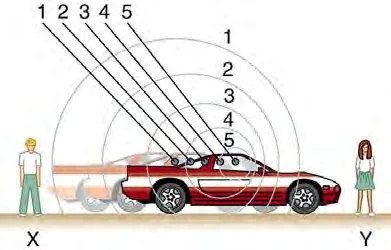
Wavefronts bunch up ahead of a moving source and spread out behind it, so observers at X and Y hear different pitches. Image: OpenStax, College Physics for AP Courses, CC BY 4.0.
The Doppler effect for a moving source
 ⤢ Enlarge
The Doppler effect for a moving source
The Doppler effect is the change in the frequency heard by an observer when the source of the sound or the observer is moving.
If a source moves toward an observer, the waves are bunched up in front of the source and the observer hears a higher frequency.
If the source moves away, the waves are spread out and the observer hears a lower frequency.
For a source moving with speed vs and an observer at rest, the observed frequency f′ is:
f′ = f · v/(v − vs)
where f is the frequency emitted by the source, v is the speed of sound in air, and vs is the speed of the source in m/s.
1 / 2Next ▶
The Doppler effect for a moving source
The Doppler effect for a moving source
Use a positive vs when the source moves toward the observer and a negative vs when it moves away.
A source moving toward a listener gives f′ >
fa source moving away gives f′ <f.
◀ Previous2 / 2
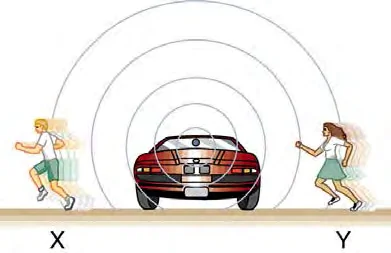
Observers running toward or away from a stationary source meet wavefronts at different rates. Image: OpenStax, College Physics for AP Courses, CC BY 4.0.
The Doppler effect for a moving observer
 ⤢ Enlarge
1
When the observer moves and the source is at rest, the observer meets the waves more often if moving toward the source and less often if moving away. For an observer moving with speed vo and a source at rest:
2
f′ = f · (v + vo)/v
3
Here vo is positive when the observer moves toward the source and negative when the observer moves away from it.
4
Both cases combine into one general formula, f′ = f (v + vo)/(v − vs), in which the same sign rule applies to vo and vs. The speed of the sound is always measured relative to the air, and only the motion of the source and observer relative to the air changes the frequency.
Beats
1
When two sound waves of slightly different frequencies arrive at the same point, they superpose. The loudness rises and falls regularly, producing beats. The number of beats heard each second is the beat frequency:
2
fbeat = |f1 − f2|
3
where f1 and f2 are the two frequencies in hertz. Beats are used in tuning instruments: when two notes are played together and the beat frequency falls to zero, the two instruments are in tune.
1Example 1: Siren approaching a listener · Example 2: Listene2Example 3: Beats from two tuning forks · Example 4: Change i
Key terms
| Term | Meaning |
|---|---|
| Longitudinal wave | A wave in which the particles oscillate parallel to the direction of travel; sound in air is an example. |
| Pitch | The quality of a sound that makes it seem high or low, determined mainly by its frequency. |
| Loudness | The strength of a sound as perceived by a listener, determined mainly by its intensity. |
| Intensity (I) | The power per unit area carried by a wave, in W/m2. |
| Decibel (dB) | A logarithmic unit for sound level, given by β = 10 log10(I/I0). |
| Doppler effect | The change in observed frequency caused by motion of the source or the observer. |
| Beats | Regular variations in loudness produced when two sounds of slightly different frequency superpose. |
| Beat frequency | The number of loudness maxima heard each second, equal to |f1 − f2|. |
1Avoid these mistakes2Avoid these mistakes3Avoid these mistakes