Curriculum
EST II Physics
1. Mechanics
0/19
2. Electricity and Magnetism
0/15
3. Waves and Optics
0/13
4. Heat and Thermodynamics
0/7
5. Modern Physics
0/11
-
5. Modern Physics
 Preview
-
5.1 Photons and the Photoelectric Effect
Preview
-
5.1 Photons and the Photoelectric Effect - Check yourself
 Preview
-
5.2 Atomic Models and Spectra
Preview
-
5.2 Atomic Models and Spectra - Check yourself
Preview
-
5.3 Nuclear Physics and Radioactivity
Preview
-
5.3 Nuclear Physics and Radioactivity - Check yourself
Preview
-
5.4 Fundamental Particles
Preview
-
5.4 Fundamental Particles - Check yourself
Preview
-
5.5 Special Relativity
Preview
-
5.5 Special Relativity - Check yourself
Preview
6. Measurement, Analysis and Contemporary Physics
0/5
Text lesson
5.1 Photons and the Photoelectric Effect
5.1 Photons and the Photoelectric Effect — EST II PHYSICS notes: You will be able to calculate the energy of a photon from its frequency or wavelength, explain the photoelectric effect using the work function and threshold frequency, relate the stopping potential to the maximum kinetic energy of emitted electrons, and calculate the de Broglie wavelength of a particle.
1Light energy comes in photons2Light energy comes in photons3Light energy comes in photons4Light energy comes in photons5Light energy comes in photons6Light energy comes in photons7Light energy comes in photons
Light energy comes in photons
Light energy comes in photons
Light and other electromagnetic waves carry energy in packets called photons.
1 / 7Next ▶
Light energy comes in photons
1
A photon is a particle of light with no rest mass, and its energy depends only on its frequency.
2
The energy of one photon is
3
E
4
=
5
hf
6
,
◀ Previous2 / 7Next ▶
Light energy comes in photons
Light energy comes in photons
where E is the photon energy in joules (J), f is the frequency in hertz (Hz),
and h = 6.63 × 10⁻³⁴ J·s is Planck’s constant.
Because the speed of light in vacuum is c = 3.00 × 10⁸ m/s, and the wave relation c = fλ links frequency and wavelength λ in metres (m), the photon energy can also be written as E = hc/λ.
Higher frequency means higher photon energy, and shorter wavelength means higher photon energy.
Violet light therefore carries more energy per photon than red light.
The electronvolt (eV) is a convenient unit for atomic energies.
◀ Previous3 / 7Next ▶
Light energy comes in photons
Light energy comes in photons
One electronvolt is the kinetic energy gained by an electron accelerated through a potential difference of one volt, and 1 eV = 1.60 × 10
−19
J.
Converting Planck’s constant gives
h
= 4.14 × 10
◀ Previous4 / 7Next ▶
Light energy comes in photons
1
−15
2
eV·s
so a photon of frequency
3
f
4
has energy
5
= (4.14 × 10
6
eV·s)
◀ Previous5 / 7Next ▶
Light energy comes in photons
1
.
2
Also,
3
hc
4
≈ 1240 eV·nm
so a photon of wavelength λ in nanometres has energy
5
≈ 1240/λ eV.
◀ Previous6 / 7Next ▶
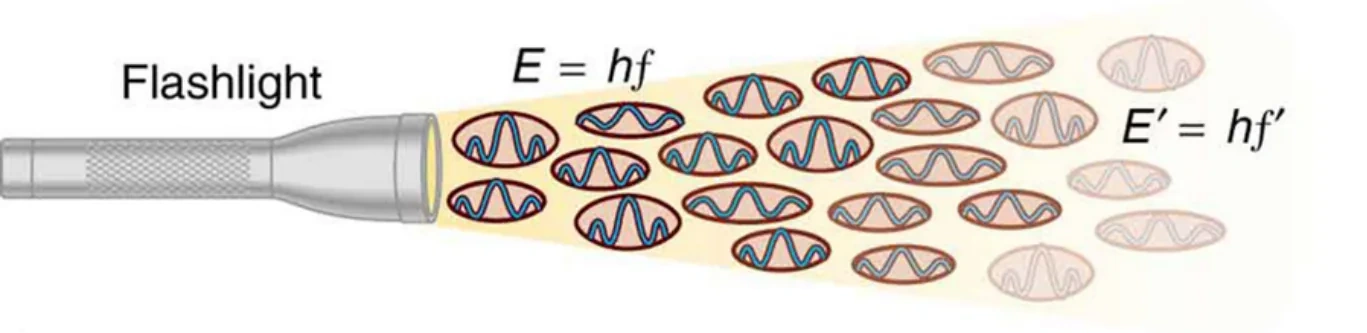
Einstein and the photon: A flashlight beam drawn as photons: each photon carries energy hf, and a higher intensity means more photons per unit area.
Light energy comes in photons
◀ Previous7 / 7
1The photoelectric effect observed2The photoelectric effect observed3The photoelectric effect observed4The photoelectric effect observed
The photoelectric effect observed
The photoelectric effect observed
The photoelectric effect is the emission of electrons from the surface of a metal when light shines on it.
1 / 4Next ▶
The photoelectric effect observed
The photoelectric effect observed
The electrons that leave the metal are called photoelectrons.
Classical wave theory of light predicted that any light of sufficient intensity should eventually release electrons, with the energy of the electrons growing with the intensity.
Experiments showed something different, and Einstein explained the results by treating light as photons.
The key observations are these.
1
First, no electrons are emitted unless the frequency of the light is at least a certain value, called the threshold frequency, whatever the intensity of the light.
◀ Previous2 / 4Next ▶
The photoelectric effect observed
The photoelectric effect observed
2
Second, above the threshold frequency, electrons are emitted almost at once, with no delay.
3
Third, the maximum kinetic energy of the photoelectrons depends on the frequency of the light and not on its intensity.
4
Fourth,
◀ Previous3 / 4Next ▶
The photoelectric experiment: An evacuated photoelectric tube with a metal plate and a collector wire, connected to a variable voltage that measures electron energy.
The photoelectric effect observed
 ⤢ Enlarge
1
increasing the intensity of light above the threshold frequency increases the number of electrons emitted per second,
2
but not the energy of each electron.
3
Each photon transfers all of its energy to a single electron. If the photon energy is less than the energy needed to free the electron from the metal, nothing is emitted. This is why intensity alone cannot cause emission: intensity measures how many photons arrive per second, not the energy that each photon carries.
◀ Previous4 / 4
1Work function and threshold frequency2Work function and threshold frequency3Work function and threshold frequency4Work function and threshold frequency
1Stopping potential and maximum kinetic energy2Stopping potential and maximum kinetic energy3Stopping potential and maximum kinetic energy4Stopping potential and maximum kinetic energy5Stopping potential and maximum kinetic energy
Wave-particle duality and the de Broglie wavelength · Wave-particle duality and the de Broglie wavelength
Wave-particle duality and the de Broglie wavelength
Light shows wave behaviour in interference and diffraction, and particle behaviour in the photoelectric effect. This dual behaviour is called wave-particle duality. Louis de Broglie proposed in 1924 that matter also has a wavelength. Electrons, protons and even larger particles have wave properties, and electron beams are diffracted by crystals in the same way that X-rays are.
The de Broglie wavelength of a particle is λ = h/p
where p = mv is the momentum of the particle in kg·m/s, m is its mass in kilograms, and v is its speed in metres per second.
Wave-particle duality and the de Broglie wavelength
Heavier or faster particles have shorter wavelengths.
Because Planck’s constant is very small, the wavelength of everyday objects is far too small to observe.
Photons also have momentum, given by p = E/c = h/λ. Their de Broglie wavelength therefore agrees with the wavelength of the light itself
which is a useful check on the formula.
1Example 1: Photon energy from wavelength2Example 1: Photon energy from wavelength3Example 2: Threshold frequency of a metal · Example 3: Stopp4Example 4: de Broglie wavelength of an electron5Example 4: de Broglie wavelength of an electron
Key terms
| Term | Meaning |
|---|---|
| Photon | A packet of electromagnetic energy with energy E = hf. |
| Planck’s constant (h) | The constant 6.63 × 10⁻³⁴ J·s that links photon energy to frequency. |
| Photoelectric effect | The emission of electrons from a metal surface when light of sufficient frequency shines on it. |
| Photoelectron | An electron emitted from a metal surface by the photoelectric effect. |
| Work function (φ) | The minimum energy needed to remove an electron from the surface of a metal. |
| Threshold frequency (f0) | The lowest frequency of light that causes photoelectric emission from a given metal. |
| Maximum kinetic energy (Kmax) | The largest kinetic energy of an emitted photoelectron, given by hf − φ. |
| Stopping potential (Vs) | The reverse potential difference that just stops the fastest photoelectrons, with eVs = Kmax. |
| Electronvolt (eV) | The energy gained by an electron crossing a potential difference of one volt, equal to 1.60 × 10⁻¹⁹ J. |
| de Broglie wavelength (λ) | The wavelength of a particle, λ = h/p, where p is its momentum. |
1Avoid these mistakes2Avoid these mistakes3Avoid these mistakes4Avoid these mistakes5Avoid these mistakes6Avoid these mistakes