Curriculum
EST II Physics
1. Mechanics
0/19
2. Electricity and Magnetism
0/15
3. Waves and Optics
0/13
4. Heat and Thermodynamics
0/7
5. Modern Physics
0/11
-
5. Modern Physics
 Preview
-
5.1 Photons and the Photoelectric Effect
Preview
-
5.1 Photons and the Photoelectric Effect - Check yourself
 Preview
-
5.2 Atomic Models and Spectra
Preview
-
5.2 Atomic Models and Spectra - Check yourself
Preview
-
5.3 Nuclear Physics and Radioactivity
Preview
-
5.3 Nuclear Physics and Radioactivity - Check yourself
Preview
-
5.4 Fundamental Particles
Preview
-
5.4 Fundamental Particles - Check yourself
Preview
-
5.5 Special Relativity
Preview
-
5.5 Special Relativity - Check yourself
Preview
6. Measurement, Analysis and Contemporary Physics
0/5
Text lesson
5.5 Special Relativity
5.5 Special Relativity — EST II PHYSICS notes: You will be able to state the two postulates of special relativity, calculate time dilation and length contraction for objects moving at a constant speed, and use the mass-energy relation E = mc2 to find the energy equivalent of a mass.
1The postulates of special relativity2The postulates of special relativity3The postulates of special relativity4The postulates of special relativity
1Time dilation2Time dilation3Time dilation4Time dilation
Time dilation
Time dilation
Time dilation is the result that a moving clock runs more slowly than a clock at rest, as judged by an observer at rest.
1 / 4Next ▶
Time dilation
1
The time measured by a clock that is at rest relative to the events is called the proper time Δ
2
t
3
0
4
.
5
An observer moving at speed
6
v
◀ Previous2 / 4Next ▶
Time dilation
Time dilation
relative to the events measures a longer time Δ
, given by Δ
= γΔ
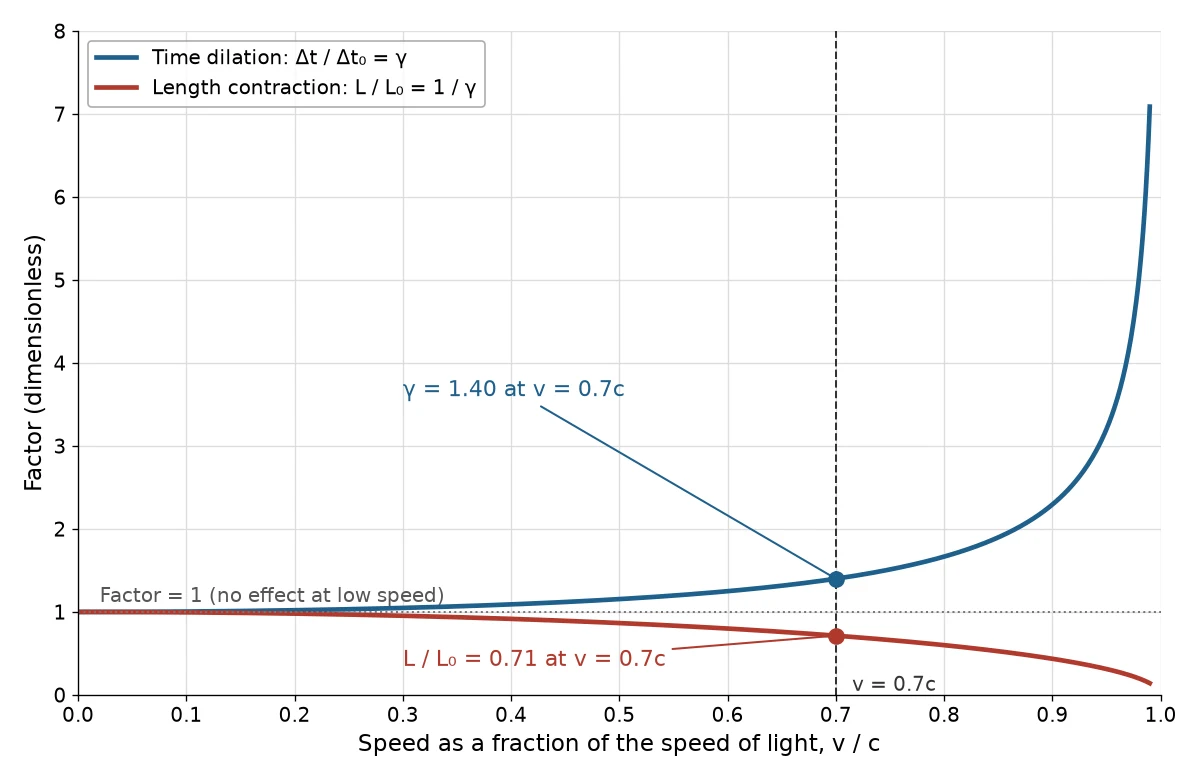
Here γ is the Lorentz factor, γ = 1/√(1 − v2/c2).
The factor γ is always greater than or equal to 1, and it is equal to 1 only when
= 0.
◀ Previous3 / 4Next ▶
Graph of time dilation factor gamma rising and length contraction factor 1/gamma falling against v/c
Time dilation
 ⤢ Enlarge
1
For speeds much less than the speed of light, γ is very close to 1 and relativistic effects are negligible.
2
Time dilation has been confirmed by measurements of fast-moving unstable particles
which live longer when they move quickly.
3
The proper time is always the shorter of the two times. It is measured by a single clock present at both events, such as a clock that starts and stops a muon’s decay in the muon’s own frame. Other observers see a longer time, and the time dilation formula relates the two.
◀ Previous4 / 4
1Length contraction2Length contraction3Length contraction4Length contraction
1Mass-energy equivalence2Mass-energy equivalence3Mass-energy equivalence4Mass-energy equivalence5Mass-energy equivalence6Mass-energy equivalence
1Example 1: Time dilation of a muon · Example 2: Length contr2Example 3: Energy equivalent of a mass
Key terms
| Term | Meaning |
|---|---|
| Inertial reference frame | A frame of reference that moves at constant velocity, in which Newton’s first law holds. |
| Postulate of special relativity | One of two basic assumptions: the laws of physics are the same in all inertial frames, and the speed of light in vacuum is the same for all observers. |
| Proper time (Δt0) | The time interval between two events measured by a single clock present at both events. |
| Time dilation | The longer time, Δt = γΔt0, measured by an observer who is moving relative to the events. |
| Lorentz factor (γ) | The factor 1/√(1 − v2/c2), which is always at least 1. |
| Proper length (L0) | The length of an object measured in the frame in which the object is at rest. |
| Length contraction | The shortening of a length along the direction of relative motion, L = L0/γ. |
| Rest energy (E0) | The energy equivalent of a mass at rest, E0 = mc2. |
| Mass-energy equivalence | The principle that mass and energy are interchangeable, given by E = mc2. |
1Avoid these mistakes2Avoid these mistakes3Avoid these mistakes4Avoid these mistakes5Avoid these mistakes